


Data Center Power Infrastructure Market Definition and Overview
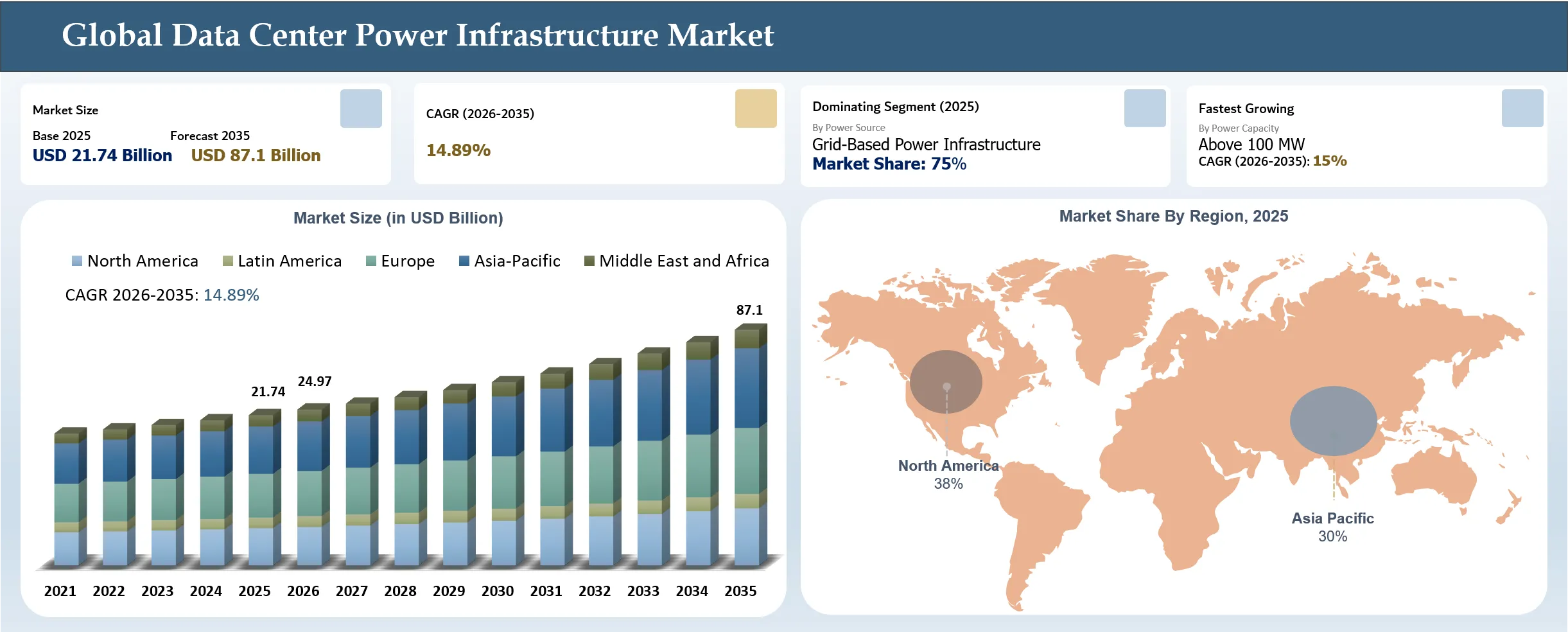
The global Data Center Power Infrastructure market reached USD 21.74 billion in 2025 and is expected to reach USD 87.1 billion by 2035, growing with a CAGR of 14.89% during the forecast period 2026-2035. The market is expanding rapidly due to increasing electricity demands from AI operations, hyperscale data centers, and cloud-based computing infrastructure. As per the International Energy Agency (IEA), in 2024, there was a use of 415 TWh of electricity consumption globally by the data center industry, which represented around 1.5% of global electricity consumption, while in the coming years, it would more than double by 2030 owing to the increased computing power of AI. The growing scale of digital infrastructure investments is further supporting market expansion, with global capacity for data centers expected to increase substantially by 2026 through investments by cloud and AI firms in the construction of hyperscale facilities. According to the U.S. Department of Energy (DOE), the data centers in the United States used about 176 TWh of electricity in 2023, which is about 4.4% of total electricity used in the country, and the need for energy is predicted to be between 325 and 580 TWh by 2028 because of the need for AI. Companies including Schneider Electric, Vertiv, Eaton, ABB, and Siemens are developing next-generation power infrastructure solutions focused on higher efficiency, grid resilience, and sustainable data center operations.
Growing demand for AI-based computing and cloud services is driving the necessity of a highly reliable and effective power infrastructure within data centers around the world. In May 2026, according to Computer Weekly, the rapid expansion of AI and cloud computing creates significant pressure on the power infrastructure of global data centers since power availability becomes an essential element of new data centers' construction. The investment in data center infrastructure in the Asia-Pacific region is expected to total USD 800 billion by 2030, whereas the consumption of electricity in global data centers will rise from 460 TWh in 2022 to over 1,000 TWh in 2026, owing to increasing AI workloads. The increasing power deficit makes the installation of power generation units, microgrids, battery energy storage systems (BESS), and energy management systems increasingly popular.
White-Space Opportunities for Grid Modernization and Transmission Infrastructure Expansion for Data Center Power Availability
In October 2025, American Electric Power (AEP) secured a USD 1.6 billion federal loan guarantee to upgrade electricity transmission infrastructure as rising demand from large-scale data centers increases pressure on regional power networks. The investment is primarily focused on transmission grid modernization and power delivery infrastructure, including upgrading nearly 5,000 miles of transmission lines across AEP’s service territories in Ohio, Indiana, Michigan, Oklahoma, and West Virginia. The highest investment opportunity is expected in high-voltage transmission systems, grid capacity expansion, and utility infrastructure upgrades to improve electricity availability for rapidly expanding AI and hyperscale data centers. Additional opportunities are emerging in substations, transformers, switchgear, grid automation systems, advanced conductors, and power management technologies required to support higher electricity loads. The investment also aligns with broader U.S. grid modernization efforts, including funding programs such as the USD 3.9 billion Grid Resilience and Innovation Partnerships (GRIP) Program and other Department of Energy transmission initiatives aimed at strengthening grid reliability and accelerating infrastructure deployment. Companies benefiting from these investments include American Electric Power (AEP) for utility-led transmission expansion; Quanta Services, MasTec, and MYR Group for transmission construction and grid upgrade projects; Hitachi Energy, Siemens Energy, GE Vernova, Schneider Electric, and Eaton for transformers, switchgear, grid control systems, and electrical distribution equipment; and Black & Veatch, Burns & McDonnell, and AECOM for engineering, project management, and grid modernization services.
The investment is expected to create significant opportunities across the data center power infrastructure value chain as utilities and data center operators seek reliable electricity supply for AI-driven workloads. Beyond transmission upgrades, additional growth areas include microgrids, battery energy storage systems (BESS), distributed power generation, renewable energy integration, and intelligent energy management platforms that can help overcome grid connection delays and power availability constraints. Companies such as Fluence, Tesla Energy, Wärtsilä, and Powin are positioned to benefit from increased demand for utility-scale and behind-the-meter energy storage solutions; Bloom Energy, Cummins, Caterpillar, and Rolls-Royce Power Systems can gain opportunities through distributed generation and backup power deployments for data centers; while hyperscale technology companies including Microsoft, Google, Amazon Web Services (AWS), and Meta are expected to accelerate investments in dedicated power procurement agreements and energy infrastructure partnerships to secure long-term electricity availability. The AEP transmission investment highlights a major white-space opportunity in the data center power infrastructure market by addressing the growing gap between rapid data center expansion and existing grid capacity, creating demand for advanced electricity delivery, reliability, and power management solutions.
Data Center Power Infrastructure Market Strategic Takeaways
- North America captured the largest regional market share at 38.0% in 2025, driven by rapid hyperscale and AI facility construction. The Asia-Pacific region held a 30% market share in 2025, with regional digital infrastructure investments expected to total USD 800 billion by 2030.
- Grid-based power infrastructure dominated the market by power source, holding approximately 75% of the total market share in 2025. In European data center evaluations covering roughly 770 facilities, renewable energy accounted for a weighted average Renewable Energy Factor (REF) of 0.87.
- Global deployments of Battery Energy Storage Systems (BESS) reached 315 GWh in 2025, expanding by nearly 50% year-over-year with 240 GWh allocated to grid-scale projects. Operational BESS projects grew from 17 in 2024 to 46 in 2025, with more than 150 gigawatt-scale projects queued for 2026.
- American Electric Power secured a USD 1.6 billion federal loan guarantee to modernize nearly 5,000 miles of power transmission lines across five states. This investment is complemented by federal funding initiatives such as the Department of Energy's USD 3.9 billion Grid Resilience and Innovation Partnerships Program.
Data Center Power Infrastructure Market Industry Trends and Strategic Insight
- The rapid adoption of generative AI, large language models (LLMs), and accelerated computing is increasing power requirements per rack, shifting data center designs from traditional kilowatt-scale environments toward high-density power architectures.
- Hyperscale cloud providers and AI companies are developing larger data center campuses that require dedicated power infrastructure, including high-voltage substations, utility-scale connections, onsite generation, and battery storage systems.
- Data center operators are increasingly integrating lithium-ion battery energy storage systems beyond traditional UPS applications to provide extended backup duration, peak-load management, and renewable energy balancing.
- Sustainability commitments from hyperscale operators are accelerating investments in renewable energy procurement, onsite solar generation, energy storage, and carbon-neutral power strategies.
- Data center operators are deploying advanced monitoring systems, digital twins, and AI-based energy management platforms to improve power utilization effectiveness (PUE), predict equipment failures, and optimize energy consumption.
Data Center Power Infrastructure Market Scope
| Metrics | Details | |
| 2025 Market Size | USD 21.74 Billion | |
| 2035 Projected Market Size | USD 87.1 Billion | |
| CAGR (2026-2035) | 14.89% | |
| Largest Market | North America | |
| Fastest Growing Market | Asia-Pacific | |
| By Data Center Type | Hyperscale Data Centers, Colocation Data Centers, Enterprise Data Centers, Others | |
| By Component | Power Distribution Systems, Backup Power Systems, Power Management and Monitoring Systems | |
| By Power Capacity | Below 500 kW, 500 kW–5 MW, 5 MW–20 MW, 20 MW–100 MW, above 100 MW | |
| By Power Source | Grid-Based Power Infrastructure, Renewable Energy-Powered Infrastructure, Hybrid Power Systems | |
| By Installation | New Installations, Retrofit & Upgrades, Banking, Financial Services & Insurance (BFSI), Government & Defense, Healthcare, Manufacturing, Retail & E-commerce, Media & Entertainment, Energy & Utilities, Others | |
| By End User | Cloud Service Providers, IT & Telecommunications | |
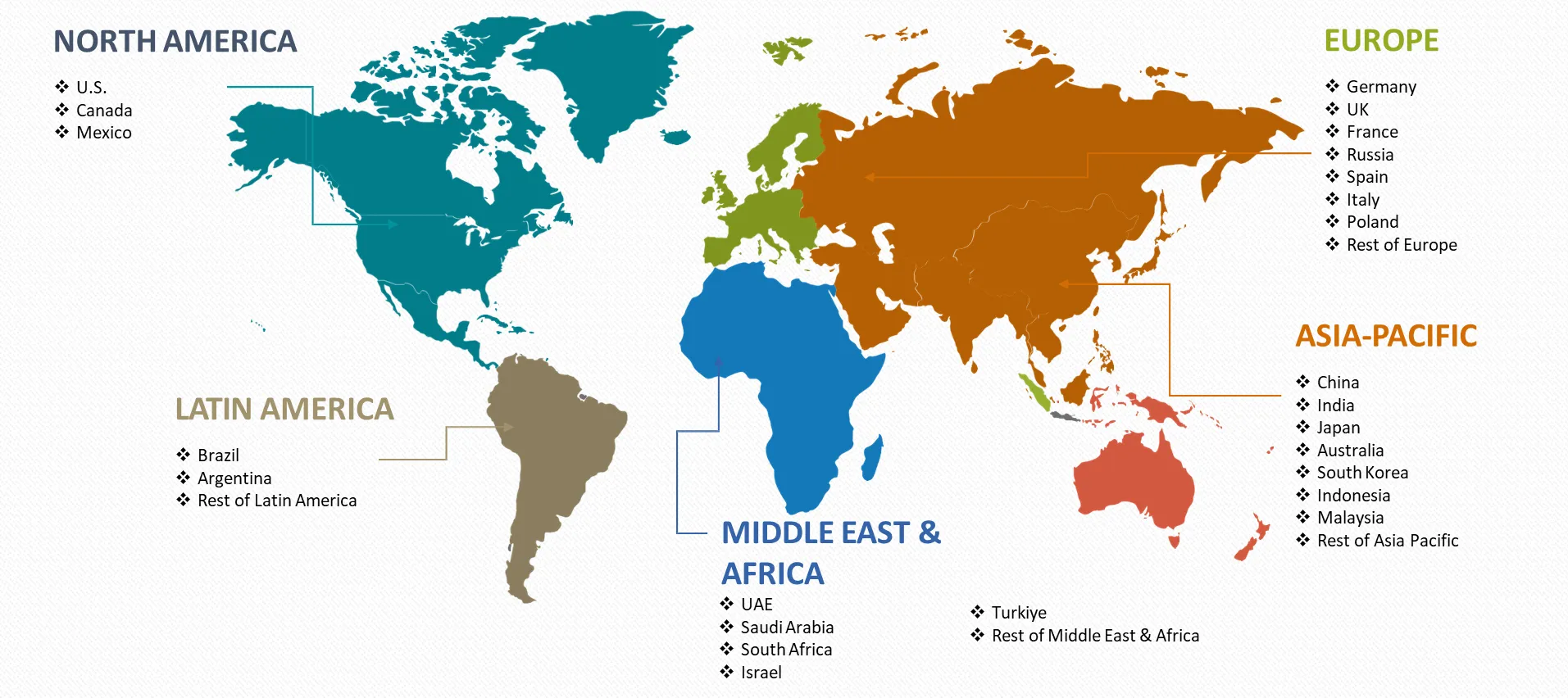
| By Region | North America | U.S., Canada, Mexico |
| Europe | Germany, UK, France, Spain, Italy, Poland | |
| Asia-Pacific | China, India, Japan, Australia, South Korea, Indonesia, Malaysia | |
| Latin America | Brazil, Argentina | |
| Middle East and Africa | UAE, Saudi Arabia, South Africa, Israel, Türkiye | |
| Report Insights Covered | Competitive Landscape Analysis, Company Profile Analysis, Market Size, Share, Growth | |
Data Center Power Infrastructure Market Disruption Analysis
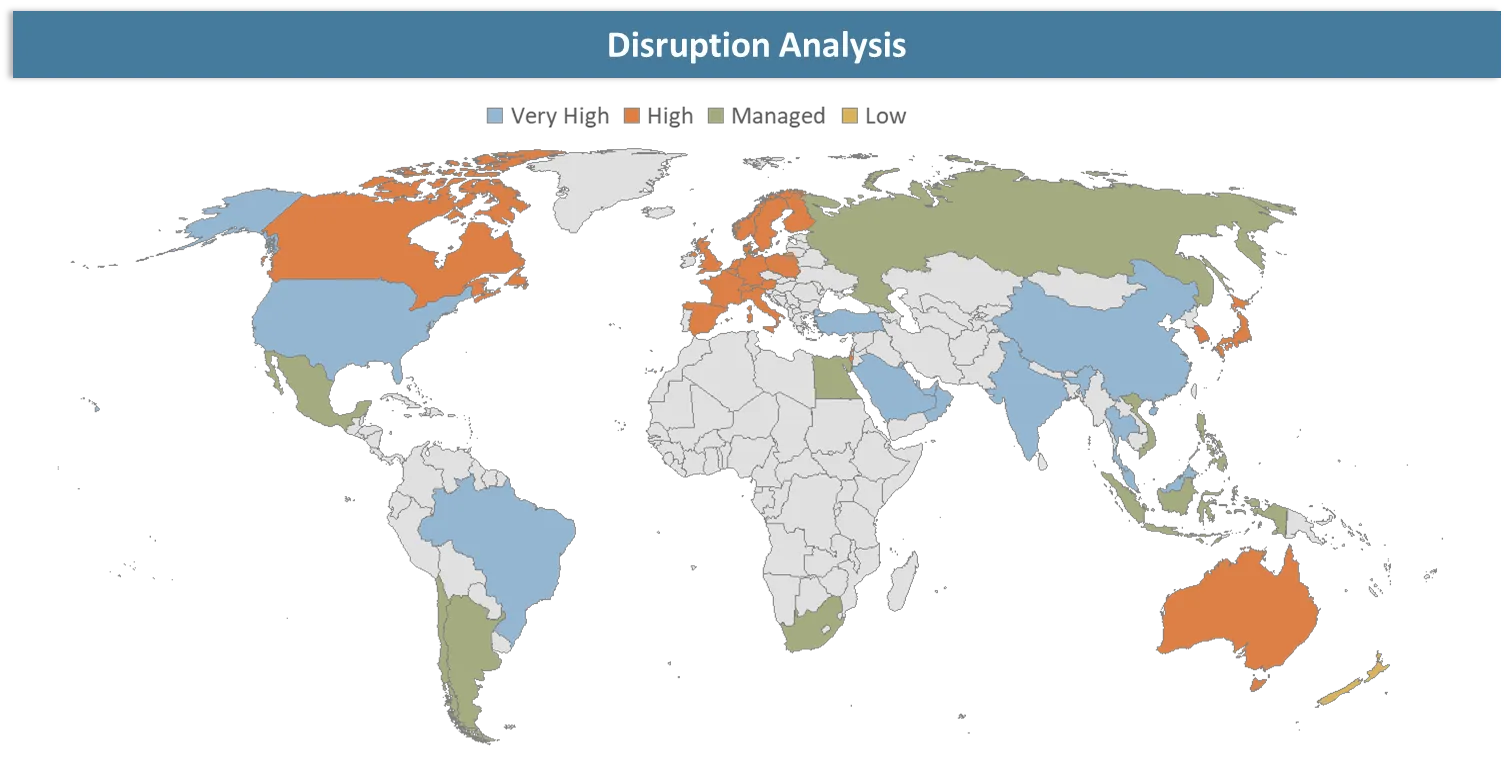
Transition from Backup Power Systems to Integrated Energy Ecosystems Reshaping Data Center Power Infrastructure Landscape
The disruption in the Data Center Power Infrastructure Market is mainly because of the shift from traditional UPSs and diesel generator-based backup systems towards an energy ecosystem that integrates battery energy storage systems (BESS), renewable energy, microgrids, and smart power management systems. Traditional backup power systems are increasingly becoming active energy management systems due to increased demands for greater resilience, better efficiency, and electricity costs control. This trend is being further fueled by the growing deployment of battery storage systems, which has led to 315 GWh of battery energy storage system (BESS) installations globally by 2025, growing almost 50% annually on a year-over-year basis, as per the ESS report from the data provided by Benchmark Mineral Intelligence. Around 240 GWh of battery energy storage system (BESS) installations were for grid-scale storage projects globally in 2025.
The growing deployment of BESS technologies is reshaping the dynamics of energy storage applications in data centers by providing applications other than traditional ones, such as peak load reduction, demand response, renewables balancing, and grid services. According to ESS, in 2025 there were 46 battery storage projects on a global level that began operations compared to 17 in 2024. ESS also reported that in excess of 150 gigawatt-scale BESS projects were in the queue for 2026. Such changes are affecting traditional backup power systems in terms of demand for integrated service providers who will incorporate UPS technology, lithium-ion batteries, microgrid control, and an energy management platform.
Data Center Power Infrastructure Market BCG Matrix: Company Evaluation
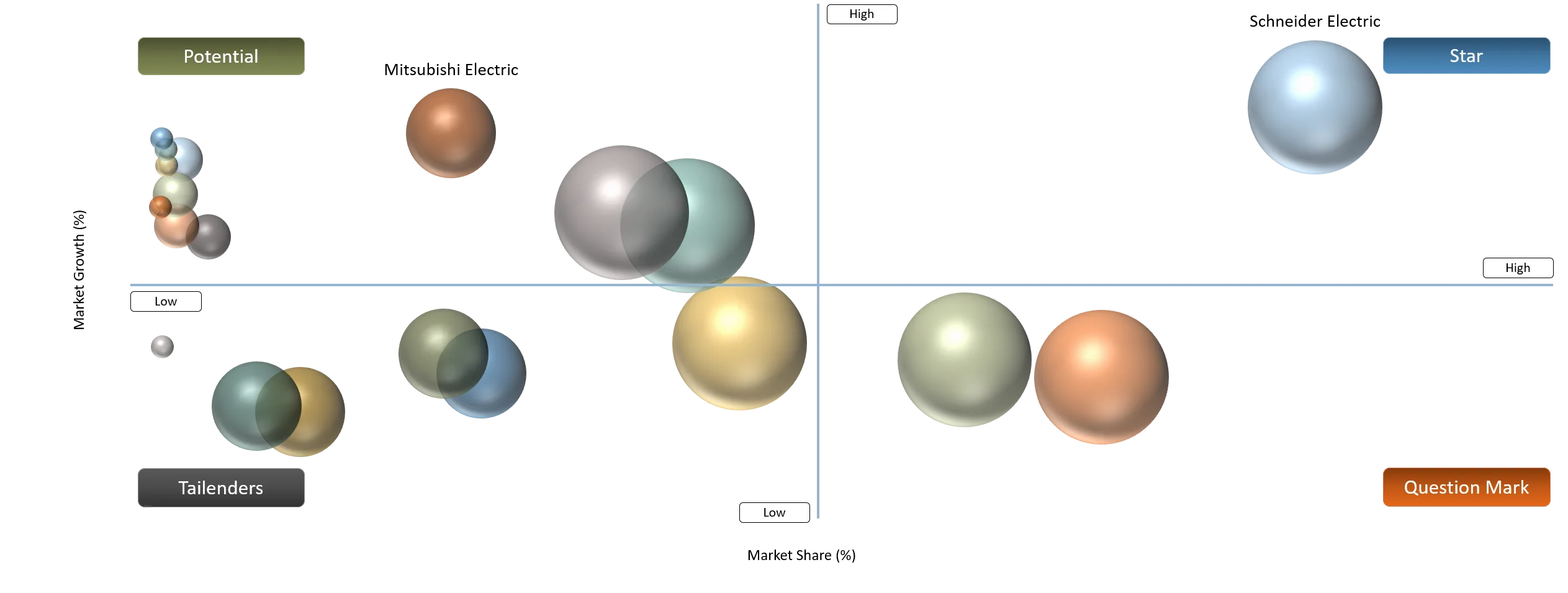
Stars include Schneider Electric, Vertiv Holdings Co., Eaton Corporation, and ABB Ltd. because these companies hold strong positions in the data center power infrastructure ecosystem through extensive portfolios covering UPS systems, power distribution units (PDUs), switchgear, energy management platforms, and modular power solutions. These companies are benefiting from increasing demand for AI-ready data centers, hyperscale infrastructure expansion, and the transition toward intelligent power management systems. Question Mark category companies such as Siemens AG, Delta Electronics, and Huawei Technologies are placed because they possess strong technological capabilities and are expanding their presence in data center power infrastructure but face intense competition from established leaders.
The category of Potential includes Legrand, Mitsubishi Electric, and Socomec, which benefit from growing demand for power distribution equipment, rack-level power solutions, UPS systems, and electrical protection technologies across enterprise, colocation, and edge data centers. These companies have specialized capabilities in critical power components and are expanding their offerings to support higher-density computing environments. Tailenders include Caterpillar Inc. and Rittal GmbH & Co. KG because their involvement in the Data Center Power Infrastructure Market is concentrated in specific segments rather than complete power ecosystem solutions.
Data Center Power Infrastructure Market Dynamics
Driver Impact Analysis
| Driver | Market Growth Impact (%) | Demand Concentration | Impacted Use Case | Strategic Impact |
Rapid expansion of hyperscale and AI-driven data centers is increasing demand for high-capacity power distribution, UPS systems, switchgear, and energy management infrastructure. | 30% | High demand concentration in North America, Asia-Pacific, and Europe due to hyperscale cloud expansion and AI infrastructure investments. | Hyperscale data centers, cloud service provider facilities, AI computing campuses, large colocation facilities. | Accelerates adoption of high-capacity UPS, MV/LV switchgear, transformers, modular power systems, and integrated power management solutions. |
Growing electricity consumption from cloud computing, artificial intelligence (AI), and high-performance computing (HPC) workloads is accelerating investments in advanced data center power systems. | 25% | Concentrated among hyperscale operators, AI infrastructure providers, and HPC facilities requiring continuous high-density power supply. | AI training clusters, machine learning infrastructure, cloud platforms, scientific computing facilities. | Drives development of AI-ready power architectures, higher-capacity electrical distribution systems, and energy-efficient infrastructure solutions. |
Rising rack power densities are driving adoption of next-generation power infrastructure capable of supporting higher electrical loads. | 20% | High concentration in AI-focused data centers and next-generation hyperscale facilities deploying GPU-intensive workloads. | High-density AI racks, GPU clusters, high-performance computing environments, advanced server infrastructure. | Creates demand for high-capacity PDUs, rack-level power solutions, advanced UPS systems, liquid-cooling-compatible electrical designs, and intelligent power monitoring. |
Expansion of edge computing facilities is creating demand for compact, modular, and efficient power infrastructure solutions. | 15% | Demand concentrated across telecom networks, smart cities, industrial IoT deployments, and distributed computing locations. | Edge data centers, telecom edge facilities, remote computing sites, industrial digital infrastructure. | Increases adoption of modular UPS systems, prefabricated power solutions, compact switchgear, and decentralized energy management platforms. |
Growing adoption of renewable energy integration and battery energy storage systems (BESS) is driving demand for sustainable data center power management solutions. | 20% | Strong demand concentration in regions with sustainability regulations and grid reliability challenges, including North America and Europe. | Renewable-powered data centers, hybrid energy systems, microgrid-enabled facilities, sustainable hyperscale campuses. | Shifts the market from traditional backup power toward integrated energy ecosystems combining BESS, microgrids, renewable power, and intelligent energy controls. |
Rising rack power densities are driving adoption of next-generation power infrastructure capable of supporting higher electrical loads
The rapid increase in rack power density within hyperscale and AI-enabled data centers is becoming one of the primary drivers fueling the adoption of innovative Data Center Power Infrastructure solutions such as high-capacity UPS systems, power distribution units (PDUs), switchgear, and sophisticated energy management systems. Traditional data center electrical infrastructures designed specifically for lower-density computing facilities are struggling with limitations due to increased power requirements of AI accelerators, GPUs, and HPC systems. According to the Vertiv 2025 Data Center Trends report, AI workloads necessitate an evolution into higher-density racks where power distribution, backup infrastructure, and electrical architecture are able to handle rapidly changing loads.
The rapid adoption of artificial intelligence is changing the demand for data center infrastructure through increased computing density and energy use per rack. In March 2026, according to Data Center Knowledge, AI-enabled workloads are significantly reshaping the design of data centers through increases in rack densities and demands for high-power infrastructure. In the AFCOM 2026 State of the Data Center Report, it was observed that the average size of a data center facility rose to around 38 MW from 32 MW in the previous year, while the average rack density shot up to 27 kW per rack from 16 kW, marking the highest ever year-to-year increase seen in the report. Moreover, 72% of the data center operators anticipate that AI workloads will increase the capacity needs of data centers.
Restraint Impact Analysis
| Restraint | Drag on Market Growth (%) | Primary Impact Area | Impacted Use Case | Strategic Impact |
Limited grid capacity and prolonged utility interconnection timelines delay the deployment of large-scale data center power infrastructure projects. | 20% | Power availability, grid connectivity, and data center expansion timelines | Hyperscale data centers, AI data centers, and colocation facilities requiring high-capacity power connections | Delays project commissioning, increases dependency on temporary power solutions, and drives investment toward onsite generation, microgrids, and energy storage solutions. |
Complex integration of renewable energy systems, BESS, and microgrid solutions increases infrastructure design challenges and operational complexity. | 15% | Energy management systems, power integration, and infrastructure design | Sustainable data centers, AI-focused facilities, and hybrid power architectures | Increases engineering complexity and deployment costs, encouraging demand for advanced power management platforms and integrated energy solutions. |
High energy consumption and rising electricity costs increase operational expenses for data center operators, affecting infrastructure expansion decisions. | 18% | Power operating costs, energy efficiency, and total cost of ownership | Hyperscale facilities, cloud service providers, and enterprise data centers | Slows expansion decisions in high-cost electricity regions and accelerates adoption of energy-efficient UPS systems, liquid cooling integration, and renewable-powered infrastructure. |
Stringent environmental regulations on diesel generator emissions and energy efficiency requirements increase compliance costs for data center power systems. | 12% | Backup power systems, emissions compliance, and regulatory adherence | Data centers using diesel generators, backup power systems, and critical infrastructure applications | Raises investment requirements for cleaner backup technologies, alternative fuels, and energy-efficient power infrastructure to meet sustainability targets. |
Complex integration of renewable energy systems, BESS, and microgrid solutions increases infrastructure design challenges and operational complexity
One of the key restraints limiting the rapid adoption of advanced power infrastructure at the data center is the growing complexity related to integration of renewable energy, BESS, and microgrids into existing power architecture. Contemporary data centers make more use of renewable energy sources and on-site energy storage solutions due to growing consumption of electricity and need for CO2 reduction; but integration of intermittent renewable energy into highly reliable power systems is a complex process.
Shifting towards sustainability within data centers is not only helping in the rise of renewable energy technologies but also presenting new obstacles in power management and optimizing infrastructure. In December 2025, according to IIFIR, the technical evaluation of data centers' sustainability done by the European Commission in 2025 showed that renewable energy accounted for a significant share of electricity consumption in EU data centers, with the Renewable Energy Factor (REF) being a weighted average of 0.87, meaning that roughly 87% of the energy consumed is from renewable energy. The evaluation was based on a number of about 770 data centers, which is almost 36% of the total EU data centers, and covered such factors as Power Usage Effectiveness (PUE), Water Usage Effectiveness (WUE), Energy Reuse Factor (ERF), and Renewable Energy Factor (REF). It also showed that there is a need for more efficiency in the usage of energy since many data centers are using energy with a PUE level above 1.3-1.4.
Data Center Power Infrastructure Market Segment Analysis
The global Data Center Power Infrastructure market is segmented based on data center type, component, power capacity, power source, installation, end user, and region.
Grid-Based Power Infrastructure Dominating Due to High Reliability and Large-Scale Power Requirements of Data Centers
The grid-based power infrastructure segment dominates the Data Center Power Infrastructure Market by power source, holding around 75% of the market share in 2025. This is because the growing use of hyperscale data centers, cloud computing, and artificial intelligence data centers increases the need for connecting the facility to the utility grid since it can offer a continuous supply of electricity. The fast growth in 2025-2026 of AI workloads and HPC applications requires an increased demand for the power infrastructure based on the utility grid, which is needed for providing power to modern data centers.
Major data centers and IT vendors are strengthening grid-based infrastructure for their power needs by establishing relationships with utilities, dedicated capacity arrangements, and green power purchasing initiatives to support the growing facilities. According to Gartner, global data center power consumption will amount to 448 TWh by 2025, with an increase of 16% year on year, which will be generated mostly by AI applications and digital infrastructure growth. This segment continues to dominate as the grid-based infrastructure ensures scalability and availability of the power supply that is required for mission-critical services, and backup solutions like UPS or generators are used only for outage protection.
Data Center Power Infrastructure Market Geographical Penetration
AI-Driven Data Center Expansion and Grid Infrastructure Investments Strengthening North America’s Market Leadership
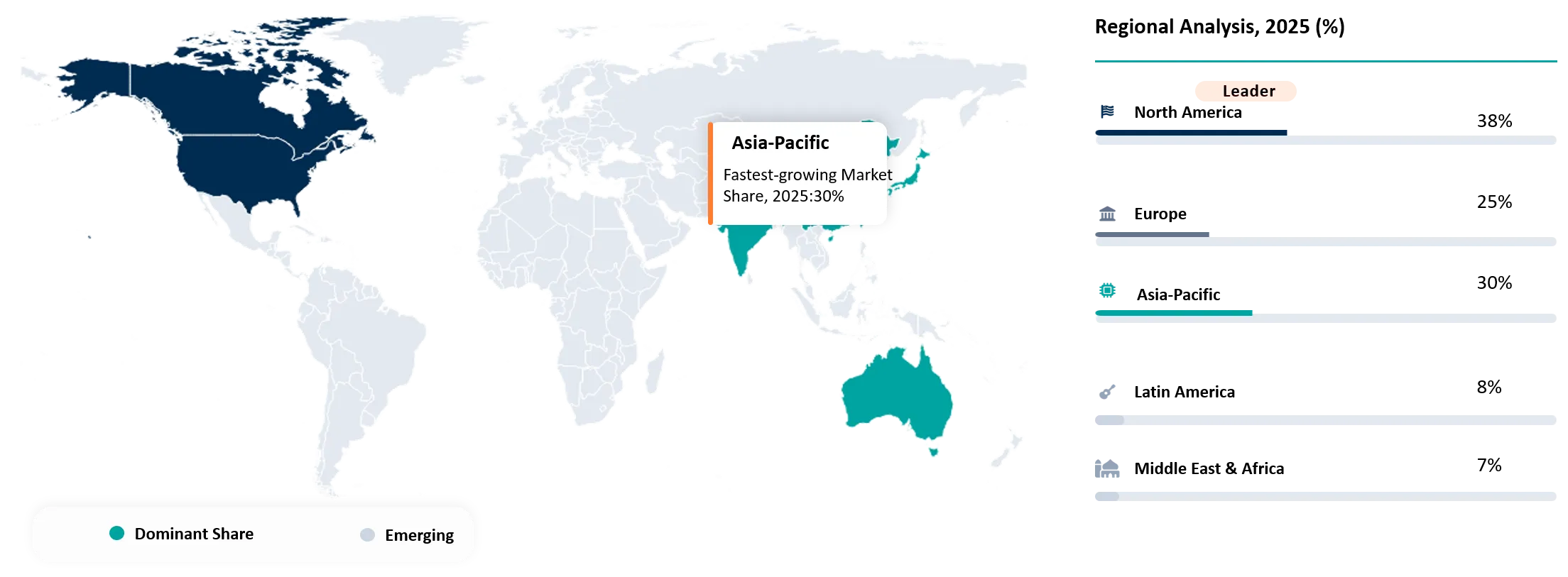
North America Region holds a dominant position in the Data Center Power Infrastructure Market, holding about 38.0% market share in 2025, due to the increasing construction of hyperscale data centers, artificial intelligence infrastructure, and cloud computing infrastructure in the US and Canada. The region holds a leadership position in the market due to the existence of major cloud service providers, technology companies, and co-location players, which are making significant investments in data centers with advanced power needs. The growing adoption of AI-enabled data centers with high-density power needs has increased investments in electricity grids of the region.
Hyperscale data center players are now looking to invest in energy infrastructure assets to ensure access to reliable and sustainable sources of energy for AI-enabled processes. In December 2025, Alphabet Inc., a U.S.-based technology firm and parent company of Google, acquired Intersect Power, a U.S.-based energy infrastructure and clean energy development firm, for a total cash consideration of USD 4.75 billion, in addition to assuming debt to enhance the power infrastructure of its data centers for the growth of AI-based computing. Intersect Power develops energy infrastructure and data centers, including large-scale clean energy projects, and the deal includes several gigawatts worth of energy and data center projects that are under development and construction. This deal will help both companies to develop co-located data centers and power plants, including their first joint venture data center and power plant in Haskell County, Texas, USA.
U.S. Data Center Power Infrastructure Market Trends
U.S. is dominating the North America Data Center Power Infrastructure Market because of its developed data center industry, presence of many hyperscaler players, superior power infrastructure networks, and fast pace of adopting AI-enabled computing infrastructure. The presence of several cloud service providers, colocation companies, and technology firms has led to the growth of big data centers that need high-capacity grid connections, medium voltage switchgear, transformers, UPS, and intelligent power infrastructure. The developed utility infrastructure, investment activity, and rising demand for AI-enabled facilities have further enhanced the dominance of the U.S. in this market.
The growing electricity demand from the AI industry and hyperscale data centers is driving the deployment of power generation infrastructure to compensate for limitations of power transmission networks. In February 2025, Vantage Data Centers, a U.S.-based hyperscale data center infrastructure provider, and VoltaGrid, a U.S.-based advanced microgrid power generation and distributed energy solutions company, announced a strategic partnership to deploy more than 1 GW (1,000 MW) of prime power generation at Vantage’s rapidly growing North America data centers. This partnership seeks to solve the issue of power availability challenges, which pose a major obstacle to the development of large-scale data centers, through quick deployment of dedicated energy infrastructure, whereby VoltaGrid’s advanced microgrid systems can be deployed in months instead of years, as in the case of connecting to a grid. The technology uses advanced natural gas-powered microgrids, which reduce criteria air pollutant emissions by up to 98% and provide flexibility to incorporate 100% hydrogen-based or renewable natural gas fuel sources when commercially viable.
Canada Data Center Power Infrastructure Market Outlook
Canada is emerging as a major source of growth in the North America Data Center Power Infrastructure Market, due to its abundant renewable electrical power and benefits from a good climate for the effective functioning of data centers. The country’s abundance of hydroelectric power, especially in provinces like Quebec and British Columbia, facilitates the setting up of energy-efficient data centers, which require good power infrastructure on the electricity grid network. Between 2025 and 2026, the growing need for AI computing, cloud services, and regional data storage facilities has led hyperscale companies and colocation companies to set up their facilities in Canada.
The rising need for computing power to support AI is making it possible to see a rise in modular data centers being coupled with their own renewable energy sources. In June 2026, PowerBank Corporation, a Canada-based independent energy development and renewable power infrastructure company, and Nodiac Development, a U.S.-based distributed data center power infrastructure company with specialization in developing modular, containerized AI data centers, signed a Joint Development Agreement for deploying the co-location of modular data centers along with renewable energy projects within North America. The terms of the agreement allow for Nodiac to develop scalable modular data centers of varying capacities, from 1 MW up to about 20 MW, at locations of PowerBank's solar and battery energy storage systems (BESS) that have power generation capabilities, land available, and are approved for development. PowerBank has over 1 GW of pipeline renewable energy projects and more than 100 MW of operational renewable energy projects within Canada and the United States, whereas Nodiac has over 800 MW of pipeline AI infrastructure across 500+ identified sites in more than 30 states of the U.S.
Accelerating Digital Infrastructure Expansion and AI-Driven Data Center Development Strengthening Asia-Pacific Market Growth
The Asia-Pacific region is a rapidly growing market in the Data Center Power Infrastructure Market, accounting for approximately 30% market share in 2025, driven by increasing cloud adoption, artificial intelligence deployment, digital transformation initiatives, and large-scale data center investments across countries such as China, India, Japan, Singapore, and South Korea. The region’s expanding internet ecosystem, growing enterprise digitization, and rising demand for AI and high-performance computing (HPC) applications are accelerating the deployment of hyperscale and colocation facilities, creating strong demand for advanced power infrastructure solutions including medium-voltage switchgear, transformers, UPS systems, power distribution units (PDUs), and intelligent energy management systems.
The rapid growth of AI computing is increasing the power intensity of data centers, creating demand for more efficient and scalable electrical architectures. In September 2025, SuperX AI Technology Limited, a Singapore-based AI infrastructure solutions provider, and Hangzhou Zhonhen Electric Co., Ltd., a China-based Digital power technology and energy infrastructure solutions company, established a joint venture to develop advanced High-Voltage Direct Current (HVDC) power solutions for global AI data centers. The partnership addresses the growing challenge of AI-driven electricity consumption, as next-generation GPUs such as NVIDIA Blackwell are pushing single-rack power consumption beyond 100 kW. Traditional AC power architectures experience approximately 10–15% energy losses due to multiple AC-DC conversion stages, while HVDC systems reduce power conversion stages from 4–5 steps to only 1–2 steps, improving end-to-end efficiency from approximately 85–90% to above 96%.
Japan Data Center Power Infrastructure Market Trends
Japan holds a dominant position in the Asia-Pacific Data Center Power Infrastructure Market due to its mature digital infrastructure ecosystem, strong presence of technology enterprises, reliable electricity networks, and increasing investments in AI-ready data centers. The country’s advanced telecommunications infrastructure, high demand for cloud services, and growing adoption of artificial intelligence and high-performance computing applications are driving the expansion of data center facilities and associated power infrastructure. Japan’s focus on energy-efficient and resilient data centers has increased demand for advanced electrical systems, including medium-voltage switchgear, uninterruptible power supply (UPS) systems, power distribution units (PDUs), and intelligent power monitoring solutions.
The increasing demand for AI and cloud computing infrastructure is driving data center developers toward integrated power generation models to secure reliable and scalable electricity supply. In April 2026, JFE Holdings, Inc., a Japan-based steel manufacturing and industrial infrastructure company, and Mitsubishi Corporation, a Japan-based Global trading, investment, and infrastructure development company, signed a second Memorandum of Understanding (MOU) to advance an integrated power business and data center project in the Ohgishima, Keihin District, Japan. The companies, together with MC Digital Realty, Inc. (Japan; Data center developer and operator), confirmed the feasibility of developing a data center on approximately 5 hectares of land adjacent to JFE’s captive power plant, which has a generation capacity of 190 MW. The initial phase targets the launch of a 60 MW data center by fiscal year 2031, with future expansion potential toward a several hundred megawatts (MW)-scale data center campus.
Data Center Power Infrastructure Market Competitive Landscape
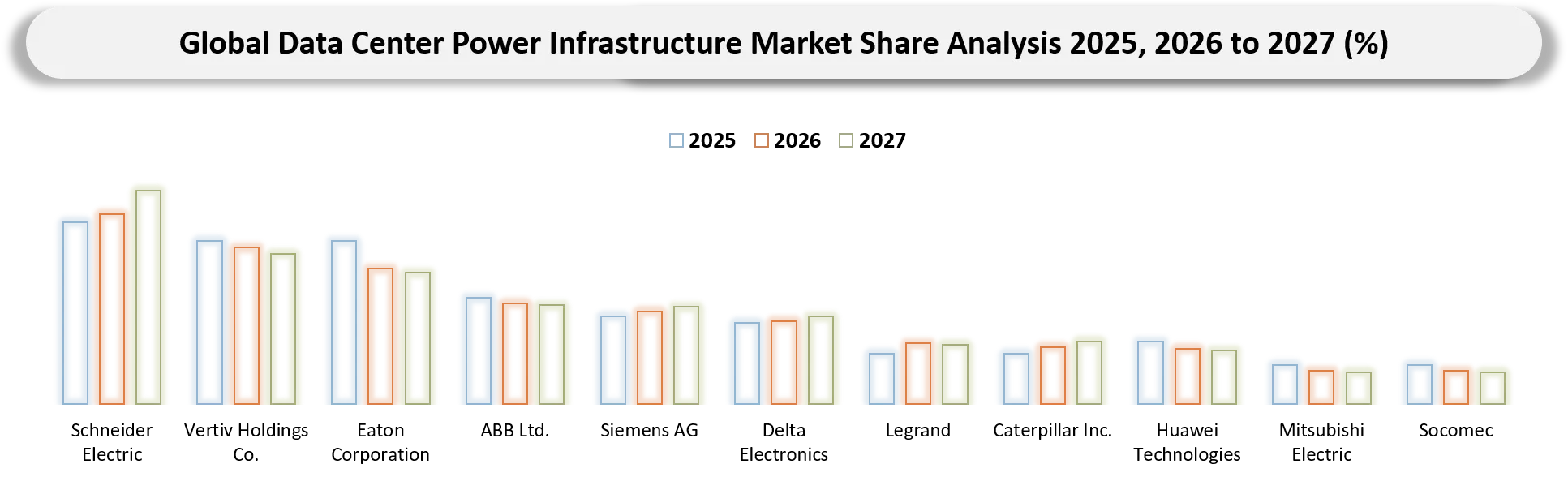
- The Data Center Power Infrastructure Market is characterized by three key participant groups: power infrastructure and electrical equipment leaders, data center power management specialists, and integrated technology solution providers. Companies such as Schneider Electric, Vertiv Holdings Co., Eaton Corporation, ABB Ltd., Siemens AG, and Legrand lead the market through comprehensive portfolios covering UPS systems, power distribution units (PDUs), medium- and low-voltage switchgear, energy management platforms, and data center infrastructure solutions. Vertiv Holdings Co. and Schneider Electric maintain strong positions in mission-critical power solutions, particularly for hyperscale and AI-driven data centers, while Eaton, ABB, and Siemens leverage their expertise in electrical distribution, automation, and grid infrastructure. Delta Electronics, Huawei Technologies, Socomec, Rittal GmbH & Co. KG, Caterpillar Inc., and Mitsubishi Electric strengthen the competitive landscape through specialized solutions in power electronics, backup power systems, thermal-integrated infrastructure, and intelligent monitoring platforms. The market remains highly ecosystem-driven, where technological innovation, global manufacturing capabilities, energy efficiency solutions, and partnerships with hyperscale data center operators determine competitiveness.
- Key players include Schneider Electric, Vertiv Holdings Co., Eaton Corporation, ABB Ltd., Siemens AG, Delta Electronics, Legrand, Caterpillar Inc., Huawei Technologies, Mitsubishi Electric, Socomec, and Rittal GmbH & Co. KG.
Key Developments
- June 2025: Takanock LLC, a U.S.-based digital and power infrastructure solutions provider for data centers, securedUSD 500 million in capital commitments from ArcLight Capital Partners, a U.S.-based infrastructure investment firm focused on electrification, power generation, renewable energy, and energy infrastructure assets, and DigitalBridge Group Inc., a U.S.-based digital infrastructure investment company specializing in data centers, fiber networks, towers, and other digital assets.
- June 2026: Legrand, a France-based electrical and digital building infrastructure solutions company headquartered in Limoges, France, acquiredGirtz Industries, a U.S.-based modular power integration and critical power solutions provider headquartered in Monticello, Indiana, USA, to strengthen its data center power infrastructure capabilities amid rising electricity demand from AI and hyperscale data centers.
- June 2026: SkyVolt Energy Inc., a U.S.-based renewable energy developer and M&A platform and Nodiac Corp. (Nodiac.ai), a U.S.-based distributed data center power infrastructure company specializing in modular AI data centers co-located with renewable energy and infrastructure assets, signed a non-binding Letter of Intent (LOI)to deploy modular data centers across SkyVolt’s renewable energy development sites in North America.
- October 2025: INNIO Group, an Austria-based energy technology and distributed power generation solutions company, and VoltaGrid, a U.S.-based energy infrastructure and portable power generation solutions company, announced a strategic partnership to deliver large-scale power generation infrastructure for one of the world’s largest data centers.
- October 2025: ESR Group Limited, a Hong Kong-based APAC-focused real asset owner and manager, and Colt Data Centre Services (Colt DCS), a UK-based hyperscale data center solutions provider,formed a joint venture to develop a 130 MW hyperscale data center campus in Minoh City, Osaka, Japan.
- July 2026: Iole Inc., a Japan-based AI infrastructure and digital services company, and Shin Energy Development Co., Ltd., a Japan-based energy development and power infrastructure consulting company, signed a basic agreement to jointly develop a100 MW-class AI data center and associated power infrastructure in Western Japan.
Key Procurement Priorities and Buyer Evaluation Criteria
- Organizations investing in the Data Center Power Infrastructure Market are increasingly selecting suppliers based on their ability to provide high-reliability power solutions, scalable electrical infrastructure, and energy-efficient systems capable of supporting hyperscale, colocation, and AI-driven data center operations.
- The procurement decision-making process is increasingly influenced by the rapid expansion of artificial intelligence workloads, high-performance computing (HPC), cloud infrastructure, and high-density server environments, which require advanced power distribution architectures, higher power capacity, and improved operational efficiency.
- Buyers evaluate suppliers based on factors such as power system reliability, UPS efficiency, power distribution capacity, scalability, energy management capabilities, equipment uptime performance, compliance with data center standards, and integration capabilities with renewable energy sources when selecting technology partners for data center power infrastructure.
Why Choose DataM?
- Technological Innovations: Explores advancements in data center power infrastructure technologies, including intelligent power distribution systems, high-efficiency UPS solutions, medium-voltage switchgear, digital power monitoring platforms, and AI-enabled energy management systems that improve reliability, operational efficiency, scalability, and power optimization for hyperscale, colocation, and enterprise data centers.
- Product Performance & Market Positioning: Evaluates how different players deliver power infrastructure solutions based on power efficiency, system reliability, scalability, uptime performance, energy management capabilities, and integration with renewable energy sources, highlighting how leading companies differentiate through advanced electrical architectures, modular designs, and solutions optimized for AI-driven high-density computing environments.
- Real-World Evidence: Highlights adoption of advanced power infrastructure solutions across hyperscale data centers, cloud facilities, AI computing campuses, and enterprise data centers, demonstrating benefits such as improved power availability, reduced energy losses, enhanced operational continuity, optimized electricity management, and support for increasing rack power densities.
- Market Updates & Industry Changes: Tracks key developments such as AI data center expansion, utility partnerships, renewable power integration, hyperscale facility investments, grid infrastructure upgrades, and deployment of next-generation power distribution systems across North America, Asia-Pacific, and Europe, supporting the transition toward sustainable and resilient data center ecosystems.
- Competitive Strategies: Analyzes how leading companies expand through product innovation, strategic partnerships, acquisitions, global service network expansion, and development of integrated power management solutions to address rising demand for reliable electricity supply driven by AI, cloud computing, and high-performance computing applications.
- Pricing & Market Access: Explains pricing variations based on power capacity, equipment type, efficiency ratings, customization requirements, and integration complexity, along with access through electrical equipment manufacturers, data center infrastructure providers, system integrators, and utility partnerships supporting global deployment.
- Market Entry & Expansion: Identifies growth opportunities driven by AI infrastructure growth, hyperscale data center development, edge computing adoption, renewable energy integration, and digital transformation, while outlining strategies such as regional manufacturing expansion, energy-efficient product development, ecosystem partnerships, and customized power solutions to strengthen global market presence.
Target Audience
- Data Center Operators and Hyperscale Companies
- Cloud Service Providers and Technology Companies
- Electrical Equipment Manufacturers and Power Solution Providers
- Data Center Infrastructure Developers and Investors
- Utility Companies and Energy Providers
- System Integrators and Engineering, Procurement & Construction (EPC) Companies
- Government Bodies and Regulatory Authorities
Suggestions for Related Report


























































