


Counter Drone Market Size and Overview
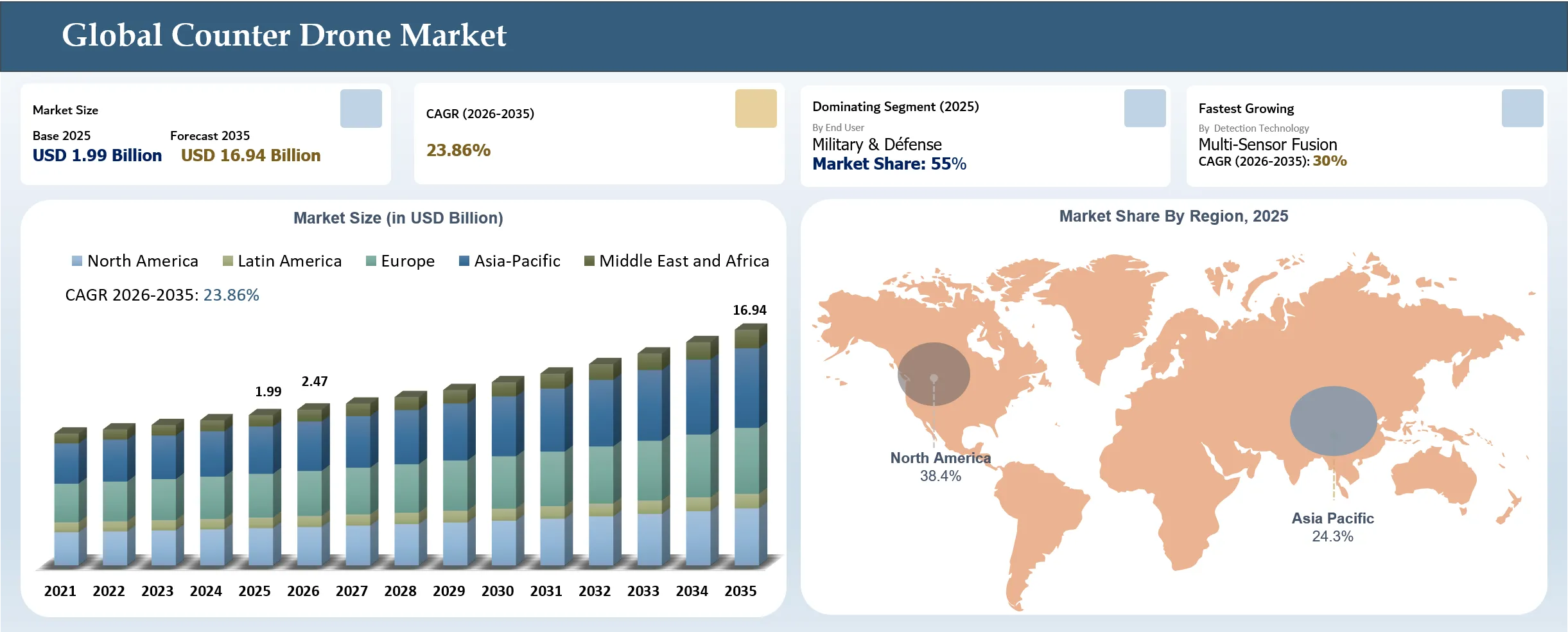
The global counter drone market reached USD 1.99 billion in 2025 and is expected to reach USD 16.94 billion by 2035, growing with a CAGR of 23.86% during the forecast period 2026-2035. The market is experiencing strong growth as governments and defense organizations increase procurement of technologies capable of detecting, tracking, identifying, and neutralizing increasingly sophisticated drone threats. According to the Congressional Research Service (CRS), the newly passed FY2025 U.S. National Defense Authorization Act has allotted approximately USD 302.3 million for the Army in Counter-Small UAS interceptors and USD 80 million for its advanced technology development, and USD 88.5 million in Marine Corps Air Defense Weapon Systems and USD 280.1 for the overall procurement for the army in Counter- Small UASs by the government, and also shows the ongoing U.S investment in Counter-drone systems. According to Unmanned Airspace predicts that global spending on Counter-UAS technology is predicted to be USD 12.6 billion by 2026 and grow rapidly by 2030 to approximately USD 24.1 billion at around 18% CAGR; both estimates were mentioned in the announcement that UAS contracts amounting to USD 29billion were declared in the first three months of 2026. The market developments are taking place by way of AI-controlled command and control, multi-sensor detection, electronic countermeasures, directed energy devices, interceptor drones, and integrated layered systems in response to drone attacks by defense establishments.
The rapid investments by Poland in layered anti-drone technologies showcase the rising trend towards deployment of Counter-Unmanned Aircraft Systems (C-UAS). In December 2025, according to TVP World, Poland has decided to spend more than USD 2.32 billion (€2 billion) on the development of an anti-drone shield at its eastern border with expected availability of initial features within the next six months and completion of the whole system within 24 months. The architecture of the anti-drone defense system would include machine guns, cannons, missiles, and electronic warfare against drone systems and would be deployed into an existing border defense line built around a decade ago. This move came after a case in September 2025 where more than a dozen of drones that were suspected to belong to Russia penetrated Polish airspace and where Polish and NATO fighter jets attacked the drones and their debris destroyed property. Poland has also been spending around 4.7% of its GDP on defense in 2025, while most of the money for the development of the anti-drone system would come from the EU.
White-Space Opportunities for Government-Funded C-UAS Detection, Monitoring, and Mitigation Infrastructure
In May 2026, the U.S. Department of Homeland Security (DHS)/Federal Emergency Management Agency (FEMA) established a USD 500 million Counter-Unmanned Aircraft Systems (C-UAS) Grant Program to strengthen state and local capabilities to detect, identify, track, and monitor unmanned aircraft systems. The funding represents a major opportunity in C-UAS detection and monitoring infrastructure, with the strongest investment focus on detection, identification, tracking, monitoring, and mitigation (DIMT-M) technologies, including radar, radio-frequency detection, electro-optical/infrared sensors, Remote ID, and integrated C-UAS systems. The program provides USD 250 million for the initial funding cycle, while the broader program totals USD 500 million, creating additional procurement opportunities as funding expands to more state, local, tribal, and territorial authorities. Other investment areas include C-UAS planning, equipment acquisition, system integration, training, exercises, and operational capabilities, allowing governments to develop complete drone-threat detection and response networks rather than purchasing individual sensors alone. FEMA guidance also confirms that eligible recipients can acquire equipment or services for the detection, tracking, and identification of drones and drone signals, further strengthening the technology procurement opportunity.
The funding is expected to create significant procurement opportunities across the C-UAS technology and services value chain. C-UAS technology providers such as RTX (Raytheon), Leonardo DRS, Anduril Industries, Dedrone, DroneShield, Thales, and Rheinmetall are positioned to benefit from demand for radar, RF detection, sensor fusion, tracking, command-and-control, and integrated counter-drone systems, while Teledyne FLIR can benefit from requirements for electro-optical/infrared surveillance and identification capabilities. AeroVironment can potentially benefit from broader unmanned-system and counter-UAS technology requirements, while systems integrators and public-safety technology providers can capture opportunities in C-UAS integration, communications, software, training, maintenance, and operational support. The strongest opportunity areas therefore extend beyond hardware into multi-sensor integration, real-time drone tracking, command-and-control software, RF and radar analytics, installation, training, and lifecycle support, as state and local agencies use the government funding to establish or expand their C-UAS capabilities.
Counter Drone Market Key Takeaways
- North America represented the largest regional market with a 38.4% share of the global total in 2025. The Asia-Pacific region accounted for 24.3% of the market in 2025 as one of the fastest-growing territories.
- The Military & Defense end-user segment dominated the global market with a 55% share in 2025. This dominant position is further reinforced by the U.S. Department of War requesting USD 3.1 billion for counter-UAS solutions in FY2026.
- Poland committed over USD 2.32 billion (€2 billion) in December 2025 to establish an anti-drone defense shield along its eastern border. The initiative is supported by national defense spending that reached approximately 4.7% of Poland's GDP in 2025.
- In May 2026, the U.S. DHS/FEMA established a USD 500 million C-UAS Grant Program to strengthen regional drone detection infrastructure. The initial funding cycle released USD 250 million to state, local, tribal, and territorial authorities.
Counter Drone Market Industry Trends and Strategic Insight
- Operators are moving away from standalone jammers and sensors toward integrated architectures combining detection, identification, tracking, command-and-control, and multiple defeat mechanisms.
- AI is increasingly being embedded into sensor fusion and command systems to classify targets, prioritize threats, and coordinate responses with reduced operator intervention.
- Interceptor drones are emerging as a dedicated defeat layer, particularly against low-cost attack drones and loitering systems that make conventional missile-based interception economically challenging.
- Competitive advantage is shifting from individual sensor or effector performance toward the ability to integrate heterogeneous technologies into a responsive sensor-to-shooter architecture.
- C-UAS suppliers must continuously adapt to changes in drone communications, autonomy, navigation, materials, flight profiles, and swarm tactics, making upgradeability a critical purchasing criterion.
Counter Drone Market Scope
| Metrics | Details | |
| 2025 Market Size | USD 1.99 Billion | |
| 2035 Projected Market Size | USD 16.94 Billion | |
| CAGR (2026-2035) | 23.86% | |
| Largest Market | North America | |
| Fastest Growing Market | Asia-Pacific | |
| By Solution | Drone Detection, Tracking & Identification, Command & Control (C2), UAS Mitigation & Neutralization, Services | |
| By Detection Technology | Radar, Radio Frequency (RF), Electro-Optical/Infrared (EO/IR), Acoustic, Multi-Sensor Fusion, Others | |
| By Neutralization Technology | RF Jamming, GNSS/GPS Jamming & Spoofing, Cyber/Protocol Takeover, Kinetic Interceptors, Directed-Energy Weapons, High-Power Microwave, Drone Capture/Net Systems, Others | |
| By Range | Short Range (<1 km), Tactical Range (1–5 km), Medium Range (6–20 km), Long Range (21–50 km), Extended Range (>50 km) | |
| By Deployment | Ground-Based, Vehicle-Mounted, Fixed-Site, Handheld/Portable, Airborne, Naval/Maritime | |
| By Application | Military Base & Force Protection, Border & Perimeter Security, Airport Security, Critical Infrastructure Protection, Public Event & Venue Security, VIP Protection, Prison Security, Maritime Security, Others | |
| By End User | Military & Défense, Government & Law Enforcement, Homeland & Border Security, Commercial & Civil, Others | |
| By Region | North America | U.S., Canada, Mexico |
| Europe | Germany, UK, France, Spain, Italy, Poland | |
| Asia-Pacific | China, India, Japan, Australia, South Korea, Indonesia, Malaysia | |
| Latin America | Brazil, Argentina | |
| Middle East and Africa | UAE, Saudi Arabia, South Africa, Israel, Türkiye | |
| Report Insights Covered | Competitive Landscape Analysis, Company Profile Analysis, Market Size, Share, Growth | |
Counter Drone Market Disruption Analysis
Fiber-Optic-Controlled Drones Disrupting RF-Based Counter-UAS Architectures
The disruption in the counter drone market is primarily associated with the rapid adoption of fiber-optic-controlled FPV drones, whose efficiency is posing serious challenges to the effectiveness of the conventional RF-based counter-drone technologies. While the traditional FPV drones use wireless connections to send control and video signals, the fiber-optic-controlled FPV drones utilize physical cables and are therefore able to operate in highly jammed electromagnetic environments. In September 2025, according to U.S. Army University Press, highlighted in the Military Review issue, FPV drones became a serious problem on the battlefield; according to experts in the Russian military, in certain sections of the battlefield, they accounted for up to 70% of losses of equipment and manpower. It was estimated that these fiber-optic controlled FPV drones were capable of penetrating the heavily jammed electromagnetic environment and attacking their targets at distances of up to 10 km.
This evolution of fiber-optically controlled drones, therefore, is changing the technological requirements for Counter-UAS technology, since radiofrequency jamming does not affect physical control links of the drones. This development is resulting in increased emphasis on radar, EO/IR, acoustic sensors, sensor fusion, autonomous detection and engagement, and kinetic or other means of defeating drones without using RF. The disruption is also leading to the adoption by Counter-UAS companies and defense organizations of multi-layered and adaptive counter-drone technologies that are able to address not only RF-controlled but also fiber-optically controlled drones. With fiber-optic control emerging as a way to get around electronic warfare, the competitive edge is being handed to those manufacturers that have multi-technology detection and mitigation solutions and not just RF/GPS disruption solutions.
Counter Drone Market BCG Matrix: Company Evaluation
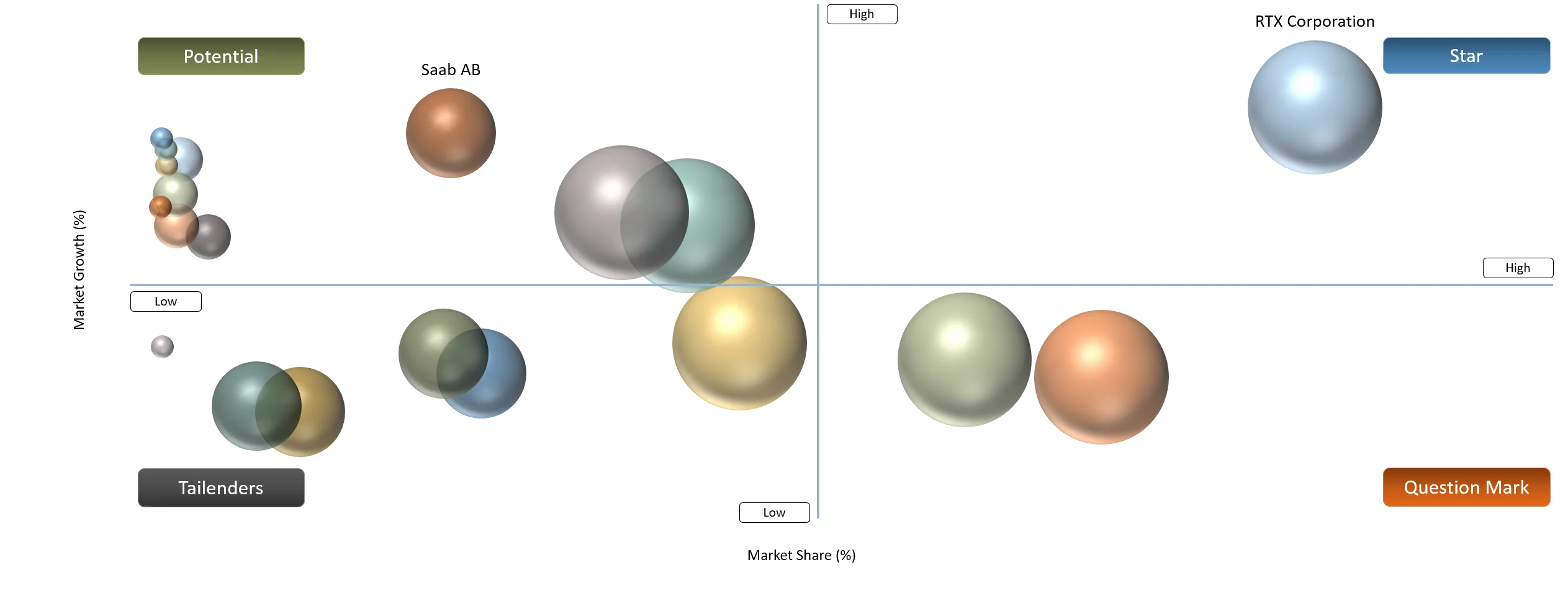
Stars include RTX Corporation, Lockheed Martin Corporation, Northrop Grumman Corporation, and Rafael Advanced Defense Systems because they have strong positions in integrated Counter-UAS, air-defense, radar, electronic warfare, and kinetic/non-kinetic defeat technologies, supported by established defense relationships and broad system portfolios. Their ability to combine detection, tracking, command-and-control, and mitigation capabilities positions them strongly as Counter-UAS procurement shifts toward layered and integrated architectures. Question Marks include Thales Group, Leonardo S.p.A., Rheinmetall AG, Israel Aerospace Industries (IAI), and Elbit Systems Ltd. These companies possess significant defense-electronics, radar, air-defense, electronic-warfare, and unmanned-system capabilities that can be leveraged for Counter-UAS applications, but their competitive positions are more diversified across broader defense markets.
Potential includes Saab AB and HENSOLDT AG, which benefit from strong expertise in radar, electronic warfare, sensor systems, air-defense technologies, and battlefield situational awareness but have comparatively narrower Counter-UAS portfolios than the leading integrated players. Tailenders include Anduril Industries, despite its rapidly expanding Counter-UAS capabilities, because its relatively shorter operating history and smaller established global defense footprint compared with the large incumbent defense contractors place it in a different strategic position.
Counter Drone Market Dynamics
Driver Impact Analysis
| Driver | Market Growth Impact (%) | Demand Concentration | Impacted Use Case | Strategic Impact |
Rising Incidents of Unauthorized and Malicious Drones | 30% | Military installations, borders, airports, critical infrastructure, public venues | Drone intrusion detection, threat identification, rapid interception, perimeter protection | Accelerates adoption of integrated detection-to-neutralization systems and shifts procurement from surveillance-only solutions toward layered C-UAS architectures. |
Growing Protection Requirements for Critical Infrastructure | 23% | Energy & utilities, oil & gas, ports, data centers, transportation infrastructure, government facilities | Asset protection, perimeter surveillance, airspace monitoring, operational continuity | Expands the addressable market beyond defense and increases demand for fixed-site, mobile, multi-sensor, and continuously operating C-UAS platforms. |
Increasing Military Adoption of Counter-UAS Technologies | 22% | Military bases, deployed forces, forward operating locations, tactical formations | Force protection, battlefield air defense, convoy protection, protection against reconnaissance and attack drones | Drives procurement of scalable military-grade systems combining radar, RF detection, C2, electronic warfare, interceptors, and directed-energy capabilities. |
Expansion of Airport Drone Detection and Mitigation | 13% | Major international airports, high-traffic aviation hubs, restricted airport airspace | Runway protection, unauthorized-drone detection, flight disruption prevention, airport perimeter security | Creates demand for high-accuracy detection and identification systems that can operate without interfering with civil aviation communications and navigation systems. |
Advancement of AI-Enabled Drone Detection and Tracking | 12% | Defense, airports, critical infrastructure, urban security, government facilities | Automated classification, multi-target tracking, sensor fusion, threat prioritization | Shifts competitive advantage toward software-defined C-UAS platforms capable of correlating radar, RF, EO/IR, and acoustic data while reducing false alarms and operator workload. |
Increasing Military Adoption of Counter-UAS Technologies
The increasing deployment of unmanned aircraft in military activities is growing; counter-drone systems are becoming more popular among defense forces as they develop their strategy for layer-by-layer protection against reconnaissance drones, attacking drones, and swarming drones. In July 2026, NATO Allies made the decision to invest more than USD 40 billion in countering drones within the next five years, together with setting up the NATO counter-drone marketplace to speed up the procurement of NATO-compatible systems. This shows that Counter-UAS systems are increasingly being integrated into multinational defense strategies.
Increased deployment of drones for military combat missions and security of important events has contributed to increasing military requirements for advanced Counter-UAS systems. In April 2026, according to Joint Base San Antonio (JBSA), Joint Interagency Task Force 401 committed to enhancing Counter-UAS capacities to support the epic operations such as the 2026 FIFA World Cup and the protection of the homeland, amounting to over USD 600 million. Out of this figure, USD 350 million was dedicated during the first month of the engagement of combat forces to meet C-UAS needs of U.S. Central Command and other military forces, whereas USD 100 million was dedicated to developing mobile C-UAS to protect the FIFA World Cup sites in 11 cities of nine states. Moreover, USD 158 million has been dedicated under Domestic Shield for the protection of defense-critical infrastructure of high priority. The investments include sensor technology, non-kinetic countermeasures, mobility of C-UAS solutions, and layered defense capabilities, indicating the growing military interest and quick procurement of Counter-UAS technologies.
Restraint Impact Analysis
| Restraint | Drag on Market Growth (%) | Primary Impact Area | Impacted Use Case | Strategic Impact |
Limited Detection Accuracy Against Small Drones | 18% | Detection & tracking systems | Airport security, critical infrastructure protection, military bases, border security | Increases false detections and missed threats, requiring multi-sensor architectures such as radar, RF, EO/IR and acoustic systems, raising deployment costs and slowing procurement. |
Regulatory Restrictions on Drone Mitigation | 15% | Legal authorization & airspace compliance | Airports, public safety, prisons, government facilities, urban security | Restricts the number of organizations legally able to deploy mitigation technologies, particularly RF jamming and other active countermeasures. |
Limited Effectiveness of Individual Counter-UAS Technologies | 13% | Mitigation performance & system reliability | Military defense, high-value asset protection, event security | No single technology reliably addresses every drone type, operating environment or attack profile. |
Interference Risks to Communication and Navigation Systems | 10% | Spectrum management, aviation safety & navigation | Airport operations, defense airspace, transportation and critical infrastructure | RF jamming and other mitigation methods can disrupt legitimate communications, navigation and radar systems. |
Limited Detection Accuracy Against Small Drones
One of the major constraints restricting the large-scale implementation of the counter-drone market is the complexity involved in the detection and identification of small drones, especially low-altitude, low-speed, and highly agile ones. According to the Congressional Budget Office (CBO), 2026, small drones are hard to detect owing to their small size, capability to hover, erratic movements, and operation at low altitude, whereas radar performance may be hampered due to line-of-sight issues as well as the small quantity of energy emanating from these objects. CBO further suggests that detection of radio-frequency (RF) signals may be undermined by RF signals in the surrounding environment, whereas fiber-optic control and autonomous guidance in advanced drones have rendered conventional RF detection useless.
The advancements in drone technology in terms of complexity, small sizes, and operational features have become a major challenge in detecting and mitigating these threats. In July 2026, according to the Congressional Budget Office (CBO), the difficulty of detecting and neutralizing small unmanned aircraft is complicated due to their small size, low-altitude flying capabilities, the ability to hover, and unpredictable flying behavior. According to CBO, RF systems can be affected by background radiation from the environment, while fiber-optic controlled and autonomous drones cannot be easily detected by modern systems. Detection range limitations are still an issue, with radar detection reaching up to 6 miles and RF up to 2.5 miles under favorable conditions. CBO calculates the costs of a layered C-UAS system to protect one military installation at around USD 74 million and USD 5 million per year, while costs for the protection of 100 installations amount to USD 7.4 billion and USD 500 million per year.
Counter Drone Market Segment Analysis
The global counter drone market is segmented based on solution, detection technology, neutralization technology, range, deployment, application, end user, and region.
Rising Defense Spending and Counter-Drone Procurement Driving Military & Defense Dominance
The Military & Defense segment dominates the counter-drone market, with a 55% market share in 2025, with rising defense budgets and an urgent requirement for fast deployment of technologies that are capable of detecting and disabling small unmanned systems. The FY2026 Budget Request of the U.S. Department of War has earmarked USD 3.1 billion to develop counter-UAS solutions for all military departments, underscoring rising investments in counter-drone solutions in defense spending. Among this, USD 1.3 billion is allotted for counter-UAS by the Department of the Navy, a substantial rise from the FY2025 figures and includes both lethal and non-lethal options. Also, the U.S. Army has allocated more than USD 1.1 billion for unmanned capabilities, including short-range reconnaissance, long-range reconnaissance, and launched effects.
Increased military emphasis on countering UAS is additionally driven by accelerated testing and acquisition of new systems. In May 2026, NATO's counter-drone technology exercise involved around 300 participants with more than 60 commercial counter-drone systems demonstrated by 40 companies from 11 Allied countries along with 40 command-and-control software tools. The purpose of the exercise was to test interoperability and assess counter-drone technologies regarding the emerging threat of drones. As a result, faster integration of commercially available solutions into defense will be facilitated. The acquisition of a new Replicator 2 system by the U.S. Army's Joint Interagency Task Force 401 took place in January 2026. Two DroneHunter F700 systems were procured, with the delivery scheduled for April 2026. The new interceptors are equipped with AI and radar technologies and allow detecting, tracking, and capturing small and low-altitude drones using a tethered net. Such rapid acquisitions and large-scale technology trials drive further demand for detection, tracking, electronic warfare, command-and-control, and interception systems, facilitating the leading position of the Military & Defense segment with 55% of market share in 2025.
Counter Drone Market Geographical Penetration
Rapid Counter-Drone Procurement and Defense Investment Driving North American Dominance
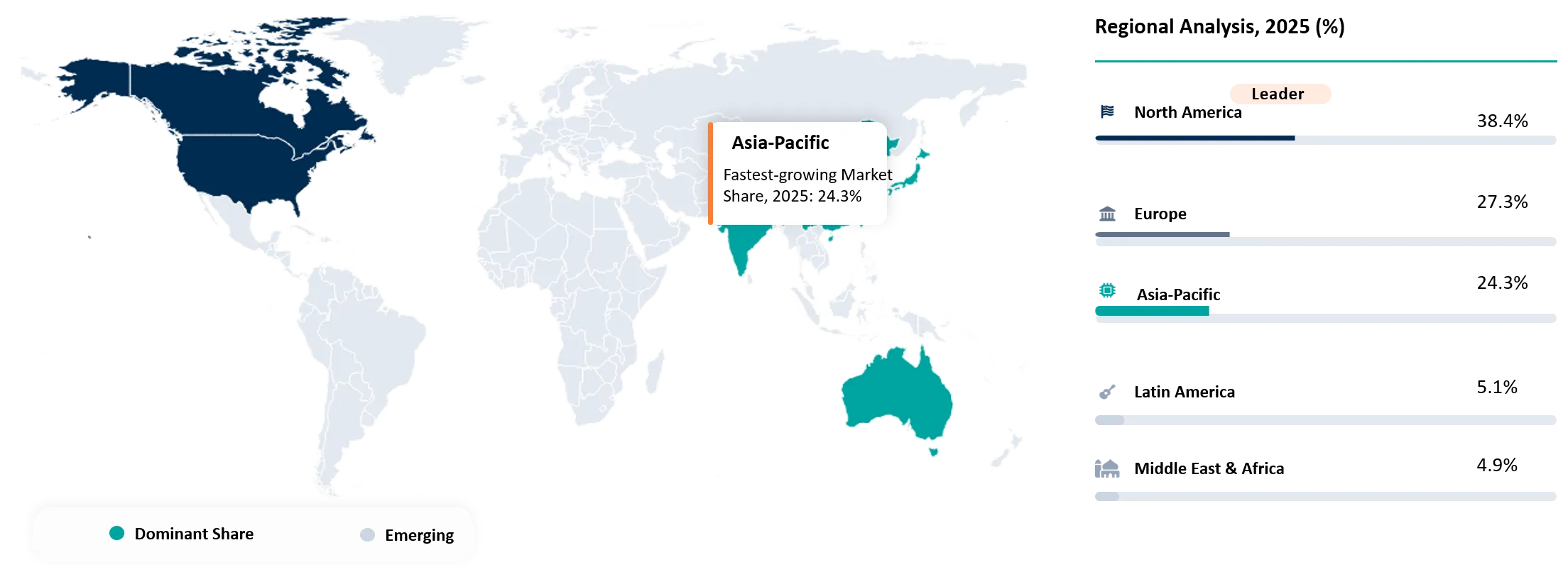
The North America region dominates the counter-drone market, with a 38.4% share of the global market in 2025, backed by high defense budgets, quick deployment of counter-drones, and the availability of leading military technology providers in the United States and Canada. The regional defense forces are focusing on having multi-layered protection against drones to secure their facilities and operations from advanced threats.
Strategic acquisitions and cross-border technology integration are strengthening the capabilities and competitive positioning of Counter-UAS providers. In November 2025, Ondas Holdings Inc., a U.S.-based autonomous robotics and private wireless technology company headquartered in Boston, Massachusetts, completed the acquisition of Sentrycs Ltd., an Israel-based Counter-UAS technology company, for approximately USD 224.6 million. Sentrycs had approximately 200 operational deployments across more than 25 countries, providing Cyber-over-RF and protocol-manipulation technology for drone detection, identification, tracking, and mitigation. The acquisition combines Sentrycs’ cyber-based drone takeover capabilities with Ondas’ Iron Drone Raider autonomous interceptor, creating an integrated detect-to-defeat Counter-UAS platform for defense, homeland security, airports, borders, and critical infrastructure.
U.S. Counter Drone Market Trends
The U.S. holds a dominant position in the counter-drone market due to the huge budget for its defense, fast development of new counter-drone technologies, and their widespread use for protection of both military facilities and critical infrastructure with layers of protection. This is explained by the advanced defense ecosystem where the Department of Defense of the USA, military services, developers of technologies, and special counter-UAS programs participate.
The development of low-cost, high-speed drone interceptors is expanding the technological capabilities of the U.S. Counter-UAS ecosystem. In August 2026, Thermopylae Aerospace, a U.S.-based defense-technology startup, demonstrated its SPART drone interceptor for the U.S. Air Force during the Game of Drones 26-2 event at Edwards Air Force Base, California. Founded by Ukrainian engineer Yehor Balytskyi in June 2025, the company had raised USD 1.6 million in pre-seed funding by November 2025 and expanded from 2 to approximately 5 employees. SPART is a foldable quadcopter designed to intercept Group 2 UAS threats, including Shahed-type attack drones, using thermal guidance, with speeds of up to 350 km/h and a target flight endurance of 20 minutes; it also features partial reusability and can be deployed from UAVs, ground vehicles, maritime vessels, and crewed vehicles.
Canada Counter Drone Market Outlook
Canada is emerging as an important country in the counter-drone market, supported by increased spending in defence, the purchase of counter-unmanned aerial systems (C-UAS), and the development of local drone defence technologies backed by the government. The counter-drone ecosystem in Canada is being developed via the Canadian Armed Forces (CAF), Defence Research and Development Canada (DRDC), and IDEaS of DND.
The growing development of mobile and integrated C-UAS platforms is strengthening Canada’s capability to counter increasingly diverse drone threats. In May 2025, Roshel, a Canada-based armored-vehicle manufacturer headquartered in Brampton, Ontario, collaborated with Leonardo, an Italy-based aerospace and defense company headquartered in Rome, Italy, to develop the Senator Counter-UAS Vehicle, a mobile platform designed to detect, track, identify, and neutralize drone threats. Unveiled at CANSEC 2025 in Ottawa, the vehicle integrates Leonardo’s Falcon Shield C-UAS system with Roshel’s Senator MRAP platform, combining 360-degree radar coverage, RF detection, EO/IR sensors, directional jamming, and kinetic/non-kinetic countermeasures. Roshel states that the vehicle has a production capacity of 140 units per month, accommodates up to five personnel, and supports payloads of up to 3,500 kg.
Rapid Military Modernization and Indigenous Counter-Drone Development Driving Asia-Pacific Region
The Asia-Pacific one of the key regions in the counter-drone market, accounting for 24.3% of the market in 2025, supported by rising military modernization, increasing drone-related security threats, and the rapid development of indigenous counter-UAS capabilities across countries such as India, South Korea, Japan, and Australia. The region's growing emphasis on strengthening airspace and critical-infrastructure protection is encouraging governments to accelerate procurement of drone detection, electronic warfare, jamming, radar, and hard-kill interception technologies.
Strategic partnerships and cross-border defense collaboration are accelerating the expansion of drone and unmanned-system capabilities across the Asia-Pacific region. In August 2026, South Korean and Japanese defense companies are strengthening cooperation with Western defense firms to expand their drone and unmanned-systems businesses, with M&A and strategic partnerships emerging as key routes for capability expansion. In South Korea, Hanwha Aerospace, a South Korean-based aerospace and defense manufacturer, and Korea Aerospace Industries (KAI), a South Korean-based aircraft and defense manufacturer, signed an agreement to jointly develop and export UAVs, while Anduril Industries, a U.S.-based AI defense technology company, has expanded partnerships with Korean defense companies including HD Hyundai, Korean Air, LIG Defense & Aerospace, and Hyundai Rotem. Anduril was valued at approximately USD 30.5 billion in 2026 and established its Seoul office to strengthen its Korean supply chain and defense partnerships.
Japan Counter Drone Market Trends
Japan is emerging as a major country in the counter drone market due to its increasing defense expenditure, growing emphasis on protection of Self-Defense Force (SDF) bases, and accelerated adoption of technologies capable of detecting, identifying, and countering unauthorized drones. Japan's defense strategy increasingly recognizes unmanned systems as a critical component of modern warfare, while the Ministry of Defense is strengthening capabilities against small unmanned aircraft through radar, electronic warfare, and other interception technologies.
Japan’s growing investment in unmanned defense capabilities is accelerating the adoption of dedicated interceptor technologies for countering hostile drones. In July 2026, Quantum Systems, a Germany-based defense and unmanned-aircraft technology company headquartered in Gilching, was selected by Japan’s Acquisition, Technology & Logistics Agency (ATLA) to participate in Japan’s Counter-UAS Proof-of-Concept Program under its Early Acquisition Program. The initiative will evaluate next-generation interceptor drones for the Japan Self-Defense Forces, supporting the development of technologies designed to detect, track, and defeat hostile UAS. Japan had allocated approximately ¥277.3 billion (about USD 1.9 billion) in its fiscal-year budget to strengthen unmanned-systems capabilities, while a separate ATLA interceptor-drone acquisition effort reportedly attracted proposals from 38 companies, with procurement targeted for late August and deliveries potentially beginning in September 2026.
Counter Drone Market Competitive Landscape
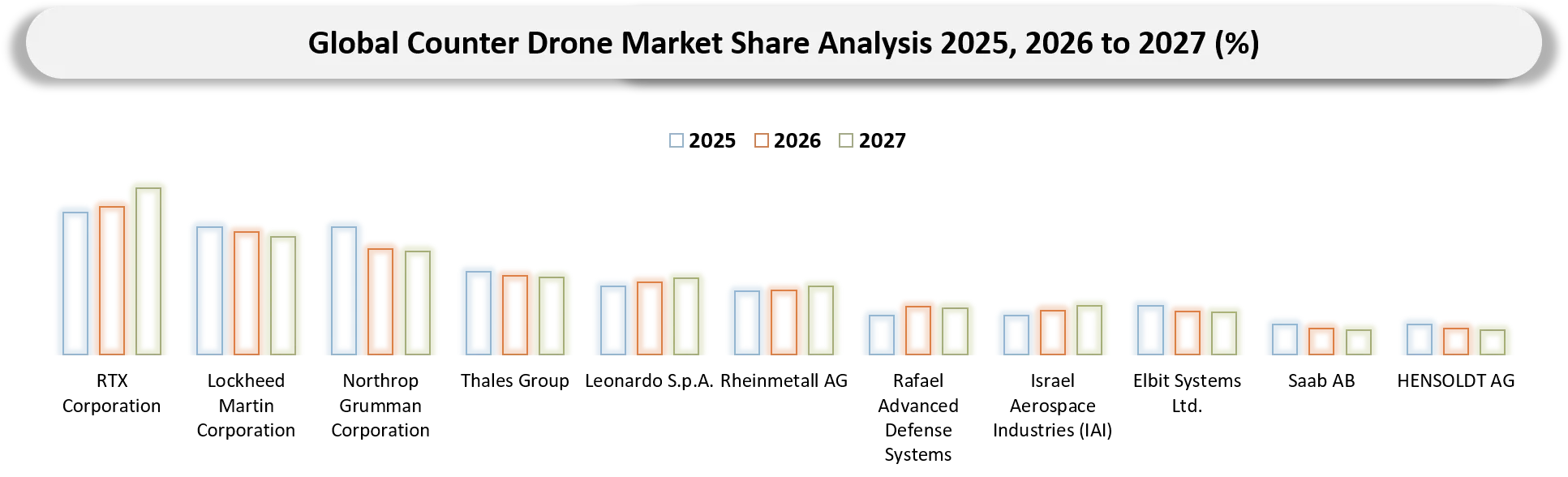
- The counter drone market is characterized by three major participant groups: large defense primes and integrated air-defense providers, specialized counter-UAS and electronic-warfare companies, and emerging autonomous-drone and interceptor specialists. RTX Corporation, Lockheed Martin Corporation, Northrop Grumman Corporation, Thales Group, Leonardo S.p.A., Rheinmetall AG, Rafael Advanced Defense Systems, Israel Aerospace Industries (IAI), Elbit Systems Ltd., Saab AB, and HENSOLDT AG participate across radar, electro-optical/infrared sensing, electronic warfare, command-and-control, air-defense, and kinetic interception technologies, while Anduril Industries is strengthening the market through autonomous systems, AI-enabled sensing, and counter-UAS solutions. The competitive environment is increasingly shaped by rapid technology deployment, integration of multiple detection and defeat layers, interoperability, autonomous decision-making, and the ability to scale production for military customers.
- Key players include RTX Corporation, Lockheed Martin Corporation, Northrop Grumman Corporation, Thales Group, Leonardo S.p.A., Rheinmetall AG, Rafael Advanced Defense Systems, Israel Aerospace Industries (IAI), Elbit Systems Ltd., Saab AB, HENSOLDT AG, and Anduril Industries.
Key Developments
- March 2026: Anduril Industries, a U.S.-based defense technology company, received a U.S. Army enterprise agreement with a potential value of USD 20 billion over 10 years to provide its Lattice command-and-control platform.
- April 2026: Echodyne, a U.S.-based radar technology company, was selected as the primary radar provider for Trust Automation’s Small-Unmanned Air Defense System (SUADS), a Counter-UAS platform being delivered to the U.S. Air Force under a USD 490 million IDIQ contract.
- August 2026: Rocket One Inc., a U.S.-based AI computing, autonomous-systems, defense, and space technology company, launched Swarm Stage AI, an autonomous swarm simulation and defense platform designed for military, government, and security organizations.
- October 2025: VisionWave Holdings Inc., a U.S.-based defense technology company, had its Counter-UAS (C-UAS) systems featured and installed on the platform of a U.S. Tier-1 defense contractor at the AUSA Annual Meeting and Exposition, held October 13–15, 2025, in Washington, D.C.
- October 2025: AeroVironment Inc. (AV), a U.S.-based defense technology company, partnered with GrandSKY, a U.S.-based unmanned aerial systems business and aviation park in North Dakota, to deploy a distributed Counter-UAS (C-UAS) capability at Grand Forks Air Force Base, North Dakota.
- July 2026: Ondas Inc., a U.S.-based autonomous systems and defense technology company, acquired DZYNE Technologies, a U.S.-based defense technology company, in a transaction valued at approximately USD 875.8 million.
Key Procurement Priorities and Buyer Evaluation Criteria
- Organizations investing in the counter drone market increasingly prioritize suppliers capable of providing multi-layered detection, identification, tracking, and defeat capabilities that can operate against small, low-observable, autonomous, and swarm-based drones across military bases, critical infrastructure, and forward operating environments.
- The procurement decision-making process is increasingly influenced by the need for rapid deployment, interoperability with existing air-defense and command-and-control architectures, autonomous threat assessment, and scalable counter-UAS capabilities. Buyers are also evaluating suppliers based on their ability to adapt systems to evolving drone tactics and integrate new sensors, effectors, and software without requiring complete system replacement.
- Buyers consider factors such as detection and tracking range, probability of detection, target identification accuracy, response time, electronic-warfare effectiveness, interceptor performance, false-alarm rates, and effectiveness against multiple simultaneous threats when selecting counter-UAS technology providers.
- Procurement teams also evaluate total lifecycle cost, ammunition/interceptor expenditure, ease of maintenance, training requirements, logistics support, upgradeability, and availability of spare parts. The ability to provide scalable solutions ranging from portable systems for individual units to fixed and networked systems for large military installations is becoming an important differentiator.
- Buyers increasingly assess suppliers on their ability to support AI-enabled autonomous operations, counter-drone swarms, low-cost defeat mechanisms, mobile deployment, and integration with existing military networks and air-defense systems, particularly as defense organizations seek solutions capable of addressing high-volume and rapidly evolving UAS threats.
Why Choose DataM?
- Technological Innovations: Explores advancements in counter drone technologies, including AI-enabled detection, 3D radar, RF sensing, electronic warfare, autonomous interceptors, directed-energy systems, and integrated command-and-control platforms, enabling faster threat detection, improved target classification, and multi-layered drone defeat.
- Product Performance & Market Positioning: Evaluates how leading players differentiate their counter-UAS solutions based on detection range, tracking accuracy, response time, multi-target engagement, electronic-warfare effectiveness, interceptor capability, mobility, and system integration, highlighting competitive positioning across military bases, critical infrastructure, border security, and battlefield applications.
- Real-World Evidence: Highlights the deployment, testing, procurement, and operational evaluation of counter-UAS technologies by defense organizations, demonstrating practical capabilities such as drone detection and identification, autonomous interception, RF jamming, kinetic defeat, and protection of personnel and high-value assets.
- Market Updates & Industry Changes: Tracks key developments including defense procurement programs, counter-drone technology demonstrations, military exercises, C-UAS contract awards, autonomous interceptor development, and investments in detection and defeat technologies across North America, Europe, Asia-Pacific, and the Middle East.
- Competitive Strategies: Analyzes how leading companies strengthen their market positions through AI integration, autonomous systems, electronic-warfare capabilities, strategic defense contracts, technology partnerships, acquisitions, and rapid product development, while expanding portfolios from individual counter-drone components toward integrated multi-layered C-UAS architectures.
- Pricing & Market Access: Examines variations in counter-UAS system costs according to detection technology, sensor configuration, electronic-warfare capability, interceptor type, engagement range, automation level, command-and-control integration, and deployment architecture, while assessing procurement access through defense ministries, military agencies, government contracts, and system integrators.
- Market Entry & Expansion: Identifies opportunities created by rising drone proliferation, military modernization, critical-infrastructure protection, border security, and counter-swarm requirements, while outlining expansion strategies such as localized manufacturing, government partnerships, defense procurement programs, modular system development, interoperability with existing air-defense networks, and regional technology collaborations.
Target Audience 2026
- Defense Ministries & Government Procurement Agencies
- Armed Forces & Military Organizations
- Counter-UAS System Manufacturers
- Defense Prime Contractors & System Integrators
- Drone & Autonomous-System Companies
- Radar, Sensor & Electronic-Warfare Technology Providers
- Critical Infrastructure & Security Operators


























































