


Cool Roofs Market Size
The Cool Roofs Market is estimated to reach USD 24.85 Billion in 2025 and is projected to grow to USD 51.21 Billion by 2035, registering strong growth at a CAGR of 7.50% during the forecast period from 2026 to 2035.
Global uptake of cool roofs is accelerating, driven by government-led programs and institutional support. Reflective roofs can stay over 50°F cooler than conventional roofs, significantly reducing building energy use. In air-conditioned homes, peak cooling demand drops by 11-27% with cool roof installation. Indonesia’s implementation of over 1.1 million m² of cool roofs covering 250,000 households demonstrates growing global momentum, with production costs expected to decline as local manufacturing expands. Additionally, over 850 certified products are now available through official rating councils, supporting standardized adoption and scaling.
Cool Roofs Market Trend
A key trend in the global cool roof market is the transition from small-scale projects to large-scale institutional adoption. In Indonesia, cool roof deployment created more than 100 local jobs and led to a roughly 20% cost reduction through localized production. The integration of international funding and local capacity building is proving highly effective in scaling these solutions. In the US, federal directives and national rating programs have institutionalized cool roofs across building codes. These efforts collectively highlight a global trend of governments promoting affordability, regulation, and scalability in the cool roofing sector.
For more details on this report - Request for Sample
Cool Roofs Market Scope
| Metrics | Details |
| By Roof Type | Steep-Slope roofs, Low-Slope roofs, Others |
| By Product | Coated Roofs, Foam Roofs, Single-Ply Membrane, Modified BUR, Metal Roofs, Asphalt Shingles, Others |
| By Reflective Coatings | White Roof Coatings, Pigmented Coatings, Aluminum Roof Coatings, Roofing Membranes, Single-Ply Thermoplastic Membranes, Others |
| By End-User | Residential, Commercial, Industrial |
| By Region | North America, South America, Europe, Asia-Pacific and Middle East and Africa |
| Report Insights Covered | Competitive Landscape Analysis, Company Profile Analysis, Market Size, Share, Growth |
Key Takeaways
- North America accounts for more than 35% of global demand, driven by stringent energy-efficiency regulations, green building initiatives, and widespread adoption of sustainable roofing technologies.
- Cool roofs can reduce rooftop temperatures by up to 50°F (28°C) or more compared to conventional roofing systems, significantly lowering cooling energy consumption.
- Buildings equipped with cool roofs can experience 11%-27% reductions in peak cooling demand, making them a cost-effective energy-efficiency solution.
- Low-slope roofs account for nearly 45% of market demand, particularly across commercial and industrial buildings.
- Cool roof coatings remain one of the largest product categories, contributing approximately 30% of market revenue due to their affordability and retrofit compatibility.
- Asia-Pacific is the fastest-growing region, supported by rapid urbanization, infrastructure expansion, and increasing government efforts to combat urban heat island effects.
- More than 850 certified cool roofing products are commercially available globally, reflecting strong product innovation and market maturity.
- Commercial buildings represent the largest application segment, accounting for over 40% of installed cool roofing systems worldwide.
- Adoption of reflective roofing technologies is accelerating in data centers, logistics facilities, warehouses, educational institutions, and healthcare buildings.
- Sustainable construction initiatives and net-zero building targets are significantly increasing demand for energy-efficient roofing materials.
- Growing integration of solar roofing systems with cool roof technologies is creating new opportunities across the commercial and residential sectors.
Analyst Viewpoint
The Cool Roofs Market is transitioning from a niche energy-efficiency solution into a mainstream component of sustainable building design. Rising global temperatures, increasing energy costs, and stricter environmental regulations are accelerating adoption across residential, commercial, and industrial buildings.
Governments and urban planners are increasingly recognizing cool roofs as an effective strategy to reduce cooling demand, lower greenhouse gas emissions, and mitigate urban heat island effects. As building owners focus on operational cost savings and sustainability targets, demand for advanced reflective roofing materials is expected to strengthen significantly.
Latest Industry Intelligence & Future Growth Catalysts (2026)
Urban Heat Island Mitigation Programs Expand
Cities worldwide are implementing cool roof initiatives to reduce urban temperatures and improve energy efficiency.
Green Building Certifications Drive Adoption
LEED, BREEAM, and other sustainability certification programs increasingly reward cool roofing installations.
Energy Efficiency Regulations Tighten
Governments are strengthening building energy codes, encouraging adoption of reflective roofing technologies.
Commercial Retrofit Market Accelerates
Existing building owners are investing in cool roof retrofits to lower operating expenses and improve building performance.
Solar-Ready Roofing Systems Gain Momentum
Manufacturers are developing roofing solutions that combine solar compatibility with high reflectivity.
Advanced Reflective Coatings Improve Performance
New coating technologies offer longer durability, improved weather resistance, and enhanced solar reflectance.
Climate Resilience Investments Increase
Infrastructure planners are incorporating cool roofs into climate adaptation and sustainability strategies.
Market Opportunities and Investment Hotspots
Significant opportunities are emerging across reflective roof coatings, energy-efficient construction materials, green building infrastructure, commercial retrofitting projects, and solar-integrated roofing systems.
Additional high-growth investment areas include:
- Reflective roof coatings
- Solar-compatible cool roofing systems
- Sustainable building materials
- Urban heat mitigation projects
- Smart roofing technologies
- Industrial facility retrofits
- Net-zero building developments
- Energy-efficient commercial construction
- Climate-resilient infrastructure projects
Companies investing in advanced materials, sustainability innovation, and large-scale retrofit solutions are expected to strengthen their competitive position.
Cool Roofs Market Dynamics
Climate Change and Urban Heat Island Mitigation
Climate change and urban heat island (UHI) effects are among the most significant drivers propelling the global cool roofs market. As global temperatures rise, cities are experiencing disproportionately higher heat levels due to dense infrastructure, dark surfaces, and limited vegetation, which contribute to the UHI effect. A recent study by the Indian Institute of Technology Bhubaneswar, India, reveals that urbanization has caused nearly 60% more night-time warming in over 140 major Indian cities compared to surrounding rural areas.
Cool roofs, designed to reflect more sunlight and absorb less heat, offer a practical and scalable solution to mitigate these impacts. In urban areas, widespread adoption of cool roofs can significantly lower ambient temperatures, reducing energy demand for air conditioning and enhancing public health by decreasing heat-related illnesses and mortality.
Municipal governments and environmental agencies are recognizing this benefit and increasingly incorporating cool roofing requirements into climate action plans and green building codes. Programs such as New York City’s Cool Roof Initiative this policy shift. Similarly, in India, Telangana has launched India’s first Cool Roof Policy (2023-2028) to make the state more heat resilient by mandating the use of cool roofing materials like solar reflective paints, tiles, and sheets. The five-year policy, effective from April 1, 2023, aims to cover 300 square kilometers of roof area, primarily in Hyderabad and other urban areas. The initiative is designed to address rising temperatures proactively, with the policy’s timing chosen to emphasize its importance during the summer months.
Moreover, climate resilience has become a core component of urban planning, with cool roofs offering an effective strategy for both mitigation and adaptation. As cities aim to reduce greenhouse gas emissions and combat extreme heat events, cool roofing solutions are being adopted as part of comprehensive climate resilience strategies.
High Initial Costs
High initial costs, ranging from USD 0.60 to 1.30 per sq. ft., are a major barrier to the adoption of cool roofs, especially when compared to basic alternatives like lime wash (USD 0.07/ft²). Despite proven benefits like 5%-14% HVAC energy savings, many building owners hesitate due to 2-3-year payback periods. India's ECBC mandates reflectivity but offers no direct financial support, limiting adoption. Without subsidies or incentives, the market struggles to scale despite rising heat stress.
Cool Roofs Market Segment Analysis
The global cool roofs market is segmented based on roof type, product, reflective coatings, end-user and region.
Steep-Slope Segment Driving Cool Roofs Market
The steep-slope roofs segment of the cool roofs market is experiencing growing demand, particularly in residential construction, due to structural advantages and increasing energy efficiency mandates. Steep-slope roofs, common in homes, are designed to allow efficient drainage of rain and snow, reducing the potential for water damage, mold, and algae buildup making them ideal for integration with reflective roofing materials.
According to the US Department of Energy (DOE), cool roofing systems particularly in residential applications can reduce annual air conditioning energy use by up to 15%. In regions with hot climates, such as the southern US, the energy and cost savings are even more pronounced when cool roof technology is applied to sloped asphalt shingle roofs.
Regulatory actions have been a significant catalyst for adoption. California’s Title 24 Building Energy Efficiency Standards, implemented by the California Energy Commission, require certain minimum levels of solar reflectance and thermal emittance for roofing materials used in both low-slope and steep-slope applications. In climate zones 10-15, these standards have led to widespread installation of “cool-colored” roofing materials, especially for steep-slope roofs on residential buildings. The US Environmental Protection Agency (EPA), through its ENERGY STAR program, recognizes steep-slope roofing materials (like reflective shingles and tiles) that meet energy efficiency guidelines.
Additionally, the Internal Revenue Service (IRS) has supported adoption through federal tax credits under the Inflation Reduction Act, offering up to 30% credit for qualified energy-efficient home improvements including reflective roofing materials used in steep-slope residential installations.
Cool Roofs Market Geographical Share
Asia-Pacific Drives the Global Cool Roofs Market
The demand for cool roofs across the Asia-Pacific region is rising steadily, driven by urgent climate adaptation needs, rapid urbanization, and government-led sustainability initiatives. Countries including India, Singapore, Japan, China, Malaysia, and the Philippines are adopting cool roofing systems to reduce urban heat island effects and lower energy consumption in residential and commercial buildings. In India, the government and municipal bodies have taken major steps. The Telangana Cool Roof Policy (2023) mandates cool roofs for large buildings and aims to cover 300 square kilometers by 2030. The initiative is projected to save 600 GWh of electricity annually and cut 30 million tons of carbon emissions over five years. Cities like Ahmedabad and Hyderabad have also adopted cool roof programs under their Heat Action Plans, targeting low-income neighborhoods and demonstrating measurable indoor cooling benefits of 2-5°C with basic reflective coatings.
In Singapore, the Building and Construction Authority (BCA) promotes energy-efficient building materials under its Green Building Masterplan, which aims to green 80% of all buildings by 2030. Cool roofs are integrated into this strategy as a passive cooling technology.
China has incorporated cool roofing into broader green building guidelines under its Three-Star Green Building Rating System. Major urban centers such as Shanghai and Beijing are increasingly adopting reflective roofing materials as part of low-carbon city frameworks.
These diverse programs across the region reflect growing governmental recognition of cool roofs as a critical climate adaptation and energy-saving strategy in Asia-Pacific.
Sustainability Analysis
The global cool roof market is increasingly recognized for its sustainability benefits, contributing to energy efficiency, climate resilience, and emissions reduction. Cool roofs, designed to reflect more sunlight and absorb less heat, play a pivotal role in mitigating urban heat islands and reducing cooling energy demands.
According to the US Department of Energy, cool roofs can significantly lower building temperatures, reducing the need for air conditioning and, consequently, energy consumption. This decrease in energy use leads to a reduction in greenhouse gas emissions associated with electricity generation.
The Environmental Protection Agency (EPA) highlights that widespread adoption of cool roofs can mitigate the urban heat island effect, leading to improved air quality and reduced heat-related health issues.
Internationally, initiatives like the Million Cool Roofs Challenge have demonstrated the effectiveness of cool roofs in various climates. This program led to the installation of over 1.1 million square meters of cool roofs across multiple countries, resulting in indoor temperature reductions of up to 10°C and creating sustainable job opportunities. In India, the state of Telangana's Cool Roof Policy aims to cover 300 square kilometers with cool roofs by 2028, projecting annual energy savings of 600 GWh and a cumulative reduction of 30 million tons of carbon dioxide emissions over five years.
Cool Roofs Market Major Players
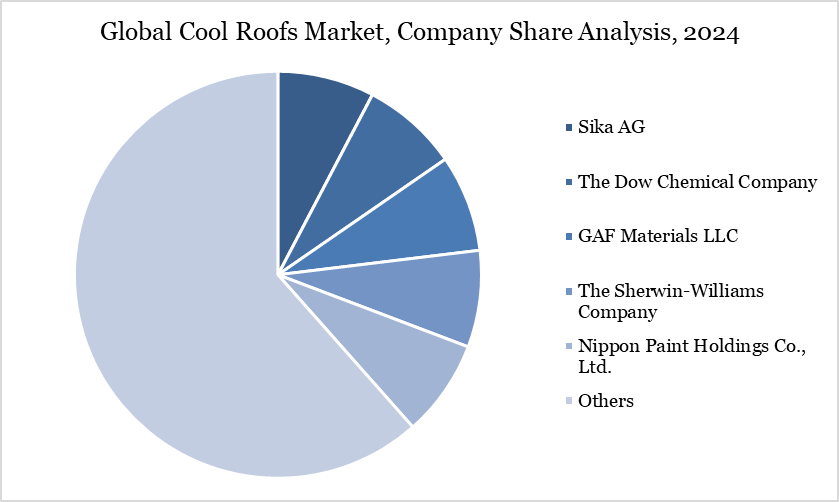
The major global players in the market include Sika AG, The Dow Chemical Company, GAF Materials LLC, The Sherwin-Williams Company, Nippon Paint Holdings Co., Ltd., Akzo Nobel N.V., Nutech Paint Pty Ltd, PPG Industries, Inc., Gaco Western LLC, and BASF SE.
Key Developments
- June 2026 - Sika and GAF expanding energy-efficient roofing solutions
Sika AG and GAF Materials LLC strengthened their cool roofing portfolios with advanced reflective coatings and roofing systems designed to reduce heat absorption, improve building energy efficiency, and support sustainability goals. - May 2026 - Sherwin-Williams and PPG advancing high-performance roof coating technologies
The Sherwin-Williams Company and PPG Industries, Inc. introduced enhanced cool roof coatings featuring improved solar reflectance, weather resistance, and durability for commercial, industrial, and residential applications. - April 2026 - AkzoNobel and Nippon Paint focusing on sustainable building materials
Akzo Nobel N.V. and Nippon Paint Holdings Co., Ltd. expanded development of environmentally friendly roof coatings aimed at reducing urban heat island effects and lowering cooling energy consumption. - April-June 2026 - Growing adoption of green building and energy conservation initiatives
Companies including BASF SE, The Dow Chemical Company, Nutech Paint Pty Ltd, and Gaco Western LLC increased investments in advanced roofing materials, elastomeric coatings, and reflective technologies to meet rising demand for sustainable construction solutions.
Why Choose DataM?
Data-Driven Insights: Dive into detailed analyses with granular insights such as pricing, market shares and value chain evaluations, enriched by interviews with industry leaders and disruptors.
Post-Purchase Support and Expert Analyst Consultations: As a valued client, gain direct access to our expert analysts for personalized advice and strategic guidance, tailored to your specific needs and challenges.
White Papers and Case Studies: Benefit quarterly from our in-depth studies related to your purchased titles, tailored to refine your operational and marketing strategies for maximum impact.
Annual Updates on Purchased Reports: As an existing customer, enjoy the privilege of annual updates to your reports, ensuring you stay abreast of the latest market insights and technological advancements. Terms and conditions apply.
Specialized Focus on Emerging Markets: DataM differentiates itself by delivering in-depth, specialized insights specifically for emerging markets, rather than offering generalized geographic overviews. This approach equips our clients with a nuanced understanding and actionable intelligence that are essential for navigating and succeeding in high-growth regions.
Value of DataM Reports: Our reports offer specialized insights tailored to the latest trends and specific business inquiries. This personalized approach provides a deeper, strategic perspective, ensuring you receive the precise information necessary to make informed decisions. These insights complement and go beyond what is typically available in generic databases.
Target Audience
Manufacturers/ Buyers
Industry Investors/Investment Bankers
Research Professionals
Emerging Companies




























































