


Coconut Sugar Market Size and Forecast
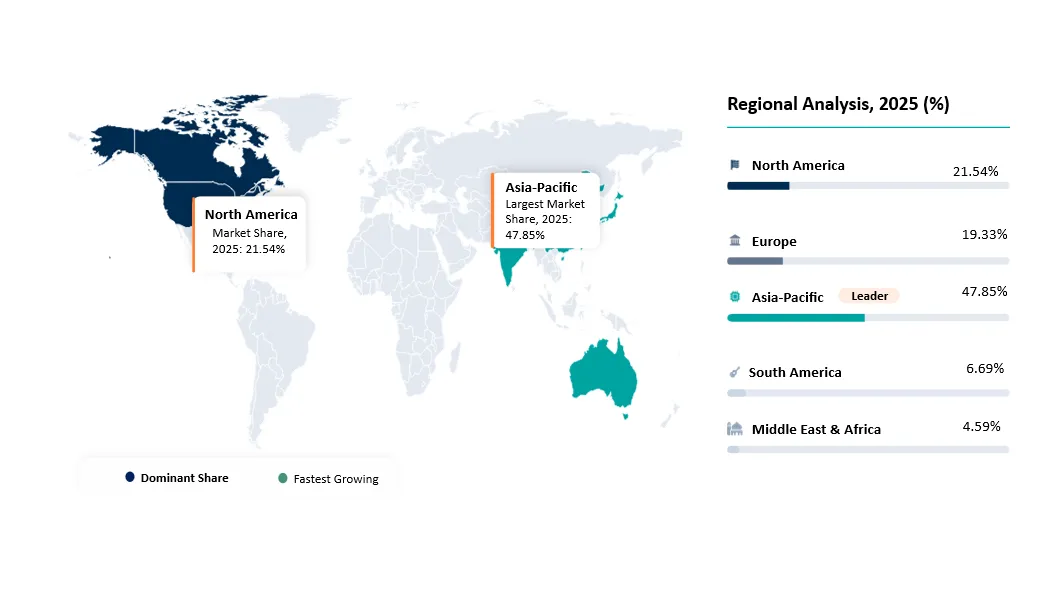
The global Coconut Sugar market reached an estimated US$ 412 million in 2025 and is expected to reach approximately US$ 798 million by 2035, growing at a modeled CAGR of 6.8% during 2026-2035. Growth is supported by clean-label product development, organic and fair-trade positioning, premium bakery and beverage applications, e-commerce availability and consumer interest in less-refined sweeteners. Asia-Pacific is both the main production base and the largest regional market, while North America and Europe account for a high share of premium retail and ingredient demand.
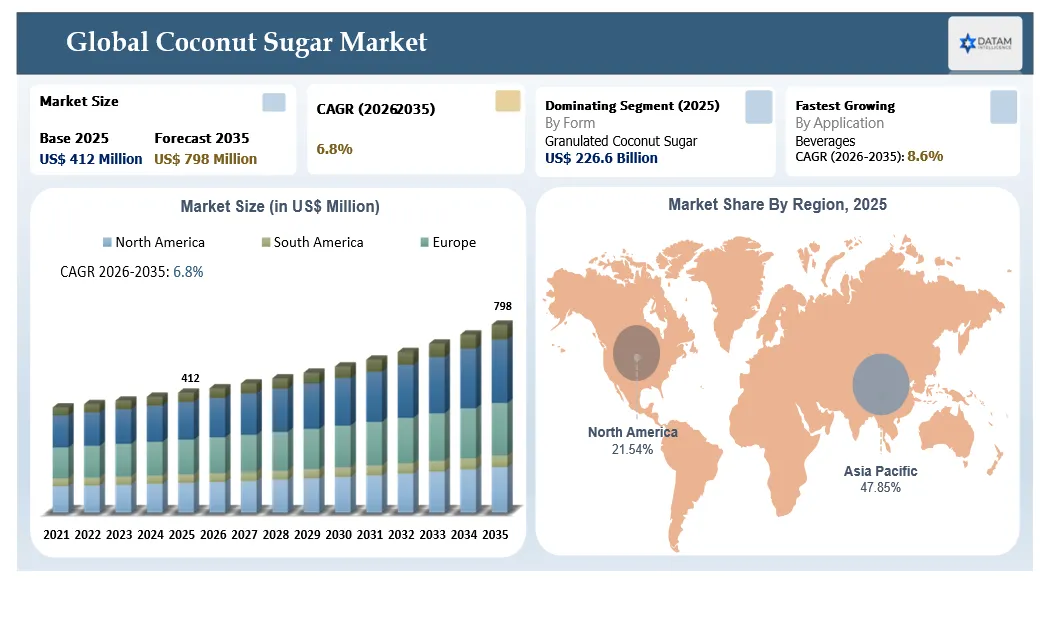
Coconut sugar is differentiated by its caramel-like flavor, plant-based origin, traceability story and compatibility with natural-product positioning. Its commercial value is higher than that of conventional cane sugar, making it more exposed to consumer purchasing power and reformulation budgets. The market is therefore concentrated in premium foods, natural retail, direct-to-consumer channels and brands able to communicate provenance and sustainability. Growth through 2035 will depend on quality standardization, farmer aggregation, reliable sap collection, process efficiency and evidence-based claims that avoid overstating nutritional advantages.
The supply chain is rooted in smallholder agriculture in Indonesia, the Philippines and other coconut-producing countries. Sap collection is labor intensive and requires daily tapping, rapid processing and disciplined hygiene. This creates a structural need for farmer training, village-level collection systems and decentralized primary processing. Integrated processors and exporters can create advantage through organic certification, fair-trade programs, traceability, quality laboratories and diversified coconut-product portfolios that stabilize farmer and plant economics.
Coconut Sugar Market Key Takeaways
- Granulated coconut sugar remains the largest product type because it can replace brown sugar in retail, bakery, beverage and snack applications with limited process changes.
- Organic products command a meaningful premium and represent the most important differentiation route in North America and Europe.
- Asia-Pacific leads production and consumption, with Indonesia and the Philippines forming the core export supply base.
- Bakery and confectionery are the largest industrial applications, while beverages and plant-based foods offer faster growth from a smaller base.
- Price remains the main adoption barrier because coconut sugar typically sells at several times the price of conventional refined sugar.
- Quality consistency, moisture control, color, particle size and flavor standardization are decisive for industrial buyers.
- Farmer aggregation and traceability are strategic assets because supply is fragmented and sap must be processed quickly after collection.
- Claims strategy is shifting from broad health positioning toward minimally processed, organic, traceable and sustainable sourcing narratives.
Coconut Sugar Industry Trends and Strategic Insights
- Brands are using coconut sugar in better-for-you cookies, granola, chocolate, coffee, plant-based beverages and functional snacks where flavor and label simplicity justify a premium.
- Ingredient suppliers are developing lighter-color, finer-particle and low-moisture grades to improve use in beverages, confectionery and dry mixes.
- Private-label growth is expanding supermarket access, but it increases price pressure and raises the importance of scale, certification and dependable supply.
- Sustainability programs increasingly focus on smallholder income, biodiversity, agroforestry, low-input farming and full traceability rather than carbon claims alone.
- Blended sweetener systems combining coconut sugar with stevia, monk fruit or allulose are emerging to reduce sugar content while retaining caramel flavor and bulk.
Coconut Sugar Market Scope
| Metric | Details |
| 2025 Market Size | US$ 412 Million (modeled estimate) |
| 2035 Projected Market Size | US$ 798 Million (modeled estimate) |
| CAGR (2026-2035) | 6.8% |
| Largest Market | Asia-Pacific |
| Fastest Growing Market | North America |
| By Product Type | Granulated Coconut Sugar, Coconut Nectar and Syrup, Blocks and Paste, Blended and Specialty Sweeteners |
| By Nature | Organic and Conventional |
| By Form | Powder and Granules, Liquid, Blocks and Paste |
| By Source | Farmer Cooperatives and Smallholders, Integrated Coconut Processors, Third-Party Aggregators |
| By Application | Bakery and Confectionery, Beverages, Dairy and Plant-Based Alternatives, Snacks and Cereals, Sauces and Condiments, Supplements, Household Sweetening and Others |
| By End Use Industry | Food and Beverage Manufacturing, Foodservice, Retail and CPG, Nutraceuticals, Private Label and Others |
| By Distribution Channel | Direct Sales, Ingredient Distributors, Supermarkets and Specialty Retail, Online Retail and B2B Platforms |
| Report Insights Covered | Market Size, Share, Growth, Pricing, Trade, Ecosystem, Competition, Company Profiles and Country-Level Opportunity |
Why does this report matter in 2026?
The year 2026 is an important planning point because coconut ingredient companies are balancing strong consumer interest in natural products against volatile freight, labor and agricultural costs. Public coconut companies are reporting improving demand and profitability in several product categories, but coconut sugar remains a niche line that is rarely disclosed separately. Buyers require clearer proof of supply continuity, food safety, organic integrity and farmer traceability. The report helps distinguish broad coconut-category momentum from the specific economics of sap-based sweeteners and identifies where premium demand can absorb higher pricing.
Coconut Sugar Market White Space & Investment Opportunities
The strongest white spaces include lighter-color coconut sugar for beverages, high-solubility powders, controlled-moisture grades for industrial baking, organic and fair-trade supply programs, low-sugar blends, foodservice sachets, and regional packing closer to end markets. Investment in farmer training, sap collection, decentralized evaporation, renewable-energy processing and digital traceability can improve both quality and farmer economics.
Coconut Sugar Future Market Transformation
The market is expected to move from fragmented artisanal production toward more standardized, auditable and application-specific supply. Industrial buyers will require documented microbiological control, batch consistency, contaminant testing and stable specifications. Premium brands will continue to sell provenance, but large-scale growth will depend on private label, bakery, beverage and snack formulations that deliver repeatable performance. Blends with high-intensity sweeteners may also expand coconut sugar into reduced-sugar products.
Coconut Sugar Market Buyer Decision-Making Criteria
Industrial buyers prioritize sweetness profile, color, caramel flavor, particle size, solubility, moisture, microbiological quality, organic status, allergen control, traceability, packaging integrity and supply reliability. Retail buyers add brand recognition, price architecture, claims compliance, packaging convenience and consumer reviews. Long-term contracts increasingly include quality tolerances, certification continuity and contingency arrangements for weather, harvest and logistics disruption.
Coconut Sugar Market Economic & Investment Analysis
Profitability depends on sap yield, labor availability, farmer participation, energy use, conversion efficiency, certification cost, export logistics and realized product mix. Integrated processors can spread fixed costs across coconut water, milk, oil, flour and desiccated coconut, while specialized producers can earn higher margins through organic, fair-trade and application-specific products. Investors should model supply at village and farmer-cluster level rather than relying only on national coconut production because not all palms or communities are suitable for sustained sap tapping.
Coconut Sugar Investment Trends in the Market
- Investment is shifting toward farmer aggregation, traceability and village-level processing rather than only central refining capacity.
- Organic and fair-trade certification remains a major use of capital because it supports premium pricing and retailer access.
- Processors are adding drying, milling, sieving and packaging equipment to produce application-specific grades.
- Digital procurement and farm-mapping systems are being used to document origin and reduce certification risk.
- Strategic investors favor diversified coconut processors that can balance demand across multiple product categories.
Strategic Indicators for Coconut Sugar Market
High Regulation Impact
Food-safety rules, organic certification, labeling standards, contaminant limits and import documentation strongly affect market access. Companies must avoid unsubstantiated glycemic or health claims and maintain chain-of-custody records for certified products.
High Investment Activity
Investment is moderate but rising in coconut processing, farmer networks, organic certification, private label and premium natural sweeteners. Capital is concentrated in integrated coconut processors and export-ready facilities.
Supply Chain Disruption
Weather, labor shortages, farmer switching, port delays and container costs can affect availability. Sap requires rapid processing, making local collection and decentralized production especially important.
Pricing Volatility
Prices respond to labor, energy, freight, certification and competition for coconut raw materials. Organic and fair-trade grades carry premiums, while private label creates downward pressure.
Procurement Pressure
Large buyers demand tighter specifications, third-party audits, traceability and year-round supply. Dual sourcing is difficult because sensory and color profiles vary by origin and process.
New Technology Adoption
Improved evaporators, vacuum concentration, low-temperature drying, moisture control, optical sorting and digital traceability can improve quality and yield.
Regional Expansion Opportunity
North America and Europe offer premium demand, while Asia-Pacific provides production scale and expanding domestic consumption. Gulf markets and urban Latin America offer smaller but growing opportunities.
Government Policy Support
Coconut-replanting, rural livelihood, export development and organic agriculture programs can strengthen supply. Policy continuity and farmer-level implementation remain uneven.
Pricing Intelligence
Bulk conventional grades compete on landed cost, while organic, fair-trade and specialty grades compete on certification, sensory consistency and traceability. Retail margins are highest in branded and convenience formats.
Disruption Analysis of Coconut Sugar Market
The market is being disrupted by reduced-sugar reformulation, new sweeteners such as allulose and monk fruit blends, private-label expansion and stricter scrutiny of health claims. Coconut sugar retains relevance where flavor, origin and minimal processing matter, but it cannot rely solely on a healthier-than-sugar narrative. Companies that build application expertise, verified sourcing and consistent industrial grades will be better positioned than sellers of undifferentiated retail packs.
Coconut Sugar Market BCG Matrix: Company Evaluation
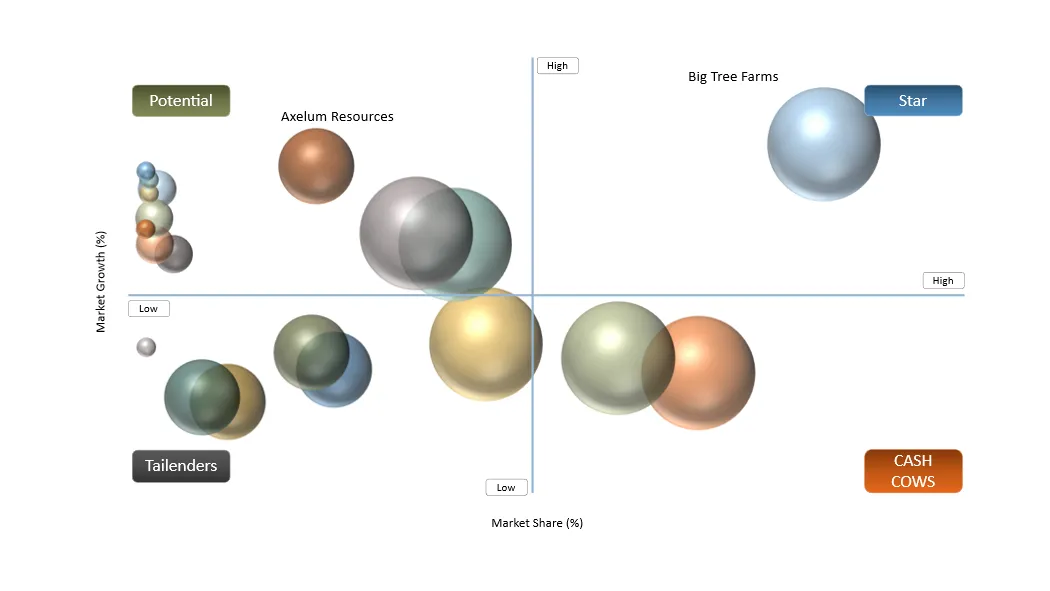
STAR: Integrated coconut processors with strong export channels, organic certification and diversified product portfolios are best positioned because they can use common farmer networks, laboratories and logistics across several coconut categories.
POTENTIAL: Specialized coconut sugar brands and farmer-linked processors can grow rapidly through e-commerce, private label and premium food applications, but they remain exposed to scale, working-capital and supply-consistency constraints.
Coconut Sugar Market Dynamics
Driver Impact Analysis
| Driver | Market Growth Impact | Demand Concentration | Impacted Use Case | Strategic Impact |
| Clean-label and natural sweetener demand | High | North America, Europe and urban Asia | Retail, bakery and snacks | Supports premium positioning and product launches |
| Organic and sustainable sourcing | High | Natural retail and premium CPG | Certified consumer and ingredient products | Creates price premiums and retailer access |
| Growth of premium bakery and beverages | Medium-High | Foodservice and specialty brands | Coffee, desserts, chocolate and plant-based drinks | Expands application-specific grades |
| E-commerce and private label | Medium | Global consumer channels | Retail packs and subscription sales | Broadens availability but increases price competition |
Driver: Rising Demand for Clean-Label and Plant-Based Sweeteners
Consumers and formulators are seeking recognizable sweeteners that fit natural, organic, vegan and minimally processed product concepts. Coconut sugar offers a distinctive caramel profile and a compelling agricultural story. This supports adoption in products where a modest ingredient cost increase can be absorbed by premium positioning, especially bakery, snacks, chocolate, coffee and natural retail.
Restraint Impact Analysis
| Restraint | Drag on Growth | Primary Impact Area | Impacted Use Case | Strategic Impact |
| High price versus refined sugar | High | Mass-market adoption | High-volume food and beverage | Limits substitution to premium products |
| Fragmented smallholder supply | High | Supply reliability | Industrial contracts | Requires aggregation and traceability |
| Quality and sensory variability | Medium-High | Formulation consistency | Beverages, confectionery and dry mixes | Raises qualification and blending costs |
| Competition from other natural sweeteners | Medium | Consumer choice | Retail and reduced-sugar products | Increases need for differentiation |
Restraint: High Price and Limited Scale
Coconut sugar is labor intensive and cannot compete with conventional refined sugar on cost. Smallholder fragmentation, rapid sap handling, certification and export logistics further increase expense. Buyers therefore use it selectively in premium products, blends or limited-edition formulations. Scale will improve only if processors increase farmer participation and standardize quality without weakening the social and environmental proposition.
Coconut Sugar Market Segmentation Analysis
The global Coconut Sugar market is segmented based on Product Type, Nature, Form, Source, Application, End Use Industry, distribution channel, and region.
By Product Type
Granulated Coconut Sugar Will Remain the Largest Product Type
Granulated products lead because they are easy to store, ship, dose and substitute for brown sugar. Coconut nectar and syrup offer faster growth in beverages, toppings and clean-label sauces but face shorter shelf-life and higher freight cost. Blocks and paste remain important in traditional and regional applications.
By Nature
Organic Coconut Sugar Will Capture the Highest Value Share
Organic certification is central to premium positioning in North America and Europe. It supports retailer qualification and reinforces the natural-sourcing narrative, although audit, segregation and documentation increase cost. Conventional products remain important in price-sensitive regional markets and foodservice.
By Form
Powder and Granules Will Dominate Commercial Demand
Dry formats offer the best logistics, shelf stability and manufacturing compatibility. Liquid coconut nectar is suited to beverages and sauces, while blocks and paste serve traditional cuisines. Fine powders and controlled-moisture grades will grow as industrial formulation expands.
By Source
Farmer Cooperatives and Smallholders Will Remain the Supply Foundation
The product depends on daily sap tapping by smallholders. Cooperatives and structured farmer networks can improve traceability, training, bargaining power and certification. Integrated processors gain advantage by combining these networks with quality control, export logistics and diversified coconut-product sales.
By Application
Bakery and Confectionery Will Continue to Lead
Coconut sugar performs well in cookies, cakes, granola, chocolate and confectionery because its caramel flavor complements roasted and cocoa notes. Beverages and plant-based foods are faster-growing opportunities, but require improved solubility, lighter color and lower sediment.
By End Use Industry
Food and Beverage Manufacturing Will Hold the Largest Share
Manufacturers account for the largest value pool through branded snacks, bakery, beverages, chocolate and plant-based foods. Retail consumer packs remain visible and profitable, while foodservice provides growth in cafés, hotels and premium dessert concepts.
By Distribution Channel
Direct Sales and Ingredient Distributors Will Control Industrial Volume
Large processors sell directly to multinational and regional manufacturers, while distributors support smaller customers and country-level compliance. Online channels are especially important for consumer packs and small-batch ingredient buyers.
Coconut Sugar Market Geographical Penetration
U.S. Coconut Sugar Market Landscape
The U.S. is the largest premium import market, supported by natural retail, e-commerce, organic products and better-for-you food launches. Demand is concentrated in retail packs, bakery, snacks, coffee and plant-based products. Buyers emphasize organic certification, traceability and reliable import logistics.
Germany Coconut Sugar Market Outlook
Germany is a major European market for organic and fair-trade sweeteners. Discounters and private labels broaden access, while specialty brands emphasize sustainable sourcing. Price sensitivity and strict claims compliance shape formulation and marketing.
Japan Coconut Sugar Market Trends
Japan offers a smaller but quality-focused market with interest in premium confectionery, beverages and natural ingredients. Buyers value consistent color, flavor, packaging and documentation. Regional proximity to Southeast Asian supply supports trade.
Indonesia Coconut Sugar Market Outlook
Indonesia is the principal production and export center, supported by extensive coconut agriculture and traditional sap-tapping knowledge. Opportunity lies in farmer aggregation, organic certification, quality standardization and higher-value export grades.
Philippines Coconut Sugar Market Outlook
The Philippines combines a large coconut sector with established export processors. Coconut sugar can benefit from integrated coconut supply chains, government livelihood programs and access to North American customers, although farmer recruitment and sap economics remain important constraints.
Middle East and Africa Coconut Sugar Market Outlook
Demand is concentrated in premium retail, hospitality and imported natural foods in Gulf countries and selected urban markets. Growth depends on distributor education, competitive landed pricing and positioning within wellness and premium food categories.
Coconut Sugar Market Competitive Landscape
- The market is fragmented across farmer-linked processors, integrated coconut companies, natural sweetener brands, private-label suppliers and online retailers.
- Competition centers on organic and fair-trade certification, traceability, color and flavor consistency, moisture control, application support, price and delivery reliability.
- Integrated processors have advantages in farmer networks, laboratories, export logistics and diversified product economics, while specialist brands are stronger in storytelling and consumer reach.
- Private label is increasing retail penetration but compressing margins and raising the importance of scale and efficient packaging.
- Partnerships with farmer cooperatives, certifiers, food manufacturers and distributors are critical for durable market access.
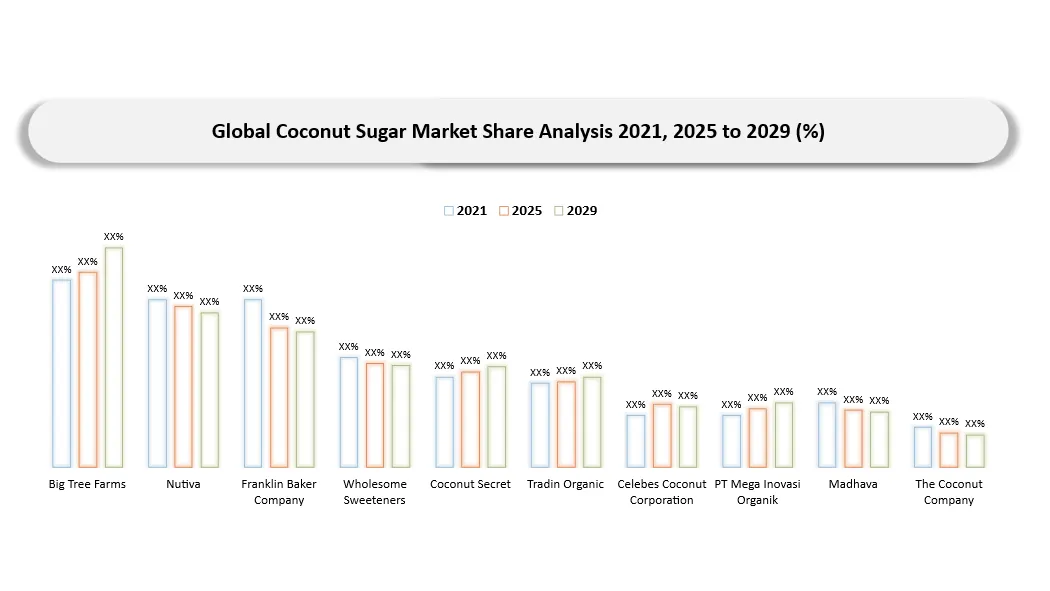
Public Company Q1-Q2 2026 Performance Comparison
| Public Company | Q1-Q2 2026 Performance Signal | Coconut Sugar Exposure | Growth Drivers Relevant to Coconut Sugar | Strategic Interpretation |
| The Vita Coco Company, Inc. | Q2 2026 net sales were US$216 million, up 28%; year-to-date sales were US$396 million, up 32%. Coconut water net sales grew 21% in Q2 and 29% year-to-date. | Indirect through coconut sourcing, consumer education and a global coconut supply chain. | Category penetration, branded demand, private label, pricing and supply-chain execution. | Strong coconut-category momentum can improve farmer networks and sourcing infrastructure, though the company does not report coconut sugar sales. |
| Axelum Resources Corp. | Reported Q1 2026 net income of PHP267 million and filed its quarterly report for the period ended March 31, 2026. | Directly relevant as a listed Philippine coconut processor with broad coconut ingredient capabilities. | Export demand, product mix, capacity utilization, integrated coconut processing and customer relationships. | One of the most relevant public comparables for industrial coconut ingredients, although coconut sugar is not separately disclosed. |
| Barry Callebaut AG | H1 FY2025/26 sales volume declined 6.9%, with Q2 improving sequentially to a 3.6% decline; AMEA returned to growth. | Indirect through chocolate, confectionery and food-manufacturer demand that can use coconut sugar. | Chocolate-market recovery, customer innovation, premiumization and improved service levels. | A useful demand-side indicator for confectionery applications, but performance reflects cocoa and chocolate economics rather than coconut sugar. |
| Archer-Daniels-Midland Company | Q1 2026 net earnings were US$298 million and adjusted EPS was US$0.71; guidance was raised on improved crushing and ethanol expectations. | Indirect through sweeteners, food ingredients, formulation and global agricultural distribution. | Ingredient innovation, customer reformulation, procurement scale and global distribution. | Provides a benchmark for large-scale ingredient economics and customer access, not direct coconut sugar exposure. |
| Wilmar International Limited | H1 2026 results were not yet publicly available at the report cutoff; the company remains a major Asian agribusiness, sugar and food-ingredient platform. | Indirect through sugar, food ingredients, Asian distribution and agricultural sourcing. | Scale, integrated processing, regional food demand and distribution reach. | Strategically relevant as a natural-sweetener and Asian food-system comparator; coconut sugar revenue is not separately reported. |
Market Ecosystem Table
| Value-Chain Sector | Role | Representative Companies and Organizations |
| Coconut farmers and sap tappers | Palm management, flower tapping and daily sap collection | Smallholder farmers, village producer groups and farmer cooperatives in Indonesia, the Philippines, Thailand and Sri Lanka |
| Farmer aggregation and primary processing | Collection, filtration, initial evaporation, quality control and traceability | Local cooperatives, village processors, Big Tree Farms-linked networks, regional aggregators |
| Integrated coconut processors | Industrial evaporation, crystallization, drying, milling, packing and export | Axelum Resources, Franklin Baker, Celebes Coconut, integrated Indonesian coconut processors |
| Specialist coconut sugar manufacturers | Organic, fair-trade, private-label and application-specific products | Big Tree Farms, Coco Sugar Indonesia, The Coconut Company, Bigtree Organic Farms |
| Natural sweetener and ingredient distributors | Import, warehousing, repacking, technical sales and country-level compliance | Batory Foods, AAK distribution partners, Brenntag, Azelis, Barentz, regional natural-ingredient distributors |
| Food and beverage formulators | Use coconut sugar in bakery, snacks, chocolate, beverages, dairy alternatives and sauces | Natural-food brands, bakery companies, plant-based beverage companies, premium confectionery manufacturers |
| Consumer brands and private label | Retail packs, sachets, syrups and branded finished products | Madhava, Coconut Secret, Nutiva, BetterBody Foods, Wholesome, retailer private labels |
| Retail and e-commerce | Consumer access, merchandising and price discovery | Whole Foods Market, Walmart, Costco, Amazon, iHerb, natural-food stores and specialty grocers |
| Testing, certification and audit | Organic, fair-trade, food-safety, contaminant and authenticity verification | Control Union, Ecocert, USDA-accredited certifiers, Fairtrade organizations, SGS, Intertek, Eurofins |
| Government and trade support | Agricultural extension, export promotion, customs and standards | Philippine Coconut Authority, Indonesian agriculture agencies, FDA, EU authorities and customs agencies |
Key Companies of Coconut Sugar Market
- Big Tree Farms
- Axelum Resources Corp.
- Franklin Baker Company of the Philippines
- Celebes Coconut Corporation
- Coco Sugar Indonesia
- Madhava Ltd.
- Nutiva Inc.
- The Coconut Company
- Coconut Secret
- BetterBody Foods
- Earth Circle Organics
- Navitas Organics
- Wholesome Sweeteners
- Bigtree Organic Farms
- SunOpta Inc.
Company Profiles
Big Tree Farms
Big Tree Farms is a prominent coconut sugar and sustainable food company associated with farmer-linked sourcing in Indonesia. Its differentiation rests on organic products, traceability, social-impact positioning and consumer recognition. Competitive priorities include supply consistency, certification continuity, application expansion and premium brand defense.
Axelum Resources Corp.
Axelum is a publicly listed Philippine coconut processor with an export-oriented portfolio spanning several coconut ingredients. Its relevance to coconut sugar comes from farmer relationships, processing infrastructure, quality systems and customer access. The company can leverage integrated sourcing and cross-product economics, although coconut sugar is not separately disclosed.
Franklin Baker Company of the Philippines
Franklin Baker is an established Philippine coconut ingredient supplier with global food-manufacturer relationships. Its strengths include industrial quality systems, export capability and broad coconut-processing knowledge. Participation in coconut sugar would benefit from shared procurement, laboratories and customer channels.
Celebes Coconut Corporation
Celebes Coconut is a Philippine processor supplying multiple coconut ingredients to international markets. It is positioned to serve industrial and private-label customers through integrated processing, export experience and product diversification.
Coco Sugar Indonesia
Coco Sugar Indonesia represents the specialist Indonesian manufacturing model focused on coconut sugar, nectar and private-label supply. Competitive advantage depends on farmer aggregation, organic certification, consistent color and moisture, and flexible packaging.
Madhava Ltd.
Madhava is a natural sweetener brand with consumer reach across coconut sugar and other alternative sweeteners. Its strengths include merchandising, brand recognition, retailer relationships and a diversified sweetener portfolio.
Nutiva Inc.
Nutiva is a natural and organic food brand known for coconut and wellness products. Its relevance lies in consumer education, natural-channel distribution and brand trust. Competitive performance depends on pricing, product assortment and e-commerce execution.
The Coconut Company
The Coconut Company focuses on coconut-based foods and ingredients for retail and foodservice. Its opportunity in coconut sugar is supported by category specialization, product bundling and direct consumer engagement.
Coconut Secret
Coconut Secret is a branded natural-food company associated with coconut-derived sweeteners and condiments. It competes through clean-label positioning, product innovation and natural retail distribution.
BetterBody Foods
BetterBody Foods participates in natural sweeteners and pantry staples through mainstream and online retail channels. Its advantage is broad distribution and value-oriented natural positioning.
Earth Circle Organics
Earth Circle Organics supplies organic superfoods and ingredients, including coconut-related products. It competes on certification, online availability and natural-product assortment.
Navitas Organics
Navitas Organics is a premium organic food brand with strong natural-channel visibility. Coconut sugar fits its broader consumer proposition around organic, plant-based pantry ingredients.
Wholesome Sweeteners
Wholesome is a major branded natural and organic sweetener platform. It is strategically relevant through retailer relationships, sweetener category management, organic expertise and consumer trust.
Bigtree Organic Farms
Bigtree Organic Farms represents the producer-exporter model centered on certified coconut sugar and farmer sourcing. Success depends on certification integrity, quality standardization and reliable export execution.
SunOpta Inc.
SunOpta is a public company in plant-based and private-label food manufacturing. Its relevance is primarily downstream, through formulation, customer relationships and demand for natural ingredients rather than direct coconut sugar production.
Coconut Sugar Market Major Pain Points
- High price relative to refined cane sugar and many alternative sweeteners.
- Fragmented smallholder supply and labor-intensive sap collection.
- Quality variation in color, moisture, flavor, particle size and microbiological performance.
- Limited ability to make strong health claims without regulatory and scientific risk.
- Dependence on organic certification and audit continuity for premium markets.
- Weather, logistics and farmer participation risks in concentrated sourcing regions.
- Competition from allulose, monk fruit, stevia blends, maple sugar, date sugar and honey.
- Need for application-specific grades and stronger technical support for industrial customers.
Coconut Sugar Market Recent Developments
- July 2026: The Vita Coco Company reported Q2 net sales of US$216 million, up 28%, and raised full-year guidance, demonstrating strong momentum across the broader coconut consumer category.
- May 2026: Axelum Resources reported Q1 2026 net income of PHP267 million, highlighting improved performance at a major listed Philippine coconut processor.
- April 2026: Barry Callebaut reported sequential volume improvement in its second fiscal quarter, with AMEA returning to growth, a relevant demand signal for premium confectionery ingredients.
- May 2026: ADM reported Q1 adjusted EPS of US$0.71 and raised full-year guidance, supporting investment capacity across food ingredients and formulation services.
- 2025-2026: Natural sweetener brands continued expanding organic, private-label and online assortments, while buyers increased scrutiny of traceability and claims compliance.
Analyst View / Opinion on Coconut Sugar Market
- The market will grow steadily rather than explosively because strong consumer appeal is balanced by high price and limited agricultural scale.
- Asia-Pacific will remain the production center, while North America and Europe will capture a disproportionate share of premium value.
- Organic certification, traceability and consistent sensory performance are more durable differentiators than generalized health claims.
- Integrated coconut processors have the strongest long-term economics because they can share farmer networks, laboratories, logistics and customer channels across several products.
- Specialist brands can outperform through storytelling, private label and e-commerce, but they must secure dependable multi-year supply.
- The most attractive growth spaces are industrial bakery, premium beverages, reduced-sugar blends and application-specific ingredients.
Coconut Sugar Market Target Audience
| Industry | Who Should Buy This Report? | Reason to Buy This Report |
| Coconut Processing | Processors, farmer cooperatives and exporters | Assess capacity, farmer economics, quality requirements and export opportunities. |
| Food and Beverage | Bakery, snack, beverage, dairy-alternative and confectionery companies | Evaluate formulation potential, pricing and supplier qualification. |
| Natural Sweeteners | Sweetener brands, distributors and private-label suppliers | Compare product positioning, channels and competitive differentiation. |
| Retail and E-commerce | Category managers, natural retailers and marketplaces | Understand consumer demand, price architecture and assortment strategy. |
| Agriculture and Sustainability | Development agencies, certifiers and ESG teams | Evaluate farmer livelihood, traceability and sustainability programs. |
| Investment and Consulting | Investors, private equity, banks and consultants | Assess market size, company positioning, risk and acquisition opportunities. |
| Foodservice | Hotels, cafés, bakeries and restaurant groups | Identify premium menu applications and sourcing considerations. |
| Testing and Certification | Laboratories, auditors and certification bodies | Understand demand for organic, fair-trade, food-safety and authenticity services. |
Why Choose DATAM?
- Data-driven insights combining market sizing, trade, pricing, farmer economics, applications and company benchmarking.
- Post-purchase analyst consultations for sourcing strategy, market entry, private label and partnership evaluation.
- Annual report updates covering company performance, regulation, certification, pricing and competitive developments.
- Specialized focus on emerging production markets and smallholder-linked supply chains.
- Actionable analysis connecting agricultural realities with customer requirements and consumer demand.
What DATAM Uniquely Provides
- Ten-year forecasts across product type, nature, form, source, application, end use, distribution channel and region.
- A market ecosystem map spanning farmers, processors, distributors, brands, retailers, laboratories and regulators.
- Public-company Q1-Q2 2026 comparison using verified disclosed performance signals.
- Buyer-focused analysis of color, flavor, moisture, certification, traceability and supply reliability.
- Country-level analysis linking production capability, consumer demand, imports and premium retail.



























































