


Cell and Gene Therapy Manufacturing Services Market Size
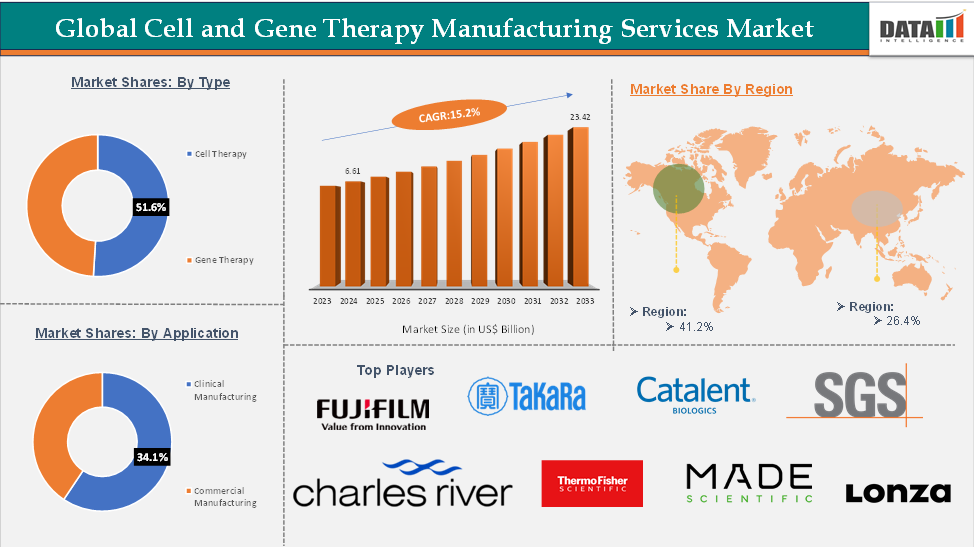
The Cell and Gene Therapy Manufacturing Services Market will reach US$ 8.77 billion in 2026, up from US$ 7.61 billion in 2025, and is projected to reach US$ 31.30 billion by 2035, registering robust growth at a CAGR of 15.2% during the forecast period from 2026 to 2035.
The cell and gene therapy manufacturing services market is experiencing robust growth, driven by the rising prevalence of cancer and other chronic diseases that demand advanced, personalized treatment options. A significant surge in pharmaceutical R&D spending, aimed at developing innovative therapies, is further propelling demand for specialized manufacturing capabilities.
Additionally, strategic partnerships and agreements between pharmaceutical companies and contract development and manufacturing organizations (CDMOs) are accelerating the development and commercialization of complex therapies. As the pipeline for cell and gene therapies expands globally, the need for scalable, compliant, and efficient manufacturing solutions is creating substantial opportunities for service providers in this space.
Cell and Gene Therapy Manufacturing Services Market Executive Summary
For more details on this report - Request for Sample
Key Takeaways
- North America accounted for approximately 41-45% of the global Cell and Gene Therapy Manufacturing Services Market share in 2025, driven by robust biopharmaceutical research activities, expanding commercialization of advanced therapeutics, and increasing investments supporting manufacturing infrastructure development.
- Cell therapy manufacturing services represented nearly 50-55% of total market revenue in 2025 owing to the growing adoption of CAR-T cell therapies, stem cell-based therapeutics, and personalized medicine applications across oncology and rare disease indications.
- Clinical manufacturing applications contributed approximately 55-60% of overall market demand in 2025, supported by increasing numbers of cell and gene therapy clinical trials progressing across global regulatory pathways.
- More than 70% of newly announced manufacturing investments globally are focused on automation technologies, viral vector production capabilities, and commercial-scale manufacturing facilities designed to improve scalability and production efficiencies.
- Pharmaceutical and biotechnology companies accounted for nearly 65-70% of total outsourcing demand in 2025, reflecting increasing strategic collaborations with specialized manufacturing service providers supporting advanced therapeutic commercialization initiatives.
- Viral vector manufacturing services are anticipated to contribute approximately 35-40% of future market opportunities through 2033 owing to increasing adoption across gene therapy programs and expanding commercial manufacturing requirements.
- Asia-Pacific is projected to register the fastest regional growth during the forecast period owing to expanding biotechnology infrastructure, increasing investments supporting advanced therapeutics manufacturing capabilities, and favorable government initiatives encouraging biopharmaceutical innovation.
- Automated and closed-system manufacturing technologies are expected to account for approximately 30-35% of future manufacturing capacity expansions globally, significantly improving product consistency and operational efficiencies across commercial production environments.
- More than 60% of strategic partnerships announced across the market involve manufacturing capacity expansion initiatives, technology transfer agreements, and commercial-scale production collaborations highlighting the increasing importance of specialized manufacturing capabilities worldwide.
Cell and Gene Therapy Manufacturing Services Market Scope
| Metrics | Details | |
| CAGR | 15.2% | |
| Market Size Available for Years | 2023-2035 | |
| Estimation Forecast Period | 2026-2035 | |
| Revenue Units | Value (US$ Bn) | |
| Segments Covered | Type | Cell Therapy, Gene Therapy |
| Indication | Oncology Diseases, Cardiovascular Diseases, Orthopedic Diseases, Ophthalmology Diseases, Central Nervous System Disorders, Infectious Diseases, Others | |
| Application | Clinical Manufacturing, Commercial Manufacturing | |
| End User | Pharmaceutical and Biotechnology Companies, Academic and Research Institutes, Others | |
| Regions Covered | North America, Europe, Asia-Pacific, South America, and the Middle East & Africa | |
Cell and Gene Therapy Manufacturing Services Market Dynamics: Drivers & Restraints
Surge in biopharmaceutical R&D investment is expected to drive the cell and gene therapy manufacturing services market
The surge in biopharmaceutical R&D investment is playing a pivotal role in accelerating the growth of the cell and gene therapy manufacturing services market, driven by the urgent need for scalable, innovative treatments and rapid advancements in gene editing technologies.
Moreover, strategic acquisitions, such as AstraZeneca’s $1 billion deal to acquire EsoBiotec in March 2025. These investments are directly boosting the need for specialized manufacturing services, as biotech and pharma companies increasingly rely on CDMOs to support the complex production and commercialization of next-generation therapies.
High costs of specialized services
The high costs of specialized services are significantly hindering the growth of the cell and gene therapy manufacturing services market, as the production of these therapies requires cutting-edge technology, highly skilled labor, and compliance with stringent regulatory standards. The complex and custom nature of cell and gene therapies, including processes like gene editing, viral vector production, and cell harvesting, leads to high operational expenses for contract development and manufacturing organizations (CDMOs).
For instance, manufacturing autologous cell therapies, which involve using a patient’s cells, requires personalized production facilities and longer timelines, raising costs further. These elevated costs can limit access to cell and gene therapies, especially for smaller biotech firms with limited funding, and can also lead to higher prices for end-users, restricting the broader adoption of these therapies in the healthcare market.
Regulatory and GMP Compliance Analysis
The Cell and Gene Therapy Manufacturing Services Market operates within a highly regulated environment characterized by stringent Good Manufacturing Practice requirements governing advanced therapeutic products. Regulatory authorities worldwide continue emphasizing manufacturing consistency, product safety, and comprehensive quality management systems supporting commercialization activities. Increasing regulatory focus surrounding process validation, sterility assurance programs, and product traceability initiatives is substantially influencing manufacturing practices globally. Furthermore, evolving regulatory frameworks supporting advanced therapeutic technologies are anticipated to accelerate innovation activities throughout the forecast period.
Manufacturing Capacity Expansion Analysis
Manufacturing capacity expansion initiatives remain among the most significant strategic priorities influencing the global market. Service providers are increasingly investing in commercial-scale manufacturing facilities supporting cell processing technologies, viral vector production capabilities, and advanced bioprocessing platforms. Capacity expansion activities are being accelerated by growing demand for commercial manufacturing services supporting approved therapies and late-stage clinical programs. Strategic investments supporting geographically diversified production capabilities are expected to strengthen future supply chain resilience while simultaneously improving global market accessibility.
Supply Chain and Cold Chain Logistics Analysis
Supply chain management remains a critical determinant influencing successful commercialization across cell and gene therapies worldwide. Advanced therapeutic products frequently require highly specialized cold chain logistics capabilities supporting product transportation, storage, and real-time monitoring functions. Manufacturers are increasingly investing in supply chain optimization technologies designed to minimize operational risks associated with temperature-sensitive products. Strategic collaborations involving logistics providers, manufacturing organizations, and healthcare institutions are anticipated to substantially strengthen global supply chain efficiencies throughout the forecast period.
Process Development and Technology Transfer Analysis
Process development activities play essential roles in ensuring manufacturing consistency and successful commercialization outcomes across advanced therapeutics. Technology transfer capabilities supporting seamless transitions between clinical and commercial manufacturing operations are increasingly becoming strategic priorities among service providers. Investments supporting analytical development technologies, process optimization initiatives, and scalable manufacturing platforms are anticipated to significantly improve operational efficiencies across the market. Furthermore, continuous improvements in technology transfer methodologies are expected to accelerate product commercialization timelines globally.
Investment and Funding Landscape Analysis
Public and private sector investments supporting advanced therapeutics manufacturing capabilities continue creating substantial commercialization opportunities worldwide. Pharmaceutical organizations, institutional investors, and biotechnology companies are increasingly allocating resources toward manufacturing infrastructure expansions, automation technologies, and viral vector production capabilities. Strategic investments supporting manufacturing innovations and commercialization initiatives are anticipated to remain among the most significant contributors influencing future market expansion across major pharmaceutical markets.
Cell and Gene Therapy Manufacturing Services Market Trends & Insights
Shift Toward Outsourced Manufacturing
Pharmaceutical and biotechnology companies are increasingly outsourcing cell and gene therapy manufacturing to specialized CDMOs to access GMP infrastructure, technical expertise and flexible production capacity without making large upfront investments in manufacturing facilities. Outsourcing is particularly attractive for emerging biotechnology companies with limited internal manufacturing capabilities.
Commercial-Scale Manufacturing Is Becoming Critical
The industry is transitioning from primarily clinical-stage production toward commercial manufacturing as more cell and gene therapies receive regulatory approvals. CDMOs are increasingly developing flexible facilities that can support programs from early clinical development through commercial production, reducing the need for technology transfers and manufacturing changes during late-stage development.
Viral Vector Capacity Remains a Key Bottleneck
AAV and lentiviral vector manufacturing remains one of the most important capacity constraints in gene therapy production. Limited specialized manufacturing capacity, complex upstream and downstream processes, high-quality requirements and lengthy technology-transfer timelines are encouraging pharmaceutical companies to secure manufacturing slots earlier in the development cycle.
Automation and Closed-System Manufacturing
Automation and closed manufacturing systems are gaining importance because they can reduce manual intervention, contamination risks, operator variability and manufacturing time. These technologies are particularly valuable for autologous therapies where individual patient batches must be produced under tightly controlled conditions.
Expansion of Allogeneic Cell Therapies
Allogeneic cell therapies are attracting increasing attention because they have the potential to support more standardized and scalable manufacturing compared with patient-specific autologous approaches. Development of off-the-shelf products could reduce production timelines and improve manufacturing utilization.
Advanced Analytical and Potency Testing
As regulatory expectations increase, analytical characterization and potency testing are becoming increasingly important components of outsourced manufacturing. CDMOs are investing in advanced analytical platforms to demonstrate identity, purity, potency, safety, genetic stability and product consistency.
Digital Manufacturing and Data Integration
Digital batch records, manufacturing execution systems, electronic quality-management systems and real-time process monitoring are becoming important differentiators for advanced therapy manufacturers. Greater digital integration can improve traceability, reduce documentation errors and support regulatory compliance.
Cold-Chain and Chain-of-Identity Management
Cell and gene therapies require highly controlled logistics because many products are temperature-sensitive and patient-specific. Chain-of-identity, chain-of-custody, cryopreservation and real-time shipment monitoring are therefore becoming increasingly important components of manufacturing-service offerings.
Cell and Gene Therapy Manufacturing Services Market Viral Vector Manufacturing Opportunity
Viral vector manufacturing is becoming one of the most strategically important segments of the cell and gene therapy manufacturing ecosystem. AAV and lentiviral platforms require specialized production infrastructure, high-quality raw materials, advanced purification capabilities and extensive analytical characterization.
The increasing number of gene therapy candidates entering clinical and commercial stages is creating demand for additional vector capacity. CDMOs with integrated plasmid DNA, vector production, purification, analytical testing and fill-finish capabilities can potentially reduce technology-transfer complexity and shorten manufacturing timelines.
Key Opportunity Areas
- AAV manufacturing
- Lentiviral vector manufacturing
- Plasmid DNA production
- Vector purification
- Vector analytics
- Process development
- GMP scale-up
- Fill-finish
- Cryopreservation
- Quality testing
Cell and Gene Therapy Manufacturing Services Market Segment Analysis
The global cell and gene therapy manufacturing services market is segmented based on type, indication, application, end user, and region.
Type:
The cell therapy segment is expected to hold 51.6% of the global cell and gene therapy manufacturing services market
The cell therapy segment is poised to dominate the cell and gene therapy manufacturing services market, driven by significant advancements and investments. Major pharmaceutical companies such as Gilead Sciences, Novartis, Johnson & Johnson, and Bristol Myers Squibb are working to reduce the manufacturing turnaround time for CAR-T therapies, personalized treatments for blood cancer, by up to half to deliver them more rapidly in a patient's disease course.
Additionally, AstraZeneca announced an investment of USD 300 million in the Roseville cell therapy manufacturing facility to focus on producing and launching T-cell therapies for oncology indications. These developments underscore the growing demand for specialized manufacturing services to support the production of both autologous and allogeneic cell therapies. The increasing number of clinical trials and regulatory approvals further contributes to the expansion of the cell therapy manufacturing services market.
Key Developments in Cell and Gene Therapy Manufacturing Services Market
- June 2026: Charles River Laboratories International, Inc. expanded its cell and gene therapy capabilities by strengthening its integrated CDMO services for viral vector development, analytical testing, and GMP manufacturing to support advanced therapy programs.
- June 2026: Thermo Fisher Scientific Inc. enhanced its end-to-end cell and gene therapy manufacturing services by expanding customized solutions for cell culture media, gene editing, and commercial-scale manufacturing support.
- May 2026: Lonza Group AG continued advancing its global cell and gene therapy manufacturing platform through investments in cGMP manufacturing technologies supporting autologous and allogeneic cell therapies and viral vector production.
- May 2026: Merck KGaA strengthened its life sciences portfolio by expanding technologies and manufacturing solutions that support cell and gene therapy development, process optimization, and quality control applications.
- April 2026: Catalent, Inc. expanded its commercial licensing agreement with Cartherics to support the manufacturing and commercialization of iPSC-derived CAR-NK cell therapies for cancer treatment, reinforcing its position in advanced cell therapy manufacturing services.
- April 2026: Takara Bio Inc. continued advancing its cell processing technologies and GMP-compliant manufacturing capabilities to support regenerative medicine and gene-modified cell therapy development programs.
- March 2026: FUJIFILM Irvine Scientific strengthened its cell culture media and bioprocessing solutions portfolio for cell and gene therapies, supporting scalable manufacturing across clinical and commercial applications.
- March 2026: Oxford Biomedica plc entered a new multi-year commercial supply agreement with Bristol Myers Squibb for the manufacture of lentiviral vectors used in CAR-T therapy programs, expanding its commercial gene therapy manufacturing capabilities.
- February 2026: SGS SA expanded its analytical testing services for cell and gene therapies by enhancing solutions for product characterization, potency testing, and regulatory compliance across all stages of development.
Cell and Gene Therapy Manufacturing Services Market Geographical Analysis
North America is expected to hold 41.2% of the global cell and gene therapy manufacturing services market
North America is expected to hold a large share in the global cell and gene therapy manufacturing services market due to a combination of a robust biopharmaceutical ecosystem, significant R&D investments, and a favorable regulatory environment. The U.S. has become a global hub for biotechnology, with leading companies like Gilead Sciences, Novartis, and Amgen driving innovation in cell and gene therapies.
Furthermore, the U.S. Food and Drug Administration (FDA) has approved several cell and gene therapies, including CAR-T cell therapies, which are boosting demand for manufacturing services.
The facility will support late-stage clinical trials and potential commercialization of BlueRock Therapeutics’ investigational cell therapy, bemdaneprocel (BRT-DA01), for Parkinson’s disease. Additionally, the facility includes space for expanding production to support other cell therapies in Bayer's growing portfolio. The region’s established infrastructure, combined with a highly skilled workforce and a favorable regulatory framework, positions North America to dominate the market in the forecast period.
Cell and Gene Therapy Manufacturing Services Market Top Companies
The top companies in the cell and gene therapy manufacturing services market include Charles River Laboratories, Thermo Fisher Scientific Inc., Lonza, Merck KGaA, Catalent, Inc, Takara Bio Inc., FUJIFILM Irvine Scientific, Oxford Biomedica plc, SGS SA, and Made Scientific, among others.
Who Should Buy This Report?
This report is designed for pharmaceutical and biotechnology companies, Contract Development and Manufacturing Organizations (CDMOs), Contract Research Organizations (CROs), healthcare technology providers, and academic research institutions seeking actionable insights into emerging cell and gene therapy manufacturing trends and commercialization opportunities. Institutional investors, venture capital organizations, strategic consulting firms, and regulatory stakeholders can leverage the report to evaluate investment opportunities, manufacturing innovations, and competitive developments shaping the global market. Manufacturing leaders, business development teams, and strategic planning professionals can additionally utilize the report to support partnership decisions, capacity expansion strategies, and long-term commercialization initiatives across advanced therapeutic manufacturing ecosystems.
Why Should You Buy This Report?
This report provides comprehensive market intelligence on the Cell and Gene Therapy Manufacturing Services Market by delivering valuable insights into technological advancements, manufacturing innovations, outsourcing trends, and investment opportunities across major global markets. It enables stakeholders to identify high-growth opportunities across viral vector manufacturing, manufacturing automation technologies, and commercial production capabilities while evaluating evolving market adoption patterns worldwide. Furthermore, the report supports strategic decision-making related to manufacturing capacity expansion, strategic partnerships, investment initiatives, and market entry strategies by providing in-depth analyses of competitive dynamics, regional growth opportunities, and future technological developments expected to shape the industry through 2033.
The global cell and gene therapy manufacturing services market report delivers a detailed analysis with 57 key tables, more than 46 visually impactful figures, and 168 pages of expert insights, providing a complete view of the market landscape.



























































