


Buy Now Pay Later Market Overview
The global buy now pay later market is witnessing robust growth, driven by rising consumer demand for flexible payment options, rapid digitalization of commerce, and increasing adoption among younger demographics. The shift toward e-commerce, coupled with growing smartphone penetration and strong fintech innovation, is fueling the widespread use of BNPL solutions across retail, travel, healthcare, and other sectors.
Additionally, merchants are embracing BNPL to boost conversion rates and average order values, further accelerating adoption. Expanding financial inclusion, particularly in emerging economies, along with continuous partnerships between retailers and fintech providers, is creating significant opportunities. Technological advancements in payment security and AI-driven credit assessment are also enhancing trust, customer experience, and regulatory compliance, supporting the market’s long-term growth trajectory.
Buy Now Pay Later Market Size & Forecast
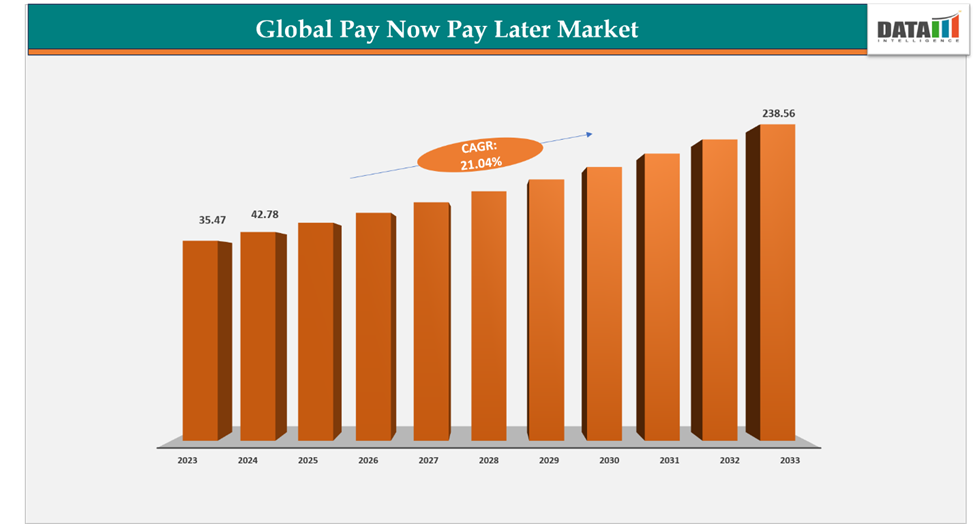
2024 Market Size: US$ 51.6 Billion
2033 Projected Market Size: US$ 238.56 Billion
CAGR (2026–2033): 21.04%
North America: Largest market in 2026
Asia Pacific: Fastest-growing market
Buy Now Pay Later Market Key Takeaways
- North America accounted for the largest share of the Buy Now Pay Later market in 2025, supported by high digital payment adoption, strong e-commerce penetration, and growing partnerships between BNPL providers and major retailers. Regulatory agencies are also increasing oversight to improve transparency, consumer protection, and responsible lending practices.
- Asia-Pacific is projected to be the fastest-growing region during the forecast period, driven by rapid expansion of digital commerce, increasing smartphone penetration, and rising demand for flexible payment solutions across emerging economies such as China, India, Indonesia, and Southeast Asian markets.
- Regulatory frameworks are becoming a defining factor for market growth. Authorities in the United States, United Kingdom, Australia, and the European Union are introducing stricter disclosure requirements, affordability assessments, and consumer-credit regulations, encouraging a more sustainable BNPL ecosystem.
- The competitive landscape is shifting from standalone BNPL providers toward integrated financial ecosystems. Leading payment companies, banks, and fintech firms are embedding installment-payment capabilities directly into digital wallets, checkout platforms, and mobile banking applications.
- E-commerce remains the largest application segment, but BNPL adoption is expanding rapidly across healthcare, travel, education, home improvement, and automotive services as consumers seek greater payment flexibility for higher-value purchases.
- Artificial intelligence and advanced analytics are transforming credit assessment models. Providers are increasingly leveraging real-time transaction data, behavioral analytics, and machine learning algorithms to improve risk management, reduce fraud, and enhance customer approval rates.
- Strategic partnerships between merchants, fintech companies, and payment networks are accelerating market expansion. Embedded finance solutions and omnichannel payment experiences are enabling BNPL services to reach broader consumer segments across both online and physical retail environments.
Buy Now Pay Later Market Dynamics & Trends
Driver: Strategic Partnerships Accelerating Buy Now Pay Later Market Expansion
The global buy now pay later market is witnessing robust growth, fueled by the increasing demand for flexible payment solutions across e-commerce, retail, and financial services. By allowing consumers to purchase products and services instantly while spreading payments into smaller, affordable installments, BNPL has become an attractive option in today’s cost-conscious environment.
A major factor driving this momentum is the rise in strategic partnerships between buy now pay later providers, fintech players, and established financial institutions. For instance, PAYONE partnered with PayPal and Volksbanken Raiffeisenbanken (VVRB) to enhance buy now pay later accessibility for both merchants and customers in Germany. These collaborations integrate buy now pay later solutions offerings directly into existing payment ecosystems, enabling seamless checkout experiences without disrupting retailers’ operations.
Beyond convenience, such alliances expand market reach, enhance consumer trust through association with regulated banks, and deliver clear benefits like improved affordability, higher merchant sales, and greater customer retention. As global e-commerce and digital transactions accelerate, strategic partnerships are expected to be a cornerstone in scaling BNPL adoption and solidifying its position as a mainstream payment solution.
Restraint: Rising Consumer Debt & Default Risk
The rising consumer debt and default risk is expected to act as a significant restraint on the growth of the global buy now pay later market. Although buy now pay later solutions provide convenient and flexible payment options, their increasing adoption is also linked to unsustainable spending behaviors. Consumers may accumulate multiple buy now pay later obligations across platforms, often without a clear understanding of repayment timelines, which increases the chances of defaults.
High default rates not only strain buy now pay later providers but also impact their partnerships with merchants and financial institutions. This risk is further magnified in regions where credit assessment mechanisms are weak, making it difficult to evaluate consumer repayment capacity. Additionally, regulators are raising concerns about the financial vulnerability created by buy now pay later, which may result in tighter compliance requirements for providers. As consumer awareness of debt traps grows and stricter regulations emerge, the BNPL market could face slower adoption, particularly among risk-averse users and merchants who prioritize financial stability.
Get a closer look at the Buy Now Pay Later Market with a sample report covering market size, growth drivers, key trends, competitive landscape, regional insights, segmentation, and emerging opportunities Request a Free Sample Report
Why does this report matter in 2026?
In 2026, the Buy Now Pay Later Market is being shaped by changing consumer payment behavior, digital commerce expansion, regulatory developments and increasing demand for flexible payment options. Merchants and financial service providers are strengthening BNPL offerings to improve checkout conversion, customer engagement and payment flexibility across online and offline channels.
The report helps payment providers, fintech companies, merchants and technology platforms identify attractive customer segments, merchant categories and regional demand centers. It also examines how e-commerce growth, mobile payments, digital wallets, embedded finance and evolving credit models are influencing BNPL adoption and business models.
Competitive advantage increasingly depends on merchant network scale, customer acquisition efficiency, responsible underwriting, fraud management, seamless digital integration and regulatory readiness. The report therefore evaluates transaction growth alongside provider strategies, product innovation, partnerships and opportunities across consumer and merchant ecosystems.
Buy Now Pay Later Market White Space & Investment Opportunities
- Expand BNPL solutions across high-frequency retail categories where flexible payment options can improve purchase conversion and customer retention.
- Develop embedded BNPL capabilities for e-commerce platforms, marketplaces and digital checkout providers seeking integrated payment experiences.
- Build AI-driven credit assessment and fraud-monitoring systems to improve risk management while supporting faster customer approvals.
- Target underpenetrated markets with mobile-first BNPL products supported by local merchant partnerships and digital payment infrastructure.
- Develop flexible repayment products tailored to different purchase values, customer profiles and merchant categories.
- Strengthen merchant acquisition through API-based integrations, white-label solutions and embedded payment partnerships.
Buy Now Pay Later Future Market Transformation
The market is expected to move beyond basic installment payments toward broader embedded financial experiences. BNPL providers will increasingly integrate payment flexibility directly into e-commerce platforms, mobile applications, digital wallets and merchant ecosystems, making installment options a seamless part of the customer journey.
Technology will play a greater role in underwriting, fraud prevention and customer personalization. Advanced analytics and AI-enabled risk models can help providers evaluate transaction behavior, identify potential fraud and optimize credit decisions while maintaining responsible lending practices.
The competitive landscape will increasingly favor providers that combine strong merchant networks with efficient technology infrastructure and effective risk management. Partnerships between fintech companies, banks, retailers, payment processors and digital platforms are expected to remain important for expanding distribution and reaching new customer segments.
Buy Now Pay Later Market Buyer Decision-Making Criteria
Merchants evaluate BNPL providers based on checkout integration, approval rates, transaction conversion, customer experience, merchant fees, settlement speed and geographic coverage. The ability to integrate smoothly with existing payment systems is particularly important for retailers seeking to introduce installment payments without adding checkout complexity.
Consumers typically assess BNPL services based on repayment flexibility, transparency of fees and terms, ease of approval, payment scheduling and overall digital experience. Providers that communicate repayment obligations clearly and offer intuitive account management can strengthen customer trust and engagement.
Financial institutions and platform partners increasingly assess providers on underwriting capabilities, fraud controls, regulatory compliance, data security and portfolio performance. Scalable technology and responsible credit practices are becoming important differentiators as the market matures.
Buy Now Pay Later Market Economic & Investment Analysis
The Buy Now Pay Later Market benefits from the continued expansion of digital commerce and consumer preference for flexible payment methods. Revenue opportunities extend across transaction fees, merchant partnerships, technology services and embedded financial products, while provider economics remain closely linked to customer acquisition, transaction volumes, credit performance and operating efficiency.
Investment is increasingly directed toward payment infrastructure, risk-management technology, merchant acquisition platforms and embedded-finance capabilities. Providers with scalable technology and diversified merchant networks can improve transaction volumes while reducing dependence on individual retail categories or distribution channels.
Regulatory developments create both challenges and opportunities. Stronger consumer-protection and responsible-lending requirements may increase compliance costs, but they can also favor established providers with robust underwriting, transparency and governance systems. Investors should therefore assess transaction growth alongside credit quality, regulatory exposure and sustainable unit economics.
Buy Now Pay Later Investment Trends in the Market
- Expansion of merchant networks across e-commerce, retail, travel, healthcare and other high-frequency payment categories.
- Investment in AI-powered underwriting, fraud detection and real-time transaction risk monitoring.
- Growth of embedded BNPL capabilities integrated into digital wallets, marketplaces and merchant checkout platforms.
- Strategic partnerships between fintech providers, banks, payment processors and major retailers to expand BNPL distribution.
- Greater investment in regulatory technology, consumer protection, data security and responsible credit-management infrastructure.
Strategic Indicators For Buy Now Pay Later Market
High Regulation Impact
The Buy Now Pay Later (BNPL) Market is increasingly influenced by consumer-credit regulations, disclosure requirements, affordability assessments, data privacy rules and responsible lending standards. Regulatory scrutiny is encouraging providers to strengthen transparency around fees, repayment terms, credit reporting and consumer protection while creating greater demand for compliant lending and risk-management systems.
High Investment Activity
Investment activity across the BNPL ecosystem includes fintech platform expansion, payment partnerships, technology development, strategic acquisitions and geographic market entry. Providers are increasingly investing in underwriting technology, fraud prevention, credit decisioning and merchant integration to strengthen transaction volumes and improve customer retention.
Supply Chain Disruption
The BNPL Market relies on interconnected payment processors, merchants, financial institutions, technology providers, credit-data platforms and digital payment infrastructure. Disruptions across these networks can affect transaction processing and merchant operations. Providers are therefore strengthening platform resilience, technology redundancy, partner diversification and real-time transaction monitoring.
Pricing Volatility
BNPL pricing is influenced by merchant fees, funding costs, customer acquisition expenses, credit losses, transaction volumes and regulatory requirements. Providers must balance competitive merchant pricing with sustainable unit economics while managing repayment risk and operational costs. Changes in interest rates and funding conditions can also affect the economics of installment-based payment models.
Procurement Pressure
Merchants and platforms increasingly evaluate BNPL providers based on transaction conversion, integration capabilities, settlement speed, consumer reach, fraud controls, repayment performance and commercial terms. Providers must demonstrate reliable technology and flexible integration while maintaining transparent customer experiences and competitive merchant economics.
New Technology Adoption
AI-driven credit assessment, real-time risk scoring, fraud detection, behavioral analytics, automated collections and API-based payment infrastructure are transforming BNPL operations. Advanced technologies enable providers to evaluate transaction and customer signals more efficiently while improving fraud prevention, personalization and repayment management.
Regional Expansion Opportunity
Asia-Pacific offers significant growth potential as digital payments, e-commerce and smartphone adoption continue to expand. North America remains an important BNPL market supported by established fintech infrastructure and strong online retail activity, while Europe presents opportunities shaped by digital commerce growth and evolving consumer-credit regulations. Emerging markets offer additional potential as alternative digital payment adoption increases.
Government Policy Support
Government initiatives supporting digital payments, financial inclusion, fintech innovation and consumer protection can influence BNPL market development. Regulatory frameworks are increasingly focused on responsible lending, transparency and consumer affordability, encouraging providers to develop stronger compliance systems and sustainable credit models.
Pricing Intelligence
BNPL pricing varies according to merchant category, transaction value, repayment duration, customer risk profile, funding structure and provider business model. Merchant-funded models commonly generate revenue through transaction-based merchant fees, while additional revenue streams can include late-payment fees, financing income where permitted, subscriptions and value-added financial services.
Provider economics are increasingly shaped by customer acquisition costs, credit losses, funding expenses and transaction frequency. Merchants evaluate BNPL solutions based on conversion improvement, average order value, customer acquisition and overall payment costs. Providers with strong risk controls, efficient technology infrastructure and diversified revenue streams can achieve greater pricing flexibility and improve long-term unit economics.
Buy Now Pay Later Market Segmentation Growth Analysis
The global buy now pay later market is segmented based on channel, enterprises size, end-user, and region.
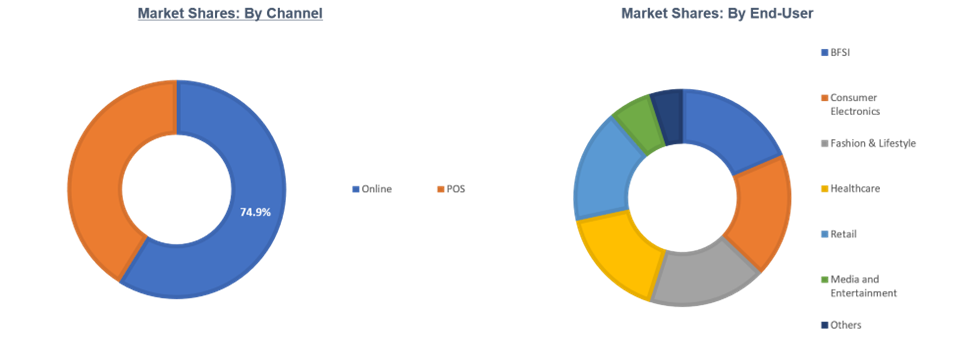
Channel: The Online Segment for buy now pay later market was valued at 40% market share in 2026
The online segment is projected to account for the largest share of the global Buy Now Pay Later market. This dominance is fueled by the rapid growth of e-commerce platforms, rising smartphone penetration, and consumers’ increasing preference for flexible and convenient digital payment options. Online buy now pay later solutions resonate strongly with younger generations, particularly Millennials and Gen Z, who value seamless checkout experiences and short-term, interest-free financing while shopping online.
The popularity of online buy now pay later offerings is further strengthened by their extensive integration with major e-commerce platforms, fashion retailers, and electronics brands. Merchants are increasingly partnering with BNPL providers to enhance customer conversion rates, reduce cart abandonment, and increase average order value. For digital-first consumers, the promise of instant credit approvals without the complications of traditional banking makes buy now pay later a vital enabler of online retail growth.
This segment also benefits from fintech-driven advancements, including AI-powered credit risk assessments, personalized repayment plans, and promotional offers such as zero-interest installments and loyalty rewards, all of which broaden accessibility and consumer adoption.
Buy Now Pay Later Market Geographical Analysis
The North America Buy Now Pay Later market accounted for 38% of the global share in 2026
North America holds a leading position in the buy now pay later market, supported by its advanced digital payment infrastructure, strong e-commerce penetration, and early embrace of fintech-driven solutions. The U.S. has witnessed substantial growth in buy now pay later adoption, with leading retailers and online platforms integrating flexible deferred payment options to cater to rising consumer demand for affordability and convenience. Industry insights highlight a steady increase in buy now pay later usage among U.S. shoppers over the past five years, particularly during peak sales seasons and for higher-value purchases such as fashion, travel, and electronics.
This leadership is further strengthened by the strong presence of established buy now pay later providers, fintech innovators, and financial institutions actively pursuing strategic partnerships to extend market reach. The region also benefits from a digitally savvy population, high credit card penetration, and robust consumer protection frameworks that enhance transparency and trust in buy now pay later services. Businesses across sectors are leveraging buy now pay later to drive higher customer conversion, reduce cart abandonment, and raise average order values. Coupled with ongoing advancements in AI-based credit scoring and loyalty-driven payment offerings, North America is expected to maintain its dominant role in the global buy now pay later landscape over the coming years.
The Asia-Pacific Buy Now Pay Later market captured 22% of the global share in 2026
Asia-Pacific represents the fastest-growing buy now pay later market, fueled by rapid digitalization, widespread smartphone adoption, and surging e-commerce activity across economies such as China, India, Japan, and Southeast Asia. Younger consumers, especially Millennials and Gen Z, are increasingly favoring buy now pay later over traditional credit options due to its frictionless checkout experience and short-term, interest-free installment features. For example, buy now pay later usage in India and Southeast Asia has surged in categories like electronics, fashion, and travel, propelled by the expansion of digital wallets and online marketplaces.
The region’s growth is further supported by robust economic development and a sizable underbanked population, creating strong demand for alternative credit solutions. Fintech firms and global buy now pay later providers are rapidly expanding through collaborations with e-commerce platforms, local retailers, and financial institutions to tap into this vast consumer base. Additionally, government-backed initiatives promoting digital payments and increasing merchant adoption of flexible financing tools are accelerating uptake. With e-commerce volumes continuing to grow and digital payment ecosystems maturing, Asia-Pacific is poised to become the primary engine of global buy now pay later market expansion, establishing itself as the fastest-advancing region during the forecast horizon.
Buy Now Pay Later Market Competitive Landscape
The major players in the buy now pay later include Affirm Inc., Klarna Inc., Splitit USA Inc., Sezzle, Perpay Inc., Zip Co, Ltd, Afterpay, Openpay, PayPal Holdings, Inc., LatitudePay Financial Services.
Affirm, Inc.: Affirm, Inc. is a leading provider in the buy now pay later market, specializing in transparent and flexible consumer financing solutions. The company’s flagship offering allows customers to split purchases into simple, interest-free or low-interest installments, enhancing affordability and convenience across online and offline retail. Affirm partners with major e-commerce platforms, travel providers, and lifestyle brands to deliver seamless checkout experiences while empowering consumers with clear repayment terms and no hidden fees, thereby reducing financial stress and driving higher merchant conversion rates.
Buy Now Pay Later Market Recent Developments
July 2026: Klarna applied for a U.S. banking license through the Utah Department of Financial Institutions and the FDIC, seeking to bring more of its U.S. banking operations in-house and support broader financial-services expansion.
- June 2026: Buyline Holding announced a formal offer to acquire Spanish AI and data company Phonr App, aiming to use AI-driven data and recommendation capabilities to strengthen risk management, profitability, and BNPL solutions for UK SMEs.
- May 2026: Zip partnered with InComm Payments to introduce installment payments for gift cards through the Zip app, expanding BNPL availability across additional consumer spending categories.
- April 2026: TrueLayer expanded its credit capabilities following its acquisition of Dutch BNPL provider In3, enabling consumers to access pay-now or pay-over-time options through the same Pay by Bank checkout experience.
- March 2026: J.D. Power reported a significant increase in U.S. BNPL usage, with 37% of consumers using BNPL in the previous 90 days, highlighting the continued expansion of installment-payment products and competition between fintech and banking providers.
- February 2026: PPRO partnered with Scalapay to expand access to BNPL across France, Belgium, Spain, Portugal, and Italy, enabling merchants and payment service providers to offer installment payments through PPRO’s platform.
- January 2026: Fibe partnered with Flipkart to integrate its BNPL solution directly into Flipkart’s checkout, expanding flexible consumer financing across India’s e-commerce ecosystem.
Buy Now Pay Later Market Scope
Metrics | Details | |
CAGR | 21.04% | |
Market Size Available for Years | 2025-2033 | |
Estimation Forecast Period | 2026-2033 | |
Revenue Units | Value (US$ Bn) | |
Segments Covered | Channel | Online, POS |
Enterprises Size | Large Enterprises, SME’s | |
| End-User | BFSI, Consumer Electronics, Fashion & Lifestyle, Healthcare, Retail, Media and Entertainment, Others |
Regions Covered | North America, Europe, Asia-Pacific, South America, and the Middle East & Africa | |
The Global Buy Now Pay Later market report delivers a detailed analysis with 64 key tables, more than 54 visually impactful figures, and 195 pages of expert insights, providing a complete view of the market landscape.



























































