


Bladder Cancer Vaccines Market Size & Industry Outlook
The global bladder cancer vaccines market reached US$ 201.13 million in 2025, and is projected to reach US$1,365.83 million by 2033, growing at a robust CAGR of 25.99% from 2026 to 2033.
The market’s rapid expansion is primarily driven by the rising global incidence of bladder cancer, particularly among the aging population, which has intensified the need for effective and long-lasting treatment options. In addition, increasing investments in research and development (R&D) focused on cancer immunotherapy and mRNA-based vaccine technologies are fueling innovation and expanding the therapeutic landscape.
The growing adoption of personalized and targeted immunotherapies is also contributing to improved clinical outcomes and reduced recurrence rates, further supporting market growth. Moreover, advancements in biotechnology have facilitated the development of next-generation vaccine platforms with enhanced efficacy and safety profiles. Favourable regulatory frameworks and accelerated approval pathways for oncology vaccines, coupled with rising awareness and screening initiatives aimed at early detection of bladder cancer, are further propelling market expansion.
Key Market Highlights
- Europe dominates the Bladder Cancer Vaccines market with the largest revenue share of 38.32% in 2025.
- North America is the fastest-growing region and is expected to grow at the fastest CAGR of 26.34% over the forecast period.
- Based on the product type, the Bacillus Calmette-Guerin (BCG) segment led the market with the largest revenue share of 67.43% in 2025.
- The major market players in the Bladder Cancer Vaccines market are Merck & Co., Inc., Shionogi & Co., Ltd., ImmunityBio, Inc., Altor BioScience, LLC, Hamlet BioPharma AB, Asieris Pharmaceuticals, Pfizer Inc., Johnson & Johnson, CG Oncology, Inc., Ferring Pharmaceuticals among others.
Market Dynamics
Drivers: The Rising Global Prevalence of Bladder Cancer is significantly driving the Bladder Cancer Vaccines market growth
The growing prevalence of bladder cancer worldwide is a major factor driving the demand for advanced therapeutic options, including vaccines. According to the World Health Organization (WHO), bladder cancer ranks among the top ten most common cancers globally, with an estimated 600,000 new cases and over 200,000 deaths reported in 2024. The incidence is particularly high in developed regions such as North America and Europe, where aging populations and increased exposure to risk factors such as smoking, occupational carcinogens, and chronic urinary tract conditions contribute to disease burden.
For instance, in the United States, the American Cancer Society projected approximately 83,190 new cases of bladder cancer in 2024, marking a steady annual increase. This rising patient pool underscores the urgent need for innovative, targeted, and long-lasting treatment options beyond conventional chemotherapy and immunotherapy. Consequently, the growing global prevalence of bladder cancer continues to stimulate R&D investments and clinical advancements in the bladder cancer vaccines market.
Restraints: High Development Costs and Lengthy Clinical Timelines are hampering the growth of the market
The development of bladder cancer vaccines is a highly complex and capital-intensive process, posing a major restraint on market growth. Vaccine candidates must undergo multiple phases of preclinical and clinical evaluation to demonstrate safety, efficacy, and immune response, which often span 10 to 15 years and cost over USD 1–2 Million from discovery to commercialization. Small and mid-sized biotech firms face additional challenges in securing funding to sustain long-duration trials and meet stringent regulatory requirements. For example, Fujifilm Cellular Dynamics’ bladder cancer vaccine candidate, Vesigenurtacel-L (HS-410), faced clinical delays due to slow patient enrollment and high operational costs during its Phase II and III trials. These extended timelines and escalating expenses not only deter new entrants but also slow the overall pace of innovation in the field. Consequently, the high financial and temporal barriers associated with vaccine development continue to hinder the rapid expansion of the bladder cancer vaccines market.
For more details on this report – Request for Sample
Bladder Cancer Vaccines Market, Segment Analysis
The global Bladder Cancer Vaccines market is segmented based on product type, route of administration, distribution channel, and region.
Product Type: The bacillus calmette-guerin segment is dominating the Bladder Cancer Vaccines market with a 67.43% share in 2024
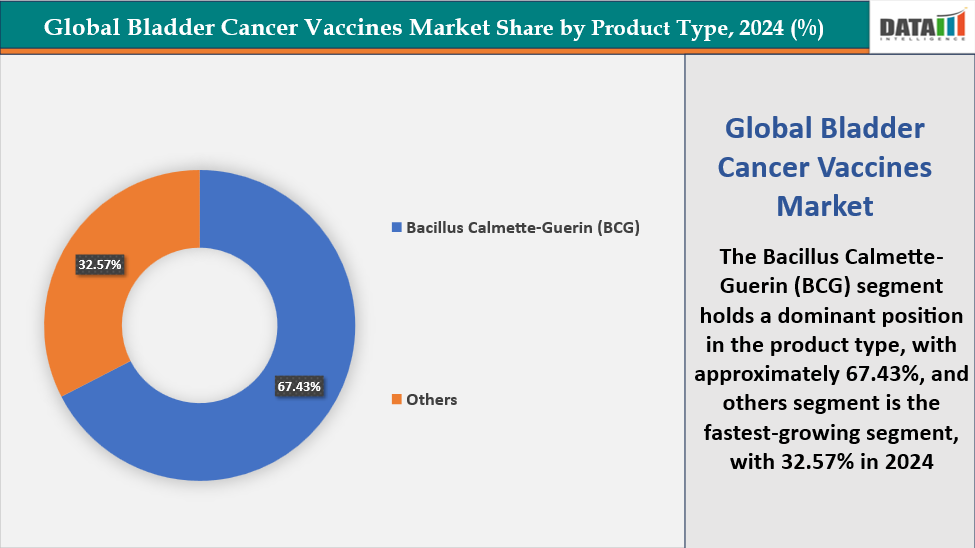
The Bacillus Calmette-Guérin (BCG) vaccine segment is dominating the bladder cancer vaccines market, accounting for a 67.43% share in 2024, due to its established efficacy and widespread adoption in clinical practice. BCG has been the gold standard for non-muscle invasive bladder cancer (NMIBC) for several decades, demonstrating significant reductions in tumor recurrence and progression. For example, a study reported by the American Urological Association (AUA) indicated that intravesical BCG therapy reduces the risk of recurrence by up to 70% in high-risk NMIBC patients. Its long-standing clinical track record, combined with ongoing research to improve formulations and dosing schedules, continues to reinforce its market leadership. As a result, the BCG segment is expected to maintain a dominant position while newer vaccine candidates gradually gain traction in the bladder cancer therapeutics landscape.
Bladder Cancer Vaccines Market, Geographical Analysis
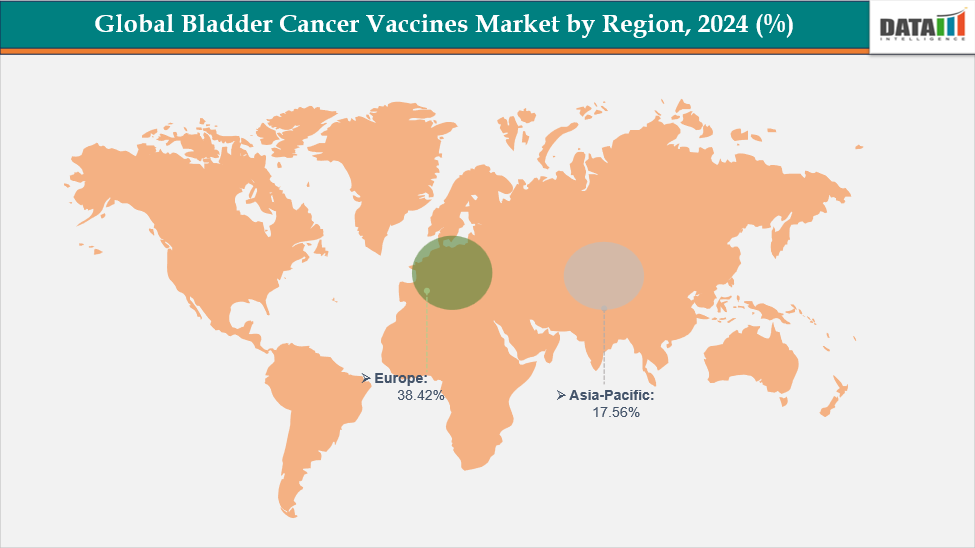
Europe is expected to dominate the global Bladder Cancer Vaccines market with a 38.42% in 2024
Europe is the dominant region in the bladder cancer vaccines market, largely due to the presence of major market players, well-established healthcare infrastructure, and widespread adoption of advanced cancer immunotherapies. Countries such as Germany, France, and the UK have strong research and clinical trial networks, enabling faster development and commercialization of bladder cancer vaccines. For example, Fujifilm Cellular Dynamics and ImmunoGen have ongoing collaborations and clinical programs based in Europe, contributing to the region’s leadership in market share.
A notable example of Europe's leadership in this domain is BioNTech, a German biotech firm renowned for its mRNA technology. In 2025, BioNTech announced plans to invest up to £1 Million ($1.33 Million) in the United Kingdom over the next decade to expand its R&D activities. This investment aims to enroll up to 10,000 patients in clinical trials for personalized cancer therapies by 2030, underscoring Europe's commitment to advancing cancer treatment through innovation and collaboration
In conclusion, Europe's dominance in the bladder cancer vaccines market is attributed to its strong pharmaceutical presence, substantial research and development (R&D) investments, and supportive regulatory policies. These factors collectively foster an environment conducive to the development and adoption of cutting-edge cancer therapies, reinforcing the region's leadership in the global oncology landscape.
The North America region is the fastest-growing region in the global Bladder Cancer Vaccines market, with a CAGR of 26.34% in 2024
The North America region is the fastest-growing market in the Bladder Cancer Vaccines market, driven by strong research and development initiatives, high healthcare expenditure, and increasing adoption of advanced immunotherapies. The region benefits from a well-established biotechnology and pharmaceutical ecosystem, with companies such as Merck & Co., Ferring Pharmaceuticals, and Heat Biologics actively engaged in bladder cancer vaccine development. Additionally, the rising incidence of bladder cancer across the United States and Canada, coupled with government support for cancer immunotherapy research and favorable regulatory pathways from the U.S. FDA, further accelerates market growth.
For instance, according to the American Cancer Society, approximately 83,190 new bladder cancer cases were reported in the U.S. in 2024, emphasizing the growing need for effective preventive and therapeutic vaccines. This strong combination of innovation, funding, and clinical focus positions North America as the fastest-growing region in the global bladder cancer vaccines market.
Asia Pacific Bladder Cancer Vaccines Market Trends
In the Asia Pacific region, the Bladder Cancer Vaccines market is witnessing steady growth, driven by increasing awareness about cancer prevention, improving healthcare infrastructure, and rising investments in biotechnology and immunotherapy research. Countries such as China, Japan, and South Korea are seeing a growing prevalence of bladder cancer, which is prompting governments and private players to focus on early diagnosis and advanced treatment options.
Additionally, favorable regulatory reforms, the expansion of clinical trial activities, and partnerships between local and global pharmaceutical companies are accelerating the adoption of bladder cancer vaccines in the region. For example, Japan has been actively promoting immunotherapy research, leading to increased clinical development of novel bladder cancer vaccines. Overall, the Asia Pacific market is poised for continued growth as healthcare access improves and innovative therapies gain traction among patients and healthcare providers.
Bladder Cancer Vaccines Market Competitive Landscape
Top companies in the Bladder Cancer Vaccines market include Merck & Co., Inc., Shionogi & Co., Ltd., ImmunityBio, Inc., Altor BioScience, LLC, Hamlet BioPharma AB, Asieris Pharmaceuticals, Pfizer Inc., Johnson & Johnson, CG Oncology, Inc., Ferring Pharmaceuticals among others.
Key Developments
- In March 2025, at the Annual Congress of the European Association of Urology (EAU25), findings from the RUTIVAC-1 trial highlighted promising progress in bladder cancer treatment. The study showed that intravesical administration of the vaccine alongside standard therapy significantly enhanced immune response, improving the body’s ability to reduce the risk of tumor recurrence.
- In January 2025, Pfizer Inc. announced positive Phase III CREST trial results for sasanlimab, an investigational anti-PD-1 monoclonal antibody, in combination with Bacillus Calmette-Guérin as induction therapy, with or without maintenance, for patients with Bacillus Calmette-Guérin-naïve, high-risk non-muscle invasive bladder cancer. The results highlighted the potential of this combination approach to improve treatment outcomes in early-stage bladder cancer management.
Market Scope
| Metrics | Details | |
| CAGR | 25.99% | |
| Market Size Available for Years | 2023-2033 | |
| Estimation Forecast Period | 2026-2033 | |
| Revenue Units | Value (US$ Mn) | |
| Segments Covered | Product | Bacillus Calmette-Guerin (BCG), and Others |
| Route of Administration | Intravesical, and Others | |
| Distribution Channel | Hospitals, Government Organizations, and Others | |
| Regions Covered | North America, Europe, Asia-Pacific, South America, and the Middle East & Africa | |
The global Bladder Cancer Vaccines market report delivers a detailed analysis with 53 key tables, more than 47 visually impactful figures, and 159 pages of expert insights, providing a complete view of the market landscape.
Suggestions for Related Report
For more pharmaceuticals-related reports, please click here


























































