


Bioink Market Size & Industry Outlook
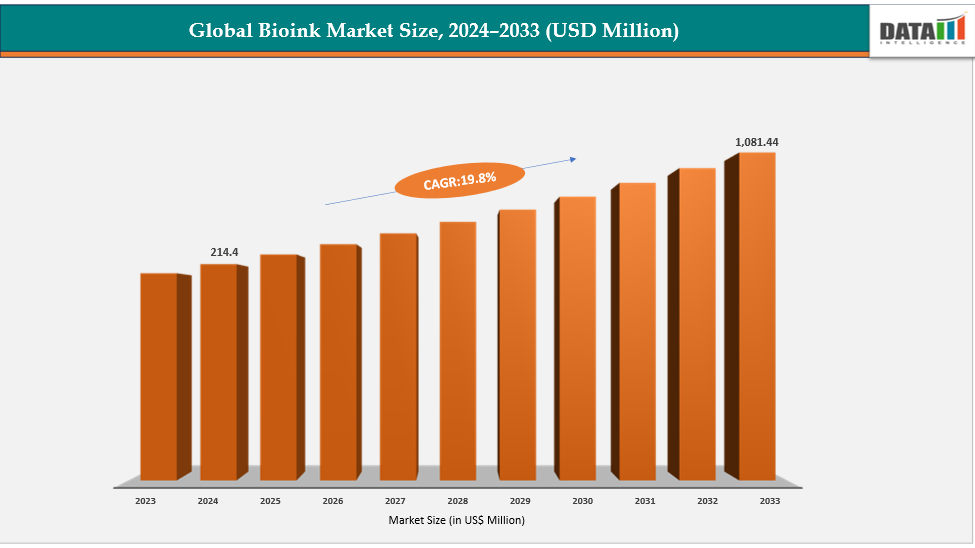
The global bioink market size reached US$ 256.92 million in 2025 is expected to reach US$ 1,081.44 million by 2033, growing at a CAGR of 19.8% during the forecast period 2026-2033. A significant driver of the global bioink market is the rising demand for personalized and regenerative healthcare solutions. The increasing prevalence of chronic diseases and age-related tissue degeneration necessitates advanced techniques for restoring damaged biological tissues.
Bioinks are essential for 3D bioprinting customized tissue constructs that match individual patients' anatomy, improving treatment outcomes and reducing implant rejection risks. The incorporation of stem cell technology and patient-derived biomaterials in bioinks is enhancing precision medicine, leading to innovations such as 3D bioprinted skin grafts and organ models. This trend, supported by government initiatives and public-private collaborations, is propelling demand for bioink materials in clinical and research settings.
Key Highlights
- North America dominates the bioink market with the largest revenue share of 43.5% in 2024.
- The Asia Pacific is the fastest-growing region and is expected to grow at the fastest CAGR of 8.1% over the forecast period.
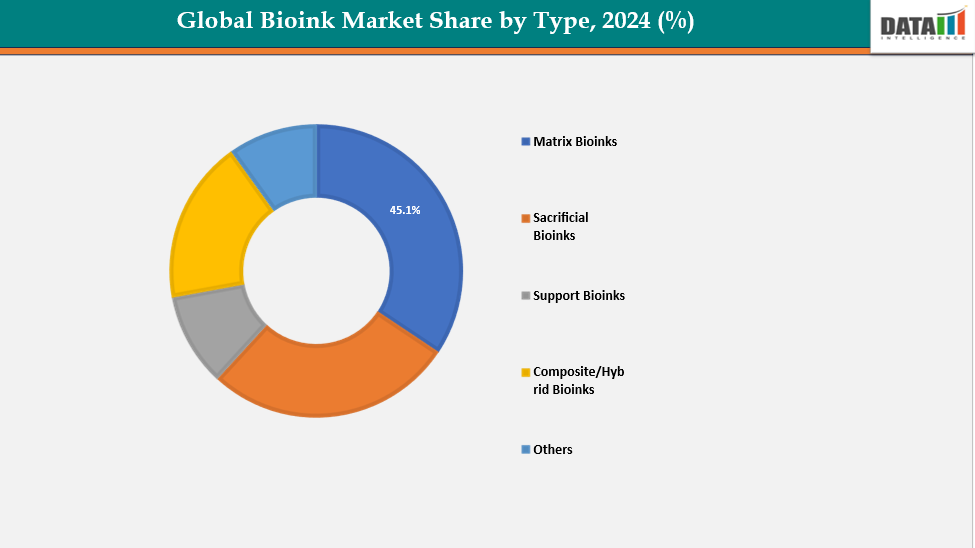
- Based on type, matrix bioinks segment led the market with the largest revenue share of 45.1% in 2024.
- The major market players in the bioink market includes BICO (CELLINK), RegenHU, CollPlant Biotechnologies, Allevi (BioBots), Rokit Healthcare, Regemat 3D, Poietis and among others.
Market Dynamics
Drivers: Increasing R&D in 3D bioprinting technologies driving the bioink market growth
The increasing R&D in 3D bioprinting technologies plays a pivotal role in driving the growth of the global bioink market, as it directly fuels innovation in materials, printing precision, and tissue engineering applications. Continuous advancements in biofabrication are allowing researchers to design bioinks that closely mimic the extracellular matrix (ECM), ensuring better cell adhesion, differentiation, and long-term viability. These R&D efforts are expanding the scope of 3D bioprinting from basic tissue models to complex functional organs, regenerative implants, and drug testing platforms.
Global investments in research infrastructure and cross-sector collaborations between academia, biotechnology firms, and medical device companies have intensified over the past few years. For instance, BICO (CELLINK) has been at the forefront of innovation, developing advanced bioinks such as CELLINK GelMA, CELLINK FIBRIN, and CELLINK START, tailored for applications in cartilage, bone, and soft tissue regeneration.
Similarly, Osaka University in Japan recently introduced a novel gelling approach for bioinks that enables the printing of intricate, multi-cellular tissue structures with improved mechanical integritypaving the way for the creation of more physiologically relevant human tissue models.
Restraints: High implementation and integration costs are hampering the growth of the bioink market
The high cost of bioprinters and bioink materials remains a significant restraint in the global bioink market. Advanced 3D bioprinters used for tissue engineering and regenerative medicine applications can range from USD 50,000 to over USD 300,000, depending on precision, automation, and multi-material capabilities.
Similarly, specialized bioinks particularly those incorporating growth factors, stem cells, or complex hydrogel matrices can cost between USD 200 and USD 1,000 per milliliter, making large-scale experimentation and commercialization expensive. These high costs limit adoption among small research institutions and startups, slowing down widespread clinical translation and scalability. As a result, cost reduction through material optimization and printer innovation remains a key focus area for industry players.
For more details on this report – Request for Sample
Bioink Market, Segment Analysis
The global bioink market is segmented based on type, application, end user and region.
Type: The matrix bioinks segment from type segment to dominate the bioink market with a 45.1% share in 2024
The matrix bioinks segment is a key growth driver in the global bioink market, supported by their vital role in replicating the natural extracellular matrix (ECM) environment for cell attachment, proliferation, and differentiation. These bioinks, often composed of collagen, gelatin, alginate, and hyaluronic acid, provide the structural and biochemical cues needed for tissue maturation in 3D bioprinting applications. Rising demand for tissue-engineered constructs and regenerative therapies is boosting the use of matrix bioinks across research and clinical settings.
Additionally, ongoing advancements in hydrogel chemistry and crosslinking techniques have improved printability, mechanical strength, and cell viability, making matrix bioinks a preferred choice for printing complex tissues such as skin, cartilage, and bone.
Application: The tissue engineering & regenerative medicine segment is estimated to have a 41.1% of the Bioink market share in 2024
The Tissue Engineering & Regenerative Medicine segment serves as a major driving force in the global bioink market. Growing demand for artificial tissues, organ regeneration, and advanced wound healing solutions has accelerated the adoption of 3D bioprinting technologies. Bioinks play a critical role in mimicking the extracellular matrix and supporting cell growth, making them essential for developing functional tissues such as skin, cartilage, bone, and liver constructs. Increasing prevalence of chronic diseases, organ shortages for transplantation, and the rising focus on personalized regenerative therapies further strengthen market demand.
For instance, in March 2025, A research team from the National Institute of Technology (NIT) Rourkela, led by Prof. Devendra Verma, Associate Professor in the Department of Biotechnology and Medical Engineering, has developed a natural-material-based bioink for 3D bioprinting of bone-like structures. This innovative bioink aims to enhance current bone repair methods by offering a biocompatible and efficient alternative to conventional bone grafts and implants.
Moreover, continuous R&D investments by academic and biotech organizations to enhance bioink biocompatibility, printability, and mechanical strength are propelling the expansion of this segment.
Bioink Market, Geographical Analysis
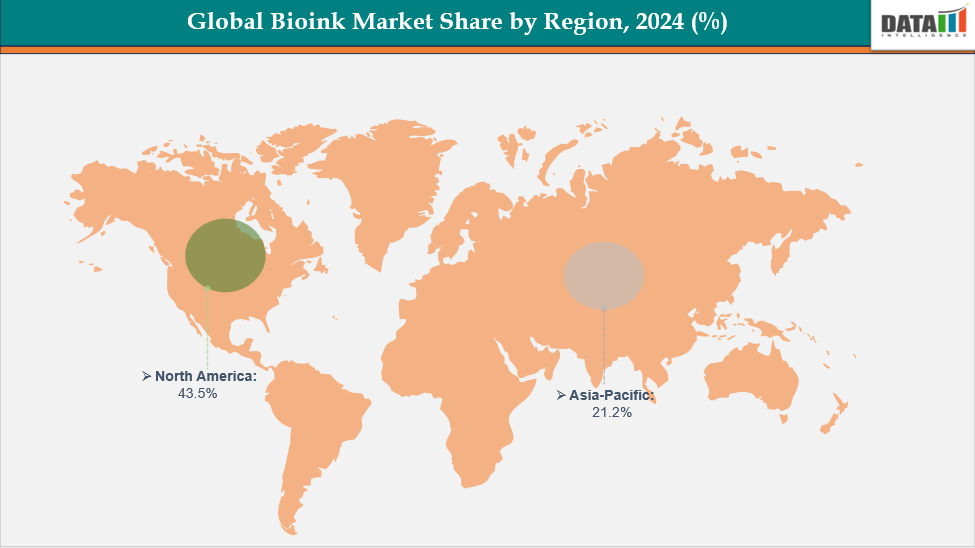
North America dominates the global bioink market with a 43.5% in 2024
North America drives the global bioink market due to strong investments in bioprinting research, robust healthcare infrastructure, and the presence of leading bioprinting companies such as BICO, Organovo, and Allevi. High adoption of regenerative medicine, coupled with significant funding from government and private sectors for tissue engineering and drug discovery applications, further fuels market growth.
The U.S. dominates the North American bioink market, driven by active R&D programs in advanced biomaterials, collaborations between biotech firms and academic institutes, and favorable regulatory support for 3D bioprinting in preclinical testing.
For instance, in October 2025, CollPlant Biotechnologies has announced an expansion into North America through a new partnership with a U.S.-based logistics center, set to become operational this quarter. The logistics hub will offer cGMP-compliant storage and distribution services, functioning as a clinical supply depot to support the increasing customer base for CollPlant's rhCollagen and BioInk products in the U.S. and Canada.
Europe is the second region after North America which is expected to dominate the global bioink market with a 34.5% in 2024
Europe remains a major hub for bioink innovation, supported by strong academic research in countries like Germany, Sweden, and the U.K. Government-backed funding for regenerative medicine, the expansion of bioprinting startups, and partnerships between universities and healthcare providers are key growth drivers across the region.
Germany leads Europe’s bioink market owing to its strong base of biotechnology research institutes and advanced manufacturing capabilities. The country’s focus on bioprinting automation, material standardization, and translational research for tissue and organ modeling has made it a center for innovation in biofabrication technologies.
The Asia Pacific region is the fastest-growing region in the global bioink market, with a CAGR of 8.1% in 2024
The Asia Pacific region is emerging as a fast-growing market for bioinks, driven by expanding healthcare infrastructure, rising investments in 3D bioprinting technologies, and growing awareness of regenerative medicine applications. Countries such as China, India, South Korea, and Japan are strengthening their research ecosystems to advance biofabrication and tissue engineering.
Japan’s bioink market growth is supported by strong government initiatives in regenerative medicine, increasing adoption of stem-cell-based therapies, and active collaboration between universities and biotech firms. The nation’s expertise in precision manufacturing and biomaterial science positions it as a leader in developing high-performance bioinks for tissue and organ regeneration.
Bioink Market Competitive Landscape
Top companies in the bioink market include eVideon, Artisight, Uniguest, Oneview Healthcare, Diligent Robotics, Andor Health and among others.
Artisight:- Artisight plays a pivotal role in advancing the global Bioink market through its AI-powered Smart Hospital Platform, which combines computer vision, machine learning, and IoT connectivity to transform hospital operations and patient care. The platform enables real-time monitoring of patient rooms, automates routine clinical workflows, and enhances communication between care teams-all while ensuring data security and compliance.
Recent Developments
- May 2026: BICO Group expanded its bioink portfolio through next-generation hydrogel formulations designed to improve cell viability, tissue mimicry, and scalability for regenerative medicine and drug testing applications.
- April 2026: 3D Systems advanced its bioprinting ecosystem by integrating enhanced bioink compatibility across multi-material printing platforms, strengthening applications in tissue engineering and personalized medical models.
- March 2026: Organovo Holdings progressed liver and kidney tissue model development using proprietary bioink formulations, supporting drug toxicity testing and preclinical research applications.
- February 2026: Aspect Biosystems expanded microfluidic bioprinting platforms leveraging advanced bioinks for vascularized tissue construction and regenerative medicine research.
- January 2026: CollPlant strengthened commercialization of recombinant human collagen-based bioinks aimed at improving scaffold biocompatibility for soft tissue regeneration and medical implants.
- December 2025: Allevi (3D Systems bioprinting division) enhanced hydrogel-based bioink systems supporting high-resolution tissue modeling and organ-on-chip research applications.
- November 2025: RegenHU advanced multi-material bioink printing systems enabling complex tissue architecture development for academic and pharmaceutical research institutions.
- October 2025: CELLINK accelerated development of standardized bioinks for stem-cell research and scalable tissue engineering applications across global biomedical research markets.
- September 2025: TissueLabs expanded bioink-compatible printing platforms supporting 3D tissue constructs for regenerative medicine, cosmetic testing and pharmaceutical screening applications.
- August 2025: Advanced Solutions Life Sciences strengthened customized bioink development services for patient-specific tissue modeling and precision medicine research initiatives.
Bioink Market Scope
| Metrics | Details | |
| CAGR | 19.8% | |
| Market Size Available for Years | 2025-2033 | |
| Estimation Forecast Period | 2026-2033 | |
| Revenue Units | Value (US$ Bn) | |
| Segments Covered | Type | Matrix Bioinks, Sacrificial Bioinks, Support Bioinks, Composite/Hybrid Bioinks, Others |
| Application | Tissue Engineering & Regenerative Medicine, Drug Discovery & Screening, Organ-on-a-Chip Models, Others | |
| End User | Hospitals & Clinics, Academic & Research Institutes, Others | |
| Regions Covered | North America, Europe, Asia-Pacific, South America and the Middle East & Africa | |
The global Bioink market report delivers a detailed analysis with 62 key tables, more than 57 visually impactful figures, and 159 pages of expert insights, providing a complete view of the market landscape.
Suggested Reports
For more medical devices-related reports, please click here


























































