


Automotive V2X Market Size and Overview
The global Automotive V2X market reached an estimated US$ 3.98 billion in 2025 and is expected to reach approximately US$ 29.12 billion by 2035, growing at a CAGR of 21.8% during 2026-2035. Growth is being driven by the transition from basic telematics toward cooperative safety, software-defined vehicles, 5G-enabled connected mobility and intelligent road infrastructure.
C-V2X is becoming the strategic center of the market because it combines direct vehicle communication with cellular-network integration and provides an evolution path from LTE-V2X to 5G NR-V2X. The commercial opportunity extends beyond vehicle radios to roadside units, secure credentials, edge platforms, cloud connectivity, cooperative perception software and infrastructure integration. Semiconductor suppliers and Tier-1s are increasingly embedding V2X into centralized connectivity and compute platforms rather than selling it as an isolated ECU.
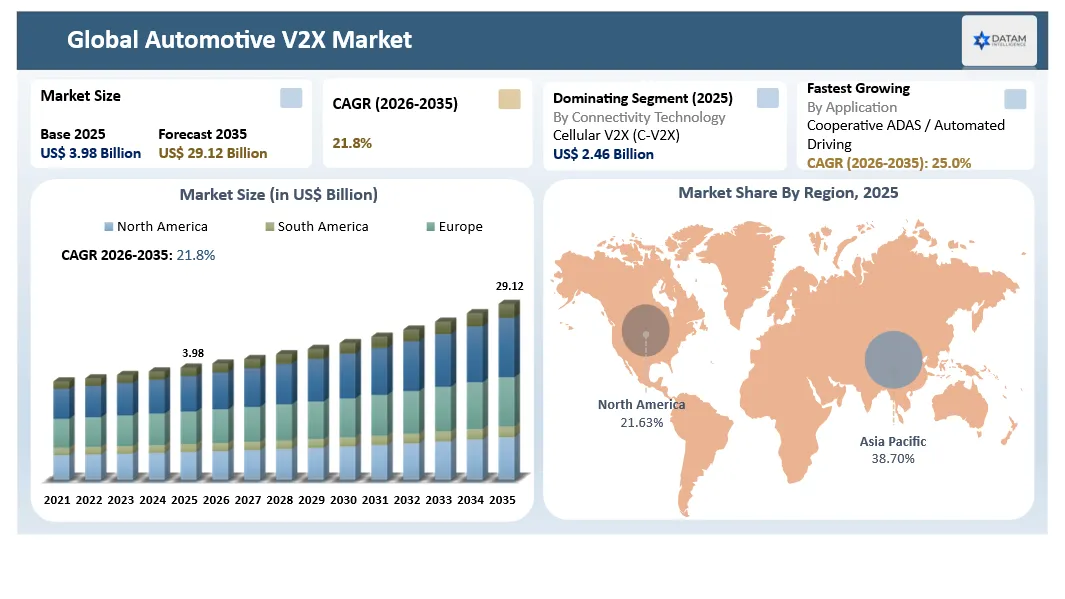
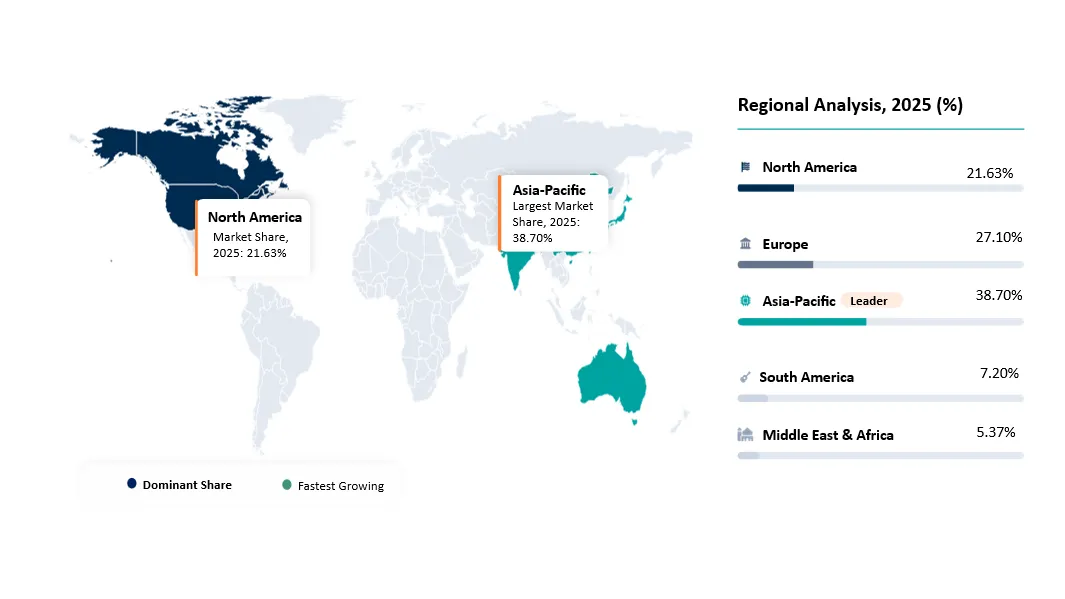
Asia-Pacific is expected to be the largest and fastest-growing region through 2035, supported by China’s C-V2X ecosystem, South Korean and Japanese automotive electronics leadership and expanding intelligent transport investment in India and Southeast Asia. North America remains strategically important because of the 5.9 GHz spectrum transition, public-sector deployment programs and large-scale connected-vehicle adoption. Europe continues to support both ITS-G5 and cellular pathways, creating a more heterogeneous but technically mature market.
| MARKET INDICATOR | VALUE |
| 2025 Market Size | US$ 3.98 Billion |
| 2035 Projected Market Size | US$ 29.12 Billion |
| CAGR (2026-2035) | 21.8% |
| Largest Region | Asia-Pacific |
| Fastest Growing Region | Asia-Pacific |
| Dominant Technology | Cellular V2X (C-V2X) |
| Fastest-Growing Application | Cooperative ADAS / Automated Driving |
Automotive V2X Market Key Takeaways
- Cellular V2X is expected to gain share as automakers align new vehicle platforms with 5G connectivity and future NR-V2X capabilities.
- V2I demand is expanding as transport authorities deploy roadside units, smart intersections, signal-priority systems and work-zone communication.
- V2V remains the core safety use case, but V2N and cooperative perception create larger software and recurring-service opportunities.
- Security credential management and authenticated message exchange are becoming mandatory design considerations rather than optional software layers.
- Software-defined vehicle architectures support consolidation of telematics, V2X, navigation and ADAS connectivity into centralized compute and communication platforms.
- Commercial fleets, autonomous shuttles, logistics corridors and smart-city deployments can accelerate adoption before universal passenger-vehicle penetration.
- Interoperability between vehicle generations, communication standards, road authorities and telecom networks remains a central commercialization challenge.
- Long-term market leadership will depend on chipset integration, standards compliance, cybersecurity, OEM design wins, infrastructure partnerships and scalable software platforms.
Automotive V2X Industry Trends and Strategic Insights
- The market is moving from pilot deployments toward platform integration as automakers incorporate V2X into broader digital chassis and software-defined vehicle roadmaps.
- NR-V2X is emerging as a long-term technology pathway for cooperative maneuvering, platooning, sensor sharing and high-reliability low-latency communication.
- Roadside infrastructure is becoming software-defined, with RSUs increasingly connected to edge computing, traffic management centers and cloud analytics.
- Vehicle cybersecurity is converging with V2X security because authenticated messages, certificate lifecycle management and trusted identities are essential for safety-critical communication.
- Public procurement is shifting toward corridor-level and city-scale deployments rather than isolated smart intersections, improving recurring maintenance and software revenue potential.
- Semiconductor integration is reducing BOM complexity by combining modem, GNSS, processing, security and wireless functions in fewer modules.
Automotive V2X Market Scope
| Metrics | Details |
| 2025 Market Size | US$ 3.98 Billion |
| 2035 Projected Market Size | US$ 29.12 Billion |
| CAGR (2026-2035) | 21.8% |
| Largest Market | Asia-Pacific |
| Fastest Growing Market | Asia-Pacific |
| By Connectivity Technology | DSRC / ITS-G5, LTE-V2X, 5G C-V2X / NR-V2X, Hybrid / Multi-Mode |
| By Communication Type | V2V, V2I, V2P, V2N, V2G, V2D / Other |
| By Component | Chipsets & Modems, OBUs, RSUs, Antennas & RF, Security, Software/Cloud/Edge |
| By Vehicle Type | Passenger Cars, LCVs, HCVs, Buses & Coaches, Two-Wheelers & Other Mobility |
| By Propulsion | ICE, Hybrid, Battery Electric, Fuel Cell & Other |
| By Application | Safety, Traffic Management, Cooperative ADAS, Emergency Notification, Fleet, Parking/Tolling, Infotainment, Smart Charging/V2G |
| By Deployment Model | Embedded OEM-Fitted, Aftermarket / Retrofit, Roadside Infrastructure, Cloud / Network-Assisted |
| By Sales Channel | Direct OEM / Tier-1, Government Procurement, Integrators / Distributors, Telecom / Managed Services |
| Report Insights Covered | Market Size, Share, Growth, Standards, Spectrum, Value Chain, Competitive Landscape, Public Company Performance and Country-Level Opportunity |
Why does this report matter in 2026?
The year 2026 is a pivotal point for Automotive V2X because multiple technology and policy transitions are converging. 5G standalone networks, software-defined vehicle platforms and centralized automotive compute are becoming more common, while road authorities are expanding connected-infrastructure programs. At the same time, automakers must decide how to future-proof vehicle platforms across LTE-V2X, NR-V2X and region-specific spectrum rules.
Commercial strategy is increasingly determined by ecosystem position. A semiconductor supplier can win the modem or connectivity processor, but value creation also depends on Tier-1 integration, certificate management, cloud services, OEM software and roadside infrastructure. The report therefore maps both the vehicle-side and infrastructure-side value chains rather than treating V2X as a single hardware category.
The market is also becoming relevant to automated driving. Sensor sharing and cooperative perception can extend awareness beyond line of sight, while connected intersections can expose signal phase, work-zone and vulnerable-road-user information to the vehicle. These applications expand V2X from a safety messaging technology into a strategic data layer for connected and automated mobility.
Automotive V2X Market White Space & Investment Opportunities
- Integrated V2X connectivity control units that combine C-V2X, 5G, GNSS, Wi-Fi, Bluetooth, cybersecurity and edge compute.
- NR-V2X solutions for cooperative perception, platooning and coordinated automated-driving maneuvers.
- Low-cost roadside units and intersection controllers for secondary cities and emerging markets.
- Security credential management, certificate lifecycle automation and zero-trust vehicle identity platforms.
- V2X analytics that combine road-side events, telematics, maps and sensor data to improve traffic management and fleet safety.
- Two-wheeler and vulnerable-road-user V2X devices for markets with high motorcycle and pedestrian exposure.
Automotive V2X Future Market Transformation
The market is expected to transform from dedicated safety radios into a distributed cooperative mobility platform. Vehicle-side hardware will increasingly be integrated into centralized connectivity and compute domains, while roadside units evolve into edge nodes that connect traffic controllers, sensors, cameras and cloud platforms. This will shift value toward software, cybersecurity, lifecycle management and data services.
By 2035, V2X is likely to be tightly linked with ADAS, automated driving, smart infrastructure and EV energy services. Vehicles will exchange richer messages, including detected objects and planned trajectories, while infrastructure will provide signal timing, work-zone conditions and localized hazard information. This will increase network and compute requirements but create recurring software and service revenue beyond the initial hardware sale.
Automotive V2X Market Buyer Decision-Making Criteria
OEMs and Tier-1 suppliers prioritize standards compliance, RF performance, low-latency communication, cybersecurity, integration with vehicle compute and long-term component availability. Design wins are influenced by chipset roadmap continuity, automotive qualification, functional safety processes, software support and the ability to operate across multiple regional standards.
Road authorities evaluate interoperability, coverage, roadside unit reliability, lifecycle cost, backhaul requirements and compatibility with traffic management systems. Telecom operators and cloud providers focus on edge integration, service orchestration, QoS and monetizable data services. Across buyers, the strongest vendors combine hardware, software, security and implementation support.
Automotive V2X Market Economic & Investment Analysis
V2X economics differ between vehicle-side and infrastructure-side deployment. OEM-fitted hardware scales with vehicle production and design-cycle penetration, while roadside systems depend on public budgets, corridor projects and smart-city investment. Software and security create recurring revenue through certificates, cloud services, analytics and lifecycle updates.
Investment is shifting toward integrated connectivity platforms because standalone V2X modules face BOM pressure. Semiconductor vendors therefore seek broader digital cockpit, telematics, ADAS and connectivity design wins that allow V2X functionality to ride on a larger silicon platform. Infrastructure vendors seek multi-year operations and maintenance contracts, while cybersecurity providers target certificate issuance and identity management across millions of devices.
Automotive V2X Investment Trends in the Market
- Semiconductor investment is moving toward integrated automotive connectivity and compute platforms with 5G, GNSS and V2X support.
- Public-sector spending is increasingly focused on connected corridors, smart intersections and work-zone safety rather than isolated pilots.
- OEMs are funding software-defined vehicle architectures that can activate or upgrade connectivity features over the vehicle lifecycle.
- Telecom operators and cloud providers are investing in edge platforms for low-latency traffic and mobility services.
- Cybersecurity investment is increasing around vehicle identity, PKI, secure boot, certificate management and authenticated V2X messaging.
Strategic Indicators For the Automotive V2X Market
High Regulation Impact
Spectrum allocation, radio certification, cybersecurity regulation, type approval and transport-safety policy directly influence deployment. Vendors must maintain regional variants and demonstrate interoperability with national infrastructure.
High Investment Activity
Automakers, semiconductor companies and transport agencies are investing in connected and software-defined mobility. Funding increasingly targets scalable C-V2X and edge-enabled infrastructure.
Supply Chain Disruption
Automotive-grade semiconductor shortages, RF component constraints and regional technology restrictions can delay vehicle programs. Multi-sourcing and longer component lifecycle commitments remain important.
Pricing Volatility
Vehicle-side ASPs decline with integration and scale, while roadside systems retain higher project-based pricing. Software, cybersecurity and managed services can offset hardware commoditization.
Procurement Pressure
OEMs demand lower BOM, long support windows and global certification. Governments require open interfaces, interoperability, cybersecurity and lifecycle maintenance.
New Technology Adoption
5G NR-V2X, cooperative perception, edge computing, digital twins, AI traffic analytics and centralized vehicle compute are reshaping the market.
Regional Expansion Opportunity
China, South Korea, Japan, the U.S. and selected European markets lead deployment, while India and Southeast Asia offer emerging infrastructure opportunities.
Government Policy Support
Road-safety programs, 5.9 GHz spectrum decisions, smart-city funding and connected-corridor programs can materially accelerate adoption.
Pricing Intelligence
Chipsets and modules face semiconductor-style price compression, while integrated connectivity control units, RSUs and security platforms command higher value based on functionality and lifecycle support.
Disruption Analysis of Automotive V2X Market
The primary disruption is the migration from DSRC-centered architectures toward cellular V2X and eventually NR-V2X in many markets. This transition changes chipset roadmaps, certification requirements and infrastructure investment. It also increases the strategic role of telecom networks and 5G edge computing while forcing legacy deployments to manage interoperability and migration.
A second disruption is the rise of software-defined vehicles. V2X functionality can be integrated into centralized compute and connectivity platforms, reducing the need for dedicated ECUs and shifting differentiation toward software. Cooperative perception also expands the market from message exchange toward shared sensor data, increasing compute, bandwidth and cybersecurity requirements.
Automotive V2X Market BCG Matrix: Company Evaluation
STAR
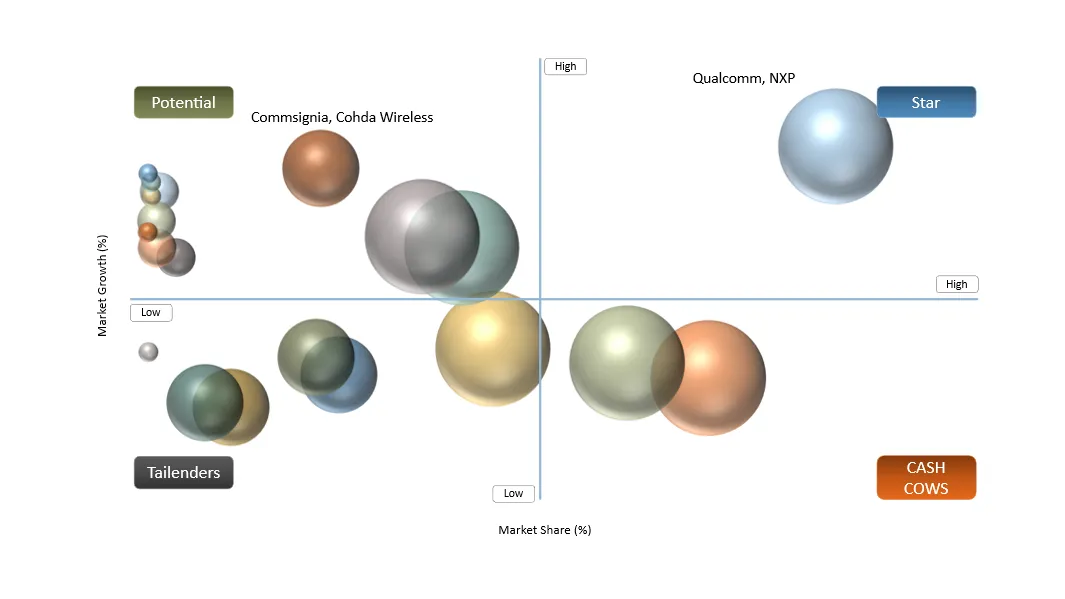
Qualcomm, NXP and major automotive connectivity suppliers occupy the Star position because they combine large OEM design-win pipelines with strong 5G, connectivity, processing and security portfolios. Their strategic advantage comes from embedding V2X into broader digital chassis and software-defined vehicle platforms.
POTENTIAL
Commsignia, Cohda Wireless, Kapsch TrafficCom, u-blox and specialized infrastructure vendors represent Potential players. Their growth depends on smart-city deployments, roadside unit scale, interoperability expertise, security software and partnerships with large OEM or Tier-1 ecosystems.
Automotive V2X Market Dynamics
Driver Impact Analysis
| Driver | Market Growth Impact | Demand Concentration | Impacted Use Case | Strategic Impact |
| Software-Defined Vehicle Integration | High | Global passenger vehicles | Integrated connectivity and centralized compute | Moves V2X from standalone module to platform feature and expands semiconductor content. |
| Growth of C-V2X and 5G | High | China, North America, Asia-Pacific | V2V, V2I, V2N | Creates a standardized cellular evolution path and enables new cooperative applications. |
| Smart Road Infrastructure Investment | Medium-High | Urban corridors and highways | V2I, traffic management | Expands RSU, edge and software demand and improves utility of vehicle-side radios. |
| Road Safety and ADAS Expansion | Medium-High | Global OEM platforms | Collision avoidance, vulnerable road users | Strengthens safety use cases and supports regulatory adoption. |
Driver: C-V2X Integration into Connected and Software-Defined Vehicles
The strongest structural driver is integration of V2X into broader connectivity architectures. New vehicle platforms increasingly use centralized compute and connectivity control units that combine cellular connectivity, GNSS, Wi-Fi, Bluetooth and safety communication. This lowers incremental V2X integration cost and allows OEMs to manage features through software over the vehicle lifecycle.
Restraint Impact Analysis
| Restraint | Drag on Market Growth | Primary Impact Area | Impacted Use Case | Strategic Impact |
| Standards and Spectrum Fragmentation | High | Platform design and certification | Global OEM deployment | Requires regional variants, interoperability testing and longer validation cycles. |
| Uneven RSU Deployment | High | V2I utility | Smart intersections and traffic management | Reduces immediate value in regions with limited infrastructure coverage. |
| Cybersecurity and Liability Risk | Medium-High | Trust and safety | All V2X messaging | Raises PKI, monitoring and compliance requirements. |
| Long Automotive Design Cycles | Medium | Commercial ramp | OEM-fitted hardware | Delays revenue recognition despite early design wins. |
Restraint: Fragmented Standards and Infrastructure Coverage
V2X adoption is slowed by regional differences in spectrum policy, technology choice and infrastructure readiness. Automakers selling globally must support multiple radio modes and certification regimes, while road authorities need confidence that infrastructure will remain compatible with future vehicle generations. These factors can delay procurement even when the safety case is strong.
Automotive V2X Market Segment Analysis
The global Automotive V2X market is segmented based on Connectivity Technology, Communication Type, Component, Vehicle Type, Propulsion, Application, Deployment Model, Sales Channel and region.
By Connectivity Technology
Cellular V2X Will Lead Market Growth
LTE-V2X provides the current commercial foundation in several major markets, while 5G NR-V2X is expected to expand advanced cooperative driving. DSRC/ITS-G5 remains relevant in installed European and U.S. deployments, but multi-mode support is increasingly important for global platforms.
By Communication Type
V2V Remains Core Safety Use Case While V2N Expands Recurring Revenue
V2V supports collision warning and situational awareness without dependence on cellular coverage. V2N adds cloud connectivity, mapping, traffic information and network-assisted services, creating recurring software and operator revenue. V2I becomes more valuable as smart-intersection coverage expands.
By Component
Chipsets and Integrated Connectivity Platforms Will Hold Major Value
Semiconductor content remains central because modem, processing, GNSS, security and RF performance determine system capability. RSUs and software carry higher per-unit value, while security and cloud services provide recurring revenue.
By Vehicle Type
Passenger Cars Will Dominate Volume
Passenger vehicles represent the largest addressable production base and will lead OEM-fitted V2X adoption. Commercial vehicles create attractive fleet and corridor use cases because safety and productivity gains are easier to quantify.
By Propulsion
Battery Electric Vehicles Will Record the Fastest Growth
EV platforms are typically newer, more software-defined and equipped with advanced connectivity, making them natural early adopters of V2X. V2G functionality also links V2X communication with charging and energy-management services.
By Application
Cooperative ADAS and Automated Driving Will Grow Fastest
Collision avoidance remains the largest safety application, but cooperative perception and maneuver coordination can create greater long-term value. These applications require higher bandwidth, lower latency, stronger security and tighter integration with ADAS compute.
By Deployment Model
Embedded OEM-Fitted Systems Will Lead
Factory integration offers better antenna placement, security and lifecycle management than aftermarket devices. Roadside infrastructure remains essential for V2I, while cloud/network-assisted services expand with telecom participation.
By Sales Channel
Direct OEM and Tier-1 Channels Will Dominate
Automotive qualification and long design cycles make direct supplier relationships essential. Government procurement is critical for RSUs and traffic systems, while telecom and managed-service channels become more important for V2N and edge services.
Automotive V2X Market Geographical Penetration
U.S. Automotive V2X Market Landscape
The U.S. market is shaped by the 5.9 GHz spectrum transition, federal and state connected-vehicle programs and strong participation from OEMs, chip suppliers and telecom companies. Deployment opportunity is concentrated in connected corridors, smart intersections, work zones and fleet safety. The move toward cellular V2X strengthens the role of 5G operators and edge platforms.
Germany Automotive V2X Market Outlook
Germany benefits from a strong premium automotive industry, Tier-1 supplier base and cooperative ITS experience. ITS-G5 remains relevant, while C-V2X and 5G integration are expanding through software-defined vehicle programs and cross-border mobility projects. Highway and urban infrastructure modernization supports V2I demand.
Japan Automotive V2X Market Trends
Japan has long experience with connected transport infrastructure and strong automotive electronics suppliers. The market is supported by OEM integration, advanced traffic systems and 5G development. Local suppliers emphasize reliability, functional safety and long lifecycle support.
China Automotive V2X Market Outlook
China is one of the most important C-V2X markets because national and city-level programs combine vehicle connectivity, roadside infrastructure and 5G networks. Domestic OEMs, telecom operators and semiconductor suppliers are integrating V2X into intelligent connected vehicle strategies, creating large-scale deployment potential.
India Automotive V2X Market Outlook
India is emerging as a high-growth opportunity because of road-safety needs, rapid 5G deployment and policy interest in connected collision-avoidance technology. Adoption will depend on spectrum clarity, low-cost hardware and deployment models that can serve mixed traffic including two-wheelers, buses and pedestrians.
Middle East and Africa Automotive V2X Market Outlook
Gulf markets provide opportunities through smart-city investment, autonomous mobility pilots and high-quality 5G networks. Wider regional adoption will be slower because of vehicle affordability and infrastructure gaps, but connected corridors, ports and logistics zones provide practical early use cases.
Automotive V2X Market Competitive Landscape
- Competition is centered on semiconductor integration, OEM design wins, roadside infrastructure, security software and standards interoperability.
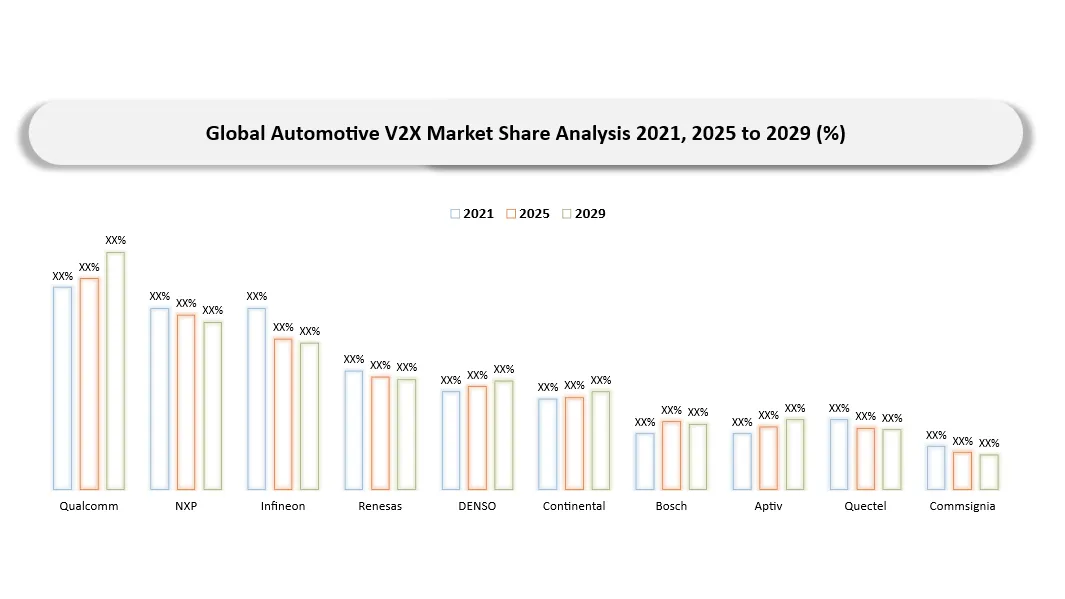
- Qualcomm and NXP are strong in automotive connectivity and digital vehicle platforms, while Infineon, STMicroelectronics and Renesas provide complementary microcontrollers, security, RF and connectivity technologies.
- Tier-1 suppliers including DENSO, Continental, Bosch and Aptiv compete by integrating V2X into telematics, ADAS and domain-control architectures.
- Specialist vendors such as Commsignia and Cohda Wireless differentiate through V2X stacks, RSUs, security, interoperability testing and deployment expertise.
- Infrastructure companies such as Kapsch TrafficCom participate through roadside units, traffic management and connected corridor projects.
- Competitive advantage increasingly comes from complete ecosystems that span vehicle silicon, software, PKI, cloud, edge and public infrastructure rather than isolated hardware.
Public Company Q1-Q2 2026 Performance Comparison
| Public Company | Q1-Q2 2026 Performance Indicator | Automotive V2X Exposure | Factors Supporting Growth |
| NXP Semiconductors | Q2 2026 revenue was US$3.50 billion, up 19% year over year. Automotive revenue was US$1.938 billion, up 12% year over year and 9% sequentially. | Automotive processors, secure connectivity, vehicle networking, V2X/telematics-adjacent semiconductor platforms and software-defined vehicle architecture. | Software-defined vehicles, edge intelligence, automotive semiconductor recovery, zonal/central compute and connectivity content growth. |
| Infineon Technologies | Q2 FY2026 revenue was €3.812 billion with a 17.1% segment result margin; management highlighted improving automotive order intake and further automotive market-share gains. | Automotive microcontrollers, security, power and connectivity-related components supporting V2X gateways and centralized vehicle electronics. | Software-defined vehicles, automotive MCU content, cybersecurity, power electronics and recovery in automotive order trends. |
| STMicroelectronics | Q2 2026 revenue was US$3.49 billion, up 26% year over year, with a 34.8% gross margin. | Automotive MCUs, GNSS, connectivity, secure elements, sensors and RF devices used in telematics and connected-vehicle systems. | Smart mobility recovery, automotive semiconductor content, zonal architectures, intelligent sensing and edge connectivity. |
| Qualcomm Incorporated | Fiscal Q2 2026 investor reporting showed continued diversification momentum; in June 2026 Qualcomm expanded its automotive design-win pipeline to US$65 billion and raised its FY2029 automotive revenue target to US$10 billion. | Snapdragon Digital Chassis, telematics and connectivity platforms, cellular modems, C-V2X and automotive compute. | Large OEM design-win pipeline, 5G connectivity, ADAS and cockpit integration, software-defined vehicles and centralized automotive compute. |
| Renesas Electronics | Q1 2026 non-GAAP revenue was ¥372.3 billion. Q2 2026 non-GAAP revenue increased to ¥405.3 billion, bringing first-half revenue to ¥777.6 billion with a 33.2% operating margin. | Automotive MCUs, SoCs, connectivity, security and software-defined vehicle platforms supporting gateways and V2X integration. | Automotive MCU leadership, SDV platform strategy, embedded processing, vehicle control integration and stronger semiconductor demand. |
Source note: NXP Q2 2026 results (July 28, 2026), Infineon Q2 FY2026 results (May 6, 2026), STMicroelectronics Q2 2026 results (July 23, 2026), Qualcomm 2026 Investor Day and fiscal Q2 reporting, and Renesas Q1/Q2 2026 results. V2X-specific revenue is generally not separately disclosed, so the comparison uses company or automotive-segment indicators and identifies the direct strategic exposure to V2X-related products.
Market Ecosystem Analysis
| Value-Chain Sector | Role in Automotive V2X | Representative Companies |
| Semiconductor Platforms | Provide C-V2X modems, processors, MCUs, RF, GNSS and secure connectivity silicon. | Qualcomm, NXP Semiconductors, Infineon Technologies, STMicroelectronics, Renesas Electronics |
| Automotive Tier-1 Integrators | Integrate V2X into telematics, connectivity control units, ADAS and domain controllers. | DENSO, Continental, Bosch, Aptiv, HARMAN |
| V2X Software & Protocol Specialists | Provide protocol stacks, applications, security integration and interoperability tools. | Commsignia, Cohda Wireless, Autotalks technology portfolio, Vector Informatik |
| Roadside Unit & ITS Vendors | Supply RSUs, connected intersection equipment, traffic management and corridor systems. | Kapsch TrafficCom, Yunex Traffic, Iteris, Commsignia |
| Telecom Operators & Edge Platforms | Provide 4G/5G connectivity, MEC, QoS and V2N services. | Verizon, AT&T, Deutsche Telekom, Vodafone, China Mobile, SK Telecom |
| Cloud & Mapping Platforms | Provide mobility cloud, mapping, data exchange and analytics. | AWS, Microsoft Azure, Google Cloud, HERE Technologies, TomTom |
| Cybersecurity & PKI | Manage certificates, secure identities, cryptography and lifecycle trust. | BlackBerry Certicom, ESCRYPT/Bosch, Thales, ID Quantique, specialized SCMS providers |
| Vehicle OEMs | Embed V2X into production vehicles and define platform requirements. | Volkswagen Group, General Motors, Toyota, Hyundai Motor Group, Mercedes-Benz, BMW, Stellantis, Chinese NEV OEMs |
| Government & Road Authorities | Procure roadside infrastructure, define deployment policy and operate traffic systems. | USDOT/state DOTs, European road authorities, Chinese municipal ITS agencies, transport ministries |
| Testing, Certification & Standards | Validate interoperability, conformance, RF performance and standards evolution. | 5GAA, ETSI, SAE, IEEE, OmniAir, TÜV organizations, test labs |
Key Companies
- Qualcomm Incorporated
- NXP Semiconductors
- Infineon Technologies
- STMicroelectronics
- Renesas Electronics
- DENSO Corporation
- Continental AG
- Robert Bosch GmbH
- Aptiv PLC
- Samsung Electronics / HARMAN
- Commsignia
- Cohda Wireless
- Kapsch TrafficCom
- Quectel Wireless Solutions
- u-blox Holding AG
Company Profiles
Qualcomm Incorporated
Qualcomm is a leading automotive connectivity and compute supplier through Snapdragon Digital Chassis. Its V2X relevance comes from cellular modems, C-V2X, telematics, GNSS, RF, integrated compute and a large automotive design-win pipeline. The company is positioning connectivity, cockpit and ADAS within a unified platform strategy.
Competitive position depends on automotive qualification, standards compliance, integration support, security, global OEM relationships, lifecycle supply and the ability to align with the transition toward software-defined vehicles and 5G-enabled cooperative mobility.
NXP Semiconductors
NXP is a major automotive semiconductor supplier with strong positions in secure connectivity, processors, vehicle networking and software-defined vehicle platforms. Its ability to combine edge processing, network interfaces and hardware security supports V2X integration in telematics and centralized gateways.
Competitive position depends on automotive qualification, standards compliance, integration support, security, global OEM relationships, lifecycle supply and the ability to align with the transition toward software-defined vehicles and 5G-enabled cooperative mobility.
Infineon Technologies
Infineon supplies automotive microcontrollers, security, power and connectivity-related semiconductors. Its AURIX and security capabilities are relevant to V2X gateways and trusted communication, while its broader automotive market share provides strong OEM access.
Competitive position depends on automotive qualification, standards compliance, integration support, security, global OEM relationships, lifecycle supply and the ability to align with the transition toward software-defined vehicles and 5G-enabled cooperative mobility.
STMicroelectronics
STMicroelectronics participates through automotive MCUs, GNSS, secure elements, RF, sensors and connectivity technologies. Its smart mobility portfolio supports telematics and connected-vehicle architectures and can complement dedicated C-V2X modem solutions.
Competitive position depends on automotive qualification, standards compliance, integration support, security, global OEM relationships, lifecycle supply and the ability to align with the transition toward software-defined vehicles and 5G-enabled cooperative mobility.
Renesas Electronics
Renesas combines automotive MCUs, SoCs, analog, power and connectivity with a software-defined vehicle strategy. Its platform approach supports centralized vehicle control and can integrate V2X communication with broader gateway and domain-controller functions.
Competitive position depends on automotive qualification, standards compliance, integration support, security, global OEM relationships, lifecycle supply and the ability to align with the transition toward software-defined vehicles and 5G-enabled cooperative mobility.
DENSO Corporation
DENSO is a major Tier-1 supplier of vehicle electronics, telematics and ADAS systems. Its OEM integration capabilities, long vehicle-program relationships and safety engineering make it a strategic participant in connected and cooperative driving systems.
Competitive position depends on automotive qualification, standards compliance, integration support, security, global OEM relationships, lifecycle supply and the ability to align with the transition toward software-defined vehicles and 5G-enabled cooperative mobility.
Continental AG
Continental supplies telematics, connectivity, ADAS and vehicle architecture technologies. V2X can be integrated into its broader connected-vehicle and software-defined mobility platforms, giving the company strong system-level positioning.
Competitive position depends on automotive qualification, standards compliance, integration support, security, global OEM relationships, lifecycle supply and the ability to align with the transition toward software-defined vehicles and 5G-enabled cooperative mobility.
Robert Bosch GmbH
Bosch combines automotive electronics, vehicle computers, cybersecurity, sensors and mobility services. Its ecosystem position supports V2X integration across vehicle networks, safety systems and infrastructure-facing applications.
Competitive position depends on automotive qualification, standards compliance, integration support, security, global OEM relationships, lifecycle supply and the ability to align with the transition toward software-defined vehicles and 5G-enabled cooperative mobility.
Aptiv PLC
Aptiv focuses on vehicle architecture, connectivity, ADAS and software. V2X complements its strengths in high-speed data networks, active safety and centralized compute, especially as OEMs consolidate electronic architectures.
Competitive position depends on automotive qualification, standards compliance, integration support, security, global OEM relationships, lifecycle supply and the ability to align with the transition toward software-defined vehicles and 5G-enabled cooperative mobility.
Samsung Electronics / HARMAN
HARMAN provides telematics control units, connected-car services and digital cockpit systems, supported by Samsung semiconductor and network assets. V2X can be incorporated into integrated connectivity and service platforms.
Competitive position depends on automotive qualification, standards compliance, integration support, security, global OEM relationships, lifecycle supply and the ability to align with the transition toward software-defined vehicles and 5G-enabled cooperative mobility.
Commsignia
Commsignia specializes in V2X communication software, on-board and roadside solutions, security and deployment tools. Its focused position makes it relevant to OEM and infrastructure projects requiring standards interoperability.
Competitive position depends on automotive qualification, standards compliance, integration support, security, global OEM relationships, lifecycle supply and the ability to align with the transition toward software-defined vehicles and 5G-enabled cooperative mobility.
Cohda Wireless
Cohda Wireless is a specialist in connected and cooperative vehicle communication with expertise in V2X stacks, on-board units, roadside units and cooperative perception. It is well positioned for pilots and infrastructure integration.
Competitive position depends on automotive qualification, standards compliance, integration support, security, global OEM relationships, lifecycle supply and the ability to align with the transition toward software-defined vehicles and 5G-enabled cooperative mobility.
Kapsch TrafficCom
Kapsch TrafficCom provides intelligent transportation systems, tolling and traffic management. Its roadside and corridor-level capabilities allow V2X to be integrated with operational transport infrastructure rather than deployed as an isolated radio network.
Competitive position depends on automotive qualification, standards compliance, integration support, security, global OEM relationships, lifecycle supply and the ability to align with the transition toward software-defined vehicles and 5G-enabled cooperative mobility.
Quectel Wireless Solutions
Quectel supplies automotive and IoT communication modules, including cellular and GNSS products. It is relevant to cost-sensitive telematics and C-V2X module integration, especially in high-volume Asian markets.
Competitive position depends on automotive qualification, standards compliance, integration support, security, global OEM relationships, lifecycle supply and the ability to align with the transition toward software-defined vehicles and 5G-enabled cooperative mobility.
u-blox Holding AG
u-blox supplies GNSS and wireless communication technologies used in connected mobility. Its positioning in automotive-grade positioning and connectivity gives it exposure to V2X-enabled telematics and navigation systems.
Competitive position depends on automotive qualification, standards compliance, integration support, security, global OEM relationships, lifecycle supply and the ability to align with the transition toward software-defined vehicles and 5G-enabled cooperative mobility.
Automotive V2X Market Major Pain Points
- Fragmented standards and regional spectrum policies increase development and certification cost.
- Roadside infrastructure coverage remains uneven, reducing V2I utility in many markets.
- Automotive design cycles delay revenue despite early technology readiness.
- Cybersecurity, certificate lifecycle management and privacy add complexity to every deployment.
- Interoperability across vehicle generations, OEMs and infrastructure vendors must be continuously validated.
- RSU deployment and maintenance require sustained public funding and operational ownership.
- Hardware ASP pressure increases as connectivity functions become integrated into larger chipsets and ECUs.
- Liability and functional-safety questions remain important for advanced cooperative-driving applications.
Automotive V2X Market Recent Developments
- July 2026: NXP reported Q2 revenue of US$3.50 billion and automotive revenue of US$1.938 billion, with management citing software-defined vehicles as a company-specific growth driver.
- June 2026: Qualcomm expanded its automotive design-win pipeline to US$65 billion and raised its fiscal 2029 automotive revenue target to US$10 billion, reinforcing the scale of its digital chassis strategy.
- May 2026: Infineon reported improving automotive order intake and further market-share gains, highlighting positive developments in software-defined vehicles.
- July 2026: STMicroelectronics reported Q2 2026 revenue of US$3.49 billion, up 26% year over year, supporting renewed investment across smart mobility and connected edge applications.
- July 2026: Renesas reported Q2 non-GAAP revenue of ¥405.3 billion and first-half revenue of ¥777.6 billion while continuing to emphasize software-defined vehicle strategy and embedded processing.
Analyst View / Opinion on Automotive V2X Market
- Automotive V2X is moving from a niche safety-communication market toward a core connectivity layer for software-defined and increasingly automated vehicles.
- C-V2X will capture most new deployment momentum because it aligns with 5G roadmaps and offers an evolution path toward NR-V2X cooperative-driving applications.
- The market will not be won by vehicle hardware alone. Infrastructure coverage, PKI, cloud integration, edge computing and standards interoperability determine whether vehicle-side radios deliver practical value.
- China and other Asian markets are likely to scale fastest because policy, telecom networks and automotive ecosystems can be coordinated more tightly.
- North America and Europe remain critical for technology validation, premium vehicle platforms and public infrastructure programs, but adoption will remain more fragmented.
- The strongest companies will combine semiconductor scale or Tier-1 integration with software, cybersecurity and long-term ecosystem partnerships.
- Cooperative perception is the most important long-term value expansion because it turns V2X from simple safety messaging into shared machine perception for automated driving.
Automotive V2X Market Target Audience
| INDUSTRY | WHO SHOULD BUY THIS REPORT? | REASON TO BUY THIS REPORT |
| Automotive OEMs | Connectivity, SDV, ADAS, purchasing and strategy teams | Assess technology roadmaps, supplier positioning, regional standards and deployment economics. |
| Tier-1 Suppliers | Telematics, domain control, ADAS and vehicle architecture teams | Benchmark semiconductor and software partners and identify integration opportunities. |
| Semiconductors | Automotive business units, product management and corporate strategy | Evaluate C-V2X, RF, processor, security and connectivity content opportunities. |
| Telecom Operators | 5G, MEC, enterprise and mobility teams | Assess V2N, edge computing and connected transport service opportunities. |
| ITS & Infrastructure | Road authorities, RSU suppliers and traffic-management vendors | Plan roadside deployment, interoperability and smart-corridor investment. |
| Cybersecurity | PKI, identity and automotive security companies | Evaluate SCMS, certificate and secure communication demand. |
| Investors & Consulting | Private equity, venture capital, institutional investors and consultants | Assess market size, ecosystem structure, competitive positioning and investment white spaces. |
Why Choose DATAM?
- Data-driven insights combining market sizing, semiconductor content, vehicle production, infrastructure deployment, standards and regional policy.
- Post-purchase analyst consultations for market entry, supplier benchmarking, partnership strategy and custom market modeling.
- Annual updates covering spectrum policy, OEM launches, new standards, infrastructure programs, partnerships and competitive changes.
- Specialized focus on emerging markets and regional deployment models rather than generalized global averages.
- Actionable analysis connecting vehicle technology with roadside infrastructure, telecom networks, cybersecurity and cloud services.
What DATAM Uniquely Provides
- Ten-year forecasts across eight segmentation categories and five major regions.
- Technology analysis separating DSRC/ITS-G5, LTE-V2X and 5G NR-V2X adoption pathways.
- Market ecosystem mapping across semiconductors, Tier-1s, software, RSUs, telecom, cloud, PKI, OEMs and government buyers.
- Public-company Q1-Q2 2026 comparison focused on companies with direct automotive connectivity and V2X exposure.
- Country-level views linking vehicle production, 5G coverage, smart-road investment and regulatory readiness.



























































