


Automotive DC-DC Converters Market Size and Overview
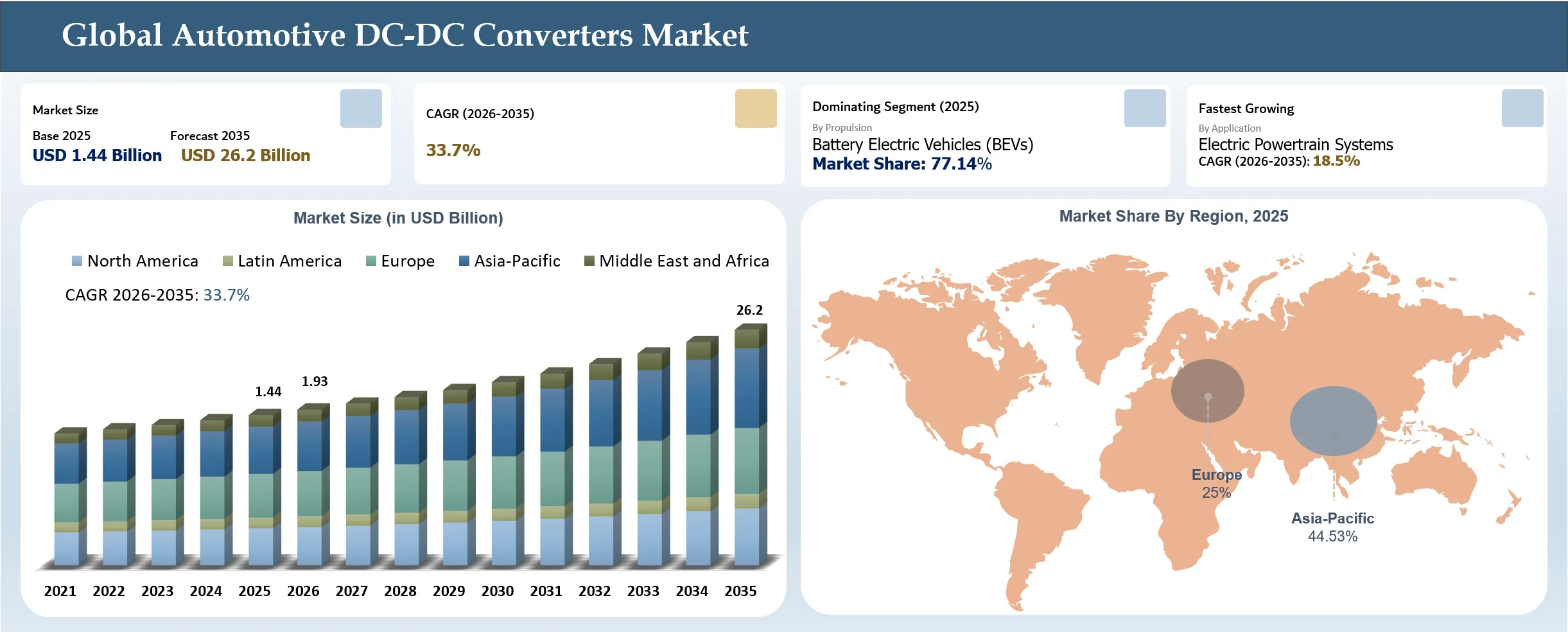
The global automotive DC-DC converters market reached USD 1.44 billion in 2025 and is expected to reach USD 26.2 billion by 2035, growing with a CAGR of 33.7% during the forecast period 2026-2035. The market is being supported by the transition toward 48V vehicle electric architectures, which have greater power handling capacity and efficiency compared to traditional 12V architectures while requiring less cabling and current. According to Powerquark stated that the global automotive 48V system market would be worth USD 8.6 billion in 2026, due to the fast adoption of hybrid automobiles moving to pure-electric platforms. The company further emphasized the significance of DC-DC converters in 48V architectures.
Product development is increasingly focused on bi-directional conversion, wide operating voltage range, high current capabilities, small-size packaging, and automotive quality. In May 2026, Powerquark launched its PQ8708Q/PQ8709Q Buck-Boost DC-DC Converter series for automotive 48V application systems certified to AEC-Q100 standards, with bi-directional conversion at voltage ratings of 80V/60V and use cases ranging from ADAS, infotainment systems, and chassis controls. PQ8708Q includes a voltage input range of 4.5V to 80V, voltage output range of 5V to 80V, 50A current rating, and 5μA shutdown quiescent current, while its 5mm x 6mm QFN-36 package enables high-power-density automotive designs.
White-Space Opportunities for the Automotive DC-DC Converters Market from UK DRIVE35 Power-Electronics and Electrification Investments
In August 2026, the UK Government expanded the DRIVE35 (Driving Research & Investment in Vehicle Electrification) programme to £4 billion (USD 5.35 billion) through 2035, providing capital and R&D funding to transform zero-emission vehicle manufacturing and its supply chain.
The largest investment opportunity within the programme is the Transformation pillar, which supports large-scale capital projects across vehicle assembly, batteries and gigafactories, electric motors and drives, power electronics, fuel cells, upstream supply chains and recycling; for the automotive DC-DC converters market, power electronics is the most directly relevant area, as DC-DC converters form part of the vehicle power-electronics architecture.
The funding is expected to create opportunities across several automotive technology areas, with power electronics directly relevant to DC-DC converters, while other eligible areas include batteries and gigafactories, electric motors and drives, fuel cells, upstream supply chains, vehicle assembly, lightweight materials, hydrogen systems, and recycling. In the power-electronics area, Vishay Newport Limited can benefit through its automotive semiconductor and electronic-component activities, while companies such as Infineon Technologies, onsemi, STMicroelectronics, and Nexperia operate across power semiconductors and components that support automotive power-conversion systems.
In batteries, Agratas supports the UK EV battery ecosystem through battery-cell manufacturing, creating opportunities for battery-management systems and associated power electronics. In electric motors and drives, YASA, Equipmake, and Integral Powertrain operate in electric-machine and drivetrain technologies, while Nissan and Jaguar Land Rover are involved in UK zero-emission vehicle manufacturing.
Automotive DC-DC Converters Market Key Takeaways
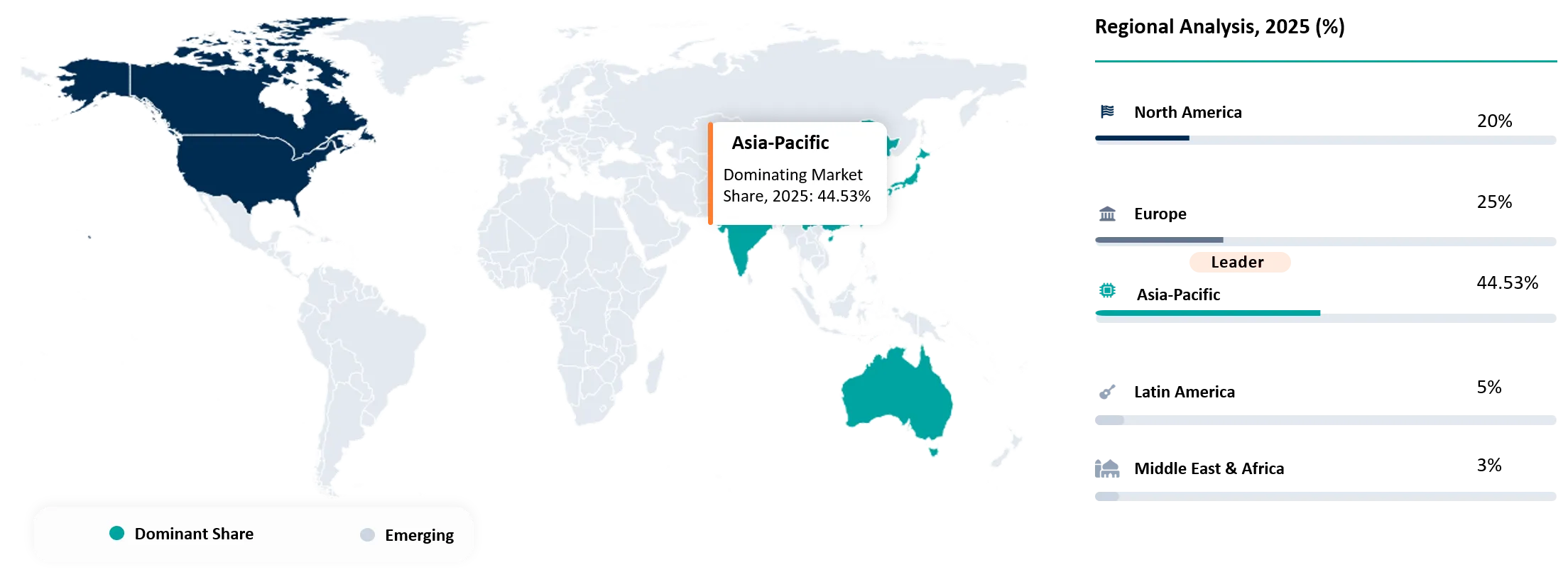
- Asia-Pacific held the largest regional market position with a 44.53% market share in 2025. The region's dominance is underpinned by its dense concentration of EV and semiconductor manufacturing.
- The Battery Electric Vehicles (BEVs) segment dominated the market with a 77.14% market share in 2025. This dominant share stems from BEVs relying on high-voltage battery systems alongside low-voltage electronics.
- A major automotive contract of €200 million (USD 229.5 million) was secured to supply DC-DC converters in China. These converters will transform 800V high-voltage battery power into 12V, with production starting in mid-2028.
- The UK expanded its DRIVE35 electrification programmer to £4 billion (USD 5.35 billion) through 2035. The funding targets capital projects across vehicle assembly, battery gigafactories, and power electronics.
Automotive DC-DC Converters Market Scope
| Metrics | Details | |
| 2025 Market Size | USD 1.44 Billion | |
| 2035 Projected Market Size | USD 26.2 Billion | |
| CAGR (2026-2035) | 33.7% | |
| Largest Market | Asia-Pacific | |
| Fastest Growing Market | Europe | |
| By Product | Isolated DC-DC Converters, Non-isolated DC-DC Converters, Bidirectional | |
| By Propulsion | Battery Electric Vehicles (BEVs), Fuel Cell Electric Vehicles (FCEVs), Plug-in Hybrid Electric Vehicles (PHEVs), Others | |
| By Input Voltage | Below 40V, 40-70V, Above 70V | |
| By Output Voltage | 3.3V, 5V, 12V, 15V, 24V and above | |
| By Output Power | Below 1kW, 1--10kW, 10–20kW, Above 20kW | |
| By Vehicle | Commercial Vehicles, Passenger Vehicles | |
| By Application | Power Electronics, Lighting Systems, Infotainment Systems, Electric Powertrain Systems, Safety Systems, Others | |
| By Region | North America | U.S., Canada, Mexico |
| Europe | Germany, UK, France, Spain, Italy, Poland, Netherlands, Switzerland | |
| Asia-Pacific | China, India, Japan, Australia, South Korea, Indonesia, Malaysia | |
| Latin America | Brazil, Argentina | |
| Middle East and Africa | UAE, Saudi Arabia, South Africa, Israel, Türkiye | |
| Report Insights Covered | Competitive Landscape Analysis, Company Profile Analysis, Market Size, Share, Growth | |
Automotive DC-DC Converters Market BCG Matrix: Company Evaluation

Stars include Infineon Technologies AG, Texas Instruments Incorporated, and STMicroelectronics, which have strong positions in automotive power semiconductors and extensive DC-DC conversion portfolios supporting EVs, 48V architectures, ADAS, zonal architectures, and high-voltage power systems. Question Marks include ROHM Semiconductor, Renesas Electronics Corporation, Mitsubishi Electric Corporation, and Vicor Corporation, which have strong technological capabilities and are expanding their presence in advanced automotive DC-DC conversion, particularly around SiC/GaN, bidirectional conversion, 48V systems, and high-voltage EV architectures.
Potential includes Toshiba Electronic Devices & Storage Corporation and Delta Electronics, Inc., which have relevant automotive DC-DC conversion technologies and are positioned to benefit from increasing adoption of 48V and high-voltage EV architectures, although their market positioning in automotive DC-DC converters is more specialized than the broad automotive power-conversion ecosystems of the leading companies. Tailenders include Panasonic Corporation, whose automotive electronics and component portfolio supports EV, ADAS, and other vehicle applications, but whose publicly visible positioning is less directly focused on dedicated automotive DC-DC converter platforms than the companies in the other categories.
Automotive DC-DC Converter Market Dynamics
Driver Impact Analysis
| Driver | Market Growth Impact (%) | Demand Concentration | Impacted Use Case | Strategic Impact |
Rapid vehicle electrification is increasing demand for HV-LV DC-DC converters to efficiently power low-voltage systems. | 4.2% | China, Europe, North America | EV/BEV power conversion, 12V auxiliary systems, low-voltage ECUs and vehicle electronics | Drives higher converter content per electrified vehicle and increases demand for efficient high-voltage-to-low-voltage architectures. |
Transition from 12V to 48V vehicle architectures is driving demand for high-efficiency 48V/12V DC-DC converters across modern automotive electrical systems. | 3.8% | Europe, China, Japan, North America | 48V mild hybrids, 48V/12V power distribution, regenerative braking and electrical accessories | Accelerates adoption of bidirectional 48V/12V converters and encourages suppliers to develop higher-efficiency, compact power-conversion platforms. |
Rising adoption of zonal electrical architectures is creating greater requirements for compact DC-DC converters within zone controllers. | 2.5% | North America, Europe, increasingly Asia-Pacific | Zonal controllers, distributed ECUs, Ethernet-connected vehicle electronics | Supports miniaturized, high-power-density converters and increases integration of DC-DC conversion directly into zonal power architectures. |
Increasing power requirements from ADAS and advanced vehicle electronics are accelerating the need for higher-power-density DC-DC conversion solutions. | 2.1% | Global, particularly premium EV and software-defined vehicle platforms | ADAS, infotainment, digital cockpit, sensors, computing and thermal-management systems | Raises required converter power density and efficiency, encouraging advanced semiconductor, thermal-management and multi-output converter designs. |
Rapid vehicle electrification is increasing demand for HV-LV DC-DC converters to efficiently power low-voltage systems
The rapid expansion of vehicle electrification has been leading to a greater need for high-voltage to low-voltage (HV-LV) DC-DC converters, which are necessary to convert the electricity stored in the batteries of electric and hybrid cars to feed the 12V or 48V electrical system. Global sales of electric cars have surpassed 20 million units by 2025, amounting to a quarter of all new cars sold globally, according to the International Energy Agency (IEA). The increasing electrification trend is leading to the need for effective conversion of power from high-voltage traction batteries to low-voltage loads such as ECUs, lighting, sensors, infotainment systems, and other auxiliary devices.
In parallel, in March 2026, according to Infineon Technologies AG, in its Unlocking Next-Gen xEV Power Conversion highlights that around 60% of total cars manufactured globally in the year 2031 will be electrified, thus driving the adoption of HV-LV DC-DC converters. According to the presentation, 400V batteries are considered mainstream, while 800V is growing and 900V+ systems are coming up. All these will lead to increased demand for higher-voltage conversion in electrified cars. Other trends that have been identified by Infineon in the next-gen xEV power conversion are bi-directional power flow, efficiency, high battery voltage, form-factor optimization, and system integration.
Automotive DC-DC Converters Market Segment Analysis
The global automotive DC-DC converters market is segmented based on product, propulsion, input voltage, output voltage, output power, vehicle, application, and region.
Battery Electric Vehicles (BEVs) Driving Dominance in Automotive DC-DC Converter Demand
Battery Electric Vehicles (BEVs) segment holds a dominant position in the automotive DC-DC converters market, with a market share of 77.14% in 2025. The leading market share of BEVs is attributed to the reliance of these vehicles on high-voltage battery systems and low-voltage electrical systems that require the use of DC-DC converters for the provision of energy to the vehicle electronics and other systems. In December 2025, according to STMicroelectronics, the common battery systems for current electric vehicles include 400V and 800V along with 12V, 24V, and 48V low voltage systems.
Further development towards more energy-efficient BEV power electronics continues to elevate the relevance of DC-DC converters. In March 2026, DENSO reported that its new generation of silicon carbide-based power semiconductors allows achieving up to 70% lower power losses compared with traditional silicon, which contributes to more compact and efficient power modules used in electrified vehicles. It was also noted that the third generation of DENSO SiC technology is currently being developed to be applied to BEV eAxle-integrated inverters, where reduction of power losses and system size is critical for improving the efficiency of the vehicle.
Automotive DC-DC Converters Market Geographical Penetration
Rapid EV Manufacturing Expansion and Power-Electronics Integration in Asia-Pacific
The Asia-Pacific region dominates the automotive DC-DC converters market, accounting for a 44.53% market share in 2025. The region’s leading position is supported by its concentration of electric-vehicle manufacturing, battery production, semiconductor supply chains, and automotive electronics production, particularly across China, Japan, South Korea, and Southeast Asia.
The partnership strengthens India’s domestic EV power-electronics manufacturing ecosystem by localizing DC/DC converter and on-board charger production. In September 2025, Sterling Tools Limited, an India-based automotive component manufacturer, through its subsidiary Sterling Gtake E-Mobility Limited, an India-based EV power-electronics company, partnered with Landworld Technology Co. Ltd., a China-based EV power-electronics and charging-system technology provider, under Technology License and Supply agreements to locally manufacture on-board chargers, DC/DC converters, and multifunction units incorporating on-board chargers, DC/DC converters, and power distribution units (PDUs) for passenger and commercial electric vehicles in India.
China Automotive DC-DC Converters Market Trends
China holds a dominant position in the Asia-Pacific automotive DC-DC converters market because of its robust electric vehicle manufacturing base and domestic automobile value chain. Moreover, with the increasing penetration of batteries, power semiconductors, inverters, and other power electronic modules in automobiles, there are many opportunities for the use of DC-DC converters in battery electric vehicles (BEVs) and hybrids. The increasing trend towards the use of high-voltage electrical systems, including 48V/12V electrical systems, is driving Chinese automakers to use more effective conversion modules.
The development highlights increasing demand for locally manufactured power-electronics solutions supporting next-generation battery-electric vehicles. In April 2025, MAHLE GmbH, a Germany-based automotive technology and components supplier, secured a €200 million (USD 229.5 million) contract to supply DC/DC converters for the future battery-electric vehicle models of an international automotive manufacturer in China. The converters will transform 800V high-voltage battery power into 12V, supplying vehicle systems such as cameras, multimedia systems and electric pumps. Series production is scheduled to begin in mid-2028 at MAHLE’s Changshu facility in China, where approximately 600 employees are currently based.
Japan Automotive DC-DC Converters Market Outlook
Japan is a key player in the Asia Pacific automotive DC-DC converters market with the help of its well-established automotive manufacturing industry, state-of-the-art power electronics technology, and presence of leading automotive vehicle and component makers from around the world. Companies based in Japan have gathered considerable experience regarding the incorporation of DC-DC converters in applications related to charging systems, power distribution, battery management, and vehicle control systems.
Growing demand for compact and efficient power-conversion solutions is accelerating the development of advanced automotive DC-DC converters. In July 2025, STMicroelectronics, a Switzerland-based semiconductor manufacturer, introduced the DCP0606Y automotive step-down DC-DC converter, designed to meet demanding power-management requirements in electric and conventional vehicles. The converter supports up to 6A continuous output current, adjustable output voltage down to 0.6V, and achieves up to 93% efficiency at full load, while its 2 × 3 mm QFN package enables compact vehicle power-electronics designs. The AEC-Q100 Grade 1-qualified device is intended for telematics, head-up displays, infotainment, camera systems and ADAS power supplies, with an operating temperature range of -40°C to +150°C.
EV Manufacturing Expansion and Power-Electronics Localization Supporting North America
North America is a significant region in the automotive DC-DC converters market, with a market share of 20% in 2025, due to the region’s presence of an established automotive industry, localization of the EV and power electronics supply chain, and development of advanced vehicle technologies. The U.S., Canada, and Mexico have shown an increased trend towards promoting local production of automobiles and components and present lucrative avenues for Automotive DC-DC Converters manufacturers catering to powertrain and battery, vehicle control electronics, and 12V/48V Electrical System applications.
The integration of high-voltage DC-DC conversion within EV battery packs is advancing more compact and efficient power-delivery architectures. In September 2026, INFAC Corporation, a South Korea-based automotive components and EV power-electronics manufacturer, introduced an 800V EV battery-pack design integrating an isolated and regulated 800V-to-48V DC-DC converter directly inside the battery pack, using Vicor Corporation, a U.S.-based power-electronics and high-density power-module manufacturer, BCM6135 DC-DC converter and PRM3735 regulator. The integrated system measures 215 × 45 × 82 mm, has a volume of approximately 793 cm³, and weighs around 1.5 kg, while supporting 3.5-12 kW loads through a 48V safety-extra-low-voltage (SELV) zonal network.
U.S. Automotive DC-DC Converters Market Trends
The U.S. holds a dominant position in the North American automotive DC-DC converters market owing to its well-established automotive sector, increasing manufacturing capabilities of electric vehicles (EVs) in the country, and availability of semiconductor and power-electronic component providers. The localization of advanced components used in electric cars in the country has increased in recent times. Some of these include batteries, silicon carbide-based semiconductors, inverters, chargers, and DC-DC converters.
The shift toward higher-efficiency EV powertrains is increasing demand for advanced semiconductor technologies in automotive power-conversion systems. In May 2025, Infineon Technologies AG, a Germany-based semiconductor manufacturer, and Visteon Corporation, a U.S.-based automotive cockpit electronics and mobility technology supplier, signed a memorandum of understanding to develop next-generation electric-vehicle powertrains. The companies will integrate Infineon’s CoolGaN gallium-nitride and CoolSiC silicon-carbide technologies into Visteon’s future EV powertrain applications, including DC-DC converters, battery junction boxes, and on-board chargers, targeting higher power density, efficiency, and thermal performance.
Automotive DC-DC Converters Market Competitive Landscape
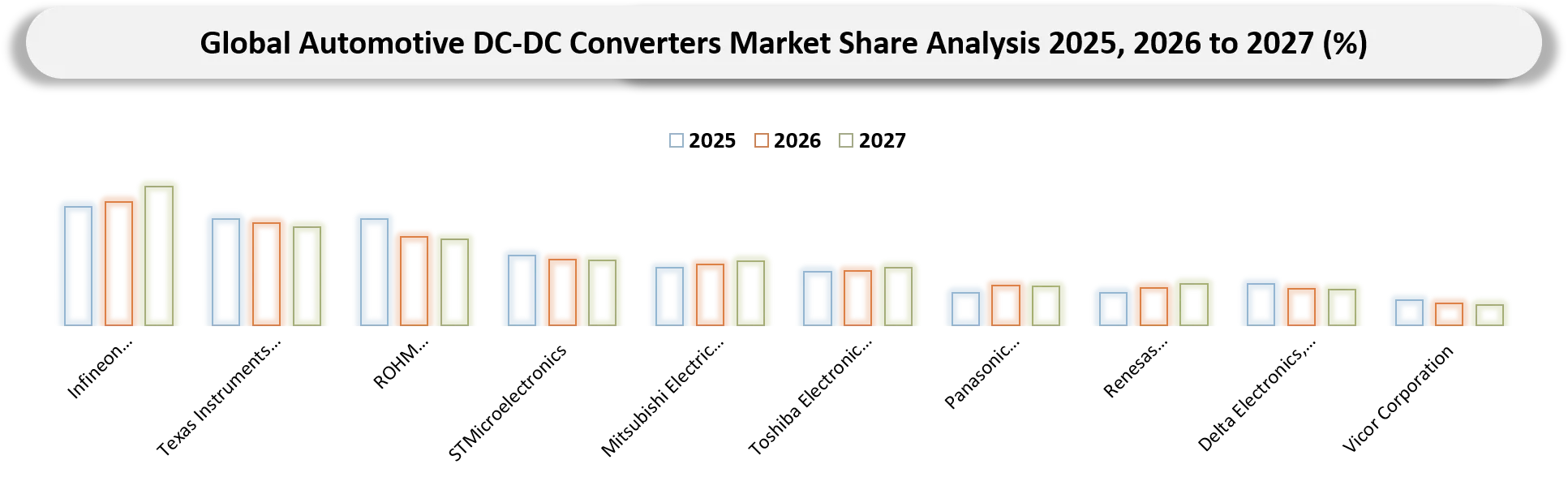
- The market is characterized by three key participant groups: automotive power-semiconductor and power-management leaders, advanced high-voltage and wide-bandgap power-conversion specialists, and integrated automotive electronics companies. Infineon Technologies AG, Texas Instruments Incorporated, ROHM Semiconductor, and STMicroelectronics lead in automotive-qualified DC-DC converters, power-management ICs, and SiC/GaN-based power technologies; Mitsubishi Electric Corporation, Toshiba Electronic Devices & Storage Corporation, and Vicor Corporation focus on high-voltage, high-efficiency, and high-power-density conversion solutions; while Panasonic Corporation, Renesas Electronics Corporation, and Delta Electronics, Inc. integrate power-management, automotive electronics, and electrification technologies for vehicle applications.
- Key players include Infineon Technologies AG (Germany), Texas Instruments Incorporated (U.S.), ROHM Semiconductor (Japan), STMicroelectronics (Switzerland), Mitsubishi Electric Corporation (Japan), Toshiba Electronic Devices & Storage Corporation (Japan), Panasonic Corporation (Japan), Renesas Electronics Corporation (Japan), Delta Electronics, Inc. (Taiwan), and Vicor Corporation (U.S.).
Key Developments
- December 2025: onsemi, a U.S.-based semiconductor manufacturer, and GlobalFoundries (GF), a U.S.-based semiconductor foundry and manufacturing company, signed a collaboration agreement to develop and manufacture next-generation 650V gallium-nitride (GaN) power devices using GF’s 200mm eMode GaN-on-silicon process.
- October 2025: BorgWarner Inc., a U.S.-based automotive technology and electrification systems supplier, expanded its collaboration with Great Wall Motor (GWM), a China-based automotive manufacturer, by securing two additional dual-inverter programs for hybrid vehicles.
- September 2025: Easytronics Co., Ltd. (Egtronics), a South Korea-based power-electronics manufacturer specializing in high-efficiency power-conversion systems, and Samvardhana Motherson International Limited (Motherson), an India-based automotive components manufacturer, formed a joint venture to manufacture and supply EV DC-DC converters and other vehicle power-electronics products in India.
- September 2025: TDK Corporation, a Japan-based electronic-components and power-electronics manufacturer, announced the transfer of its new automotive power-supply development business to Astemo, Ltd., a Japan-based automotive components and mobility technology company.
- July 2025: Vicor Corporation, a U.S.-based high-performance power-module and power-electronics manufacturer, announced that its Japanese subsidiary Vicor K.K. would present high-density automotive power-conversion solutions at the Automotive Engineering Exposition 2025 Nagoya.
- June 2025: Delta-Q Technologies, a Canada-based electric-vehicle and industrial-equipment power-management and charging solutions provider, acquired SMPC Technologies, a Canada-based power-electronics company specializing in chargers, DC-DC converters, and inverters.
Key Procurement Priorities and Buyer Evaluation Criteria
- Organizations procuring Automotive DC-DC Converters increasingly prioritize suppliers capable of delivering high-efficiency, compact, and automotive-qualified power-conversion solutions that can operate reliably across high-voltage traction-battery and 12V/48V electrical architectures.
- The procurement decision-making process is increasingly influenced by the transition toward BEVs, 400V/800V vehicle platforms, 48V electrical systems, zonal architectures, and software-defined vehicles, which increases requirements for efficient voltage conversion, higher power density, bidirectional operation, and integration with vehicle power-distribution systems.
- Buyers consider factors such as conversion efficiency, input/output voltage range, output power, thermal performance, electromagnetic compatibility (EMC), power density, operating temperature, transient response, functional safety, and AEC-Q qualification when selecting DC-DC converter suppliers.
Why Choose DataM?
- Technological Innovations: Explores advancements in automotive DC-DC converter technologies, including bidirectional conversion, 48V architectures, high-voltage conversion, silicon-carbide (SiC) and gallium-nitride (GaN) semiconductors, high-power-density designs, and integrated power electronics for EVs, ADAS, and zonal vehicle architectures.
- Product Performance & Market Positioning: Evaluates how different players differentiate their DC-DC converter solutions based on conversion efficiency, voltage range, output power, thermal performance, power density, compactness, reliability, and integration capabilities across BEVs, PHEVs, commercial vehicles, and passenger vehicles.
- Real-World Evidence: Highlights the deployment of automotive DC-DC converters across electric powertrains, 12V/48V auxiliary systems, lighting, infotainment, safety systems, ADAS, battery management, and vehicle control electronics, demonstrating their role in efficient power distribution and reliable operation of increasingly electronic vehicles.
- Market Updates & Industry Changes: Tracks key developments such as new converter launches, EV platform upgrades, 48V and 800V architecture adoption, SiC/GaN integration, manufacturing capacity expansions, semiconductor investments, and strategic collaborations across Asia-Pacific, North America, and Europe.
- Competitive Strategies: Analyzes how leading companies expand their automotive power-electronics portfolios through technology innovation, automotive-qualified semiconductor development, strategic partnerships, platform integration, capacity expansion, and solutions tailored to EV, hybrid, ADAS, and software-defined vehicle applications.
- Pricing & Market Access: Examines pricing variations according to voltage class, output power, topology, semiconductor technology, power density, thermal-management requirements, functional-safety requirements, and level of integration, while assessing supply channels through automotive OEMs, Tier-1 suppliers, semiconductor manufacturers, and power-electronics providers.
- Market Entry & Expansion: Identifies growth opportunities arising from vehicle electrification, 48V systems, 400V/800V EV platforms, zonal architectures, advanced driver-assistance systems, and increasing vehicle electronics content, while outlining strategies such as regional manufacturing, technology differentiation, OEM partnerships, and localized supply-chain development.
Target Audience
- Automotive OEMs
- Tier-1 Automotive Suppliers
- DC-DC Converter & Power Electronics Manufacturers
- Semiconductor & Power Device Companies
- EV & Battery Technology Companies
- Automotive Electronics & System Integrators
- Procurement & Supply-Chain Managers



























































