


Automotive Collision Repair Market Overview
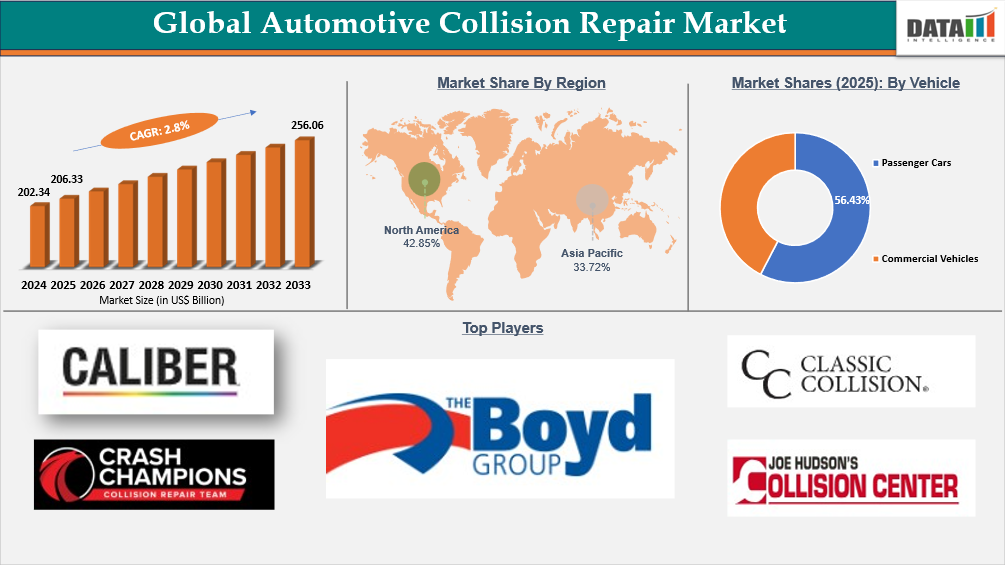
According to DMI analysis, the global automotive collision repair market reached US$ 202.34 billion in 2024, rising to US$ 206.33 billion in 2025 and is expected to reach US$ 256.06 billion by 2033, growing at a strong CAGR of 2.8% during the forecast period from 2026 to 2033.
The global automotive collision repair market is driven by rising vehicle ownership and the increasing number of road accidents, including the estimated 3,000 daily global crashes, with up to 22% caused by alcohol or drug impairment, which elevates demand for professional repair services. The demand is also rising because of more traffic and vehicles in developing countries, leading to higher accident rates and repair needs. Because of this, repair shops are increasing their capacity and using better technology to handle more repairs quickly. As more people have car insurance and there is a need for reliable, high-quality repairs, the market is expected to grow a lot.
The market also continues to grow through technological innovation and strategic investments that further improve repair speed, accuracy, and transparency of workflows, as witnessed by PartsTrader's launch in December 2025 of Orderly, an AI-powered procurement platform that simplifies how parts are ordered and elevates compliance within DRP networks. Digital solutions support, reduction of cycle times by repairers and automation of back-office tasks without compromising supplier choice, are reinforcing efficiency and collaboration within the industry.
Automotive Collision Repair Industry Trends and Strategic Insights
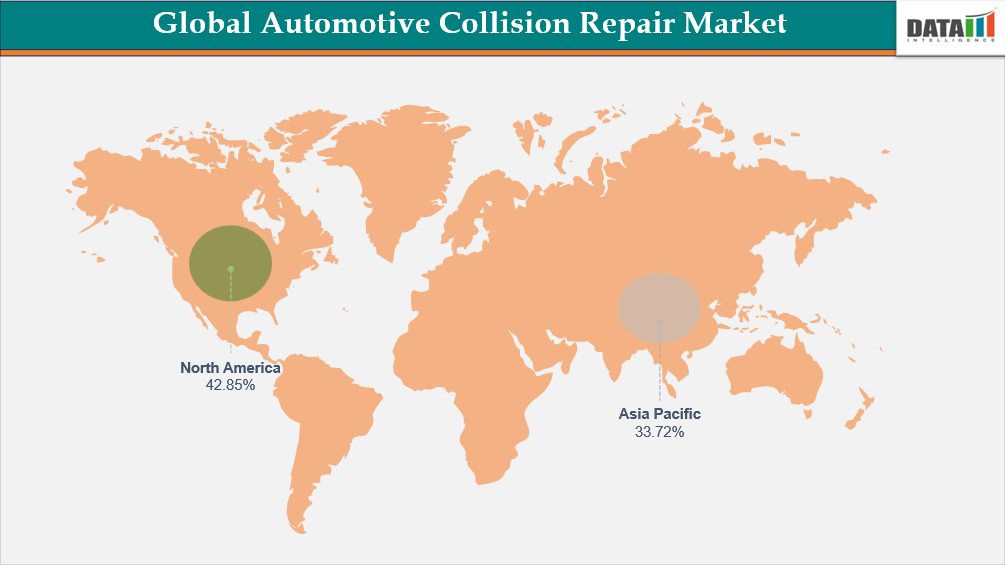
- North America dominates the global automotive collision repair market with a 42.85% revenue share in 2025, driven by high vehicle ownership, accident rates and strong insurance-backed repair networks.
- By vehicle segment, passenger cars dominated the global automotive collision repair market with a 56.43% revenue share in 2025, driven by their high ownership levels and greater accident frequency worldwide.
Global Automotive Collision Repair Market Size and Future Outlook
- 2025 Market Size: US$ 206.33 Billion
- 2033 Projected Market Size: US$ 256.06 Billion
- CAGR (2026–2033): 2.8%
- Dominating Market: North America
- Fastest Growing Market: Asia-Pacific
Market Scope
| Metrics | Details | |
| By Offering | Parts, Paints & Coatings, Adhesives & Sealants, Consumables, Equipment & Tools, Services (Labor), Others | |
| By Part Source | OEM / Genuine Parts, Certified Aftermarket Parts, Recycled / Salvage Parts, Remanufactured / Reconditioned Parts | |
| By Vehicle | Passenger Cars, Commercial Vehicles | |
| By Repair Type | Structural Repair, Cosmetic & Paint Repair, Glass Repair & Replacement, Mechanical Collision-Related Repair, Electrical & Electronics Repair, ADAS Calibration, Others | |
| By Service Provider | Independent Body Shops, Multi-Shop Operators (MSOs), Dealer / OEM-Authorized Body Shops, Specialist Service Providers | |
| By Service Mode | Do-It-For-Me (DIFM), Do-It-Yourself (DIY), Hybrid (DIY Parts Purchase + Professional Installation) | |
| By Payer | Insurance-Paid Repairs, Customer-Pay (Out-of-Pocket), Fleet / Rental / Leasing Programs | |
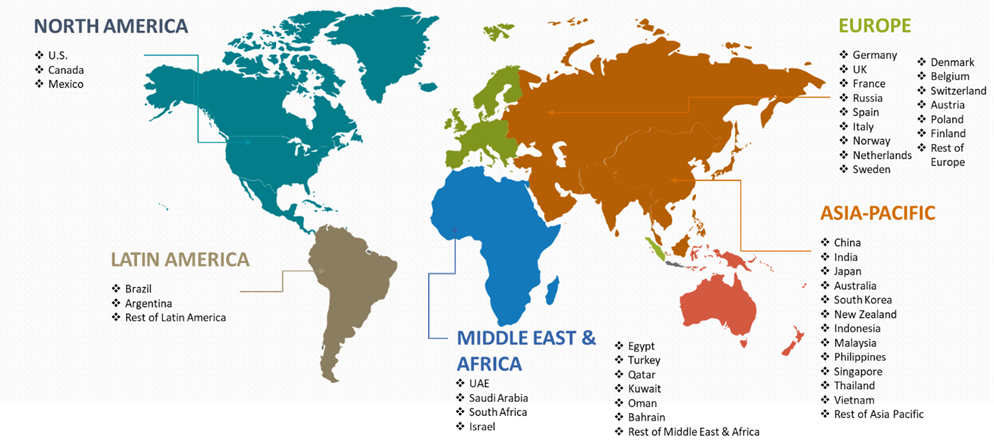
| By Region | North America | U.S., Canada, Mexico |
| Europe | Germany, UK, France, Spain, Italy, Norway, Netherlands, Sweden, Denmark, Belgium, Switzerland, Austria, Poland, Finland | |
| Asia-Pacific | China, India, Japan, Australia, South Korea, New Zealand, Indonesia, Malaysia, Philippines, Singapore, Thailand, Vietnam | |
| Latin America | Brazil, Argentina | |
| Middle East and Africa | UAE, Saudi Arabia, South Africa, Israel, Egypt, Turkey, Qatar, Kuwait, Oman, Bahrain | |
| Report Insights Covered | Competitive Landscape Analysis, Company Profile Analysis, Market Size, Market Share, Market Growth | |
Market Dynamics
Increasing Vehicle Ownership and Road Accidents
Some of the key factors driving the growth of the automotive collision repair market includes increasing vehicle ownership. About 92% of households in U.S. are noted to own at least a car, which shows that most of them are dependent on vehicles to move around. With almost 285 million private and commercial vehicles registered, traffic density is rising. The increased concentration of vehicles enhances the probability of collision, thereby increasing the demand for collision repair services.
The increase in the number of accidents due to higher traffic density further increases the repair needs arising from collisions directly. Advanced structural, welding, and refinishing repairs are needed for modern vehicles that are involved in an accident. Institutions are expanding their training to meet the demand. For example, Johnson College, a U.S. based institute announced the introduction of a new program in Automotive Collision Repair via its WAVE department in July 2025. The program was developed in collaboration with I-CAR, Toyota of Scranton, and Sherwin-Williams and contains 104 lessons and more than 500 hours of contact. The developments support workforce growth and consequently reinforce market expansion globally.
Segment Analysis
The global automotive collision repair market is segmented based on offering, part source, vehicle, repair type, service provider, service mode, payer and region.
High ownership of Passenger Cars and usage in daily activities impacted sales
Passenger cars make up a substantial percentage of the total global automotive collision repair market because they constitute the largest percentage of automobiles used for daily activities. High ownership, as well as urban traffic and commuting frequency, exposes passenger cars to an increased risk of accidents, either big or small. Passenger cars have, therefore, shown steady demand for repair services involving body work, repainting, and replacement of body components.
Additionally, the stability in vehicle sales also boosted the dominance in the collision repair industry. According to the International Council on Clean Transportation, the new car registrations in the EU pointed to a total of 10.6 Million vehicles in 2024, an increase from the previous years, which shows the stability in the industry, building on the upward trend in 2022 and 2023. The stability of the passenger cars is beneficial in the long-term growth of the global collision repair market.
Geographical Penetration
DOMINATING MARKET:
North America Dominates Because of High Vehicle Age and Strong Insurance Coverage
The high ownership of vehicles, along with many aging vehicles on the highways, places North America in a position of strong share in the automotive collision repair market. Advanced technologies in vehicles and an organized network of repair shops create a positive influence on the market in the region. Strong insurance penetration, along with mandatory vehicle safety regulations, will keep the demand for professional collision repair services high. Additionally, major automobile manufacturers located in the region ensure high consumer spending, thereby helping to grow the market. Further, increased adoption of advanced materials and repair technologies are going to help strengthen the market.
U.S. Automotive Collision Repair Market Outlook
U.S. market is dominant in terms of automotive collision repair, given its higher rate of vehicle ownership and the number of older vehicles requiring repairs. According to the latest U.S. Census statistics, 92% of American families own at least one vehicle. Furthermore, there are close to 285 million private and commercial vehicles registered in U.S. The market is also driven by a wide availability of insurance and safety regulations. Secondly, there was a growth in demand due to 8% new registrants in 2024, which consisted of Electric Vehicles.
Canada Automotive Collision Repair Market Trends
Canada's automotive repair market is growing because of an increase in vehicles on the road, with 26.8 million road motor vehicles registered in 2024, up by 4.2% from previous years. More than 9 in 10 (91.6%) of vehicles registered in 2024 were light-duty vehicles, as opposed to heavy vehicles, and these tend to have higher repair needs because of extensive use. Also contributing to the growth of the repair market in Canada are electric vehicles which made up 5.2% of registered vehicles in 2024 and increased from 3.9% in 2023. Safety regulations and well-established repair shops contribute to the growth of the automotive repair market in Canada.
Regulatory Analysis
Major government agencies responsible for the safety of vehicles, environment, and protection of consumers act as a driving factor affecting the automotive collision repair market worldwide. For instance, in U.S., the NHTSA will govern the aspects relating to the safety and repair of motor vehicles while the OSHA will govern the safety aspects of the auto repair shops. Apart from these, the EPA would be in charge of safe hazardous waste disposal, paint, and solvents, while state agencies such as the California Air Resources Board, CARB, would be in charge of stringent regulations about air-quality aspects.
In Europe, it is maintained under the European Union (EU) and individual regulatory bodies with the implementation of regulations such as the EU's "Registration, Evaluation, Authorization, and Restriction of Chemicals" regulation and the "End-of-Life Vehicles" directive. In UK, the Department for Transport (DfT) and the Environment Agency regulate the implementation of regulations on the environment and safety.
Similarly, in Asia, countries such as Japan and China utilize organizations such as Japan's Ministry of Land, Infrastructure, Transport and Tourism (MLIT) and China's Ministry of Ecology and Environment (MEE) for regulations on repair standards, emissions, handling of hazmat materials, etc., for vehicles.
Competitive Landscape
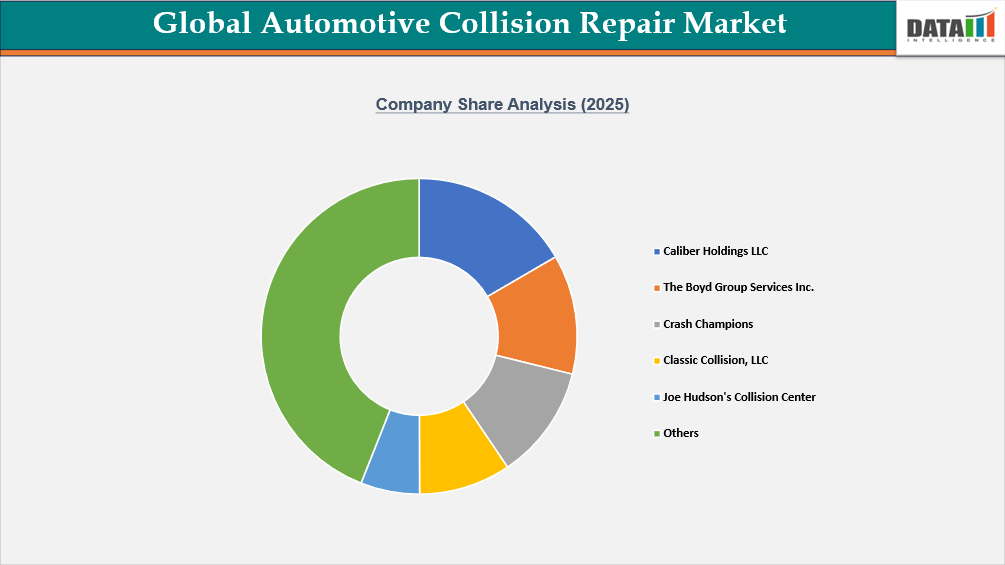
- The automotive collision repair industry is fragmented and includes a combination of independent and multi-location providers. Its competition is based on price, quality, and service.
- Major firms in the market include Caliber Holdings LLC, The Boyd Group Services Inc., Crash Champions, Classic Collision, LLC, Joe Hudson's Collision Center, 3M Company, LKQ Corporation, PPG Industries, Inc., BASF SE, and Driven Brands, Inc.
- Providers compete in terms of investment in high-tech equipment used for diagnosing and repairing complex vehicles and insurance contracts, which impact market share.
Key Developments
- In January 2026, PPG’s SEM Products and 4Plastic launched a next-generation texture coating system in the U.S. and Canada to repair non-painted, textured plastic auto parts. The coatings replicate common OEM textures and use the 4Plastic app to quickly identify the correct texture for each job, enabling accurate and efficient repairs.
- In December 2025, PartsTrader launched Orderly, an AI-powered, end-to-end procurement platform designed to modernize collision repair parts ordering. The system includes all modules of order procuring, starting with correct pre-procurement and followed by intelligent procuring, culminating with intelligent financial reconciliations.
- In January 2025, Sony Honda Mobility of America (SHMA) collaborated with Crash Champions at CES 2025. They announced that SHMA would utilize Crash Champions to offer repair and maintenance services for customers of their AFEELA electric vehicles. The partnership will offer AFEELA customers access to Crash Champions’ network of I-CAR Gold Class collision repair centers.
- In April 2024, I-CAR introduced a mobile application for the Repairability Technical Support (RTS), which is expanding the functionality from a web-based only solution to a more mobile technology-enabled solution for collision repair. The application will benefit collision repairers with the availability of OEM repair information, calibrations, updates, and best practices.
- In January 2023, Fix Network World marked a significant milestone with the opening of 17 Fix Auto Collision outlets in Saudi Arabia, in partnership with Gulf Motor Company, which is a member of United Motors Group. The Fix Network World expansion was completed in just over two years and was launched in January 2023. It is the world's largest Fix Auto Collision center with the capability to service up to 880 vehicles monthly.
Investment & Funding Landscape
The global automotive collision repair market has good growth potential with increasing numbers of vehicles being owned, advancements in safety technologies leading to repairs, and hence promises to be a good investment opportunity. When it comes to risks, there are concerns about capital intensity and cyclicality in the market, including those related to government regulations and economic conditions.
| Company | Investment/Funding | Year | Details | |
| Kinetic | US$ 21 Million Funding | June, 2024 | Kinetic, a specialist automotive infrastructure company that provides digital vehicle maintenance and repair services to EVs and AVs, raised a US$ 21 million Series B round from investors like Menlo Ventures, with participation from Allstate Strategic Ventures, Liberty Mutual Strategic Ventures, and others. The funds will be used to drive growth, increase its facilities, and hire top talent within the technology and engineering spaces. | |
What Sets The Global Automotive Collision Repair Market Intelligence Report Apart
- Latest Data & Forecasts – Comprehensive, up-to-date insights and projections through 2033. Coverage includes global value by offering, part source, vehicle, repair type, service provider, service mode, payer. Scenario forecasts with region-level splits (North America, Europe, Asia-Pacific, Latin America, Middle East and Africa) and sensitivity to factors such as regulatory reclassification and raw-material costs.
- Regulatory Intelligence – Actionable analysis of regulatory frameworks that materially affect Automotive Collision Repair commercialization, revenue by country, allowable label claims, permitted doses, import/export controls and advertising restrictions.
- Competitive Benchmarking – Standardized profiling and benchmarking of leading pharma and nutraceutical players, contract manufacturers and e-commerce specialists active in the market.
- Geographic & Emerging Market Coverage – Region-by-region market sizing, growth drivers, reimbursement dynamics, cultural/consumer behavior and market access considerations. Focus on high-growth or regulatory-uncertain markets.
- Actionable Strategies – Identify opportunities for launching innovative products, while leveraging strategic partnerships and supply chain integration for maximum ROI.
- Pricing & Cost Analysis – In-depth assessment of price trends, raw material costs and sustainability-driven cost efficiencies across regional markets.
- Expert Analysis – Insights from industry experts such as industry leaders, regulatory affairs professionals and key manufacturing companies.
Target Audience 2026
- Original Equipment Manufacturers (OEMs) – Automotive manufacturers and authorized repair networks defining repair standards, certification programs, parts usage and repair technologies for modern vehicles.
- Insurance Companies & Claims Managers – Auto insurers, third-party administrators and claims adjusters managing accident claims, repair approvals, cost control and preferred repair networks.
- Aftermarket Parts & Materials Suppliers – Manufacturers and distributors of replacement parts, paints, coatings, adhesives, tools and repair equipment supporting collision repair operations.
- Technology & Equipment Providers – Companies supplying diagnostic tools, ADAS calibration systems, frame alignment equipment, paint booths, robotics and digital repair management solutions.
- Fleet Operators & Mobility Providers – Rental car companies, ride-hailing platforms, logistics fleets and corporate vehicle operators requiring fast, cost-effective and scalable collision repair services.
- Investors & Financial Institutions – Private equity firms, venture capital groups, strategic investors and lenders tracking consolidation, technology adoption and growth opportunities in the collision repair sector.
- Consulting & Advisory Firms – Automotive consultants, operational improvement specialists and digital transformation advisors supporting repair shops, insurers and OEM networks.


























































