


Asia-Pacific Advanced Wound Care Market Size
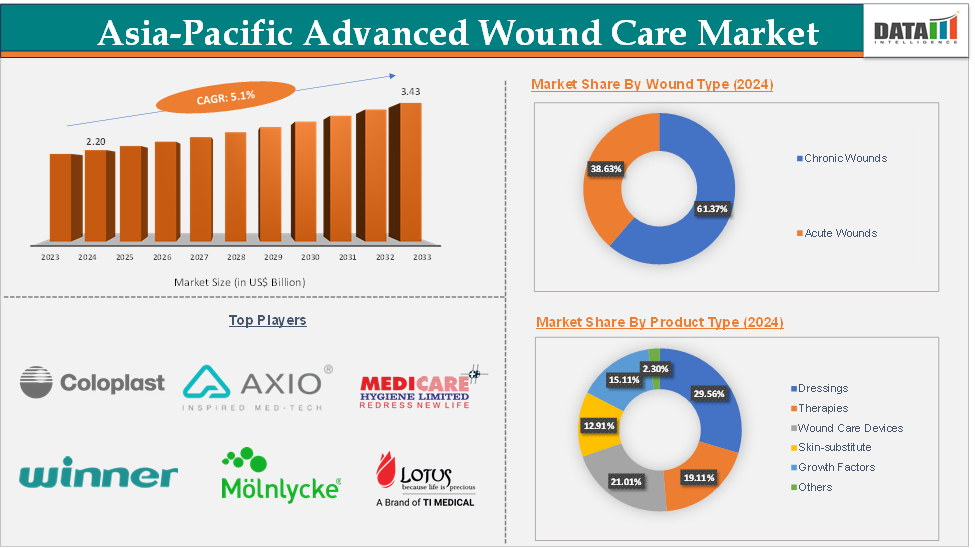
Asia-Pacific advanced wound care market reached US$2.20 billion in 2024 and is expected to reach US$3.43 billion by 2033, growing at a CAGR of 5.1% during the forecast period 2025-2033, according to DataM Intelligence report.
Asia-Pacific Advanced Wound Care Market Overview
The Asia-Pacific advanced wound care market is experiencing significant growth, driven by factors such as the increasing prevalence of chronic diseases, technological advancements, and rising awareness and wound care initiatives in the region. For instance, in September 2024, HCAH, a leading provider of comprehensive out-of-hospital healthcare solutions in India, introduced a groundbreaking initiative aimed at accelerating patient recovery and improving healing processes. The company partnered with Aroa Biosurgery of New Zealand to tackle the challenges associated with bedsores and enhance patient care. With this partnership, HCAH launched the "WOW (Warriors of Woundcare) Nurses" programme, which focuses on preventing and treating bedsores effectively.
Executive Summary
For more details on this report – Request for Sample
Asia-Pacific Advanced Wound Care Market Dynamics: Drivers & Restraints
Rising aging population and prevalence of chronic diseases are significantly driving the Asia-Pacific advanced wound care market growth
As people age, they are more susceptible to conditions that require advanced wound care, such as pressure ulcers due to prolonged immobility, diabetic foot ulcers due to complications from diabetes, and venous leg ulcers from poor circulation. Countries like Japan reported significant increases in the number of elderly patients requiring advanced wound management solutions.
For instance, according to the study conducted by the National Institute of Health, of the 1,126 participants, 113 (10%) had one or more pressure injuries. Overall, the estimated number of adults with pressure injuries in Goto (a city located on a remote rural archipelago in Japan) was 301.4. The prevalence rate of pressure injuries was 9.2 per 1000 population in adults aged ≥18 years, 20.3 in those aged ≥65 years, and 44.6 in those aged ≥80 years.
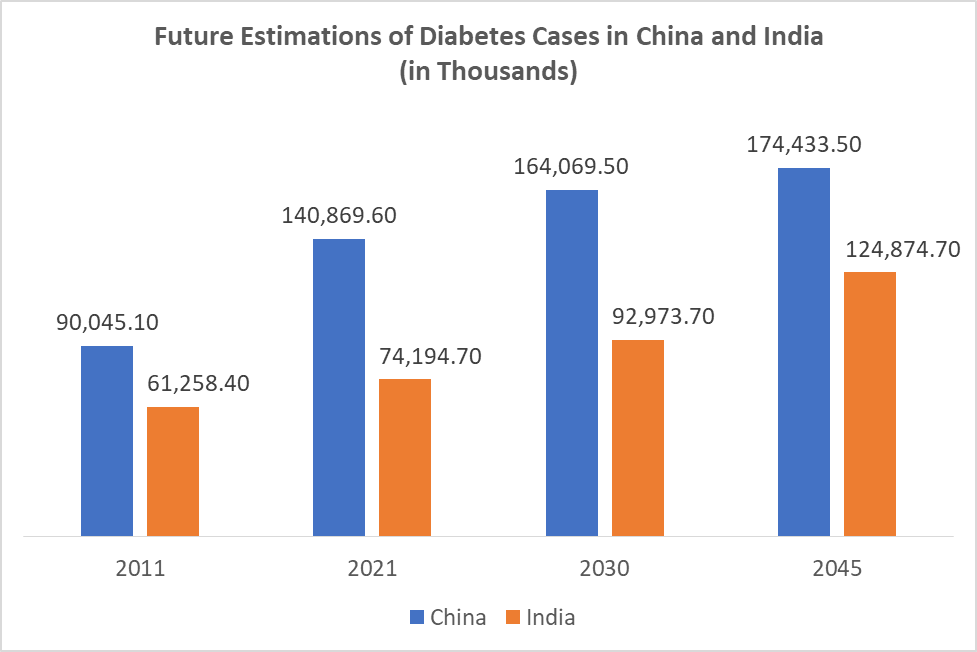
The high prevalence of diabetes across Asia, especially in countries like India and China, contributes significantly to the demand for advanced wound care. Chronic diabetic wounds, such as diabetic foot ulcers, are a major concern as they can lead to severe complications like amputations if not treated properly. For instance, according to the International Diabetes Federation, 107 million people have diabetes in Southeast Asia, and by 2050, this will rise to 185 million. These lead to an increased need for advanced wound care products, such as advanced dressings and therapy devices, to manage chronic wounds effectively.
Cultural and traditional preferences are hampering the growth of the Asia-Pacific advanced wound care market.
In many Asian countries, there is a strong cultural inclination towards using herbal and natural remedies for health issues, including wound care. These treatments are perceived as more accessible, cost-effective, and culturally acceptable, often passed down through generations. For instance, in countries like India and China, traditional medicines, such as turmeric, neem, and aloe vera, are widely used to treat wounds due to their antiseptic and healing properties.
In rural areas of India, it’s common for families to use turmeric paste or neem leaves to cover wounds, believing that these natural substances promote faster healing and prevent infections. This preference for home remedies or traditional methods over modern, scientifically backed wound care solutions hinders the adoption of advanced wound care products that could offer better outcomes.
Cultural resistance plays a significant role in the slow uptake of advanced wound care solutions. In some communities, there is skepticism about the safety and efficacy of new technologies due to concerns about side effects or unfamiliarity. Traditional methods, deeply rooted in local culture, are often trusted more because they are seen as safe and proven over generations.
Asia-Pacific Advanced Wound Care Market Segment Analysis
The Asia-Pacific advanced wound care market is segmented based on product type, wound type, end-user, and region.
The chronic wounds from the wound type segment are expected to hold 61.37% of the market share in 2024 in the Asia-Pacific advanced wound care market.
The prevalence of diabetes in the Asia-Pacific region is among the highest in the world. In countries like India and China, the rising incidence of diabetes has led to a significant increase in diabetic foot ulcers, a common type of chronic wound. These ulcers are difficult to heal due to poor circulation, high blood sugar levels, and decreased immunity. The high prevalence of diabetes directly correlates with a higher incidence of diabetic foot ulcers, driving the demand for advanced wound care products.
Chronic wounds, such as diabetic foot ulcers, pressure ulcers, and venous ulcers, are difficult to treat with conventional methods due to factors like bacterial contamination, lack of moisture balance, and impaired tissue regeneration. Advanced wound care products provide specialized solutions such as bioengineered skin substitutes, growth factors, and advanced dressings to manage these complex wounds effectively.
Asia-Pacific Advanced Wound Care Market Major Players
The major Asia-Pacific players in the advanced wound care market include Coloplast Group, Axio Biosolutions Pvt Ltd, Lotus Surgicals Pvt Ltd, Medicare, Winner Medical Co., Ltd., 3M, Smith+Nephew, Cardinal Health, Mölnlycke Health Care AB, and Convatec Inc., among others.
Market Scope
Metrics | Details | |
CAGR | 8.5% | |
Market Size Available for Years | 2022-2033 | |
Estimation Forecast Period | 2025-2033 | |
Revenue Units | Value (US$ Bn) | |
Segments Covered | Product Type | Dressings, Therapies, Wound Care Devices, Skin Substitutes, Growth Factors, and Others |
Wound Type | Chronic Wounds and Acute Wounds | |
End-User | Hospitals, Homecare Settings, Specialty Clinics, Ambulatory Surgical Centers, and Others | |
The Asia-Pacific advanced wound care market report delivers a detailed analysis with 39 key tables, more than 30 visually impactful figures, and 147 pages of expert insights, providing a complete view of the market landscape.




























































