


Ankle Replacement Devices Market Size
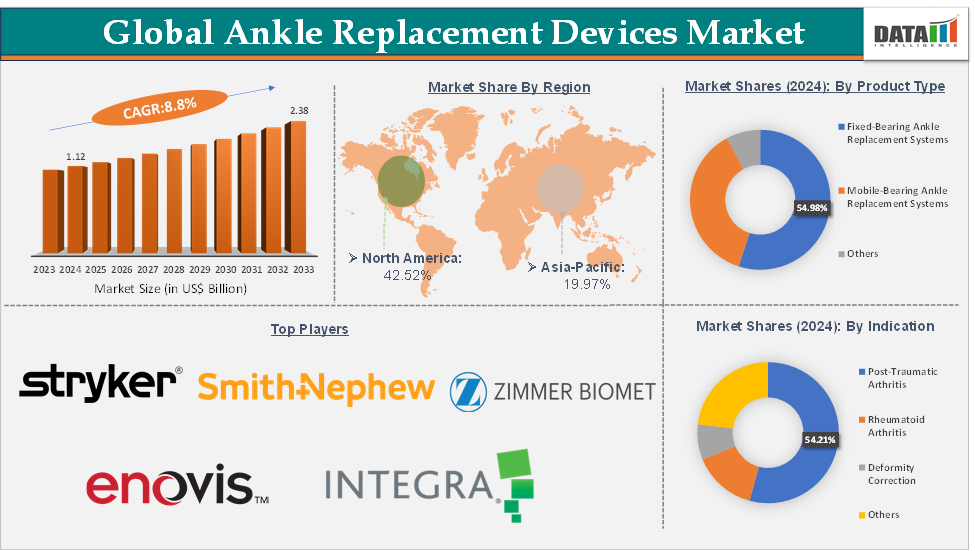
The global ankle replacement devices market size reached US$ 1.22 Billion in 2025 from US$ 1.04 Billion in 2023 and is expected to reach US$ 2.83 billion by 2035, growing at a CAGR of 8.8% during the forecast period 2026-2035.
Ankle Replacement Devices Market Key Takeaways
- Fixed-bearing systems held 54.98% of revenue in 2025, supported by established clinical use, simpler design characteristics, and established implant platforms.
- Post-traumatic arthritis represented 54.21% of the market in 2025, highlighting the importance of trauma-related joint degeneration to total ankle replacement demand.
- North America accounted for 42.52% of revenue in 2025, reflecting high procedural activity, advanced orthopedic infrastructure, and the presence of major implant manufacturers.
- Asia-Pacific is projected to record the fastest regional CAGR of 8.9%, creating additional opportunities for orthopedic suppliers as access to specialized procedures expands.
- Stryker, Zimmer Biomet, Smith+Nephew, Enovis, restor3d and other orthopedic companies are competing through implant platforms, product development, personalized solutions, and portfolio expansion.
Ankle Replacement Devices Market Scope
| Metric | Details |
| Market Size in 2025 | US$ 1.22 billion |
| Market Size by 2035 | US$ 2.83 billion |
| CAGR | 8.80% |
| Historic Years | 2023-2024 |
| Base Year | 2025 |
| Forecast Period | 2026-2035 |
| Segments Covered | Product Type, Material, Indication, End-User, Region |
| Leading Region | North America |
| Fastest Growing Region | Asia-Pacific |
Executive Summary
Ankle Replacement Devices Market Dynamics
Drivers - The rising prevalence of end-stage ankle osteoarthritis and post-traumatic injuries is significantly driving the ankle replacement devices market growth
The rising prevalence of end-stage ankle osteoarthritis, particularly cases stemming from post-traumatic injuries, is a major driver of ankle replacement device market growth. Unlike hip and knee osteoarthritis, which is often degenerative, approximately 80% of ankle OA cases are post-traumatic, according to the National Institutes of Health (NIH), commonly linked to fractures and severe sprains.
According to the World Health Organization (WHO), every year, the lives of approximately 1.19 million people are cut short as a result of a road traffic crash. Between 20 and 50 million more people suffer non-fatal injuries, with many incurring a disability. This surge in global road traffic accidents, sports-related injuries, and aging populations has further intensified disease incidence, while older adults now increasingly seek motion-preserving alternatives to fusion.
According to the World Health Organization, by 2030, 1 in 6 people in the world will be aged 60 years or over. At this time, the share of the population aged 60 years and over will increase from 1 billion in 2020 to 1.4 billion in 2030. By 2050, the world’s population of people aged 60 years and older will double (2.1 billion). With these demographic projections indicating that the elderly population will double by 2050 and growing awareness of ankle replacement as a superior option for mobility preservation, demand is accelerating across regions.
Restraints - High device and procedure costs are hampering the growth of the ankle replacement devices market
The high cost of ankle replacement devices and procedures is a major factor hampering market growth, especially when compared to the more economical ankle fusion. On average, total ankle replacement costs range from $5,130 to $39,253. With Medicare, ankle replacement surgery costs $1,446 to the person undergoing the surgery. In emerging markets, where healthcare reimbursement systems are still developing, device and procedure costs well higher, often pushing surgeons to recommend fusion instead, which is cheaper and more widely accessible. For instance, the basic price for total ankle replacement cost in India in a general ward starts at USD 6,500, and for a twin-sharing room, the price tag is approximately USD 7,500.
Moreover, TAR demands specialized instruments, longer operating times, and higher post-operative care costs, further straining hospital budgets and insurance approvals. This financial burden, coupled with inconsistent reimbursement policies, restricts patient access and slows adoption, making cost one of the most persistent restraints limiting the ankle replacement devices market despite their clinical advantages.
For more details on this report – Request for Sample
Ankle Replacement Devices Market Segmentation Analysis
The global ankle replacement devices market is segmented based on product type, material, indication, end-user, and region.
Product Type - The fixed-bearing ankle replacement systems segment is dominating the ankle replacement devices market with a 54.98% share in 2025
Fixed-bearing ankle replacement systems dominate the global market, primarily due to their simpler two-component design, cost-effectiveness, and proven clinical reliability. Their popularity is reinforced by strong product portfolios such as INBONE II and INFINITY ankle systems and Salto Talaris fixed-bearing solutions. These implants have consistently demonstrated high survivorship rates, functional improvement, and lower revision risks compared to mobile-bearing devices, making them the preferred choice among surgeons.
Clinical studies also highlight that fixed-bearing systems may yield lower cumulative revision rates than mobile-bearing alternatives, reinforcing payer and provider confidence. For instance, according to the study conducted by the National Institutes of Health (NIH), 3902 ankles in 28 studies were included. 719 were fixed-bearing and 3104 mobile bearings with an overall survivorship of 94% and 89% respectively. With their balance of affordability, ease of surgical use, and durability, fixed-bearing systems continue to maintain their lead as the gold standard in ankle replacement worldwide.
Indication - The post-traumatic arthritis segment is dominating the ankle replacement devices market with a 54.21% share in 2025
The post-traumatic arthritis segment is driven by the high prevalence of trauma-related ankle degeneration and the growing need for motion-preserving alternatives. According to the National Institutes of Health, in the case of ankle replacement, post-traumatic is the dominant one, accounting for 54%, whereas primary osteoarthritis had 19%, and rheumatoid had 14.6%. For the demographic, total ankle replacement (TAR) offers superior functional restoration compared to ankle fusion, helping preserve gait biomechanics and mobility.
Leading products such as Stryker’s INFINITY and INBONE II systems and Integra’s Salto Talaris are widely used in PTA cases due to their proven durability and adaptability to post-traumatic deformities. Moreover, expanding adoption in Asia-Pacific, where trauma-related arthritis incidence is rising, is expected to fuel further growth. Collectively, these factors underscore why post-traumatic arthritis dominates as a key driver for ankle replacement devices, balancing clinical demand with robust industry innovation.
Ankle Replacement Devices Market Geographical Share Analysis
North America is expected to dominate the global ankle replacement devices market with a 42.52% in 2025
North America, especially the United States, is the undisputed leading region in the global ankle replacement devices market, a dominance driven by its advanced healthcare infrastructure, high procedural volume, and strong presence of major orthopedic manufacturers. On the innovation side, North America is home to front-line product development and approvals.
For instance, in August 2024, Enovis Corporation unveiled its Scandinavian Total Ankle Replacement (STAR Ankle), now with new e+ Polyethylene. Recent U.S. Food and Drug Administration (FDA) approval makes STAR Ankle the first and only mobile bearing ankle system with e+ Polyethylene in the United States. The implant’s new vitamin E-blended e+ Polyethylene insert will offer improved durability, stability, and longevity.
Moreover, leading global orthopedics companies such as Stryker, Zimmer Biomet, DePuy Synthes, and Enovis have deep U.S. roots. Their local R&D operations, surgeon training programs, and distribution networks underpin the region’s strength.
Ankle Replacement Devices Market Competitive Landscape
Top companies in the ankle replacement devices market include Stryker, Smith+Nephew, Enovis Corporation, Zimmer Biomet, restor3d, CONMED Corporation, Exactech, Inc., Arthrex, Inc., and Integra LifeSciences, among others.
Stryker: Stryker is a major market leader in the ankle replacement devices market, largely due to its acquisition of Wright Medical, which added the flagship INBONE and INFINITY Total Ankle Systems to its portfolio. The INFINITY system, in particular, has become the most widely implanted prosthesis in the U.S. and U.K., with over 48,000 procedures performed globally. Building on this foundation, Stryker has continued to innovate, most recently gaining FDA clearance in June 2025 for the Incompass Total Ankle System, which merges the strengths of INBONE and INFINITY into a single next-generation platform.
Recent Developments
August 2026: Globally, ankle replacement device development increasingly focused on patient-specific implants, 3D-printed components, advanced biomaterials, improved implant designs, and minimally invasive surgical techniques to enhance implant stability and functional outcomes.
July 2026: In North America, orthopedic companies continued advancing total ankle replacement systems, mobile-bearing implants, improved fixation technologies, and patient-specific surgical planning for patients with end-stage ankle arthritis.
June 2026: In Europe, the industry increasingly emphasized 3D printing, additive manufacturing, advanced implant coatings, improved bone-implant integration, and customized orthopedic solutions for ankle reconstruction.
May 2026: In Asia-Pacific, adoption of total ankle arthroplasty, advanced orthopedic implants, computer-assisted surgery, and minimally invasive procedures continued expanding alongside improvements in orthopedic healthcare infrastructure.
April 2026: The market continued shifting toward robotic-assisted surgery, digital surgical planning, patient-specific instrumentation, advanced bearing materials, implant longevity, and personalized ankle replacement solutions.
Target Audience
The report is particularly relevant for:
- Orthopedic implant manufacturers
- Medical device and surgical technology companies
- Hospitals and healthcare systems
- Ambulatory surgical centers
- Orthopedic specialty clinics
- Rehabilitation providers
- Medical device distributors
- Procurement and sourcing teams
- Private equity and healthcare investors
- Corporate strategy and business development teams
- Product managers and orthopedic technology developers
- Suppliers of implant materials and surgical instruments
- Companies evaluating personalized and 3D-printed orthopedic solutions
Conclusion
The ankle replacement devices market presents a commercially relevant opportunity at the intersection of ageing, trauma-related joint degeneration, mobility preservation, and orthopedic technology development.
The central commercial question is not simply how many ankle replacement procedures can be performed, but how effectively manufacturers and healthcare providers can expand access while maintaining clinical and economic value. Fixed-bearing systems currently provide the strongest product position, while post-traumatic arthritis represents the largest indication opportunity. North America provides the established commercial base, whereas Asia-Pacific offers the faster growth trajectory.
Through 2035, competitive advantage is likely to depend on a combination of implant reliability, anatomical adaptability, surgeon familiarity, procedural efficiency, material innovation, and the ability to address both primary and revision procedures. At the same time, high treatment costs and uneven reimbursement must be managed carefully.
For decision-makers, tracking ankle replacement devices now provides visibility into a specialized orthopedic market where established implant platforms remain important, but personalized implants, modular systems, and technology-assisted procedures are creating new routes for differentiation and investment.
The global ankle replacement devices market report delivers a detailed analysis with 67 key tables, more than 65 visually impactful figures, and 159 pages of expert insights, providing a complete view of the market landscape.




























































