


The Lithium Battery Pretreatment Market is segmented by battery chemistry (LFP, NMC, NCA, LCO, LMO, and LTO), pretreatment process (discharging, disassembly, shredding, separation, and black mass production), automation level (manual, semi-automated, and fully automated), and region (North America, Europe, Asia-Pacific, Latin America, and the Middle East & Africa).
Rising Electric Vehicle Adoption, Growing Battery Recycling Demand, and Expanding Critical Mineral Recovery Initiatives Accelerate Global Lithium Battery Pretreatment Market
FOR IMMEDIATE RELEASE
LEANDER, Texas: DataM Intelligence, a global market intelligence and consulting firm, has released its latest analysis has just published its latest report on the Global Lithium Battery Pretreatment Market, which states that the market has promising growth prospects, with Asia-Pacific emerging as the leading regional market due to its huge manufacturing ecosystem for batteries as well as recycling capabilities. Furthermore, the report states that the fast-growing number of end-of-life lithium-ion batteries contributes about 40% of the impact on market growth, followed by large-scale investments in battery recycling facilities making up 30% of the impact, thereby showing the growing importance of advanced pretreatment activities like battery discharge, battery dismantling, shredding, and production of black mass. Alongside this, the rising adoption of automated battery discharge and robotic battery disassembly, which account for 22% of the market growth impact, and the growing number of gigafactories creating large amounts of manufacturing waste are helping drive the development of fully automated pretreatment systems.
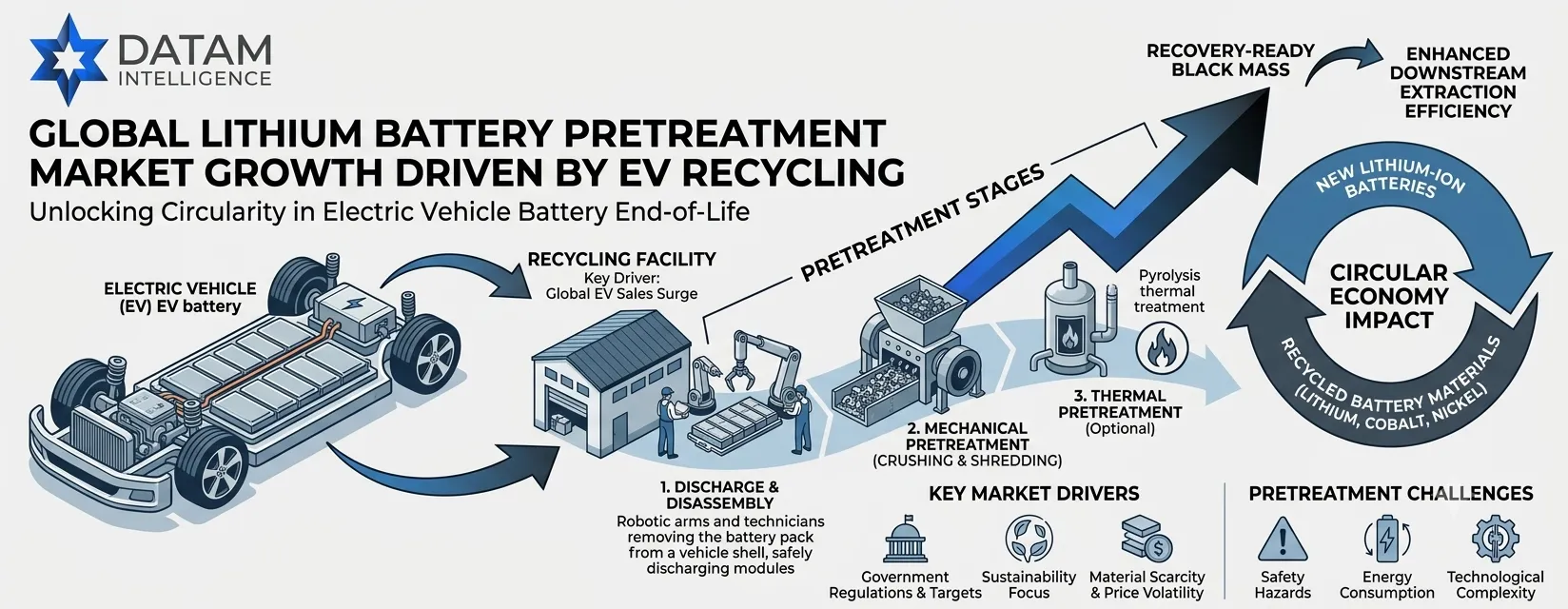
The global Lithium Battery Pretreatment Market is propelled by the increasing number of end-of-life lithium-ion batteries, rising investments in battery recycling facilities, and rising demand for metal extraction. The growing production of electric cars and battery gigafactories is resulting in large amounts of scrap produced during battery manufacturing and defective batteries, ensuring sustained demand for pretreatment processes. Rising environmental restrictions, the circular economy, and metal extraction such as lithium, nickel, cobalt, graphite, and copper are making manufacturers opt for discharge of batteries, dismantling of batteries, shredding, sorting, and black mass production systems.
Key Takeaways
- Asia-Pacific was the dominant region in the lithium battery pretreatment market and had a 46.8% share in the global market in 2025. China is the country that heads this group with 70% of lithium-ion battery manufacturing capacity and over 75% of the cell manufacturing capacity of the world.
- The segment of semi-automated pretreatment processes has been dominating the market through its huge market share of 51.9% in 2025.
- In 2025, the project was piloted under the California Energy Commission for direct battery recycling, and it successfully managed to produce recycled cathode purity levels above 95%. The recycled batteries were able to maintain over 90% of their original capacity during this process.
- In 2025, Lithium Iron Phosphate (LFP) batteries accounted for nearly 50% of the total market demand for electric vehicle batteries. This is a huge change from the market preference that was experienced just five years back, where the LFP battery had only a 10% share.
Rapid growth in End-of-Life lithium-ion batteries is significantly increasing the volume of batteries requiring a safe pretreatment process before recycling
With the rapid expansion of electric vehicles, battery energy storage systems, and consumer electronics, the number of lithium-ion batteries nearing the end of their lives will grow quickly in the near future, which will make pretreatment a necessary process before starting the actual recycling process. To extract the metals (lithium, nickel, cobalt, graphite, copper, manganese), spent lithium-ion batteries need to be safely discharged, disassembled, shredded, and separated into high-quality black mass, which can be done with the help of pretreatment. Besides this, the quick growth of battery gigafactories will lead to increased amounts of scrap, damaged cells, and non-conforming battery modules. At the same time, according to Benchmark Mineral Intelligence, the total capacity of lithium-ion battery recycling in 2025 was more than 1.5 million tonnes per year.
For instance, in April 2026, Mobec Innovation highlighted that there will be a huge increase in end-of-life lithium-ion batteries in India due to the fast adoption of electric vehicles. With that country handling nearly 50,000 tonnes of waste lithium-ion batteries in 2025, it is forecasted that in 2026 there will be about 60,000 tonnes of lithium-ion battery waste with total recycling capacity of over 100,000 tonnes per annum. The company also noted that only 25 to 30% of used batteries are currently collected through formal recycling systems.
Semi-Automated Pretreatment Dominates the Lithium Battery Pretreatment Market Due to Its Balance of Processing Efficiency and Capital Cost
Semi-automated pretreatment operations have become the most favored form of automation adopted by the global lithium battery pretreatment market in efforts to find a middle ground between efficiency, safety, flexibility, and cost. In contrast to fully automated systems, which entail a substantial initial cost outlay and need for standardized batteries, semi-automated systems integrate automated battery discharging, crushing, and shredding with manually operated modules of inspection and dismantling. This blend allows recycling firms to recycle batteries with different chemistries and designs at minimal costs and maximum flexibility.
The semi-automated pretreatment segment holds a market share of 51.9% in 2025, thus becoming the most prevalent automation sub-segment. This segment's dominance is additionally supported by the fast-growing industry of battery production and recycling around the globe. As per the International Energy Agency (IEA), global battery manufacturing capacities had surpassed the 3 TWh mark in 2024, causing an increase in the amount of scrap produced during the manufacturing process, which then required pretreatment prior to materials recovery. Besides, there were estimated to be about 400 lithium-ion battery gigafactories already built, being constructed, or just planned to be built by 2025.
Lithium Iron Phosphate (LFP) Batteries Emerge as the Fastest-Growing Chemistry with Rising EV Adoption and Expansion of Energy Storage Systems
Lithium-Iron Phosphate (LFP) batteries are emerging as one of the fastest-growing segments within the lithium battery pretreatment market due to increased use of LFP batteries in applications such as electric vehicles, stationary energy storage solutions, and commercial vehicles. Their benefits in terms of cycle life, thermal stability, low cost of production, and absence of cobalt and nickel have spurred manufacturers of batteries and automakers to increase production of LFP batteries, resulting in greater volumes of manufacturing scrap and used batteries needing pretreatment in the coming years. With increased volume of LFP batteries reaching the recycling facilities, the technology for pretreatment is evolving to ensure safe discharge, dismantling, shredding, and recovery of lithium, graphite, copper, aluminum, and other valuable metals.
The LFP batteries market segment is expected to witness the highest growth rate (CAGR) of 19.2%, surpassing other types of batteries on account of its increasing adoption. The industry trend also backs up this growth rate, as LFP batteries have been contributing around a 50% share of the global electric vehicle battery demand in recent times.
Rapid Expansion of Battery Manufacturing and Recycling Infrastructure Strengthening Asia-Pacific's Market Leadership
Asia-Pacific continues to dominate the global lithium battery pretreatment market, with a market share of 46.8% in 2025, supported by its extensive lithium-ion battery manufacturing base, rapid electric vehicle production, and expanding battery recycling ecosystem. Countries including China, Japan, and South Korea have established integrated battery supply chains encompassing raw material processing, cell manufacturing, battery pack assembly, and recycling, creating sustained demand for advanced pretreatment technologies. The region is also benefiting from increasing government support for circular economy initiatives, stricter battery waste management regulations, and large-scale investments in recycling facilities designed to recover critical minerals from end-of-life batteries and manufacturing scrap. For instance, in June 2026, N.A.N. GreenMet and Silox formed a joint venture with equal partnership to build India's largest platform for lithium-ion batteries' recycling and extraction of critical minerals in the state of Andhra Pradesh in India.
This development will happen in stages, with a capacity target of 40,000 tons per year (TPA) for shredding of waste batteries and 20,000 TPA for hydrometallurgical processing to enhance battery pre-treatment and critical metals recovery amid rising demand for electric vehicles and energy storage systems in the Asia-Pacific market.
China Leads the Lithium Battery Pretreatment Market Through Its Dominant Battery Manufacturing Base and Expanding Recycling Ecosystem
China continues to hold the top position in the global lithium battery pretreatment industry on account of its unmatched lithium-ion battery production capability, significant production of electric vehicles, and increasing battery recycling facilities. According to statistics released by the International Energy Agency (IEA), 70% of the world’s total lithium-ion battery production capability belongs to China in 2025, and Benchmark Mineral Intelligence believes that China possesses more than 75% of the world’s battery cell production capability.
For instance, in February 2026, China intensified efforts to develop an infrastructure for its lithium-ion battery recycling industry by formulating policies aimed at developing a “standardized, safe, and efficient” battery recycling process in preparation for an anticipated spike in the quantity of EV batteries that have reached the end of their lifespan. The annual volume of end-of-life EV batteries is expected to hit about 1 million tonnes by 2030.
Competitive Landscape and Strategic Developments
The global lithium battery pretreatment market is characterized by a competitive landscape driven by technological advancements, efficiency of the process, compatibility with batteries’ chemical makeup, and handling of large quantities of discarded and manufacturing scraps. In the market, companies are concentrating on increasing pretreatment capacity, upgrading black mass, automating the dismantling processes, and forming strategic alliances as a way of strengthening themselves in the battery recycling supply chain. There are rising investments in inert atmosphere shredding, robotic disassembly, and chemistry-specific pretreatments.
In June 2025, the BASF corporation, a Germany-based chemical company, started commercial operations at its Black Mass plant located in Schwarzheide, Germany. This plant will further enhance the ability of the company to process and recycle its lithium-ion battery pretreatment. It is the largest commercial black mass plant in Europe with a processing capacity of 15,000 tonnes of lithium-ion batteries annually.
Key Developments:
- In January 2025, Marubeni Corporation, a Japan-based trading and investment firm, made a monetary investment amounting to USD 5 million in Altilium, a UK-based company that deals with lithium-ion battery recycling.
- In June 2025, Ace Green Recycling, a Singapore-based battery recycling technology firm, signed a strategic partnership agreement with Enecell, which is an Australian-based battery collection and recycling firm, to create a sustainable lithium-ion battery recycling ecosystem in Australia.
- In January 2025, Ace Green Recycling, a Singapore battery recycling technology company, launched an initiative to expand its battery recycling facilities for lithium iron phosphate (LFP). They are planning to build the largest LFP battery recycling facility in Mundra, Gujarat.
Leading Company Profiles and Strategic Developments
Redwood Materials (U.S.)
Redwood Materials is one of the dominant companies in the lithium battery pretreatment and recycling industry, with an overall business model including battery collection, pretreatment, recycling, recovery of critical minerals, and production of battery materials. It has entered into partnerships with some of the big automobile companies to set up an overall supply chain for batteries that allows them to recover and recycle lithium, nickel, cobalt, copper, and graphite from batteries and manufacturing scrap. Their emphasis on battery material production and recycling has improved their standing in the North American battery recycling ecosystem.
In June 2026, Redwood Materials strengthened its cooperation with General Motors (GM), thus becoming the first company in the automobile industry to partner with Redwood for the whole process of battery lifecycle management, including recovering manufacturing scraps and recycling old EV batteries as well as installing second-life battery energy storage systems. In the framework of the cooperation, Redwood will install about 100 repurposed GM battery packs at GM’s manufacturing plant in Michigan, resulting in 1.5 MW/7.2 MWh of energy storage.
Analyst Opinion
The Lithium Battery Pretreatment Market is entering an era when operability is taking precedence equally to recycling capacity. While much of the debate in relation to battery recycling concerns itself with recycling lithium, nickel, and cobalt from batteries, pretreatment is the stage at which the efficiency, safety, and viability of their extraction depend. With battery types diversifying, along with the rise of LFP chemistry among others, the pretreatment solutions should allow for processing of various types of batteries without sacrificing safety and efficiency. One trend that stands out is the increasing inclination towards automation. Whereas fully automated processes tend to draw interest, semi-automated pretreatment facilities will continue to be the most sought after by many recyclers for the next few years to come, owing to their ability to offer necessary flexibility and keep capital costs low. This becomes particularly relevant with recycling centers moving away from mainly treating manufacturing scrap and beginning to process greater quantities of end-of-life EV batteries. From my perspective, companies that can safely treat different types of battery chemistry, enhance the quality of black mass, and combine pretreatment with the process of refining will have a strategic advantage over firms that focus solely on their capacity for treatment. As battery manufacturing keeps growing around the world and the first wave of electric vehicles’ batteries comes to its EoL stage, the pretreatment process will play an increasingly significant role in the whole recycling value chain of batteries.
Media Contact
Company Name: DataM Intelligence 4Market Research
Contact Team: Media Relations and Analyst Inquiries
Email: [email protected]
Corporate Address: 2243 Rocoso TRL, Leander, TX 78641, USA
Official Website: https://www.datamintelligence.com
Topic: Lithium Battery Pretreatment Market
Download Sample Report: https://www.datamintelligence.com/download-sample/lithium-battery-pretreatment-market