


Published Date: June 10th, 2026
FOR IMMEDIATE RELEASE
LEANDER, Texas - As automakers shift away from isolated testing toward large-scale commercial deployments of software-defined vehicles, centralized cloud networks are hitting a hard operational boundary. The necessity to ingest, fuse, and interpret multi-gigabit streams of simultaneous data inputs including high-resolution video feeds, LiDAR point clouds, and real-time radar metrics is driving a structural realignment in automotive vehicle architecture.
According to the latest industry intelligence report released by DataM Intelligence, the global edge computing for autonomous vehicles market has crossed a critical threshold, expanding from a baseline valuation of $7.64 billion in 2024 to a projected valuation of $39.00 billion by 2032. This trajectory reflects an aggressive 22.60% compounded annual growth rate (CAGR) during the forecast window.
Driven by hardware platform consolidation, localized AI processing needs, and zero-latency safety mandates, the automotive supply chain is systematically moving mission-critical workloads off remote servers and directly onto high-performance onboard edge computing systems.
The Safety Imperative: Eliminating Cloud Latency & Network Variables
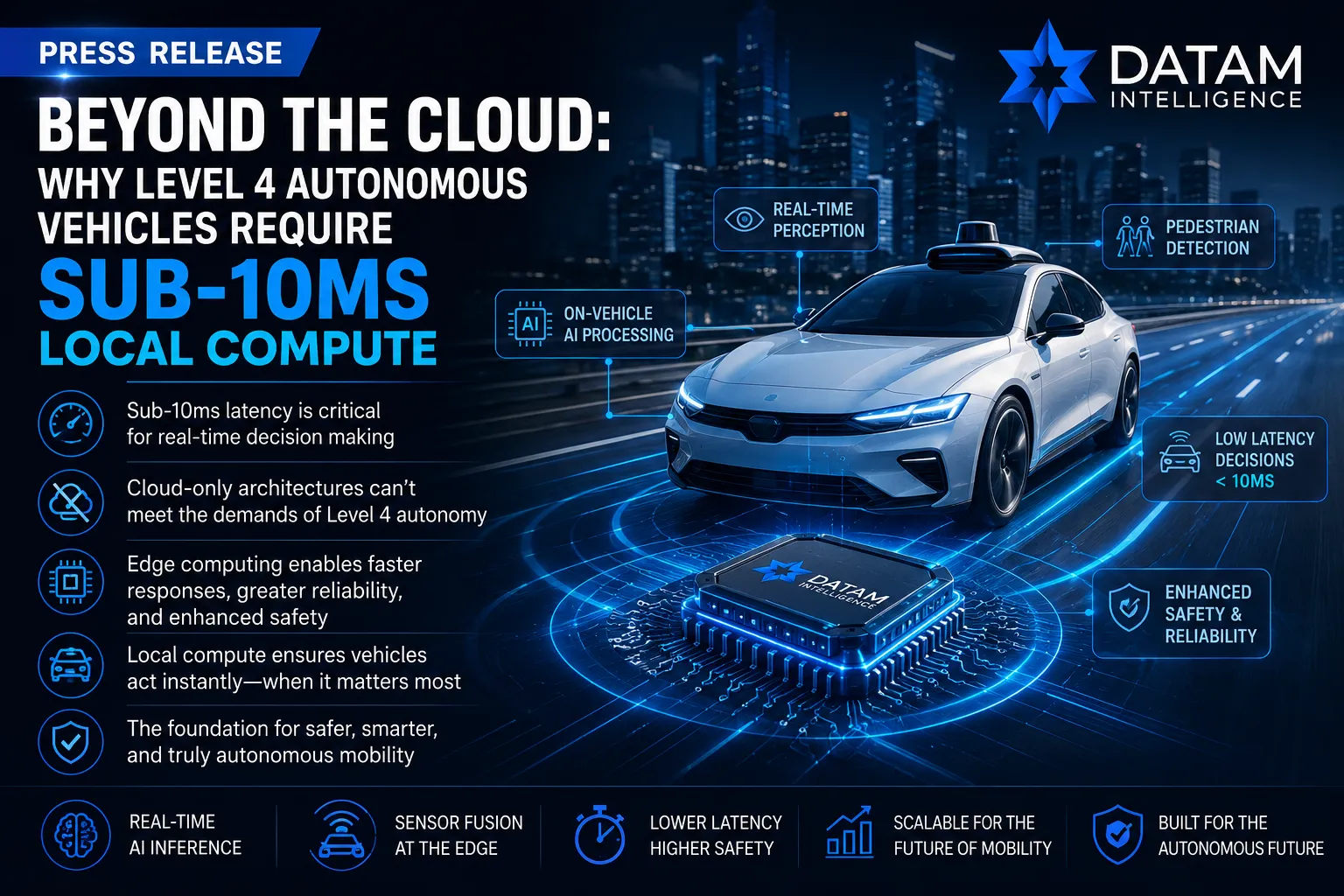
While cloud infrastructure remains ideal for long-term fleet training and macro mapping updates, remote data centers cannot fulfill the sub-10 millisecond latency windows required for split-second steering, braking, and hazard avoidance. Relying entirely on remote data transmission creates severe safety vulnerabilities when vehicles travel through cellular dead zones, underground parking structures, or highly congested urban environments.
By moving sensor fusion and predictive inference models directly to the vehicle's edge, autonomous systems process critical datasets closer to the source. This strategy focus guarantees real-time insights and continuous operational control completely independent of external network availability. The onboard architecture provides crucial system redundancy, allowing embedded modules to execute deterministic fail-safe maneuvers and satisfy strict functional automotive safety standards.
Overcoming Hardware, Silicon, and Implementation Constraints
The transition to edge intelligence is introducing a secondary wave of engineering hurdles focused tightly on vehicular resource scarcity. Onboard compute rigs must handle real-time decision-making without exploding vehicle power consumption, space restrictions, or thermal thresholds. High implementation and continuous system upgrade expenses also present capital challenges across the automotive ecosystem.
To solve these hardware processing bottlenecks, key players are rolling out centralized automotive computers that consolidate clustering, automated driving, and parking tasks into single, cost-effective centralized platforms. This specialized hardware integration enables advanced driver-assistance systems (ADAS) and AI modules to instantaneously recognize and respond to road signs, pedestrians, and dynamic traffic conditions while reducing bandwidth constraints.
Structural Demand Shifts Across Segments
While high-profile passenger cars from major automakers lead mainstream public interest, commercial transport and advanced infrastructure integrations are scaling fast. The transportation industry is capitalizing on edge computing to dramatically enhance vehicle-to-infrastructure (V2I) and vehicle-to-everything (V2X) communications.
Geographically, North America continues to strongly drive the autonomous mobility and edge-enabled transportation space, sustained by large-scale robotaxi fleets navigating complex urban grids. Concurrently, infrastructure development across global smart city frameworks and cellular-vehicle networks is rapidly expanding the total addressable footprint for low-latency compute topologies.
Institutional Analyst Perspective
"Autonomous navigation has evolved from a data-gathering exercise into a strict data-triage challenge," states the Automotive Research Analyst team at DataM Intelligence. "Sending raw, continuous multi-sensor logs directly to the cloud is no longer economically or operationally sustainable. The modern software-defined vehicle must act as its own self-contained edge data center, leveraging localized AI modules to filter safety-critical decisions in real-time while preserving cellular network bandwidth exclusively for macro metadata uploads."
Access the Full Technical Market Profile
For automotive OEMs, Tier-1 component suppliers, semiconductor strategists, and investment managers requiring verified segment data, regional deployment indexes, and deep competitive player benchmarking, DataM Intelligence has made the comprehensive market intelligence report accessible.
The report details granular growth parameters, technological trends, sustainability analyses, and long-term hardware-software forecasting through the extended horizon.
Download the Strategic Executive Sample & Technology Blueprint:
DataM Intelligence Edge Computing for Autonomous Vehicles Market Insights
About DataM Intelligence
DataM Intelligence is a premier global market advisory, corporate strategy, and consulting firm. Covering over 35 distinct industry verticals, DataM Intelligence delivers customized market entry intelligence, primary-source research, and competitive tracking to enterprise clients and Fortune 500 corporations worldwide.
Media Contact
- Company Name: DataM Intelligence 4Market Research
- Contact Team: Media Relations & Analyst Inquiries
- Email: [email protected]
- Corporate Address: 2243 Rocoso TRL, Leander, TX 78641, USA
- Official Website: https://www.datamintelligence.com/
- Topic: Global Edge Computing for Autonomous Vehicles Market
- Get Download Sample Insights Report: https://www.datamintelligence.com/download-sample/edge-computing-for-autonomous-vehicles-market