


FOR IMMEDIATE RELEASE
LEANDER, Texas: The bioinformatics market is becoming one of the most important layers of modern life sciences because biology is now producing more data than most organizations can manage manually. Sequencing, proteomics, single cell analysis, clinical genomics and drug discovery platforms are creating large datasets that need interpretation, not only storage. This is where bioinformatics is moving from research support into core decision infrastructure.
According to DataM Intelligence, the global Bioinformatics Market reached US$ 16.34 billion in 2025 and is expected to reach US$ 46.92 billion by 2035, growing at a CAGR of 12.8% during 2026 to 2035. North America is the largest region, while Asia Pacific is the fastest growing region.
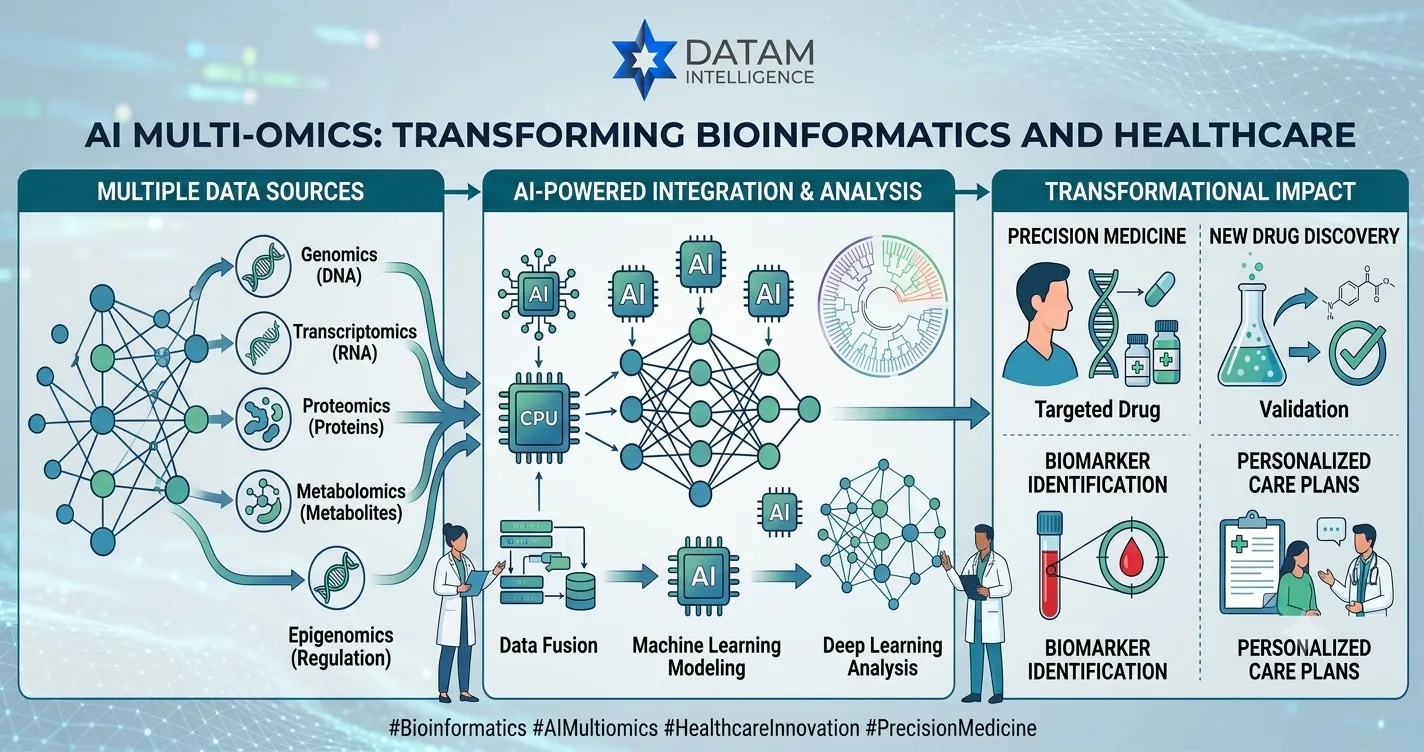
The market is being driven by the rising adoption of genomics and personalized medicine, increasing use of AI and machine learning, growth in cloud computing and big data analytics, stronger demand for nucleic acid and protein sequencing and the need to integrate multi-omics data into usable biological insight.
Here are a few options for your Call-to-Action (CTA) headings and text, incorporating the key data points from the bioinformatics market report (such as the market growing from $16.3B to $42.0B, the 12.8% CAGR, and the rise of AI-driven multi-omics).
Download the Bioinformatics Market Sample Report
The global bioinformatics market is projected to expand from $16.3 billion to $42.0 billion by 2033. Download bioinformatics market free sample report today to explore actionable growth forecasts, segment breakdowns (including genomics and personalized medicine), and the AI-driven analytics shaping a 12.8% CAGR industry.
North America Region Analysis: Research Scale and Clinical Genomics Keep the Region Ahead
North America leads the bioinformatics market because the region has a dense base of sequencing companies, pharmaceutical R&D centers, academic research institutions, clinical laboratories and healthcare systems adopting molecular diagnostics. DataM Intelligence identifies North America as the largest region, supported by advanced healthcare systems, strong R&D investment and high biotechnology funding.
The region’s advantage is not only technology availability. It is the connection between research and commercialization. Pharmaceutical companies use bioinformatics to identify targets, analyze biomarkers, optimize drug discovery and design more efficient translational research workflows. Clinical laboratories use genomic interpretation tools for oncology, rare disease, inherited disease and companion diagnostics. Research centers use bioinformatics platforms to manage sequencing, RNA Seq, CRISPR analysis, proteomics and multi omics workflows.
North America benefits from increasing research in nucleic acid and genetic engineering, drug discovery funding using proteomic and metagenomic techniques and growing awareness around biological data. The region also has major players such as Illumina, Thermo Fisher Scientific, QIAGEN and Agilent Technologies actively operating in the market.
The challenge is skill availability. Bioinformatics requires people who understand both biology and computation. There is a lack of skilled professionals as a restraint because organizations may struggle to implement tools, interpret data and keep pace with fast changing analytical methods.
Asia Pacific Region has Fastest Growth From Sequencing Adoption and Biotech Expansion
Asia Pacific is the fastest growing region in the bioinformatics market. Growth is being supported by expanding genomics programs, rising pharmaceutical and biotechnology R&D, increasing sequencing adoption, stronger public health surveillance and improving digital healthcare infrastructure. China, India, Japan, South Korea and Singapore are becoming more important across clinical genomics, population sequencing, bioinformatics services and AI assisted research.
The region has a scale advantage. Large patient populations, rising cancer burden, infectious disease surveillance needs and expanding precision medicine programs are creating demand for faster genomic interpretation. Bioinformatics is also becoming more useful in agriculture and public health, where sequencing and pathogen genomics can help improve disease monitoring and outbreak detection.
Asia Pacific’s opportunity is large, but uneven. Some markets have advanced clinical genomics and pharmaceutical research ecosystems. Others are still building sequencing infrastructure, trained workforce and reimbursement systems. The companies that succeed in the region will need flexible pricing, local partnerships, cloud based access and training support rather than assuming one global platform will fit every market.
The growth story is also helped by the shift from infrastructure ownership to accessible platforms. Cloud based bioinformatics can allow hospitals, universities and biotech firms to run complex analyses without building every capability internally. That makes adoption easier, especially for emerging research hubs and mid sized laboratories.
Application Segment Analysis: Genomics Holds the Core Commercial Position
Genomics accounted for approximately 34.3% of the bioinformatics market share, making it the leading application segment. This leadership is due to advances in sequencing technology, lower costs and expanding use across personalized medicine, disease genomics, agricultural genomics, population genomics and large scale genomic data processing.
The reason is simple. Sequencing creates the data. Bioinformatics creates the interpretation. In oncology, genomic analysis helps identify actionable mutations and guide targeted therapy selection. In rare disease, it can shorten diagnostic journeys. In infectious disease, it supports outbreak surveillance and pathogen tracking. In agriculture, it supports trait discovery and crop improvement.
The segment also benefits from collaborations. A partnership has been established between Ultima Genomics and Genome Insight to provide affordable whole genome sequencing options for cancer patients, with Genome Insight developing an optimized whole genome bioinformatics solution for Ultima’s sequencing technology.
Genomics will likely remain the largest segment because sequencing demand keeps expanding. The next phase will be less about generating data and more about delivering clinically usable insight faster, cheaper and with stronger confidence.
Product and Services Segment Analysis: Platforms and Services Are Becoming More Important Together
The bioinformatics market is segmented into knowledge management tools, platforms and services. Platforms are gaining stronger relevance because users need integrated workflows that can manage sequencing files, run analysis pipelines, visualize results and support collaboration. Services remain important because not every organization has enough computational biologists, data scientists or infrastructure to run complex analyses internally.
This platform and services overlap is becoming more visible in recent developments. In April 2026, Illumina introduced enhanced cloud based bioinformatics workflows and AI driven genomic interpretation tools to accelerate precision medicine, transcriptomics and large scale population genomics research. QIAGEN expanded its Digital Insights portfolio with upgraded genomic interpretation and clinical decision support tools for oncology, companion diagnostics and translational research. Thermo Fisher Scientific also advanced automated sequencing analysis and cloud bioinformatics solutions aimed at improving genomic data processing efficiency.
AI is changing the segment’s value proposition. Bioinformatics platforms are no longer only organizing data. They are helping researchers identify disease pathways, prioritize variants, predict therapeutic targets and model biological systems. Dassault Systèmes’ expansion of AI driven virtual biology and biomedical modeling tools through its BIOVIA portfolio is supporting drug discovery, molecular simulation and digital twin healthcare applications.
The strongest companies will be those that make complex analysis easier for end users. A platform that requires too much specialist labor can slow adoption. A platform that combines validated workflows, AI support, data visualization and clinical or research interpretation can become much harder to replace.
Analyst Insight
Bioinformatics is becoming a core operating layer for modern life sciences. The market is growing because sequencing, multi omics, AI based discovery and personalized medicine are creating more data than traditional research systems can handle. The strongest opportunities will come from platforms that combine scalable cloud infrastructure, validated analytical pipelines, clinical interpretation, AI assisted insight generation and user friendly workflows. The main bottleneck will remain talent. Companies that reduce the need for deep in house computational expertise will have a strong adoption advantage.
About DataM Intelligence
DataM Intelligence is a market intelligence and strategic consulting firm specializing in high growth sectors including healthcare IT, biotechnology, pharmaceuticals, clinical diagnostics, medical devices, life sciences, agriculture and digital health. Through analyst led research, market assessment, competitive intelligence, value chain analysis, product launch assessment and custom consulting, DataM Intelligence helps organizations identify growth opportunities, evaluate adoption barriers, benchmark competitors and support stronger strategic decisions.
Media Contact
Company Name: DataM Intelligence 4Market Research
Contact Team: Media Relations and Analyst Inquiries
Email: [email protected]
Corporate Address: 2243 Rocoso TRL, Leander, TX 78641, USA
Official Website: https://www.datamintelligence.com
Topic: Bioinformatics Market
Download Sample Report: https://www.datamintelligence.com/download-sample/bioinformatics-market