


Pharmacy Automation Systems Market Size and Forecast
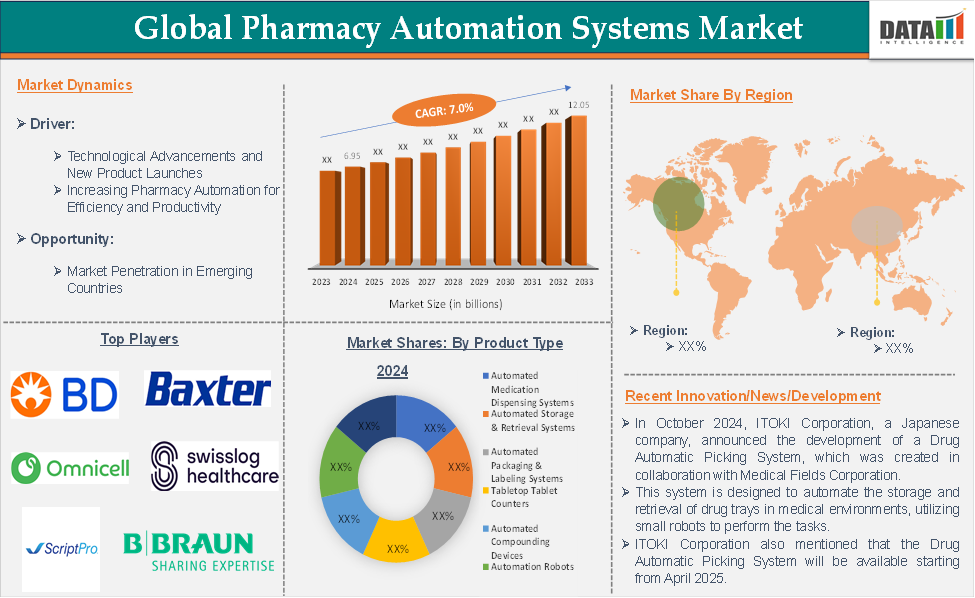
The Pharmacy Automation Systems Market will reach US$ 7.96 billion in 2026, up from US$ 7.44 billion in 2025, and is projected to reach US$ 14.61 billion by 2035, registering steady growth at a CAGR of 7.0% during the forecast period from 2026 to 2035.
Pharmacy automation systems are advanced technological solutions that enhance efficiency in pharmaceutical operations by automating key processes such as medication dispensing, storage, labeling, and inventory management. These systems use robotics, software, and artificial intelligence (AI) to ensure precision in medication handling, reducing the risk of human errors in dispensing and packaging.
By integrating automated workflows, pharmacies can optimize their supply chain, improve medication tracking, and enhance compliance with regulatory standards. The technology is particularly beneficial in high-volume settings such as hospitals and retail pharmacies, where accuracy and efficiency are critical to patient safety and operational effectiveness.
Pharmacy Automation Systems Market Executive Summary
Key Takeaways
- North America accounted for approximately 41-45% of the global Pharmacy Automation Systems Market share in 2025, driven by increasing healthcare digitization initiatives, rising adoption of automated dispensing technologies, and substantial investments in hospital pharmacy modernization programs.
- Automated Medication Dispensing Systems held nearly 38-42% of the total market share in 2025, making them the largest product segment owing to their widespread adoption across hospital and retail pharmacy settings to improve medication safety and operational efficiency.
- Hospital pharmacies represented approximately 55-60% of the overall market demand in 2025, supported by increasing prescription volumes, stringent medication safety requirements, and growing adoption of robotic dispensing technologies.
- Retail pharmacies accounted for nearly 30-35% of the market share in 2025, driven by increasing investments in workflow automation, inventory management solutions, and centralized prescription fulfillment systems globally.
- Large healthcare institutions contributed approximately 65-70% of pharmacy automation system deployments in 2025, owing to their higher prescription volumes and increasing focus on reducing medication errors and labor-intensive processes.
- More than 75% of healthcare organizations implementing pharmacy automation technologies report significant improvements in medication dispensing accuracy and inventory management efficiencies, highlighting the growing importance of automation across pharmaceutical operations.
- AI-enabled pharmacy automation platforms are expected to account for approximately 25-30% of future technology investments by 2030, driven by increasing adoption of predictive analytics, intelligent inventory forecasting, and automated prescription verification systems.
- Asia-Pacific is projected to register the fastest regional growth with an estimated CAGR of 9-11% during the forecast period, supported by expanding healthcare infrastructure, rising pharmaceutical expenditures, and increasing adoption of hospital automation technologies across emerging economies.
- Cloud-connected and integrated pharmacy automation systems accounted for nearly 30-35% of new installations in 2025, reflecting growing demand for real-time inventory monitoring, interoperability, and centralized pharmacy management capabilities.
Pharmacy Automation Systems Market Scope
| Metrics | Details | |
| CAGR | 7.0% | |
| Market Size Available for Years | 2022-2035 | |
| Estimation Forecast Period | 2026-2035 | |
| Revenue Units | Value (US$ Bn) | |
| Segments Covered | Product Type | Automated Medication Dispensing Systems, Automated Storage & Retrieval Systems, Automated Packaging & Labeling Systems, Tabletop Tablet Counters, Automated Compounding Devices, Automation Robots, Others |
| End-User | Hospital & Central Pharmacy, Retail Pharmacy, Specialty Pharmacy | |
| Regions Covered | North America, Europe, Asia-Pacific, Latin America, and the Middle East & Africa | |
Pharmacy Automation Systems Market Dynamics: Drivers & Restraints
Technological Advancements and New Product Launches
The technological advancements and new product launches are key drivers for market growth in the forecast period. The key companies in the market landscape, such as BD, Omnicell, Swisslog Healthcare, and other regional manufacturers, constantly invest in launching technologically advanced pharmacy automation systems.
For instance, in October 2024, ITOKI CORPORATION in Japan announced the launch of the Drug Automatic Picking system with MediMonitor, jointly developed with Medical Fields Corporation. This system uses small robots to store and retrieve drug trays and audits the whole process. ITOKI said that these systems would be available starting in April 2025.
Moreover, in April 2024, Swisslog Healthcare, one of the global market players in hospital automation systems, launched the ezCUT Automated Tablet Cutter in the North American market in collaboration with JVM Manufacturing. This machine automates the cutting of solid oral formulations to fulfill the half-strength prescriptions. This system can significantly reduce the time and manual labor. All these factors demand the global pharmacy automation systems market.
High Cost of Pharmacy Automation Systems
High initial investment costs represent a major challenge in the global pharmacy automation systems market, particularly affecting the adoption of these technologies among smaller pharmacies. Pharmacy automation systems, which include automated dispensing machines, robotic systems, and software solutions, come with significant upfront costs. These systems can range from $64,571.54 to over $6,45,715.35, depending on their complexity and scale.
The largest portion of the initial investment is typically spent on acquiring advanced automation equipment. High-quality robotic dispensers and automated storage systems are especially costly. Additionally, the installation of these systems requires specialized knowledge, leading to further costs related to infrastructure modifications or upgrades.
Staff training is also essential to ensure the proper operation and maintenance of these technologies, and training programs contribute to the overall expenditure. This financial burden can be a significant barrier, particularly for smaller pharmacies that may have limited budgets for such investments. Thus, the above factors could be limiting the global pharmacy automation systems market's potential growth.
Pharmacy Automation Systems Market Segment Analysis
The global pharmacy automation systems market is segmented based on product type, end-user, and region.
Product Type:
The automated medication dispensing systems segment in product type is expected to dominate the global pharmacy automation systems market with the highest market share
Automated dispensing systems are tools that are currently being widely adopted in pharmacies across the world to automate the process of drug dispensing. These systems are incorporated with advanced software to improve the accuracy, speed, and efficiency of medication dispensing. Moreover, these systems play a crucial role in reducing human errors that can occur during dispensing, which may lead to medication errors and often fatalities.
The key players manufacturing automated medication-dispensing systems include BD, Omnicell, Inc., and ScriptPro, among others. The market for automated medication-dispensing systems is mainly driven by technological advancements, product approval and launches, mergers, rising collaborations between manufacturers and end-users, and increasing automation of pharmacies across the world.
For instance, in October 2024, the first Automated Dispensing Medication System, i-Pharmabot, was launched in Malaysia by the National Heart Institute (IJN). The system can dispense up to 180 medications per minute and drastically reduce dispensing errors. With this new system in action, IJN plans to improve the safety and experience for outpatients along with the inpatient population.
Moreover, in October 2023, JVM, an affiliate of Hanmi Science, launched the next-generation automated drug dispensing machine “MENITH,” featuring a robotic arm, in the European market. Through this launch, JVM also entered a supply contract in the Netherlands with Brocacef, a company that operates large, factory-type dispensing pharmacies in Europe. These factors have solidified the segment's position in the global pharmacy automation systems market.
Artificial Intelligence Integration Analysis
Artificial intelligence is emerging as a transformative technology within pharmacy automation systems by enabling predictive analytics, intelligent prescription processing, and automated decision-support capabilities. AI-driven solutions are increasingly supporting medication adherence programs, prescription verification processes, and demand forecasting applications across healthcare settings. Furthermore, AI-enabled automation platforms are expected to significantly enhance medication safety initiatives by reducing dispensing errors and improving clinical workflow efficiencies during the forecast period.
Pharmacy Automation Systems Market Geographical Analysis
North America is expected to hold a significant position in the global pharmacy automation systems market with the highest market share
The North America pharmacy automation systems market refers to the adoption and use of automation technologies in pharmacies across North America, which includes solutions for dispensing, storing, tracking, and managing medications. Increasing concerns about medication errors and patient safety have pushed healthcare providers to adopt automated systems. These systems, such as robotic dispensing units and barcode scanning, help reduce the risk of human error and improve medication accuracy, directly benefiting patient safety.
The aging population in North America, particularly in the U.S. and Canada, is driving the demand for medication management solutions. Older adults often take multiple medications, which increases the risk of medication errors and the complexity of dispensing. Automation helps to ensure these medications are dispensed correctly and on time, which is crucial for elderly patients' health management.
Continuous advancements in technology, such as robotic systems, artificial intelligence, and machine learning, have made pharmacy automation more accessible and affordable. These innovations provide advanced features like real-time inventory tracking, automated prescription refills, and medication management, making it easier for pharmacies to integrate these systems into their operations.
For instance, in August 2024, Omnicell launched a new service called Central Med Automation, designed to optimize medication dispensing across entire health system enterprises using robotics and smart devices. The goal of this service is to streamline the entire process of medication management from a centralized fulfillment area, enabling more efficient and accurate dispensing throughout the healthcare system. Thus, the above factors are consolidating the region's position as a dominant force in the global pharmacy automation systems market.
Pharmacy Automation Systems Market Trends & Insights
AI-Enabled Pharmacy Automation
Artificial intelligence is becoming an important layer within pharmacy automation, supporting prescription verification, demand forecasting, inventory optimization, medication management and workflow automation. AI-enabled systems can analyze operational data in real time and help pharmacies improve dispensing accuracy while reducing repetitive manual activities.
Robotics and Intelligent Dispensing
Robotic dispensing is increasingly being adopted in high-volume pharmacy environments to automate medication picking, sorting, counting and dispensing. The growing emphasis on accuracy, throughput and labor efficiency is encouraging pharmacies and healthcare systems to invest in robotic automation.
Centralized Pharmacy Fulfillment
Large healthcare networks and retail pharmacy groups are increasingly adopting centralized fulfillment models in which automated systems manage medication storage, picking, packaging and distribution from centralized facilities. This model can improve utilization of automation equipment while supporting multiple pharmacy locations.
Cloud-Connected Pharmacy Automation
Cloud connectivity is becoming increasingly important as pharmacies seek centralized inventory visibility, remote monitoring, analytics and integration across multiple locations. Connected platforms can also facilitate software updates and centralized management of automated equipment.
Medication Safety & Error Reduction
Medication safety remains one of the strongest adoption factors for pharmacy automation. Automated dispensing, barcode verification, robotic picking and electronic tracking can reduce manual handling and improve medication traceability across pharmacy workflows.
Labor Optimization
Pharmacies are increasingly using automation to address repetitive workload and workforce constraints. By automating counting, dispensing, packaging and inventory activities, pharmacy staff can allocate more time to clinical, patient-facing and higher-value activities.
Integration with Pharmacy Information Systems
Integration with electronic health records, pharmacy management systems, computerized physician order-entry systems and medication administration platforms is becoming increasingly important. Interoperability allows automation systems to operate as part of a connected medication-management workflow rather than as standalone equipment.
Smart Inventory Management
Automated inventory systems are increasingly incorporating real-time tracking, predictive demand forecasting and automated replenishment. These capabilities can help reduce stockouts, overstocking, medication wastage and inefficient inventory handling.
Pharmacy Automation Systems Market Product Innovation Analysis
Automated Medication Dispensing Systems
Automated medication dispensing systems remain a core technology within pharmacy automation because they can improve dispensing speed, medication accuracy and workflow efficiency. Adoption is particularly relevant in high-volume hospital, retail and centralized pharmacy environments.
Automated Storage & Retrieval Systems
Automated storage and retrieval technologies enable pharmacies to optimize medication storage, retrieval and inventory tracking. These systems are particularly valuable where pharmacies handle large medication inventories and require rapid access to frequently dispensed products.
Automated Packaging & Labeling
Automated packaging and labeling systems are gaining importance as pharmacies seek to standardize medication packaging, improve labeling accuracy and reduce repetitive manual processes.
Automated Compounding Devices
Automated compounding technologies provide opportunities to improve precision and standardization when preparing medications, particularly in hospital and specialty pharmacy environments.
Pharmacy Automation Systems Market Competitive Landscape Analysis
The competitive landscape of the Pharmacy Automation Systems Market is characterized by continuous technological innovation, strategic partnerships, and product portfolio expansions undertaken by leading industry participants. Companies are increasingly focusing on developing intelligent automation solutions capable of addressing evolving healthcare requirements across hospital and retail pharmacy environments. Strategic acquisitions, geographic expansion initiatives, and investments in cloud-enabled pharmacy technologies continue to strengthen competitive positioning across global markets. Product differentiation through interoperability capabilities and advanced analytics functionalities is expected to remain a key competitive factor throughout the forecast period.
Pharmacy Automation Systems Market Competitive Landscape
The major global players in the pharmacy automation systems market include BD, Omnicell, Swisslog Healthcare, ScriptPro, ARxIUM, B. Braun Medical Inc., Baxter, ICU Medical, Inc., Capsa Healthcare, Pearson Medical Technologies, and Willach Group among others.
Recent Developments in Pharmacy Automation Systems Market
- June 2026: BD (Becton, Dickinson and Company) expanded its medication management portfolio by advancing pharmacy automation solutions that improve dispensing accuracy, workflow efficiency, and patient safety across healthcare facilities.
- June 2026: Omnicell, Inc. strengthened its autonomous pharmacy vision by enhancing intelligent automation technologies designed to optimize medication inventory management and support centralized pharmacy operations.
- May 2026: Swisslog Healthcare continued expanding its robotic pharmacy automation capabilities by advancing integrated medication management solutions for hospitals and health systems worldwide.
- May 2026: ScriptPro LLC enhanced its pharmacy robotics portfolio by improving prescription dispensing and workflow automation technologies for retail and hospital pharmacy settings.
- April 2026: ARxIUM Inc. expanded its automated medication dispensing and packaging solutions to support greater operational efficiency and medication safety in healthcare institutions.
- April 2026: B. Braun Medical Inc. strengthened its smart infusion and medication management solutions through continued investments in connected healthcare technologies and pharmacy automation systems.
- March 2026: Baxter International Inc. advanced its connected care portfolio by enhancing automated medication delivery and pharmacy workflow solutions for healthcare providers.
- March 2026: ICU Medical, Inc. continued developing intelligent infusion and medication management technologies designed to improve safety and efficiency in pharmacy and clinical environments.
- February 2026: Capsa Healthcare expanded its healthcare automation portfolio by strengthening mobile medication management and pharmacy workflow solutions across acute and long-term care facilities.
Why Choose DataM?
Technological Innovations: DataM evaluates advances in robotic dispensing, AI-enabled pharmacy automation, automated storage and retrieval, automated packaging and labeling, automated compounding, smart inventory management, cloud-connected systems, barcode verification, predictive analytics, and integrated pharmacy-management technologies.
Product Performance & Market Positioning: The report evaluates pharmacy automation solutions based on dispensing speed, medication accuracy, throughput, storage capacity, inventory visibility, automation level, integration capability, scalability, workflow efficiency, error reduction, maintenance requirements, system reliability, and total cost of ownership.
Real-World Evidence: DataM connects market developments with applications across hospital pharmacies, central pharmacies, retail pharmacies, specialty pharmacies, outpatient facilities and centralized prescription-fulfillment centers, assessing how automation improves medication dispensing, inventory management, packaging, distribution and pharmacy workflow efficiency.
Market Updates & Industry Changes: The report tracks new automation-system launches, robotic pharmacy developments, AI integration, pharmacy modernization programs, healthcare digitization, centralized fulfillment, strategic partnerships, acquisitions, interoperability developments, medication-safety initiatives, and regulatory changes influencing pharmacy automation adoption.
Competitive Strategies: DataM analyzes how leading companies strengthen their positions through robotic technology development, AI-enabled solutions, product launches, healthcare-provider partnerships, acquisitions, pharmacy software integration, geographic expansion, centralized fulfillment solutions, and expansion across hospital and retail pharmacy applications.
Pricing & Market Access: The report evaluates pricing based on automation type, system capacity, dispensing volume, robotics, software functionality, installation requirements, integration complexity, maintenance, training, support services and facility size while assessing adoption across hospitals, retail pharmacies, specialty pharmacies and centralized fulfillment facilities.
Market Entry & Expansion: DataM identifies opportunities created by rising prescription volumes, medication-safety requirements, pharmacy labor constraints, healthcare digitization, hospital modernization and centralized pharmacy operations. The report outlines strategies involving local distribution networks, hospital partnerships, pharmacy-chain collaborations, system integration, technology licensing and expansion into high-growth Asia-Pacific markets.
Why Purchase the Report?
This report provides comprehensive market intelligence on the Pharmacy Automation Systems Market by delivering valuable insights into emerging technologies, regulatory developments, competitive strategies, and investment opportunities across major global markets. It enables stakeholders to identify high-growth segments across automated dispensing systems, pharmacy workflow management, and intelligent inventory solutions while evaluating evolving healthcare automation trends. Furthermore, the report supports strategic decision-making related to partnerships, product development, capacity expansion, and market entry initiatives by providing in-depth analyses of regional dynamics, technology adoption patterns, and future market developments expected to shape the industry through 2035.
- Pipeline & Innovations: Reviews ongoing clinical trials and product pipelines and forecasts upcoming advancements in medical devices and pharmaceuticals.
- Product Performance & Market Positioning: Analyzed product performance, market positioning, and growth potential to optimize strategies.
- Real-World Evidence: Integrates patient feedback and data into product development for improved outcomes.
- Physician Preferences & Health System Impact: Examines healthcare provider behaviors and the impact of health system mergers on adoption strategies.
- Market Updates & Industry Changes: This covers recent regulatory changes, new policies, and emerging technologies.
- Competitive Strategies: Analyze competitor strategies, market share, and emerging players.
- Pricing & Market Access: Reviews pricing models, reimbursement trends, and market access strategies.
- Market Entry & Expansion: Identifies optimal strategies for entering new markets and partnerships.
- Regional Growth & Investment: Highlights high-growth regions and investment opportunities.
- Supply Chain Optimization: Assesses supply chain risks and distribution strategies for efficient product delivery.
- Sustainability & Regulatory Impact: Focuses on eco-friendly practices and evolving regulations in healthcare.
- Post-market Surveillance: Uses post-market data to enhance product safety and access.
- Pharmacoeconomics & Value-Based Pricing: Analyzes the shift to value-based pricing and data-driven decision-making in R&D.
The global pharmacy automation systems market report delivers a detailed analysis with 57 key tables, more than 47 visually impactful figures, and 176 pages of expert insights, providing a complete view of the market landscape.
Target Audience
- Pharmacy Automation Manufacturers - For technology trends, competitive positioning and expansion opportunities.
- Hospitals & Pharmacy Chains - For automation adoption, workflow optimization and technology evaluation.
- Healthcare Technology Companies - For AI, robotics, interoperability and digital pharmacy opportunities.
- Investors & Financial Institutions - For market growth, investment opportunities and competitive intelligence.
- Consultants & System Integrators - For market entry, partnerships and implementation strategies.
- Government & Healthcare Organizations - For healthcare automation, medication safety and digitalization insights.




























































