


Trump’s 100% Drone Tariffs Could Reshape Global UAV Supply Chains and Boost U.S. Manufacturing
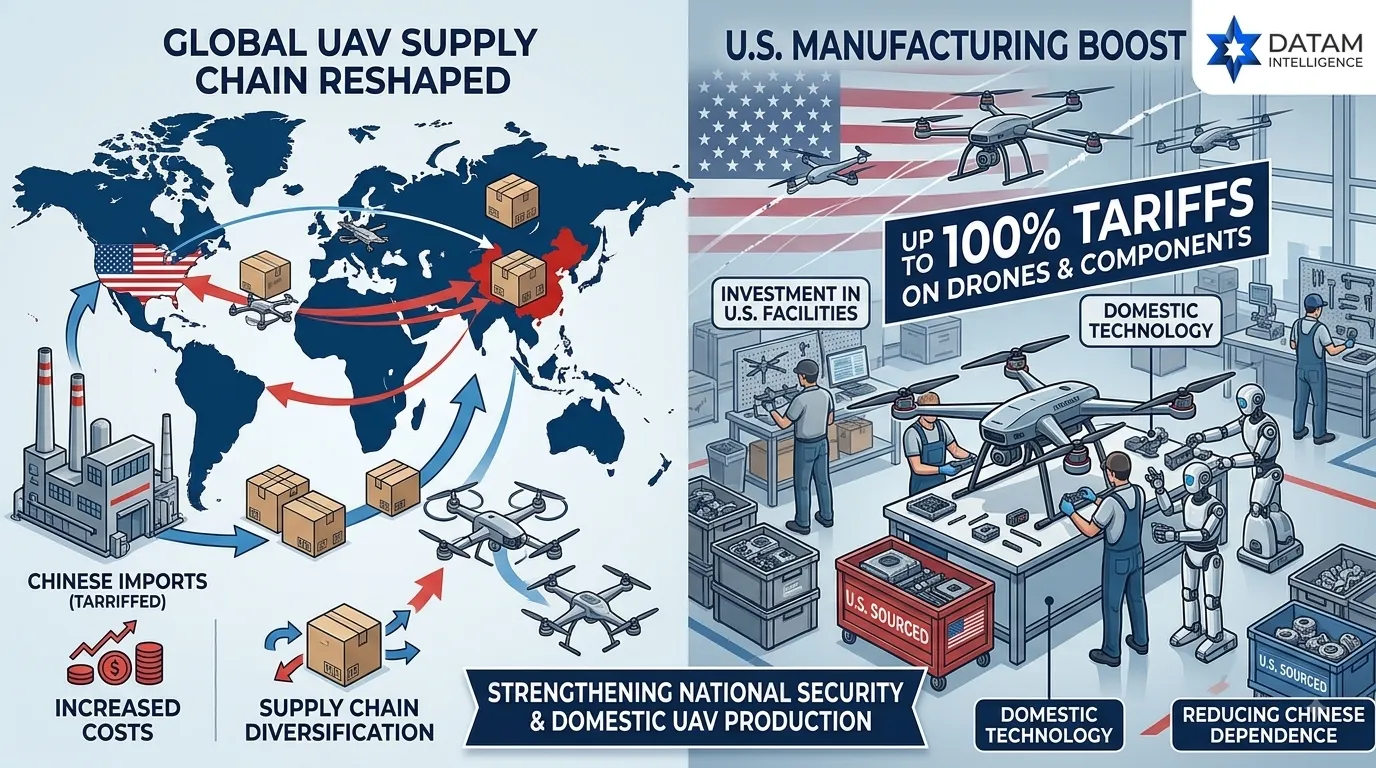
The United States has introduced tariffs of up to 100% on imported drones and selected drone components, marking a significant shift in its effort to reduce dependence on foreign drone technology, particularly products and components sourced from China.
The measures are expected to have a substantial impact on the U.S. commercial drone industry, affecting manufacturers, distributors, public safety agencies, agricultural operators, infrastructure companies, and component suppliers. Chinese manufacturers such as DJI and Autel Robotics are likely to face the greatest pressure, while U.S. companies such as Skydio, BRINC, Red Cat, and domestic component manufacturers could benefit from growing demand for locally produced alternatives.
Explore the Commercial Drone Market Report
Discover High-Growth Opportunities Across the Global Commercial Drone Industry
Access in-depth market intelligence on Commercial Drone Market size, growth trends, AI-enabled autonomy, Drone-as-a-Service, precision agriculture, infrastructure inspection, logistics, regional opportunities, and competitive strategies. The report provides actionable insights to help businesses, investors, and technology leaders identify growth opportunities and make informed strategic decisions.
New Tariff Structure
Under the new policy, certain drones and components will face significantly higher import duties.
Drones weighing more than 25 kilograms, drones equipped with thermal imaging systems, selected sensitive components, and certain docking stations can face tariffs of up to 100%.
Many smaller drones weighing 25 kilograms or less are expected to face a 25% tariff.
Some component tariffs are scheduled to take effect in February 2027, providing manufacturers additional time to develop alternative supply chains and increase domestic production capacity.
The tariff structure also provides preferential treatment to qualifying products from several U.S. allies, including the European Union, Japan, South Korea, Taiwan, Switzerland, Liechtenstein, and the United Kingdom.
This creates a significant competitive difference between Chinese products, products manufactured in approved allied countries, and equipment produced within the United States.
DJI Faces Significant Market Pressure
DJI is likely to be one of the companies most affected by the new policy.
The company has historically controlled more than two thirds of the global civilian drone market. Chinese manufacturers also maintain a substantial presence across the U.S. consumer, enterprise, and public safety drone segments.
DJI drones are widely used in agriculture, construction, surveying, utilities, firefighting, infrastructure inspection, law enforcement, mapping, and industrial operations.
Several important DJI product categories could face particularly strong pressure.
The DJI Matrice 4T, for example, includes thermal imaging capabilities. Thermal imaging drones fall within one of the most heavily affected categories.
DJI also sells automated docking systems for enterprise applications. Certain docking stations are included in the higher tariff categories.
Agricultural drones represent another important area of exposure. Large DJI Agras models can weigh considerably more than 25 kilograms when configured for agricultural operations. As a result, agricultural drone operators in the United States could face substantially higher equipment acquisition costs.
The tariffs add to existing regulatory pressure facing DJI in the United States, including restrictions related to communications equipment authorization and national security concerns.
Autel Robotics Could Also Face Challenges
Chinese drone manufacturer Autel Robotics is another company likely to experience negative effects.
Autel has increasingly focused on enterprise and professional drone applications. Several of its products include thermal imaging technology, including platforms designed for industrial inspection, emergency response, security, and infrastructure monitoring.
These product categories are directly exposed to the new tariff structure.
Autel's increasing focus on enterprise markets could therefore become a disadvantage in the United States if commercial and government customers begin moving toward U.S. manufactured alternatives.
Skydio Could Be a Major Beneficiary
California based Skydio is one of the companies best positioned to benefit from the policy change.
The company announced plans in 2026 to invest approximately $3.5 billion in U.S. manufacturing and research and development over five years.
According to the company, the investment is expected to create more than 2,000 direct jobs, support more than 3,000 additional supply chain jobs, and direct more than $1 billion toward U.S. suppliers.
Skydio has reported shipping more than 60,000 drones to over 3,800 customers, including more than 1,200 public safety organizations, over 450 utility and energy companies, all branches of the U.S. military, and customers across 29 allied countries.
These customer relationships could provide Skydio with a strong competitive position as U.S. organizations seek alternatives to Chinese drone platforms.
BRINC Could Gain in Public Safety Applications
BRINC, a U.S. drone manufacturer focused on emergency response and public safety applications, could also benefit.
The company has expanded its manufacturing capacity in Seattle and has reported strong revenue and production growth.
Public safety represents an important opportunity because police departments, fire departments, and emergency response organizations frequently depend on thermal imaging drones.
Thermal imaging is used for applications including search and rescue, firefighting, hazardous material incidents, nighttime operations, and tactical response.
If imported thermal drones become significantly more expensive, American manufacturers such as BRINC could become increasingly attractive to public sector buyers.
Drone Components Could Become an Even Larger Opportunity
The impact of the tariff policy extends beyond finished drones.
Many drones assembled in the United States still depend on imported components, including motors, electronic speed controllers, lithium ion batteries, cameras, sensors, navigation systems, communications modules, and flight controllers.
This creates a significant opportunity for domestic component manufacturers.
Unusual Machines, for example, has been expanding its U.S. drone component manufacturing capabilities.
The company reported approximately $16.7 million in revenue during the second quarter of 2026, compared with approximately $2.1 million in the same period a year earlier. This represented year over year growth of roughly 687%.
The company has also invested in automated motor manufacturing capacity.
The introduction of component tariffs could encourage drone manufacturers to qualify more domestic suppliers and reduce their dependence on Chinese electronics and mechanical components.
Potential growth areas include motors, batteries, flight controllers, cameras, sensors, navigation systems, communication modules, propellers, thermal imaging systems, and drone charging infrastructure.
Red Cat Highlights Growing Domestic Demand
Red Cat Holdings, which owns Teal Drones, provides another example of growing demand for domestically manufactured drone systems.
The company reported approximately $20.2 million in revenue in the second quarter of 2026, representing year over year growth of more than 500%.
Red Cat is primarily focused on defense and government drone applications.
Although the new tariffs are not the sole driver of its growth, the policy supports the broader trend toward increased procurement of U.S. manufactured drone systems for government and security applications.
European and Asian Suppliers Could Gain Market Share
The tariff structure may also create opportunities for manufacturers outside the United States.
Companies located in Europe, Japan, South Korea, Taiwan, and other approved markets could become alternative suppliers if their products meet origin requirements.
French drone manufacturer Parrot is one example.
Parrot reported approximately €27.9 million in revenue in the first quarter of 2026, representing growth of about 52% year over year. Its professional micro drone business generated approximately €21.3 million during the quarter.
Manufacturers with production networks located in the United States or qualifying allied countries could gain a pricing advantage over Chinese competitors.
This could contribute to the development of a broader trusted drone supply chain involving the United States and strategic partner countries.
Agriculture Could Experience Significant Cost Pressure
Agricultural drones represent one of the market segments most exposed to the new tariff regime.
Large agricultural drones used for spraying pesticides, fertilizers, and other agricultural inputs frequently exceed the 25 kilogram weight threshold.
Higher tariffs could increase acquisition costs for U.S. farmers and agricultural service providers that currently depend on Chinese equipment.
The impact could also extend to batteries, chargers, controllers, spreading systems, replacement parts, software, and maintenance services.
This creates potential opportunities for U.S. and allied manufacturers capable of developing competitive agricultural drone platforms and supporting infrastructure.
Public Safety Is Another Important Market
Public safety agencies represent another major area of potential disruption.
Chinese drone manufacturers currently hold a significant position within the U.S. state and local first responder market.
Police departments, fire departments, and emergency services frequently use drones for surveillance, search and rescue, disaster management, accident investigation, firefighting, and emergency response.
The higher tariffs on thermal imaging drones could accelerate procurement of domestically manufactured systems, particularly from companies such as Skydio and BRINC.
The U.S. Commercial Drone Fleet Is Already Large
The policy affects an industry that has already reached considerable scale.
The Federal Aviation Administration previously estimated the U.S. commercial drone fleet at approximately 966,000 units at the end of 2024.
The agency projected that the commercial fleet could exceed one million aircraft and reach approximately 1.18 million drones by 2029.
This large installed base creates significant potential replacement demand as operators gradually move toward compliant domestic or allied country platforms.
Businesses will need to determine whether to continue using existing equipment, absorb higher import costs, purchase from alternative international suppliers, or transition toward U.S. manufactured drone systems.
Global Drone Supply Chains Could Gradually Separate
The tariff announcement should also be viewed in the context of increasing technology competition between the United States and China.
China has introduced tighter controls on exports of certain drones, drone components, and related technologies to the United States.
The combination of U.S. tariffs and Chinese export restrictions increases uncertainty throughout the supply chain.
Manufacturers may therefore accelerate investment in alternative production locations to ensure access to critical components and reduce geopolitical risk.
The market could increasingly develop into two separate ecosystems: a China centered drone supply chain and a U.S. and allied country supply chain.
Companies Most Likely to Be Affected
| Company | Expected Impact | Key Reason |
| DJI | Strong Negative | High dependence on Chinese manufacturing and strong exposure to commercial, thermal, docking, and agricultural drone categories |
| Autel Robotics | Negative | Chinese enterprise and thermal drone portfolio faces higher import costs |
| Potensic, Holy Stone, Hubsan | Negative | Consumer drone products could face higher U.S. import tariffs |
| Skydio | Strong Positive | Large U.S. manufacturing expansion and established enterprise and government customer base |
| BRINC | Strong Positive | U.S. manufactured public safety drones compete directly with imported thermal platforms |
| Unusual Machines | Strong Positive | Growing domestic manufacturing of drone components |
| Red Cat and Teal Drones | Positive | Strong exposure to U.S. defense and government procurement |
| Parrot | Positive | European manufacturing footprint could provide a competitive advantage |
| Japanese, South Korean, Taiwanese suppliers | Potential Positive | Could become alternative suppliers under preferential tariff arrangements |
Market Outlook
The immediate impact of the new tariffs is likely to be higher prices for certain imported drones and components.
The longer term effect could be far more significant.
Drone manufacturers now have stronger financial incentives to establish production in the United States, diversify their component suppliers, and build manufacturing networks across allied countries.
This could increase investment in batteries, sensors, motors, electronic components, thermal imaging systems, cameras, navigation equipment, docking infrastructure, software, and contract manufacturing.
The competitive structure of the U.S. drone industry is therefore likely to change.
The market may gradually move away from competition between individual drone brands and toward competition between two broader supply chain ecosystems: Chinese manufacturing and a growing U.S. and allied manufacturing network.
For market research companies, this shift creates opportunities for specialized studies covering the U.S. drone components market, non Chinese drone market, domestic drone manufacturing market, public safety drone market, agricultural drone market, thermal imaging drone market, docking station market, and trusted drone supply chain market.
The tariff announcement could therefore represent more than a short term trade policy change. It may become an important catalyst for restructuring drone manufacturing, sourcing, and procurement across the United States over the remainder of the decade.
News source: https://www.ndtv.com/world-news/donald-trump-announces-tariffs-of-up-to-100-on-imported-drones-to-counter-china-11907595