


Why Thailand’s Electronics Investment Is Accelerating
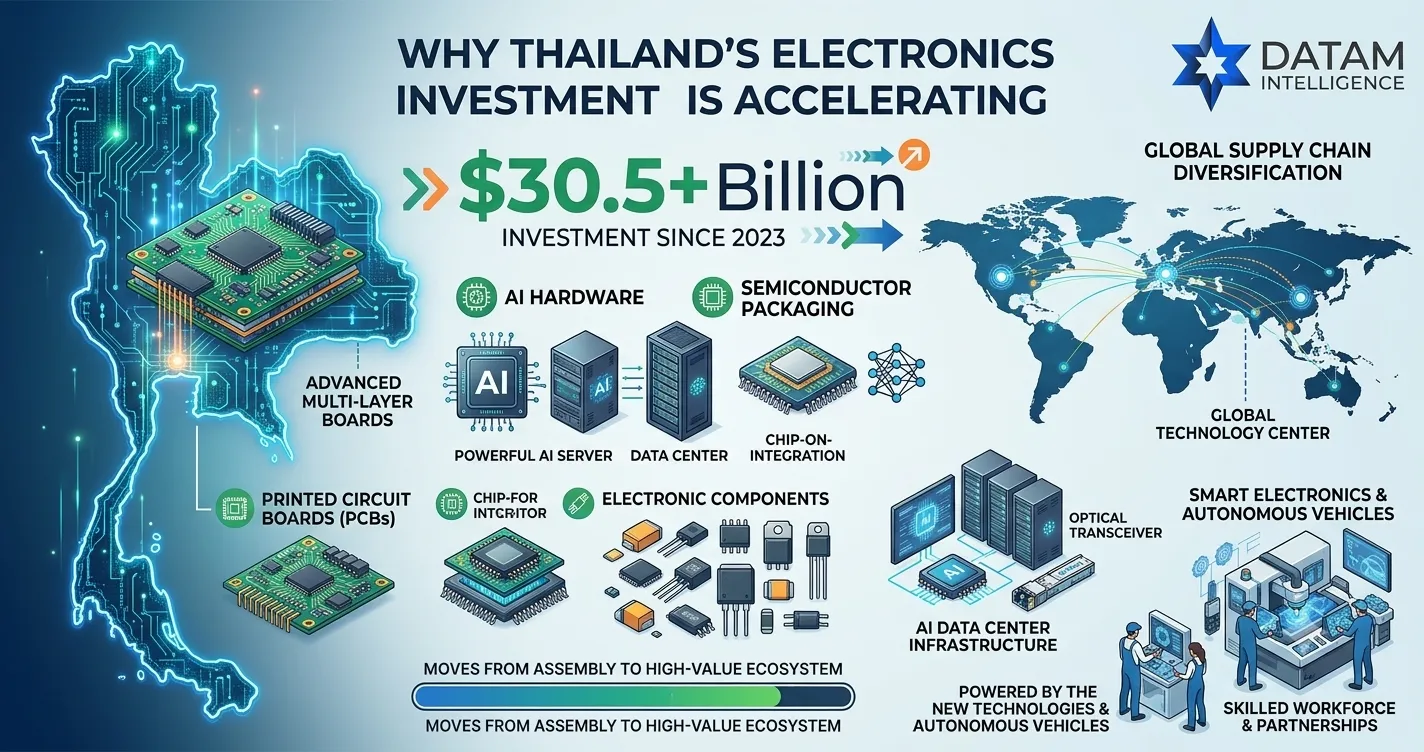
Thailand is strengthening its position in Southeast Asia’s advanced electronics supply chain after attracting more than $30.5 billion in electronics investment since 2023, with AI hardware, printed circuit boards, electronic components and advanced semiconductor packaging emerging as major areas of activity.
Thailand’s electronics industry is entering a new phase as global manufacturers increasingly look beyond traditional production locations to build more diversified and resilient technology supply chains.
Explore the Semiconductor Chip Ecosystem Market Report
Discover where growth and investment opportunities are emerging across chip design, wafer fabrication, advanced packaging, chiplets, semiconductor equipment, materials, and OSAT.
Explore the sample report for actionable market intelligence and strategic insights. Request a Sample Repoort Today!
According to Thailand’s Board of Investment (BOI), the country has secured more than $30.5 billion in electronics-sector investment since 2023. More than $10.1 billion across 224 projects has been directed toward printed circuit boards (PCBs) and electronic components, highlighting the growing importance of Thailand in the regional supply chain supporting artificial intelligence, advanced computing and semiconductor-related applications.
Why Thailand’s Electronics Investment Is Accelerating
The latest investment wave is being shaped by structural changes in global technology manufacturing.
Demand for AI infrastructure is increasing the need for high-performance electronic components, advanced PCBs, semiconductor packaging, photonics, data-storage technologies and other hardware used across data centers and intelligent devices.
At the same time, multinational manufacturers are diversifying production across Asia to reduce supply-chain concentration risks. Thailand is attempting to capitalize on this shift by combining its established electronics manufacturing base with investments in higher-value technologies.
The country's strategy is therefore moving beyond conventional electronics assembly toward a broader ecosystem covering components, advanced manufacturing, semiconductor-related activities, engineering capabilities and technology infrastructure.
AI Is Reshaping Thailand’s Electronics Manufacturing Opportunity
Artificial intelligence is becoming an important driver of Thailand’s electronics investment cycle.
AI data centers and computing infrastructure require significantly more sophisticated hardware than conventional IT systems. This creates opportunities across several parts of the electronics value chain, including PCBs, optical components, advanced packaging, high-capacity storage and power electronics.
Thailand’s BOI has also highlighted AI-linked investment covering areas such as optical transceivers, PCBs, high-capacity hard disk drives, AI servers, smart electronics and digital infrastructure. Realized investment in AI-related activities represented a substantial share of Thailand’s broader investment momentum during the first half of 2026.
This creates a potentially important advantage for Thailand: the country does not necessarily need to compete only for front-end semiconductor fabrication. It can strengthen its position across complementary segments of the AI hardware ecosystem.
PCB and Electronic Components Become Strategic Growth Areas
More than one-third of Thailand’s reported electronics investment since 2023 has been concentrated in PCBs and electronic components.
The significance goes beyond the value of individual projects.
PCBs and components are fundamental building blocks for AI servers, industrial automation systems, connected vehicles, consumer electronics and telecommunications equipment. As AI workloads become more complex, the requirements for board density, power management, thermal performance and high-speed connectivity are also increasing.
Thailand’s growing PCB ecosystem could therefore support manufacturers seeking a regional production base connected to the broader ASEAN electronics supply chain.
Advanced Semiconductor Packaging Could Strengthen Thailand’s Position
Thailand’s opportunity is also extending toward advanced semiconductor packaging and related technologies.
The regional semiconductor industry is increasingly focused not only on chip fabrication but also on packaging, testing, integration and supporting electronics infrastructure.
Advanced packaging is particularly important for AI hardware because modern computing systems increasingly depend on the integration of processors, memory and high-speed interconnect technologies.
Thailand’s investment push therefore comes at a time when semiconductor companies are reassessing where different stages of the chip and electronics value chain should be located.
Thailand Competes for a Larger Role in Southeast Asia’s Technology Supply Chain
Thailand is not competing in isolation.
Countries across Southeast Asia are attracting new investment as semiconductor and electronics manufacturers seek geographically diversified supply chains.
Vietnam, Malaysia and Singapore are also strengthening their roles in electronics, semiconductor manufacturing, AI infrastructure and advanced technology.
Thailand’s differentiation could come from its existing electronics manufacturing capabilities, industrial infrastructure, automotive ecosystem and growing focus on smart electronics.
The country's participation in regional technology initiatives is also increasing. At Thailand Electronics Circuit Asia (THECA) 2026, more than 300 global technology enterprises and around 7,000 delegates from 40 countries gathered to discuss AI infrastructure, semiconductors, photonics, advanced packaging, PCBs and electronics manufacturing services.
Investment Alone Will Not Determine Thailand’s Semiconductor Future
The next challenge for Thailand is converting investment into long-term domestic capabilities.
Capital inflows can create factories and production capacity, but a competitive advanced-electronics ecosystem also requires skilled engineers, research capabilities, local suppliers, reliable energy infrastructure, technology partnerships and strong links between industry and universities.
Thailand’s BOI has therefore emphasized a broader investment strategy focused on high-value industries, workforce development, stronger domestic supply chains and international technology partnerships.
This distinction will become increasingly important as competition for semiconductor and AI-related investment intensifies across Asia.
Thailand’s Electronics Industry Outlook
Thailand’s $30.5 billion electronics investment milestone indicates that the country is becoming more strategically important to the regional technology manufacturing landscape.
The strongest opportunity may lie at the intersection of electronics manufacturing, AI infrastructure, semiconductor packaging, advanced PCBs, photonics, storage technologies and smart mobility.
Thailand’s selection to host the 17th Electronic Circuits World Convention in 2027 is another indication of its increasing visibility within the global electronics manufacturing community.
For investors and technology companies, the key question is no longer whether Thailand can attract electronics investment. The more important question is how effectively the country can transform this capital into a deeper, higher-value and more technologically integrated electronics ecosystem.
If Thailand succeeds, its electronics industry could evolve from a traditional manufacturing base into a strategically important node in Southeast Asia’s AI and semiconductor supply chain.
Related FAQs
1. How much electronics investment has Thailand attracted?
Thailand has secured more than $30.5 billion in electronics-sector investment since 2023, according to Thailand’s Board of Investment. More than $10.1 billion of that investment is concentrated across 224 PCB and electronic-component projects.
2. Why is Thailand attracting electronics investment?
Thailand is benefiting from global supply-chain diversification, increasing demand for AI hardware, advanced electronics manufacturing, semiconductor packaging and its established industrial base.
3. Is Thailand becoming a semiconductor hub?
Thailand is strengthening its position in the broader semiconductor and advanced-electronics ecosystem, particularly through PCBs, electronic components, packaging, photonics and related manufacturing rather than competing solely on semiconductor fabrication.
4. How is AI driving Thailand’s electronics industry?
AI is increasing demand for servers, high-performance electronics, optical components, PCBs, storage technologies, advanced packaging and digital infrastructure. Thailand is targeting several of these areas to capture more value from the AI hardware supply chain.
5. What role do PCBs play in Thailand’s electronics investment?
PCBs are a major investment category because they are essential components in AI servers, telecommunications equipment, smart vehicles, industrial systems and consumer electronics.
6. What is advanced semiconductor packaging?
Advanced semiconductor packaging refers to technologies used to integrate and connect semiconductor components to improve performance, bandwidth, power efficiency and system-level functionality.
7. Which industries could benefit from Thailand’s electronics expansion?
Potential beneficiaries include AI infrastructure, data centers, semiconductor packaging, PCB manufacturing, automotive electronics, smart mobility, photonics, telecommunications and industrial automation.
8. How does Thailand compare with other Southeast Asian electronics hubs?
Thailand is competing with countries such as Malaysia, Vietnam and Singapore for electronics and semiconductor-related investment. Its advantages include an established manufacturing ecosystem, industrial infrastructure and links to automotive and electronics supply chains.
9. What is THECA 2026?
Thailand Electronics Circuit Asia 2026 is an industry event focused on electronics manufacturing, AI infrastructure, semiconductors, photonics, advanced packaging, PCBs and electronics manufacturing services. The event brought together more than 300 global technology companies and approximately 7,000 delegates.
10. What is the outlook for Thailand’s electronics industry?
Thailand’s electronics outlook is increasingly linked to AI infrastructure, advanced electronics, semiconductor-related manufacturing, smart mobility and regional supply-chain diversification. Future competitiveness will depend on skills, local suppliers, technology partnerships and infrastructure as well as investment.