


Semiconductor Chip Ecosystem Market Size
The global Semiconductor Chip Ecosystem market reached US$ 693.45 billion in 2025 and is expected to reach US$ 1860.12 billion by 2035, growing with a CAGR of 10.6% during the forecast period 2026-2035.
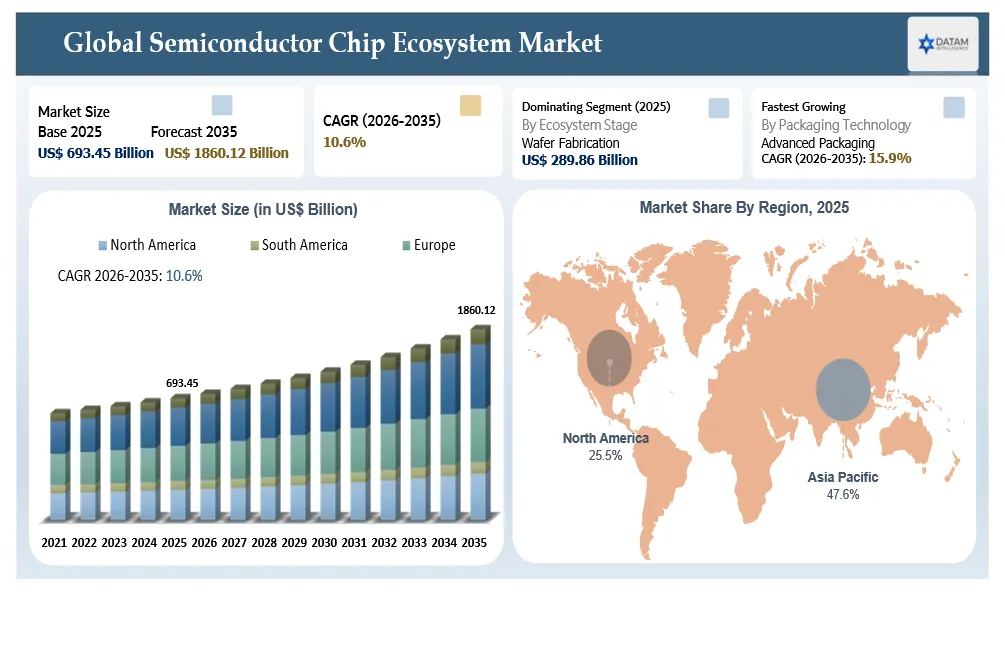
The rapid growth of the market is driven by increasing demand for artificial intelligence (AI), high-performance computing (HPC), 5G, cloud computing, electric vehicles (EVs) and the Internet of Things (IoT). According to the World Semiconductor Trade Statistics (WSTS), global semiconductor device sales reached US$ 795.6 billion in 2025, representing a year-on-year growth of 26.2%, reflecting strong demand for AI, cloud computing and advanced electronics. Within the Semiconductor Chip Ecosystem Market, Logic semiconductors emerged as the largest semiconductor type in 2025, supported by strong demand for AI processors, CPUs, GPUs and application-specific integrated circuits (ASICs), while High-Bandwidth Memory (HBM) experienced rapid adoption owing to increasing deployments of AI servers and hyperscale data centers.
The semiconductor ecosystem encompasses chip design, electronic design automation (EDA), semiconductor intellectual property (IP), wafer fabrication, semiconductor manufacturing equipment, semiconductor materials and outsourced semiconductor assembly and testing (OSAT). Continued investments in advanced fabrication facilities, next-generation packaging technologies and semiconductor manufacturing equipment are expanding production capacity and accelerating technology innovation across the global semiconductor ecosystem. The construction cost of a leading-edge semiconductor fabrication facility can exceed US$20 billion, highlighting the industry's capital-intensive nature and the need for sustained long-term investment.
Semiconductor Chip Ecosystem Market Key Takeaways
- Asia-Pacific region possessed 47.6% of the Semiconductor Chip Ecosystem Market in 2025 owing to its concentration of foundries, Integrated Device Manufacturer (IDMs), Outsourced semiconductor assembly and test (OSAT) providers, semiconductor equipment manufacturers and suppliers.
- Wafer Fabrication occupied 41.8% of the market in 2025 by ecosystem phase due to continuous investments in the latest processes, advanced foundries and increasing production capacity of semiconductors.
- Logic Semiconductors dominated the semiconductor market in 2025 with a market share of 30.6% driven by robust demand for AI accelerators, processors, graphics processors, smartphones and cloud computing infrastructures.
- 300 mm wafers accounted for 68.9% of the wafer size segment market in 2025 due to the high adoption rates of this wafer type in high-volume semiconductor processes and advanced developments.
- Investments in sub-2 nm processing methods, chip architecture, advanced packaging, high-bandwidth memory and EUV lithography have boosted technology advancement and ensured sustained growth in the semiconductor chip marketplace.
Semiconductor Chip Ecosystem Industry Trends and Strategic Insights
- Computing Powered by AI is Contributing to Innovative Chip Making: The increasing spending in generative AI, high-performance computing and hyperscale data centers has greatly increased the demand for AI accelerator chips, GPU chips, custom ASICs and HBM chips that are changing semiconductor development practices.
- Innovative Packaging and Chiplet Technology Capturing Attention: The semiconductor sector has started implementing 2.5D and 3D packaging, chiplet technologies and hybrid integration techniques in order to increase efficiency and decrease energy usage.
- The Expansion of Global Manufacturing Capacity to Reinforce Supply Chains: Government bodies and chip producers are putting money into advanced industrial facilities and packaging plants for the purpose of reinforcing their supply chains.
- Electrification of Vehicles and Digitalization in Industry Leads to a Higher Need for Semiconductor Chips: The surge in demand for logic, power, analog and sensor semiconductor chips is going to be driven by the growing popularity of electric vehicles, autonomous driving technologies, industrial automation, robotics and edge computing.
- Strategic Ecosystem Partnerships Speeding Up Technological Developments: Collaboration among fabless companies, foundries, integrated device manufacturers (IDMs), electronic design automation (EDA) suppliers, intellectual property (IP) providers, outsourcing semiconductor assembly and test (OSAT) enterprises and equipment makers is becoming more vital for boosting innovation, ensuring capacity and shortening time to market.
Semiconductor Chip Ecosystem Market Scope
| Metrics | Details | |
| 2025 Market Size | US$ 693.45 Billion | |
| 2035 Projected Market Size | US$ 1860.12 Billion | |
| CAGR (2026-2035) | 10.6% | |
| Largest Market | Asia-Pacific | |
| Fastest Growing Market | Asia-Pacific | |
| By Ecosystem Stage | Chip Design, Electronic Design Automation (EDA), Semiconductor IP Wafer Fabrication, Semiconductor Equipment, Semiconductor Materials, Assembly, Packaging & Testing (OSAT) and Distribution | |
| By Semiconductor Type | Logic, Memory, Analog, Microcontrollers & Processors, Power Semiconductors, Sensors, RF & Connectivity and Optoelectronics | |
| By Process Node | 2 nm & Below, 3 nm, 5 nm, 7 nm, 10 nm, 14 nm, 16/22 nm, 28 nm, 40–65 nm and Above 65 nm | |
| By Wafer Size | 150 mm, 200 mm, 300 mm and 450 mm | |
| By Packaging Technology | Wire Bond, Flip Chip, Wafer-Level Packaging (WLP), Fan-Out Packaging (FOWLP), System-in-Package (SiP), 2.5D IC Packaging, 3D IC Packaging and Chiplet Packaging | |
| By End-Use Industry | Consumer Electronics, Automotive, Data Centers & Cloud, Telecommunications, Industrial, Healthcare, Aerospace & Defense, Energy & Utilities and Others | |
| By Region | North America | U.S., Canada, Mexico |
| Europe | Germany, UK, France, Spain, Italy, Poland | |
| Asia-Pacific | China, India, Japan, Australia, South Korea, Indonesia, Malaysia, Singapore, Vietnam, Thailand, Philippines, Taiwan | |
| South America | Brazil, Argentina | |
| Middle East and Africa | UAE, Saudi Arabia, South Africa, Israel, Egypt | |
| Report Insights Covered | Competitive Landscape Analysis, Company Profile Analysis, Market Size, Share, Growth | |
Why does this Semiconductor Chip Ecosystem Market report matter in 2026?
2026 marks an important turning point for the Semiconductor Chip Ecosystem Market because there is an increase in the demand for artificial intelligence (AI), high performance computing (HPC), 5G network infrastructure, cloud computing and automotive electronics. Governments across the globe are focusing on becoming more self-sufficient in semiconductors by giving large scale incentives to manufacture chips and firms are increasing capacity, improving process technology and implementing advanced packaging.
The study gives an in-depth analysis of the developing semiconductor ecosystem, which takes into account the prospects of market trends, competitive developments, innovations in technologies and regional investments throughout the value chain. It helps semiconductor manufacturers, foundries, equipment suppliers, material providers, investors, OEMs and policymakers to identify growth opportunities, evaluate the top competitors, develop investment strategies and make informed business decisions.
Semiconductor Chip Ecosystem Market White Space & Investment Opportunities
- Chiplet Architecture Investment Opportunities: The growing trend towards the use of chiplets is opening up investment opportunities for companies in advanced packaging solutions, substrates and interconnections.
- Domestic Production of Semiconductors and Localized Supply Chain: Incentive schemes from governments have led to the formation of new wafer fabrication plants, specialized foundries, semiconductor materials and logistics to make countries less reliant on imported semiconductors.
- AI-Enabled Semiconductor Design & IP Generation: There is an increasing need for AI chips, customized semiconductors, RISC-V processors and semiconductor IP which opens up white spaces for the fabless companies and EDA providers.
- Wide Bandgap Semiconductors for Next-Generation Power Electronics: The use of silicon carbide (SiC) and gallium nitride (GaN) components in electric vehicles, renewable energy, industrial automation and fast charging represents a great long-term investment opportunity.
- Equipment, Chemicals, Materials and Testing Tools for Semiconductor Manufacturing: With a rise in fabrication plant construction globally, there is a growing need for lithography tools, deposition/etching tools, chemicals, silicon wafers, photomasks, testing gear and metrology tools.
Semiconductor Chip Ecosystem Future Market Transformation
The Semiconductor Chip Ecosystem Market would evolve through increased integration from the design of the chip through wafer production, advanced packaging, testing, to semiconductor equipment driven by the increased need for higher performance through AI-powered computing. Foundries are anticipated to increase their manufacturing capacities for leading-edge semiconductors below 2 nm, while advanced packaging such as 2.5D/3D packaging and chiplets would be adopted widely for AI accelerators, HPC chips and data center processors. This is happening against a backdrop of increasing adoption of HBM, silicon photonics and heterogeneous integration.
The ecosystem is likely to become more regionally diversified as countries continue investing in their own semiconductor manufacturing, advanced packaging and the supply chain for critical materials to ensure resilience to geopolitical shocks. Increased cooperation among semiconductor fabless companies, foundries, IDMs, OSAT providers, EDA vendors, semiconductor IP companies and equipment manufacturers will lead to faster innovation and shorter time to market. As AI, automotive electronics, industrial automation, cloud infrastructure and edge computing continue to expand, value creation will increasingly shift toward companies with expertise in advanced manufacturing technologies, packaging innovation and ecosystem-wide partnerships.
Semiconductor Chip Ecosystem Market Buyer Decision-Making Criteria
In the market of Semiconductor Chip Ecosystem, buying decisions are now made based on the capability of suppliers in providing the latest semiconductor chip development, production, packaging and manufacturing services. The buyers in this market, which include fabless semiconductor firms, integrated device manufacturers (IDM), hyperscale cloud companies, auto-OEM and electronic manufacturers, favor suppliers that can provide top-notch process capabilities, efficient manufacturing, packaging and production capacity. With the advancement of AI processor, automotive chips and HPC devices, technology leadership and compatibility to the ecosystem have become factors in selecting suppliers.
Semiconductor Chip Ecosystem Major Buyer Decision-Making Criteria
- Process Node Leadership and Manufacturing Yield
- Wafer Fabrication Capacity and Supply Assurance
- Advanced Packaging and Chiplet Integration Capabilities
- Power Efficiency and Power Performance
- Compatibility with EDA Tools, Semiconductor IP and Design Ecosystems
- Quality, Reliability and Automotive/Industrial Certification
- Cost Effectiveness and Long-Term Supply Commitment
- Technical Roadmap and R&D Competence
Semiconductor Chip Ecosystem Market Economic & Investment Analysis
The Semiconductor Chip Ecosystem Market is witnessing a record level of capital investment as both government and private sector companies intensify their investments in semiconductor chip fabrication, packaging and regionalization of the supply chain. The establishment of cutting-edge semiconductor fabs, OSAT capacity expansion and investments in semiconductor equipment and materials are driving changes to the economic dynamics of the industry. The policy efforts including the US CHIPS and Science Act, European Chips Act, Japanese, Korean, Taiwanese, Chinese and Indian national semiconductor schemes will enhance manufacturing capacities domestically while decreasing dependence on geographically concentrated manufacturing centers.
From the point of view of investment, capital is being directed at 2 nanometer or below process technology, advanced packaging, HBM, silicon photonics, semiconductor fabrication equipment, EDA and semiconductor intellectual property because of the increasing demand for AI infrastructure, cloud computing, automotive semiconductors and edge computing. While setting up a leading-edge semiconductor fabrication plant might cost more than US$20 billion, the high barrier to entry in the semiconductor market, capacity contracts and increasing AI-related semiconductor demand will still continue to foster investment and expansion within the global semiconductor landscape.
Semiconductor Chip Ecosystem Investment Trends in the Market
- Increase in Leading-edge Wafer Manufacturing Capability: The investment in sub-2 nm process technology, extreme ultraviolet lithography-based fabrication capability and advanced logic manufacturing is increasing due to the growing demand for artificial intelligence, high-performance computing and advanced computing technologies.
- Higher Investment in Advanced Packaging and OSAT Capability: Semiconductor companies are investing more money in advanced packaging and testing capabilities such as 2.5D/3D packaging, chiplets, wafer-level packaging, etc.
- Greater Capital Flow to AI-based IC Design, Semiconductor IP and EDA Tools: There is a greater flow of funding toward AI-based accelerators, RISC-V chips, customized ASICs, semiconductor IP and AI-enhanced electronic design automation (EDA).
- Higher Capital Flow to Semiconductor Production Equipment and Materials: The greater demand for EUV machines, deposition/etching machines, silicon wafers, photomasks, gases and semiconductor materials is causing greater capital investment throughout the upstream value chain.
- Development of Regional Semiconductors Ecosystem with Government Support: There is a fast-paced growth of investments towards the development of home-grown fabrication units, advanced packaging facilities, testing facilities and the manufacturing of semiconductors materials.
Strategic Indicators For Semiconductor Chip Ecosystem Market
High Regulation Impact
Due to its strategic significance for economic growth, national defense and technological advancement, the Semiconductor Chip Ecosystem Market is situated in one of the world’s most regulated industrial environments. The sector is governed by robust export laws, limitations on technology transfer, intellectual property protection systems, environmental compliance regulations, as well as rules for cyber and foreign investments. The government regulations such as the U.S. CHIPS and Science Act, European Chips Act and national semiconductor initiatives in Asia facilitate domestic production and global supply chain transformation. Meanwhile, limitations concerning cutting-edge semiconductor production equipment, advanced chips and modern process technologies still have an impact on international trade, capacity enlargement, agreements with suppliers and investment decisions. The growing geopolitical competition has made regulatory compliance one of the most important factors affecting technology access, planning of production, market penetration and positioning of its players.
High Investment Activity
Heavy investments from private and public sectors are being poured into the Semiconductor Chip Ecosystem Market, owing to the booming demand for AI, high-performance computing and cloud infrastructure. Thus, capital is being invested in advanced packaging facilities and wafer fabrication plants as well as in equipment used in manufacturing semiconductor components and devices such as EDA software and semiconductor IP. The incentives backed by governments as well as spending from businesses are supporting the development of processes, manufacturing in the country and diversification of supply chains. As the industry is shifting towards architectures based on chips, sub-2nm technologies, high-NA EUV lithography and heterogeneous integration, it remains critical to continue investing money into technologies.
Supply Chain Disruption
Supply Chain Disruption: Due to the concentration of advanced wafer fabrication, semiconductor manufacturing equipment, advanced packaging and crucial materials production in only a few countries and suppliers, the Semiconductor Chip Ecosystem Market is prone to supply chain issues. Geopolitical events, restrictions on exports, limitations in trade, natural disasters and constraints of logistics can result in difficulties with silicon wafer availability, specialty gases and chemicals, photomasks, advanced packaging substrates and EUV lithography equipment, making the manufacturing of semiconductors expensive, slow and less reliable. Thus, semiconductor businesses are changing their manufacturing footprints, optimizing relationships with suppliers, expanding scale of operations in regional locations of production and packaging and increasing investments in supply chain resilience.
Export restrictions by the U.S. on advanced semiconductor manufacturing equipment and technologies to China have further intensified supply chain disruptions across the global semiconductor ecosystem. Restrictions in the areas of EUV lithography systems, advanced DUV lithography, deposition, etching, metrology and inspection equipment have hindered China from expanding production capacity of semiconductors in sub-14 nm, 7 nm, 5 nm, 3 nm and future process nodes, thus slowing down expansion of advanced manufacturing capacity and making it increasingly dependent on mature node manufacturing for its semiconductor production needs. These restrictions have facilitated regionalization of semiconductor supply chains, as more investments are being made in building new fabrication plants and advanced packaging plants in the U.S., Taiwan, Japan, South Korea and Europe.
Pricing Volatility
The Semiconductor Chip Ecosystem Market is characterized by pricing volatility driven by fluctuations in wafer fabrication capacity, semiconductor equipment costs, raw material availability and demand from AI, high-performance computing, automotive electronics and cloud infrastructure. Establishing a leading-edge semiconductor fabrication plant costs more than US$20 billion and High-NA EUV lithography equipment costs in excess of US$350 million per unit, thereby affecting the capital expenditure of the players in the ecosystem. On top of that, there is an impact of volatility in the prices of silicon wafers, specialty gases, rare materials, advanced packaging substrates and memory devices due to periodic variations in supply and demand.
Procurement Pressure
The Semiconductor Chip Ecosystem Market is seeing more procurement challenges due to the shortage in supply of leading-edge wafer capacity, packaging, semiconductor equipment, gases, silicon wafers and other materials that are exceeding the demand in certain sectors. The lengthy qualification process, restricted availability of suppliers and dependency on a few technology providers make it difficult to procure the required resources and increase the risks in the process. Besides, geopolitical trade barriers and capacity allocation from foundries and equipment suppliers make it mandatory for semiconductor companies to have long-term procurement agreements and strategic sourcing.
New Technology Adoption
The Semiconductor Chip Ecosystem Market is experiencing the fast uptake of new technologies with producers and players in the ecosystem pouring resources into the sub-2 nm process node, High-NA EUV lithography, chiplet design and packaging technologies like 2.5D/3D, silicon photonics and AI-based EDA (Electronic Design Automation). All of these technologies give opportunities for higher transistor density, better performance per watt, better design flexibility and higher production efficiency for meeting increased demand for various fields, such as AI, high-performance computing, automotive electronics and edge computing. Nevertheless, the commercialization of these technologies requires hefty investment, advanced production capabilities, cooperation of all players in the ecosystem and R&D efforts of various companies from fabricators to companies producing semiconductor IP.
Regional Expansion Opportunity
In terms of geography, the Semiconductor Chip Ecosystem presents ample opportunity for growth in light of the fact that a number of government agencies and industry players are investing in the development of localized semiconductor ecosystems which is expected to help increase the capacity of semiconductor manufacturing and reduce supply chain over-concentration. There are key initiatives aimed at development of wafer fabrication plants, advanced packaging and assembly facilities and development of semiconductor materials, equipment manufacturing and research and development centers across the USA, Europe, Japan, South Korea, India and South East Asia. At the same time, growing demand for AI, HPC technologies, automotive electronics and digitalization of industry has convinced many foundries, integrated device manufacturers, fabless companies, outsourced assembly and test providers, semiconductor equipment manufacturers and semiconductor IP vendors to move forward with regional expansion and cooperation in terms of supply chain.
Government Policy Support
There is ongoing substantial government policy assistance that benefits Semiconductor Chip Ecosystem Market because different countries focus on semiconductor production in order to increase their technological independence and economic competitiveness. This market is being largely supported by such policies as the CHIPS and Science Act in the USA, the European Chips Act, as well as incentive programs for semiconductor production in Japan, South Korea, Taiwan, China and India that stimulate investments in wafer manufacturing, packaging, equipment, raw materials and scientific research. Those initiatives provide financial allowances, tax benefits, investments in infrastructure and education of professionals so that semiconductor manufacturing grows stronger and investors' chains become more dependable. Since competition is stepping up in the sphere of semiconductor production technologies, continuous support of the policies is meant to speed up the development of the ecosystem and help the business get investments in the market.
Semiconductor Chip Ecosystem Pricing Intelligence
Pricing intelligence is emerging as a crucial element in the Semiconductor Chip Ecosystem Market, helping businesses improve their procurement and production costs. Prices depend on the process node, wafer size, packaging technology, equipment availability and AI-driven demand. Price premiums for advanced node semiconductor production are incurred primarily due the complexities of and investment in production processes. High-NA EUV lithography systems typically have a market price exceeding US$350 million per system, complemented by higher prices for packaging technologies of 2.5D and 3D integrated circuits, as well as chiplet technology. Hence, companies resort to pricing intelligence and enter long-term supply contracts to achieve greater levels of cost-effectiveness.
| HS Code | Reporter | Trade Flow | 2025 Trade Value | Interpretation |
8542-Electronic Integrated Circuits | China | Imports | US$ 412.8 Billion | China remains the world's largest importer of integrated circuits, reflecting its dominant electronics manufacturing and assembly industry. |
8542-Electronic Integrated Circuits | Taiwan | Exports | US$ 233.6 Billion | Taiwan leads global IC exports, supported by advanced foundry manufacturing and strong demand for AI and high-performance computing chips. |
8486- Semiconductor Manufacturing Equipment | Japan | Exports | US$ 28.9 Billion | Japan is a major supplier of semiconductor manufacturing equipment, benefiting from its leadership in precision manufacturing and process technologies. |
3818-Doped Silicon Wafers & Semiconductor Materials | South Korea | Exports | US$ 11.4 Billion | South Korea maintains strong exports of semiconductor materials driven by its advanced memory semiconductor and wafer fabrication ecosystem. |
AI Impact Analysis of Semiconductor Chip Ecosystem Market
The semiconductor chip ecosystem market is being affected by artificial intelligence as demand is being created all across the semiconductor value chain. This is mainly because of generative AI and autonomous systems along with other technologies like edge AI, which is creating more supply requirements for all components like HBM and High-NA EUV lithography that are needed to manufacture the chips. In 2025, the semiconductor industry is expected to generate US$795.6 billion in revenue. In particular, the tech industry will benefit from the development of the infrastructure that is required to carry out activities across the semiconductor chain such as designing and supplying semiconductor manufacturing equipment.
The use of AI is making an impact in semiconductor design and production through the use of AI technology in electronic design automation (EDA), forecasting and predicting of processes, detecting defects, efficiency of production process, maintenance of machinery and analysis of supply chain. All of these will shorten the period of production of chips, improve wafer processing, raise the efficiency of capacitor production and stimulate wider introduction of new semiconductor technologies. In future, AI technology will stay a powerful force of innovations, investments and growth within the entire global semiconductor industry.
Disruption Analysis of Semiconductor Chip Ecosystem Market
Changes in the Semiconductor Chip Ecosystem Market are being driven by major transformations in AI computing, chiplet structure, under 2 nm processing technology, High-NA EUV lithography, silicon photonics and heterogeneous integration. The traditional technique of monolithic chip design is gradually being replaced by the approaches of modular chiplet structure and new channels of packaging, which allow increasing performance, scalability and speed of product development in such fields as AI, high-performance computing, developing and data processing. In addition to major developments in chip design and manufacturing, innovations in AI will enhance electronic design automation (EDA), digital twins, predictive process control and inspections of electronic devices.
On top of technological changes, the industry is also being restructured through semiconductor incentive programs backed by the government, localization of the supply chain, export regulations, expansion of capacity in various regions and strategic technological partnerships. Investment into wafer fabrication systems, modern packaging systems, semiconductor equipment and essential materials accelerates regional semiconductor ecosystems' development. Such changes create better cooperation between foundries, IDMs, fabless companies, OSAT service providers, equipment manufacturers, semiconductor material suppliers, EDA vendors and semiconductor IP vendors and change the process of how semiconductors are designed, manufactured, packaged and supplied.
Semiconductor Chip Ecosystem Market BCG Matrix: Company Evaluation
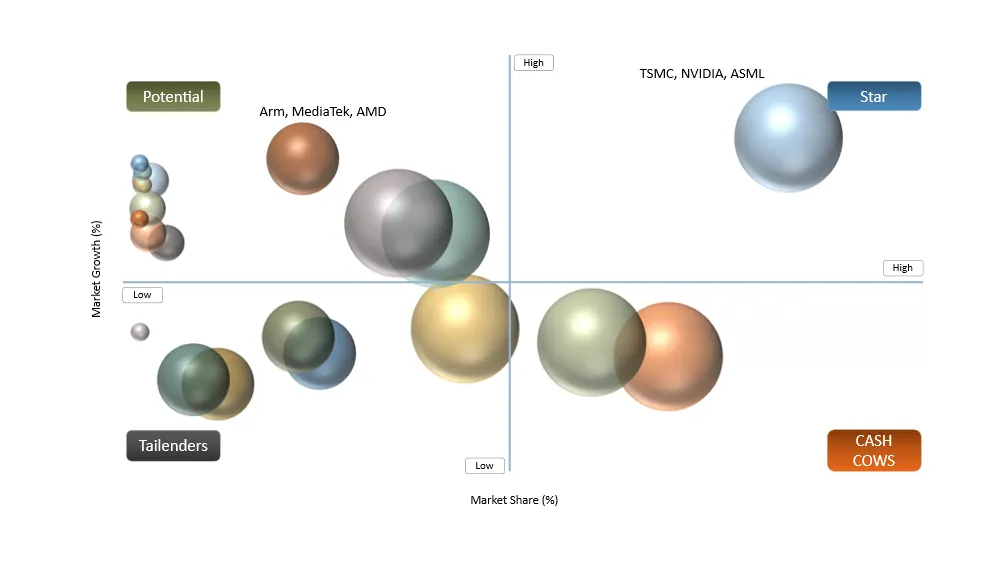
STAR
Companies like TSMC, NVIDIA, ASML, SK hynix and Applied Materials are classified into the Star quadrant because of their high level of market leadership and strong growth potential. The companies are leading the way in innovative AI semiconductors, advanced wafer manufacturing, High-NA EUV lithography, HBM manufacture, semiconductor equipment and premiere techniques. It is through constant investment in capacity, research and development and next-generation semiconductors that these firms are reaping benefits of demand surge from the field of AI, cloud computing, automotive electronics and high-performance computing.
POTENTIAL
Companies such as Arm, MediaTek, AMD, ASE Technology and Amkor Technology are categorized as Potential firms as they operate in growing fields but also have opportunities to expand their share in the overall semiconductor value chain. Their expertise in semiconductor IP, AI processors, chiplet architectures, advanced packaging and outsourced semiconductor manufacturing and assembly provides them with opportunities for major growth in the future, especially due to the rising demand for sophisticated AI technologies, heterogeneous integration and packaging techniques.
Semiconductor Chip Ecosystem Market Dynamics
Driver Impact Analysis
| Driver | Market Growth Impact (%) | Demand Concentration | Impacted Use Case | Strategic Impact |
| AI & High-Performance Computing (HPC) Expansion | 31% | Very High | AI accelerators, GPUs, data center processors, HBM | Accelerates investment in leading-edge process nodes, advanced packaging and high-performance chip production. |
| Government Semiconductor Incentive Programs | 27% | High | Domestic wafer fabrication, packaging, equipment manufacturing | Expands regional manufacturing capacity, strengthens supply chain resilience and encourages private capital investment. |
| Automotive Electrification & ADAS Adoption | 22% | High | EV power semiconductors, MCUs, sensors, automotive SoCs | Increases demand for automotive-grade semiconductors, mature-node capacity and long-term supply agreements. |
| Advanced Packaging & Chiplet Adoption | 20% | Medium-High | AI processors, HPC, networking, advanced computing | Drives investment in OSAT infrastructure, heterogeneous integration and next-generation semiconductor packaging technologies. |
Major Driver: AI and High-Performance Computing Fuel Demand Across the Semiconductor Ecosystem
The Semiconductor Chip Ecosystem Market is being significantly enhanced by the quick rise in the market of AI technologies, HPC and hyperscale data centers. The increased use of generative AI technologies, cloud infrastructure, autonomous machines and edge AI applications is causing the demand for AI accelerator, GPU, HBM, the advanced packaging and the latest semiconductor processes to increase. This demand is leading to a large amount of investment along the semiconductor value chain in chip design, wafer fabrication, SEMI equipment, materials and OSAT. With the continuous investment in AI technologies and latest computing platforms, semiconductor firms are ramping up their production, boosting their technology innovations and strengthening their global supply chain, making the growth of the market generated by the AI technologies.
Restraint Impact Analysis
| Restraint | Drag on Market Growth (%) | Primary Impact Area | Impacted Use Case | Strategic Impact |
| High Capital Investment Requirements | 32% | Wafer Fabrication & Advanced Packaging | Leading-edge fabs, EUV lithography, OSAT expansion | Increases entry barriers, delays capacity expansion and limits participation to financially strong companies. |
| Geopolitical Tensions & Export Controls | 28% | Global Supply Chain & Technology Access | AI chips, advanced process nodes, semiconductor equipment | Restricts technology transfers, disrupts cross-border supply chains and accelerates regional manufacturing localization. |
| Semiconductor Talent Shortage | 22% | Design, Manufacturing & R&D | Process development, chip design, equipment engineering | Slows technology development, fab ramp-up and commercialization of next-generation semiconductor technologies. |
| Long Manufacturing & Equipment Lead Times | 18% | Production Capacity & Procurement | Wafer fabrication, advanced packaging, manufacturing equipment | Delays production expansion, extends project timelines and increases procurement complexity for critical semiconductor infrastructure. |
Major Restraint: High Capital Investment and Manufacturing Complexity
The Semiconductor Chips Ecosystem Market suffers from constraints that emanate from the very high amount of capital outlay and complexity of the technological processes involved in advancing the manufacture of semiconductors. Setting up world class wafer fabrication plants, investing in High-NA EUV Lithography systems, increasing capabilities for advanced packaging and developing next generation process technologies call for very costly investments. In addition, the reliance on the highly specialized semiconductor equipment, pure materials, advanced production knowledge and tight process control makes production very expensive and inflexible. Such constraints limit entry into the market and growth of the market as a whole.
Semiconductor Chip Ecosystem Market Segmentation Analysis
The global Semiconductor Chip Ecosystem market is segmented based on the Ecosystem Stage, Semiconductor Type, Process Node, Wafer Size, Packaging Technology, End-Use Industry and region.
By Ecosystem Stage
Wafer Fabrication Leads the Semiconductor Chip Ecosystem Market
The Wafer Fabrication accounted for 41.8% of the global market share in the Semiconductor Chip Ecosystem Market in 2025. The market dominance of the Wafer Fabrication can be explained by its important position in the semiconductor manufacturing process and huge capital investment involved in the semiconductor chip manufacturing process. With the increasing requirement of AI processor chips, HPC chips, automotive semiconductor chips and advanced logic devices, there have been huge investments made towards the wafer fabrication facilities and wafer fabrication processes.
By Packaging Technology
Rising Adoption of Advanced Packaging Fuels Rapid Growth
It is estimated that the Advanced Packaging segment will grow at a CAGR of 15.9% in 2026-2035, making it the fastest-growing packaging technology in the Semiconductor Chip Ecosystem Market. The increasing use of chiplet architecture, 2.5D/3D heterogeneous integration, HBM and AI has been responsible for this growth. Advanced packaging technology has become vital in transforming the future of artificial intelligence, data centers, automotive industry and high-performance computing as semiconductor manufacturers strive for better performance, more bandwidth, improved power efficiency and enhanced transistor density.
Semiconductor Chip Ecosystem Market Geographical Penetration
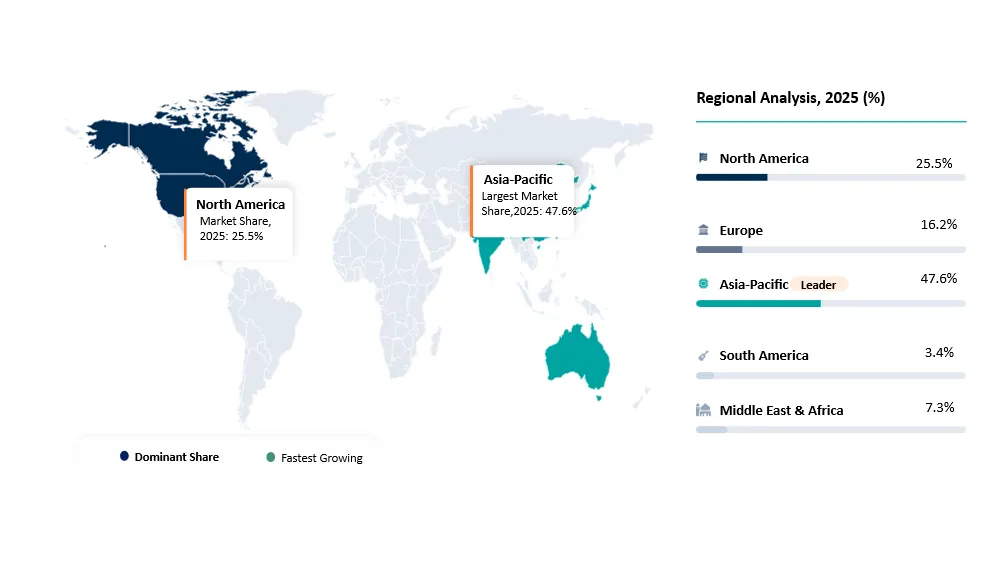
U.S. Semiconductor Chip Ecosystem Market Landscape
The ecosystem of semiconductors in the United States is one of the best in the world because of its great strength in chip design, manufacture equipment, wafer fabrication and advanced packaging. The growing demand for AI chips, data centers, automotive electronics and defense, as well as governmental efforts to support the semiconductor industry via the CHIPS and Science Act, are fueling the investments in the semiconductor industry. Despite all the existing challenges, including high production costs and fierce competition, the market will grow steadily.
Japan Semiconductor Chip Ecosystem Market Outlook
Despite all the competition and rivalries, Japan still plays an important role in the international market of Semiconductor Chip Ecosystem. This is due to the fact that Japan holds leading positions in the development of the technologies associated with the production of semiconductors, including the production of equipment, silicon wafers, photo-resist, special chemicals and other advanced materials necessary for manufacturing the chips. Being a leader in precision engineering and having a resilient industrial capacity, Japan keeps strengthening its positions in providing advanced materials and technologies used in the manufacturing process.
Taiwan Semiconductor Chip Ecosystem Market Trends
Taiwan is still dominating the market of the Semiconductor Chip Ecosystem Market owing to its strong presence in the areas of advanced foundries, leading edge wafer fabrication and next generation process technology. The nation is still leading in the areas of 3 nm and below manufacturing, advanced packaging, chiplets and artificial intelligence semiconductors by providing high-performance chips for AI, data center, cloud computing, automotive electronics and high-performance computing. The investments made in fabrication capacity, advanced packaging and manufacturing processes are contributing to Taiwan's domination as the premier semiconductor manufacturer in the world.
South Korea Semiconductor Chip Ecosystem Market Trends
South Korea is one of the world’s dominant players in the Semiconductor Chip Ecosystem Market due to the country’s strengths in memory semiconductors, advanced logic technology manufacturing and semiconductor technology fabrication. In fact, South Korea continues to ramp up its investments in HBM, AI memory, next-gen process nodes, advanced packaging and semiconductor technology research and development in order to cater to increased demand in applications such as AI, high performance computing, data centers and automotive electronics. This can be attributed to the government policies of the country and capacity additions from top-tier manufacturers.
Semiconductor Chip Ecosystem Market Competitive Landscape
- The concept of technology leadership includes cutting-edge process nodes, artificial intelligence accelerators, high-NA extreme ultraviolet lithography, chip architectures and modern packaging. Different companies are fighting for leadership and are using continual research and development as well as innovations in the area of production.
- In order to improve ecosystem integration and minimize product time to market, it is indispensable to set reliable partnerships between foundries, fabless companies, integrated device manufacturers, OSAT providers, electronic design automation companies, semiconductor intellectual property suppliers, providers of equipment and material suppliers.
- Expanding the production capacity of plants seems to be an effective strategy, with investments made in innovative plants designed for wafer production, packaging facilities and semiconductor factories in North America, Asia-Pacific and Europe.
- Businesses are bolstering supply chain resilience by diversifying their manufacturing hubs, signing long-term contracts for semiconductors and expanding manufacturing capabilities regionally in order to avoid geopolitical and supply chain threats.
- Competitive differentiation is now largely shaped by artificial intelligence computing, novel packaging methods, chiplet architecture, HBM chips, photonic silicon and modern production technologies, providing enhancements in efficiency, functionality and system integration.
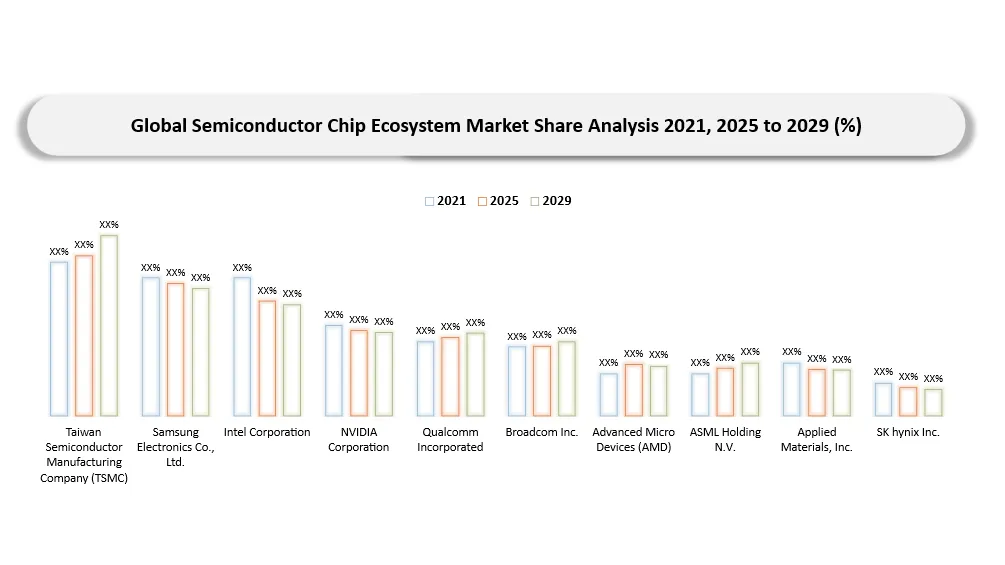
Semiconductor Chip Ecosystem Market Key Companies
- Taiwan Semiconductor Manufacturing Company (TSMC) (Taiwan)
- Samsung Electronics Co., Ltd. (South Korea)
- Intel Corporation (United States)
- NVIDIA Corporation (United States)
- Qualcomm Incorporated (United States)
- Broadcom Inc. (United States)
- Advanced Micro Devices, Inc. (AMD) (United States)
- SK hynix Inc. (South Korea)
- Micron Technology, Inc. (United States)
- MediaTek Inc. (Taiwan)
- ASML Holding N.V. (Netherlands)
- Applied Materials, Inc. (United States)
- Lam Research Corporation (United States)
- KLA Corporation (United States)
- Tokyo Electron Limited (Japan)
- Synopsys, Inc. (United States)
- Cadence Design Systems, Inc. (United States)
- Arm Holdings plc (United Kingdom)
- ASE Technology Holding Co., Ltd. (Taiwan)
- Amkor Technology, Inc. (United States)
Semiconductor Chip Ecosystem Market Major Pain Points
- The considerable introduction cost of manufacturing plants equipped with the most cutting-edge technologies, High-NA EUV lithography systems and developed packaging facilities results in substantial financial restrictions and hampers speedy expansion.
- Soaring geopolitical strain, controls on trade and disturbances in supply chains connected to equipment for semiconductor production, vital substances and progressive technologies bring about uncertainties in terms of operational performances and sourcing issues.
- The semiconductor development and manufacturing cycle is long and complicated by verification of the design, qualification of the processes and product yield. Moreover, the development of the product and getting it to market takes a long time.
- There exists a continuous shortage of experts within the semiconductor industry, which hampers advancements and production efficiency.
- The rapid transformation of technology to less than 2 nm process nodes, chiplet systems, High-Bandwidth Memory (HBM), silicon photonics and artificial intelligence accelerators calls for consistent investment in research and development, countless manufacturing enhancements and speedy manufacturing processes, resulting in significantly increasing difficulties and financial difficulties for stakeholders.
Recent Developments in the Semiconductor Chip Ecosystem
- August 2026: Applied Materials projected fourth-quarter revenue of approximately US$10.25 billion, supported by strong semiconductor manufacturing-equipment demand, while expecting 2026 advanced-packaging revenue growth of more than 70%.
- July 2026: TSMC announced an additional US$100 billion investment in Arizona, bringing its planned U.S. investment to approximately US$165 billion, supporting additional advanced fabs, advanced packaging facilities and an R&D center.
- July 2026: Samsung Electronics expanded its strategic collaboration with Broadcom across memory and foundry technologies while continuing to advance its HBM4E and AI-infrastructure memory portfolio.
- July 2026: Intel Corporation announced a €5 billion investment to expand manufacturing capacity at its Leixlip campus in Ireland, targeting advanced production for Xeon processors and strengthening Europe's semiconductor supply chain.
- July 2026: Intel Foundry continued advancing domestic leading-edge manufacturing and highlighted advanced packaging technologies such as Foveros and EMIB for next-generation AI processors.
- July 2026: NVIDIA entered a long-term strategic partnership with Safe Superintelligence and made an investment in the company, providing access to NVIDIA's next-generation Vera Rubin computing platform.
- July 2026: Qualcomm completed its acquisition of Modular, strengthening its AI software ecosystem and expanding its capabilities across devices, edge infrastructure and data centers.
- July 2026: Broadcom established the AI XPV Platform with Apollo and Blackstone, targeting more than 20 GW of AI compute capacity through 2028 using Broadcom XPUs and networking solutions.
- July 2026: AMD expanded its strategic partnership with Microsoft Azure, with Microsoft planning deployment of AMD Helios rack-scale systems and next-generation EPYC processors for AI inference and cloud workloads.
- July 2026: SK hynix announced a KRW 100 trillion investment in the Chungcheong region of South Korea, including plans for the M17 NAND fabrication facility and P&T7 advanced packaging facility to support AI semiconductor demand.
- July 2026: Micron Technology announced plans to invest up to US$3 billion to strengthen the U.S. semiconductor supply chain, including strategic financing for a 300mm silicon-wafer manufacturing facility in Texas.
- July 2026: Lam Research reported record quarterly revenue of US$6.72 billion, driven by continued AI-related demand for semiconductor manufacturing equipment and advanced processing technologies.
- July 2026: Synopsys and Intel Foundry expanded collaboration around Intel 14A, providing AI-powered EDA flows, multiphysics analysis and advanced packaging design capabilities for next-generation multi-die semiconductor systems.
- July 2026: Cadence Design Systems introduced its AuraStack AI Super Agent for PCB and advanced packaging design, targeting faster system-design cycles and greater automation across the silicon-to-system workflow.
- July 2026: Amkor Technology announced a US$1.5 billion multi-year strategic partnership with NVIDIA to expand advanced semiconductor packaging and testing capabilities in the United States for next-generation AI infrastructure.
- July 2026: Cadence partnered with Rapidus to integrate agentic AI technologies into advanced-node SoC design, targeting up to 2× faster design turnaround times.
- June 2026: SK hynix shipped samples of its 12-layer HBM4E memory to major customers, achieving speeds of up to 16Gbps per pin and improving thermal performance through advanced packaging technology.
- May 2026: ASE Technology and WUS announced plans to build an advanced manufacturing facility in Kaohsiung, creating an AI and high-performance-computing packaging hub with more than 113,000 square meters of floor space.
- May 2026: Amkor Technology expanded its Arizona advanced-packaging footprint by acquiring an additional 67-acre parcel, providing capacity for future high-volume semiconductor packaging and testing.
Analyst View / Opinion on Semiconductor Chip Ecosystem Market
- AI is altering the entire semiconductor environment as it is creating steady investments in chip design, advanced chip fabrication, advanced packaging, high bandwidth memory (HBM), semiconductor systems and manufacturing components instead of benefiting only a few major players in the semiconductor industry.
- Advanced packaging and chiplet-based systems of architecture will soon become a major difference in selective semiconductor manufacture, allowing for improved effectiveness without the use of traditional transistor size increase; and proven to be necessary for the leading semiconductors of AI, high-performance computing (HPC) and any data centers.
- Government incentives will aid the expansion of local chip production, but the Asia-Pacific region will continue to dominate the fabrication of wafers with many renowned companies producing chips for the foreseeable future.
- The competitive environment is likely to benefit companies with either vertically integrated functions or robust ecosystem alliances across the domains of EDA, semiconductor IP, fabricating companies, IDMs, OSATs, machinery manufacturers and suppliers.
- The industry is set to change from a manufacturing industry to one of continually innovating firms that rely increasingly on groundbreaking process methods, artificial intelligence in chip creation and unique connections among supply chain partners.
Semiconductor Chip Ecosystem Market Target Audience
| INDUSTRY | WHO SHOULD BUY THIS REPORT? | REASON TO BUY THIS REPORT |
| Semiconductor Foundries | Executive Management, Strategy Teams, Fab Expansion Managers | Evaluate capacity expansion opportunities, technology roadmaps, regional investments and competitive positioning. |
| Fabless Semiconductor Companies | CEOs, Product Managers, Supply Chain & Procurement Heads | Understand foundry capacity, advanced packaging trends, technology adoption and sourcing strategies. |
| Integrated Device Manufacturers (IDMs) | Business Development, Manufacturing & R&D Leaders | Assess market demand, optimize manufacturing investments and strengthen product portfolios. |
| OSAT (Assembly, Packaging & Testing) Companies | Operations Directors, Packaging Engineers, Strategy Teams | Identify growth opportunities in advanced packaging, chiplet integration and outsourced manufacturing services. |
| Semiconductor Equipment Manufacturers | Product Strategy, Sales & Business Development Teams | Track investments in wafer fabrication, advanced process nodes and equipment demand across global fabs. |
| Semiconductor Materials Suppliers | Commercial Directors, Procurement & Supply Chain Teams | Analyze demand for silicon wafers, specialty chemicals, gases, photomasks and packaging materials. |
Electronic Design Automation (EDA) & Semiconductor IP Companies | Product Management, Technology & Innovation Teams | Evaluate demand for next-generation chip design tools, AI-driven EDA and semiconductor IP licensing. |
| Data Center & Cloud Infrastructure Companies | Infrastructure Planning, Technology Procurement, Data Center Architects | Understand semiconductor supply, AI accelerator trends and processor technology roadmaps for infrastructure planning. |
| Automotive OEMs & Tier-1 Suppliers | Procurement Heads, Electronics Engineering, Supply Chain Managers | Monitor semiconductor availability, automotive chip trends and long-term sourcing strategies for EVs and ADAS. |
Government Agencies, Investors & Research Institutions | Policymakers, Investment Analysts, Economic Development Agencies | Support semiconductor policy development, evaluate investment opportunities, strengthen domestic manufacturing ecosystems and monitor industry competitiveness. |
Why Choose DATAM?
- Data-Driven insights: Dive into detailed analyses with granular insights such as pricing, market shares and value chain evaluations, enriched by interviews with industry leaders and disruptors.
- Post-Purchase Support and Expert Analyst Consultations: As a valued client, gain direct access to our expert analysts for personalized advice and strategic guidance, tailored to your specific needs and challenges.
- White Papers and Case Studies: Benefit quarterly from our in-depth studies related to your purchased titles, tailored to refine your operational and marketing strategies for maximum impact.
- Annual Updates on Purchased Reports: As an existing customer, enjoy the privilege of annual updates to your reports, ensuring you stay abreast of the latest market insights and technological advancements. Terms and conditions apply.
- Specialized Focus on Emerging Markets: DataM differentiates itself by delivering in-depth, specialized insights specifically for emerging markets, rather than offering generalized geographic overviews. The approach equips our clients with a nuanced understanding and actionable intelligence that are essential for navigating and succeeding in high-growth regions.
- Value of DataM Reports: Our reports offer specialized insights tailored to the latest trends and specific business inquiries. The personalized approach provides a deeper, strategic perspective, ensuring you receive the precise information necessary to make informed decisions. The insights complement and go beyond what is typically available in generic databases.
What DATAM Uniquely Provides
- Complete coverage of the ecosystem including semiconductor IP, EDA companies, fabless companies, foundries, IDMs, OSAT suppliers, manufacturers and other distributors, providing an overall outlook on Semiconductor Chip Ecosystem Market.
- Detailed classifications and forecasting across ecosystem stages, types of semiconductors, process nodes, wafer sizes, packaging technology, industries and regions to shape successful strategy formation and investment decisions.
- Thorough research has been done on the technology trends that are currently shaping the future of semiconductors. These are as follows: AI accelerators, chiplet architectures, HBM, high-NA EUV graphic design, advanced packaging technology, Silicon Photonics and the new generation in manufacturing process technology.
- Valuable competitive intelligence has also been compiled on topics such as how to increase production capacity, pursue technology roadmaps, form partnerships, follow government programmes to promote the creation of new companies and boost the market presence.
- All-inclusive strategic insights integrating market sizing, forecasts, benchmarks, technological evaluations, country level analysis, trade intelligence and trends in investment for guiding business and investment decisions.


























































