


South Korea Launches $3.5 Billion Fund to Accelerate Chip Industry Growth
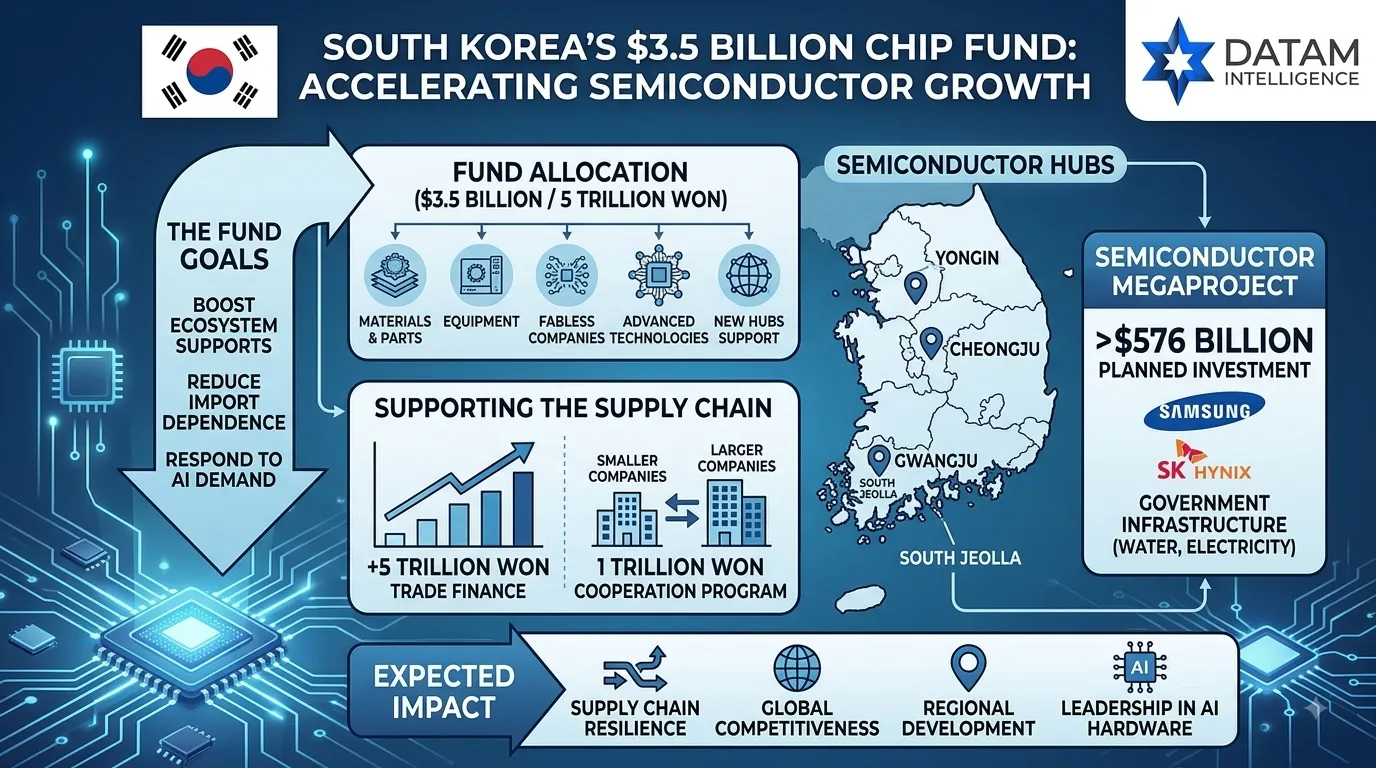
South Korea is stepping up government support for its semiconductor industry with a 5 trillion won (approximately US$3.5 billion) semiconductor fund, targeting chip materials, parts, equipment and fabless semiconductor companies as the country accelerates the development of new semiconductor manufacturing hubs.
The initiative forms part of a broader semiconductor strategy led by President Lee Jae Myung's administration to expand domestic production capacity, strengthen the semiconductor supply chain and respond to growing demand from artificial intelligence (AI), data centers and advanced computing.
Explore the Semiconductors Market Report
Gain in-depth insights into Semiconductor Market size, growth trends, AI-driven demand, advanced packaging, supply-chain dynamics, regional developments, and competitive strategies. Request a Free Sample Market Report to make informed business and investment decisions.
South Korea will also provide an additional 5 trillion won in trade finance to support semiconductor suppliers, increasing financial support available across the country's chip ecosystem.
What Is South Korea's US$3.5 Billion Chip Fund?
The new semiconductor fund is designed to provide financing to companies operating across critical segments of the chip value chain, including:
- Semiconductor materials
- Semiconductor components and parts
- Semiconductor manufacturing equipment
- Fabless chip companies
- Advanced semiconductor technologies
- Suppliers supporting new chip manufacturing facilities
The policy is intended to ensure that South Korea's semiconductor expansion extends beyond large chip manufacturers and strengthens the smaller and specialized companies that support semiconductor production.
The government also plans a 1 trillion won, 10-year program designed to encourage cooperation between large semiconductor companies and smaller suppliers.
Why Is South Korea Expanding Semiconductor Investment?
The latest funding initiative comes as semiconductor demand is being reshaped by AI infrastructure, high-performance computing and data-center expansion.
South Korea is already one of the world's most important semiconductor manufacturing locations, particularly in memory technologies. However, expanding future production requires investment across the wider semiconductor ecosystem, including equipment, materials, components, advanced packaging and specialized chip design.
The government is therefore pursuing a broader semiconductor industrial strategy rather than focusing exclusively on wafer fabrication.
South Korea's semiconductor expansion also includes plans for new production hubs outside the Seoul metropolitan area. In June 2026, the government announced plans for a southwestern semiconductor cluster involving 800 trillion won in corporate investment, including four memory chip fabrication plants. The initiative is intended to create a second major semiconductor production base while reducing pressure on existing infrastructure in the Seoul metropolitan region.
South Korea's Semiconductor Hubs Enter a New Investment Phase
The new fund is part of a much larger semiconductor investment program involving major manufacturers, suppliers and regional governments.
South Korea's broader semiconductor megaproject includes more than US$576 billion in planned investments from major companies and local governments, according to Reuters. The government is also working on infrastructure requirements, including electricity and water supplies, which are becoming increasingly important as semiconductor fabs become larger and more resource-intensive.
The strategy includes the development of semiconductor infrastructure in regions such as Gwangju and South Jeolla, alongside continued investment in established clusters such as Yongin.
The government is also pursuing regulatory measures intended to accelerate permitting and infrastructure development for major semiconductor projects.
AI Demand Is Increasing the Strategic Importance of Chip Capacity
The semiconductor investment push comes at a time when AI infrastructure is increasing demand for advanced processors, memory and high-bandwidth computing components.
AI data centers require significant quantities of high-performance computing hardware and advanced memory. This is increasing the strategic importance of semiconductor manufacturing capacity and supply-chain resilience.
South Korea's position in memory semiconductors gives its manufacturers an important role in the AI hardware ecosystem. The country's investment strategy is consequently focused not only on increasing production but also on strengthening the supporting ecosystem required for future AI and semiconductor growth.
Samsung and SK Hynix Strengthen South Korea's Semiconductor Position
South Korea's semiconductor ecosystem is anchored by major manufacturers including Samsung Electronics and SK Hynix, while thousands of suppliers and technology companies support materials, equipment, components and manufacturing operations.
Recent investment announcements demonstrate the scale of private-sector expansion.
SK Hynix announced plans in August 2026 to invest approximately 54 trillion won in semiconductor facilities in Yongin and Cheongju, including investment in its second Yongin fab and the M17 facility in Cheongju. This follows the company's broader mid- to long-term semiconductor investment strategy.
These investments reinforce the government's objective of building semiconductor clusters capable of supporting growing demand for memory and AI-related technologies.
What the Chip Fund Means for South Korea's Semiconductor Supply Chain
The US$3.5 billion fund could have implications beyond semiconductor manufacturers because it targets companies throughout the supply chain.
Greater access to capital for materials, parts and equipment suppliers could help:
- Expand domestic semiconductor production capacity.
- Improve supply-chain resilience.
- Support smaller semiconductor technology companies.
- Accelerate equipment and materials development.
- Increase domestic participation in advanced chip manufacturing.
- Support the development of new regional semiconductor clusters.
- Strengthen South Korea's position in the global semiconductor supply chain.
The additional 5 trillion won in trade finance is also significant because semiconductor manufacturing depends on highly specialized international supply chains and large volumes of equipment and materials.
Analyst View: South Korea's Chip Strategy Moves Beyond Fab Expansion
DataM Intelligence analysis: South Korea's latest semiconductor funding initiative signals a shift from capacity expansion alone toward a more integrated semiconductor ecosystem strategy.
The US$3.5 billion fund is strategically important because the competitiveness of future semiconductor hubs will depend on the availability of materials, equipment, components, design capabilities, skilled talent and infrastructure alongside wafer-fabrication capacity.
For semiconductor companies, equipment manufacturers, materials suppliers and investors, this creates potential opportunities across multiple layers of the chip value chain.
The combination of government financing, trade support and large corporate investments could also improve the ability of smaller suppliers to participate in South Korea's next phase of semiconductor expansion.
At the same time, execution will remain critical. Semiconductor hubs require reliable electricity, water, logistics infrastructure, skilled labor and predictable regulatory approvals. South Korea's ability to coordinate these requirements will influence how quickly announced investments translate into operational manufacturing capacity.
Global Semiconductor Market Implications
South Korea's latest investment push could intensify competition among major semiconductor-producing economies.
Governments in the United States, China, Japan, Taiwan, South Korea and Europe are increasingly using industrial policies, incentives and public financing to secure semiconductor production and technology capabilities.
South Korea's approach is notable for combining direct semiconductor funding with large-scale private investment and regional cluster development.
As AI infrastructure continues to expand, competition is increasingly shifting from individual chip companies to complete semiconductor ecosystems capable of supporting advanced manufacturing at scale.
What Happens Next for South Korea's Semiconductor Industry?
The effectiveness of the new chip fund will depend on how quickly capital reaches semiconductor suppliers and fabless companies and how efficiently new manufacturing hubs can be developed.
Key developments to watch include:
- Deployment of the 5 trillion won semiconductor fund.
- Allocation of the additional 5 trillion won in trade finance.
- Development of new semiconductor clusters in southwestern South Korea.
- Expansion of Yongin and other established semiconductor hubs.
- Investment by Samsung Electronics and SK Hynix.
- Growth of semiconductor materials and equipment suppliers.
- Government measures to accelerate permitting and infrastructure development.
- New investment linked to AI chips, memory and advanced computing.
Conclusion
South Korea's US$3.5 billion semiconductor fund represents another major step in the country's effort to reinforce its position as a global semiconductor manufacturing powerhouse.
With additional trade financing, large corporate investments and new regional semiconductor hubs, South Korea is building a broader chip ecosystem designed to capture future demand from AI, data centers, advanced computing and high-performance semiconductor applications.
For semiconductor manufacturers, suppliers, investors and technology companies, the initiative could create new opportunities across South Korea's semiconductor value chain while intensifying global competition for advanced chip capacity.
News source: https://www.nst.com.my/business/economy/2026/08/1508336/south-korea-launch-us35bil-chip-fund-speed-development