


SK hynix’s $38 Billion Expansion Accelerates the Global AI Memory Race
SK hynix is committing approximately $38 billion to expand semiconductor manufacturing capacity in South Korea, reinforcing the growing strategic importance of memory chips in the global artificial intelligence infrastructure buildout.
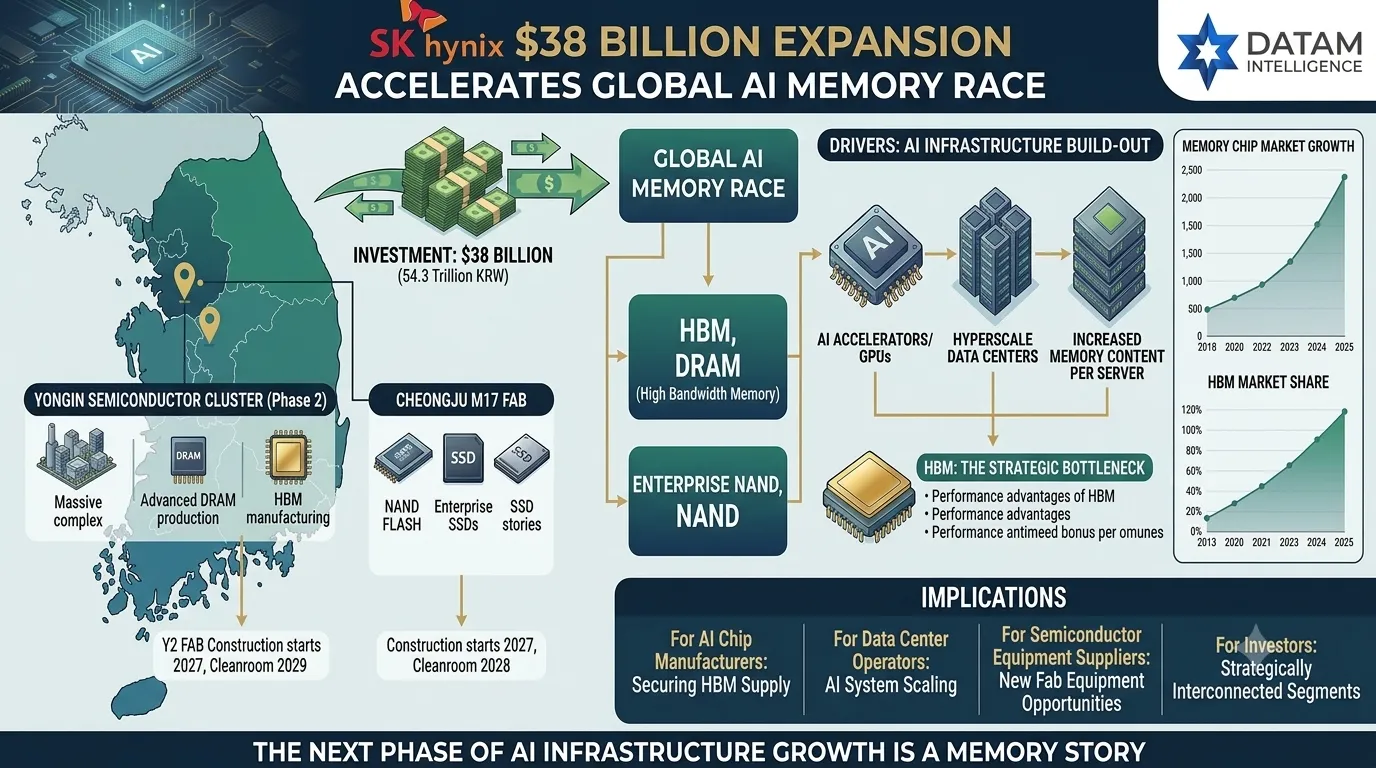
The investment, equivalent to about 54.3 trillion Korean won, will be deployed through 2031 across new manufacturing facilities in Yongin and Cheongju. The plan includes approximately 35.2 trillion won for the second phase of the Yongin semiconductor cluster and 19.1 trillion won for the M17 fabrication plant in Cheongju.
The move comes as AI training and inference workloads drive unprecedented demand for high-performance memory, particularly High Bandwidth Memory (HBM), advanced DRAM and enterprise NAND storage.
Why Is SK hynix Investing $38 Billion in AI Memory?
The central driver behind the investment is the structural increase in memory requirements created by AI infrastructure.
Modern AI accelerators require extremely high memory bandwidth to process increasingly complex models. HBM has therefore become a critical component of AI accelerator platforms, while DRAM and NAND support server memory and high-capacity data storage.
SK hynix's expansion directly addresses this changing demand profile. The company plans to expand DRAM manufacturing capacity at its Yongin facility, including production of advanced memory products such as HBM, while the Cheongju M17 facility will focus on NAND flash memory.
This indicates that the AI infrastructure opportunity is extending beyond GPUs and AI processors into the memory layer of the semiconductor ecosystem.
HBM Becomes a Strategic Bottleneck for AI Infrastructure
High Bandwidth Memory has moved from being a specialized memory technology to a strategic component of AI computing infrastructure.
AI accelerators require rapid access to large volumes of data. HBM addresses this requirement by providing substantially higher bandwidth than conventional memory architectures, making it particularly important for AI training, inference and high-performance computing.
DataM Intelligence estimates that the global High Bandwidth Memory market was valued at approximately US$3.58 billion in 2025 and is projected to reach US$29.65 billion by 2035, representing a CAGR of 23.63% during 2026–2035.
The market is being shaped by the expansion of AI accelerators, GPUs, ASICs, networking infrastructure and hyperscale data centers. Competitive differentiation increasingly depends on HBM generation, bandwidth, capacity, thermal performance, manufacturing yields, advanced packaging and the ability to secure long-term customer allocations.
Yongin and Cheongju Expansion Strengthen South Korea’s AI Semiconductor Position
The investment also reinforces South Korea's position as a critical manufacturing hub for advanced memory semiconductors.
The Yongin semiconductor cluster is planned as a major manufacturing base for advanced DRAM products. The second Yongin fab, known as Y2, is expected to begin construction in 2027, with its first cleanroom targeted for completion in 2029.
Meanwhile, SK hynix's M17 facility in Cheongju will expand NAND flash manufacturing capacity. Construction is expected to begin in 2027, with the cleanroom targeted for completion in 2028.
The two-site strategy is significant because AI infrastructure requires both high-performance memory for computation and high-capacity storage for data-intensive workloads.
AI Data Centers Are Reshaping the Memory Chip Market
The latest investment illustrates how AI data center expansion is changing the economics of the memory semiconductor industry.
Traditional memory demand has historically been heavily influenced by PCs, smartphones and consumer electronics. AI infrastructure is creating a different demand profile, characterized by:
- Higher memory content per AI accelerator
- Rapid growth in HBM adoption
- Increasing server DRAM requirements
- Expanding enterprise SSD demand
- Greater demand for high-capacity data storage
- Longer-term capacity planning by hyperscale data center operators
DataM Intelligence estimates that the global Memory Chip Market reached approximately US$227 billion in 2025 and is projected to reach US$739.46 billion by 2035, growing at a CAGR of 12.5% from 2026 to 2035.
The market is increasingly being supported by AI infrastructure, cloud computing, high-performance computing, automotive electronics, edge computing and next-generation data centers.
What Does the SK hynix Investment Mean for the HBM Market?
The investment provides an important signal about the long-term outlook for AI memory demand.
Rather than treating current memory shortages as a short-term inventory cycle, major semiconductor manufacturers are committing billions of dollars to capacity expansion that will come online over several years.
This matters because HBM manufacturing requires specialized processes, advanced packaging integration, high manufacturing yields and significant capital expenditure. Expanding capacity therefore requires considerably more planning than simply increasing conventional memory output.
DataM Intelligence analysis indicates that HBM3E remains a major product category in 2026, while HBM4 is emerging as the next major technology transition. AI accelerator manufacturers and hyperscale technology companies are increasing their focus on higher bandwidth and greater memory capacity as AI models become more computationally intensive.
Semiconductor Capacity Expansion Could Remain a Key Investment Theme
SK hynix's investment also highlights a broader trend across the semiconductor industry: manufacturers are increasingly investing ahead of expected AI infrastructure demand.
The capital expenditure cycle extends across several areas, including:
Advanced DRAM manufacturing:
AI servers require increasing amounts of high-performance memory, creating opportunities for advanced DRAM technologies.
HBM production:
HBM capacity is becoming strategically important as AI accelerators demand greater bandwidth and memory capacity.
NAND and enterprise SSDs:
AI data centers generate enormous volumes of data, supporting demand for high-capacity storage and enterprise SSDs.
Advanced packaging:
HBM requires close integration with AI processors and advanced packaging technologies, making packaging capacity an increasingly important part of the AI semiconductor supply chain.
Semiconductor manufacturing infrastructure:
New fabs require substantial investment in equipment, materials, cleanrooms and supporting infrastructure, creating opportunities across the broader semiconductor ecosystem.
Will the $38 Billion Investment Ease the Global Memory Shortage?
The investment is expected to increase future semiconductor capacity, but it is unlikely to immediately resolve near-term supply constraints.
New semiconductor fabs require years of construction, equipment installation, qualification and production ramp-up. SK hynix's latest facilities are therefore better viewed as a long-term capacity response to structural AI-driven memory demand rather than an immediate solution to current shortages.
At the same time, increasing capacity could eventually improve supply conditions and reduce the risk of prolonged memory bottlenecks.
The timing will depend on AI server deployments, HBM adoption rates, semiconductor yields, customer qualification cycles and the pace at which competing memory manufacturers expand their own production.
Analyst View: AI Memory Is Becoming Core Infrastructure
SK hynix's $38 billion commitment reflects a broader transformation in the semiconductor value chain.
Memory is no longer simply a supporting component in AI systems. With AI workloads increasingly constrained by bandwidth, capacity and data movement, advanced memory technologies are becoming fundamental determinants of AI system performance.
The strategic importance of HBM is likely to increase as AI models grow larger, inference workloads expand and hyperscale data centers deploy increasingly powerful accelerator architectures.
For semiconductor manufacturers, the competitive advantage will increasingly depend on the ability to combine HBM technology, manufacturing scale, advanced packaging, yield optimization and reliable customer supply.
For investors and technology companies, this creates a new layer of opportunity across the AI semiconductor ecosystem—from memory fabs and wafer production to packaging, equipment, materials and enterprise storage.
What SK hynix’s Investment Means for Businesses and Investors
The investment creates several implications for the global semiconductor market:
For AI chip manufacturers:
Securing reliable HBM supply will remain a critical factor in scaling next-generation AI accelerators.
For data center operators:
Memory availability will increasingly influence AI infrastructure deployment schedules and system economics.
For semiconductor equipment suppliers:
New fabs create long-term opportunities for wafer-processing, deposition, lithography, testing and packaging equipment.
For semiconductor materials companies:
Expansion of advanced memory manufacturing can increase demand for specialty chemicals, substrates, wafers and other manufacturing inputs.
For investors:
HBM, advanced DRAM, NAND, semiconductor equipment and advanced packaging are emerging as strategically interconnected segments of the AI infrastructure investment cycle.
The Bottom Line
SK hynix's $38 billion semiconductor expansion in South Korea is more than a capacity investment it is a signal that AI is fundamentally reshaping the memory semiconductor industry.
With new DRAM and HBM capacity planned for Yongin and additional NAND capacity planned for Cheongju, SK hynix is positioning itself for continued growth in AI-driven memory demand.
As AI data centers expand, the semiconductor industry's competitive landscape will increasingly be determined not only by computing power but also by the availability, bandwidth, capacity and efficiency of memory.
The next phase of AI infrastructure growth could therefore become as much a memory story as a processor story.
Market Intelligence Perspective
DataM Intelligence tracks the evolution of the global memory semiconductor ecosystem across HBM, DRAM, NAND, AI chips, advanced packaging and semiconductor manufacturing. The latest market analysis highlights AI infrastructure as one of the most important structural drivers of memory demand through 2035.
Explore the Memory Chip Market and High Bandwidth Memory (HBM) Market research for market size, competitive landscape, growth drivers, investment trends and future opportunities.
News source: https://www.livemint.com/news/world/sk-hynix-to-invest-38-billion-to-expand-ai-memory-chip-production-in-south-korea-11786094727324.html