


NTPC Simhadri Advances Indigenous Iron-Air Battery Technology for Long-Duration Energy Storage
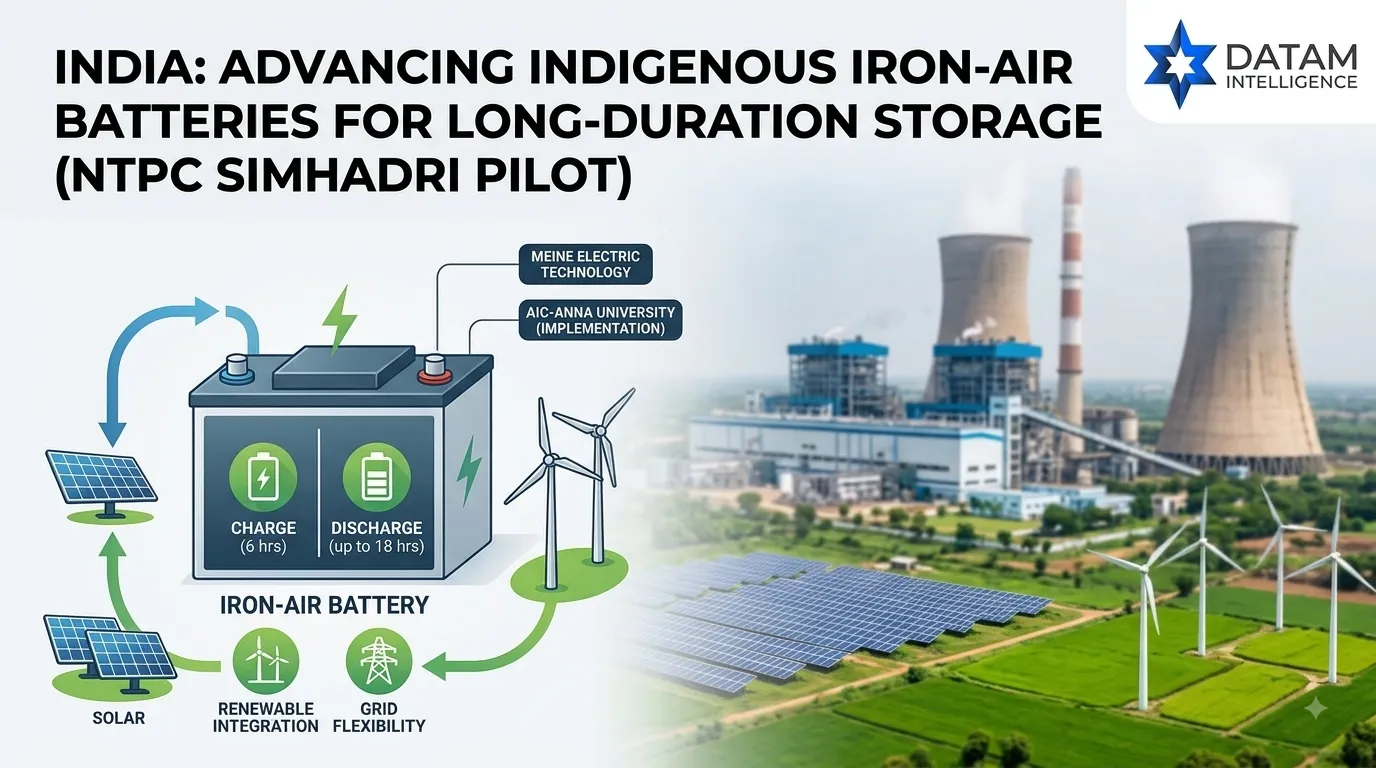
India is moving to strengthen its long-duration energy storage capabilities as NTPC Simhadri Thermal Power Station prepares to host a pilot project evaluating indigenous iron-air battery technology developed by deep-tech startup Meine Electric. The initiative is designed to assess the technology under real-world utility operating conditions and generate performance data for future commercial-scale deployment.
Explore the Iron-Air Battery Market Report
Gain a comprehensive view of the global iron-air battery market, including market size and growth forecasts, long-duration energy storage trends, renewable energy firming applications, competitive landscape, regional opportunities, key market dynamics, and emerging investment areas. Request a Sample Report Today!
NTPC Simhadri Advances Indigenous Long-Duration Energy Storage
The pilot will be implemented by Atal Incubation Centre–Anna University (AIC-AU) at NTPC Simhadri, with Meine Electric serving as the technology partner. The project will evaluate the iron-air battery system's technical performance, operational reliability and operating characteristics in a utility environment.
Meine Electric will undertake system development, integration and performance monitoring, while operational data generated through the project is expected to provide a benchmark for further technology development and potential large-scale deployment.
Six-Hour Charging and 18-Hour Discharge Capability
A key feature of Meine Electric's proprietary Fast Charge Long Discharge (FCLD) technology is its stated ability to charge for six hours and discharge for up to 18 hours. The company said the technology has also undergone independent testing by Customised Energy Solutions (CES), including assessments of electrochemical performance, capacity retention and operational stability across the charging and discharge cycle.
This operating profile positions the technology for applications where storage duration and renewable-energy shifting are more important than the high energy density typically associated with conventional lithium-ion batteries.
Why Iron-Air Batteries Matter for India's Energy Transition
India's rapid expansion of solar and wind generation is increasing the need for flexible storage that can shift electricity over longer periods. Long-duration energy storage can help address renewable intermittency, evening demand peaks, grid balancing and system resilience.
Iron-air technology is attracting attention because it can potentially use abundant iron rather than relying heavily on critical battery minerals. DataM Intelligence's market analysis identifies iron-air batteries as an emerging solution for 24-to-100-hour storage requirements in renewable-heavy power systems, although the technology remains in an early commercialization phase.
The global Iron-Air Battery Market was valued at approximately US$247.31 million in 2025 and is projected to reach US$14.27 billion by 2035, representing a 46.25% CAGR from 2026 to 2035, according to DataM Intelligence.
From Pilot Validation to Commercial Deployment
The NTPC Simhadri project is significant because utility-level validation can help bridge the gap between laboratory performance and commercial energy-storage deployment.
For emerging battery technologies, real-world operating data is particularly important for evaluating:
- Long-duration discharge performance
- Capacity retention
- System reliability
- Thermal and operational stability
- Integration with utility infrastructure
- Renewable-energy firming potential
- Lifecycle economics and scalability
The pilot is therefore more than a technology demonstration. Its results could help determine whether indigenous iron-air systems can progress toward larger utility-scale applications in India's evolving energy-storage ecosystem.
Implications for Renewable Integration and Grid Flexibility
The project comes as India seeks storage technologies capable of supporting increasing renewable penetration while maintaining grid reliability. Long-duration storage can provide an additional flexibility layer alongside shorter-duration battery systems.
Potential applications include renewable-energy firming, shifting surplus solar or wind generation, supporting grid flexibility and enabling more reliable clean-power delivery. The pilot is expected to generate technical insights that can inform future commercial-scale projects.
For utilities, developers and investors, the development also highlights an emerging opportunity to diversify beyond conventional lithium-ion storage and evaluate alternative chemistries based on duration, cost, material availability and operational requirements.
Analyst View: Why the NTPC Simhadri Pilot Matters
The NTPC Simhadri pilot represents an important validation stage for India's indigenous long-duration energy-storage ecosystem. The immediate commercial impact will depend on measured system performance, degradation, reliability, integration requirements and economics under actual utility conditions.
From a market perspective, successful pilot validation could strengthen the investment case for iron-air storage in applications where extended discharge duration is more valuable than compact energy density. It could also encourage partnerships among utilities, startups, research institutions and energy-storage developers.
However, iron-air technology remains an emerging segment. Commercial scalability, bankability, manufacturing economics, operational track record and project financing will remain critical factors before widespread deployment. DataM Intelligence similarly identifies limited operating experience and bankability as key challenges for the emerging iron-air battery market.
What Comes Next for Iron-Air Battery Storage in India?
The next milestone will be the operational performance data generated at NTPC Simhadri. Demonstrating reliable long-duration cycling under utility conditions could support larger demonstrations and accelerate commercialization of indigenous storage technologies.
As India's renewable fleet expands, the market opportunity for long-duration energy storage is likely to increasingly depend on technologies capable of delivering reliable electricity beyond the typical short-duration storage window. The Simhadri pilot provides an important test case for whether iron-air batteries can become part of that future grid-storage mix.
Key Takeaway
NTPC Simhadri's pilot of indigenous iron-air battery technology marks an important step in India's long-duration energy storage development, with the six-hour charging and 18-hour discharge capability potentially addressing renewable integration and grid-flexibility requirements. The project's real-world performance data could help determine the technology's path toward larger-scale commercial deployment.
News source: https://www.energetica-india.net/news/ntpc-simhadri-to-pilot-indigenous-iron-air-battery-technology-for-long-duration-energy-storage