


Micron’s $10 Billion AI Memory Research Investment Highlights Explosive Growth in AI Infrastructure Demand
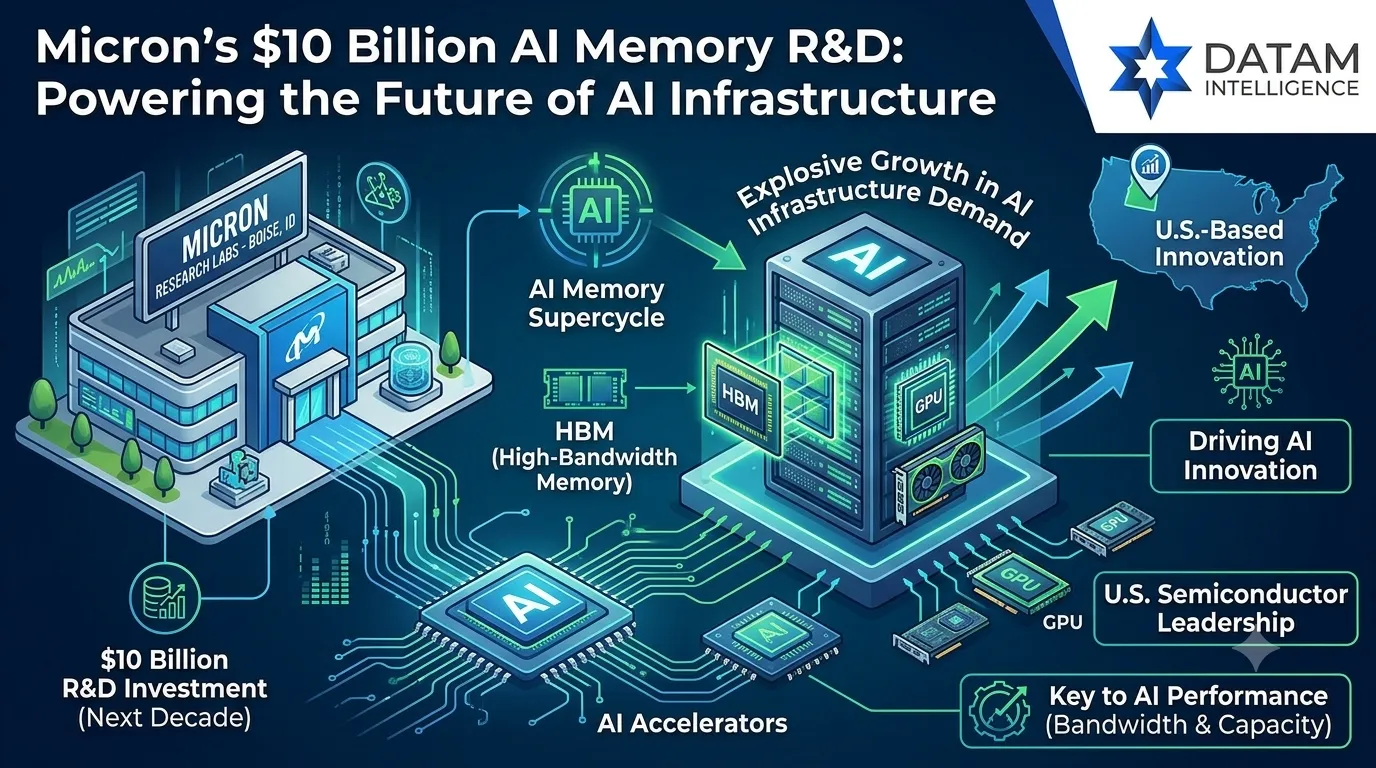
Micron Technology has announced plans to invest $10 billion over the next decade in a new research facility in Boise, Idaho, marking one of the most significant long-term commitments to memory technology innovation in recent years. The new center, known as Micron Research Labs, will focus on advancing memory architectures, next-generation compute systems, and future semiconductor manufacturing technologies designed to support increasingly demanding artificial intelligence workloads.
The announcement comes at a pivotal moment for the semiconductor industry. As enterprises accelerate AI adoption, demand for advanced memory solutions has surged alongside the rapid deployment of AI servers, hyperscale data centers, and generative AI applications. Industry leaders are racing to secure access to high-bandwidth memory (HBM), a critical component that enables AI accelerators and GPUs to process vast amounts of data with minimal latency.
Explore the Memory Chip Market: Trends, Growth Opportunities & Competitive Insights
Stay ahead of the rapidly evolving memory semiconductor landscape with DataM Intelligence’s Memory Chip Market Report. Get in-depth insights into market size and forecasts, AI-driven HBM and DRAM demand, emerging memory technologies, regional opportunities, supply-chain dynamics, investment trends, and competitive strategies. The report covers the market through 2035, with detailed analysis across type, application, and region.
DataM Intelligence combines market research, competitive intelligence, custom consulting, and dedicated analyst support into a single intelligence platform, helping enterprises make faster and more confident strategic decisions across 35+ industries and 100+ countries. Request a Sample Report Today!
According to Micron, the new research facility is expected to break ground in 2027 and will house hundreds of researchers dedicated to developing technologies that power the next generation of AI infrastructure. The investment reinforces the company's strategy to strengthen U.S.-based semiconductor innovation while addressing the growing global need for advanced memory solutions.
Why AI Is Driving a New Memory Supercycle
Artificial intelligence is fundamentally changing semiconductor demand patterns. While GPUs and AI accelerators often receive the most attention, memory technologies have become equally critical to AI performance. Large language models, generative AI systems, AI training clusters, and inference workloads require unprecedented memory bandwidth and capacity.
This shift has fueled substantial growth for memory manufacturers, including Micron, Samsung Electronics, and SK Hynix, as cloud providers and enterprises expand AI infrastructure investments. Analysts increasingly view advanced memory as one of the most strategic segments of the semiconductor value chain due to its direct influence on AI model efficiency and scalability.
The rapid expansion of AI infrastructure has also created sustained demand for HBM solutions, driving increased investments across research, manufacturing, and supply-chain development. Industry forecasts suggest memory demand will remain elevated as AI adoption expands across healthcare, financial services, manufacturing, autonomous systems, and enterprise software.
Strategic Importance for U.S. Semiconductor Leadership
Micron's latest investment aligns with broader efforts to strengthen domestic semiconductor capabilities and reduce supply-chain vulnerabilities. The company recently expanded its long-term U.S. investment commitment to more than $250 billion through 2035, encompassing manufacturing expansion, supply-chain resilience initiatives, and advanced semiconductor research programs.
By establishing a dedicated research ecosystem focused on AI memory innovation, Micron aims to accelerate breakthroughs in DRAM, HBM, and future memory architectures that will be essential for increasingly sophisticated AI applications. The initiative is expected to contribute to U.S. competitiveness in a market where memory technology has become a strategic asset for both economic growth and technological leadership.
Analyst View
DataM Intelligence believes Micron's $10 billion research commitment reflects a broader transformation underway in the semiconductor market industry, where memory is becoming a central enabler of AI performance rather than a supporting component. As AI model complexity increases, memory bandwidth, power efficiency, and data movement capabilities will play a decisive role in determining overall system performance.
The investment signals growing confidence that demand for advanced memory technologies will remain structurally higher over the coming decade. Companies capable of innovating in HBM, DRAM, and AI-optimized memory architectures are expected to benefit significantly from sustained investments in AI infrastructure, cloud computing, and next-generation data centers.
Market Outlook
The AI-driven semiconductor expansion is creating substantial opportunities across memory technologies, chip manufacturing, advanced packaging, and data-center infrastructure. Micron's latest investment reinforces the industry's long-term outlook and highlights how memory innovation is becoming a critical competitive advantage in the global AI race.
As enterprises continue scaling AI deployments, demand for high performance memory solutions is expected to remain a key growth driver across the semiconductor ecosystem, positioning memory technology providers at the center of the next wave of AI innovation.
News source: https://www.outlookbusiness.com/corporate/micron-plans-10-bn-research-push-as-ai-fuels-memory-chip-demand