


KKR’s $9B UGI Bid Signals a Shift in Energy Infrastructure
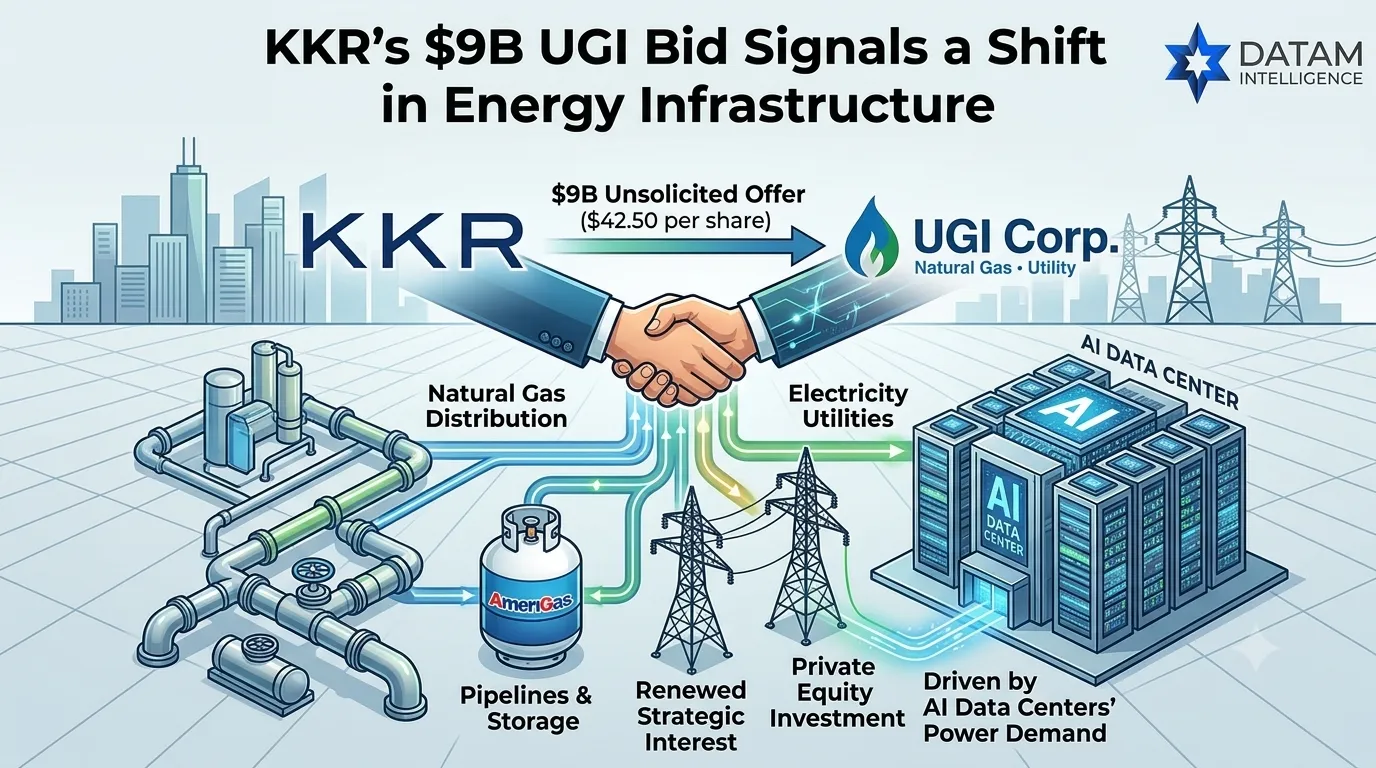
Private-equity firm KKR has reportedly made an unsolicited offer of approximately $9 billion to acquire UGI Corp., highlighting renewed investor interest in natural gas, electricity distribution and energy infrastructure as power demand rises across the U.S.
According to The Wall Street Journal, KKR's proposal values UGI at $42.50 per share, compared with UGI's previous closing price of $35.09. Reuters reported that the offer represents a premium of approximately 21.1%. However, the proposal does not guarantee a completed transaction, and UGI has not indicated whether it will accept the offer.
Explore the Renewable Natural Gas Market Report
Discover actionable insights into the Renewable Natural Gas Market, including market size and forecasts, growth drivers, emerging investment opportunities, feedstock and technology trends, regional outlook, competitive landscape, and strategic developments. DataM Intelligence estimates the market at US$16.40 billion in 2025, with projections reaching US$49.10 billion by 2035 at a CAGR of 11.6%. Request a Sample Report Today!
KKR’s $9 Billion UGI Takeover Bid: What Happened?
KKR has approached UGI with a proposed acquisition valued at roughly $9 billion, targeting the Pennsylvania-based energy company whose operations include natural gas and electricity distribution, propane distribution through AmeriGas, and gas pipeline and storage assets across the U.S. and Europe.
The reported $42.50-per-share offer represents a substantial premium to UGI's pre-bid market price. Following reports of the proposal, UGI shares gained more than 11%, while KKR shares declined by approximately 1.3%, according to Reuters.
The deal remains subject to further discussions. Since the offer is reportedly unsolicited, investors will be watching for UGI's response and whether KKR improves or formalizes its proposal.
Why Is KKR Targeting UGI Now?
The proposed acquisition comes at a time when reliable electricity supply has become increasingly strategic for businesses, utilities and infrastructure investors.
One of the strongest forces reshaping energy investment is the rapid expansion of AI data centers. Data centers require large quantities of dependable electricity, increasing attention on generation capacity, transmission networks, natural gas infrastructure and other assets capable of supporting growing power demand.
Natural gas can provide dispatchable generation that complements intermittent renewable power, while gas distribution and storage infrastructure can support energy reliability. The renewed interest in gas-linked infrastructure therefore reflects not only traditional fuel demand but also the broader economics of power availability.
The WSJ reported that rising demand for dependable energy, particularly from AI data centers, has helped revive investor interest in natural-gas-related assets.
AI Data Centers Are Changing the Energy Infrastructure Investment Landscape
The connection between artificial intelligence and energy infrastructure is becoming increasingly important for investors.
AI workloads require high-density computing infrastructure, and hyperscale data centers can place significant demands on regional electricity systems. This creates opportunities for companies that control generation, natural gas supply, storage, pipelines, utilities and other critical energy assets.
The KKR–UGI proposal therefore illustrates a broader investment theme: power availability is becoming a strategic asset for the AI economy.
For infrastructure investors, the value proposition extends beyond commodity prices. Assets with regulated revenues, established customer bases, strategically located infrastructure and access to growing electricity demand can offer different risk-return characteristics from upstream energy investments.
What UGI Brings to the Potential Transaction
UGI's portfolio provides exposure to multiple parts of the energy value chain. The company operates natural gas and electric utilities, owns AmeriGas and has pipeline and storage operations in the U.S. and Europe.
This diversified infrastructure footprint could make UGI strategically attractive to a financial sponsor seeking exposure to energy infrastructure while maintaining a broad portfolio across gas distribution, electricity and related services.
From an investment perspective, established infrastructure can also provide potential opportunities for operational optimization, capital investment and portfolio restructuring. However, regulated utility assets carry regulatory, capital expenditure and policy considerations that would need to be evaluated as part of any acquisition.
Natural Gas Infrastructure Regains Strategic Importance
The potential UGI transaction comes amid a broader shift in how investors view natural gas.
Natural gas infrastructure has faced long-term questions around decarbonization and the transition toward renewable energy. At the same time, increasing electricity consumption and grid reliability requirements are creating new strategic considerations for gas-fired generation and gas infrastructure.
DataM Intelligence's natural gas engine research similarly identifies data-center energy demand, distributed generation and grid reliability as factors strengthening the long-term role of natural gas-based power systems.
This does not necessarily mean that natural gas will replace renewable energy. Instead, investment strategies are increasingly focused on how gas infrastructure can operate alongside renewables, storage and other technologies to provide flexible and dependable energy.
Private Equity Expands Its Energy Infrastructure Footprint
KKR's reported interest in UGI also fits into a wider pattern of private-equity investment in energy distribution and infrastructure.
In July 2026, KKR and Energy Capital Partners agreed to acquire DCC Energy in a transaction valued at approximately $7.7 billion, demonstrating continued private-equity appetite for energy distribution assets.
The UGI proposal would extend that investment theme into the U.S. utility and natural gas infrastructure market.
For private-equity firms, energy infrastructure can offer exposure to long-duration assets, essential services and structural demand growth. The challenge is balancing these characteristics against regulatory requirements, decarbonization policies, commodity-market volatility and the significant capital investment required to maintain and modernize infrastructure.
What the KKR–UGI Deal Could Mean for the Energy Market
If the transaction progresses, it could have implications beyond UGI and KKR.
1. More Private Equity Interest in Utilities
A successful transaction could encourage infrastructure funds and private-equity firms to evaluate additional regulated utilities, gas distributors and power infrastructure companies.
2. Higher Valuations for Strategic Energy Assets
Premium acquisition offers can encourage investors to reassess the value of energy infrastructure, particularly assets connected to regions experiencing rapid electricity-demand growth.
3. Greater Focus on Data-Center Power Supply
The transaction reinforces the connection between AI expansion and energy infrastructure. Investors may increasingly evaluate energy assets based on their ability to serve data centers and other high-load customers.
4. Increased M&A Activity Across Energy Infrastructure
The combination of electricity-demand growth, grid investment requirements and private capital availability could support continued M&A activity across utilities, natural gas infrastructure, power generation and distributed energy.
Analyst View: Energy Infrastructure Is Becoming an AI-Era Strategic Asset
The reported KKR–UGI proposal highlights an important structural development in the energy market: the economics of electricity demand are increasingly influencing the valuation of natural gas and utility infrastructure.
The rapid development of AI data centers is creating a requirement for reliable, scalable and geographically available power. This can increase the strategic value of infrastructure capable of delivering or supporting that power.
For investors, the opportunity is therefore shifting from a simple natural gas commodity thesis toward an integrated infrastructure thesis encompassing gas supply, electricity distribution, grid reliability, distributed generation, storage and data-center demand.
The UGI proposal remains subject to significant uncertainty, but its reported valuation demonstrates how investors are reassessing the strategic importance of established energy infrastructure in an increasingly power-intensive economy.
What Happens Next for UGI?
The immediate focus will be UGI's response to KKR's reported proposal and whether negotiations progress toward a definitive agreement.
Investors will also monitor the potential valuation implications, financing structure, regulatory considerations and strategic rationale behind any revised offer.
Until a formal agreement is reached, the reported $9 billion proposal should be viewed as a potential transaction rather than a completed acquisition.
Frequently Asked Questions
What is KKR offering for UGI?
KKR has reportedly proposed acquiring UGI for approximately $9 billion, valuing UGI shares at $42.50 each.
Why is KKR interested in UGI?
UGI provides exposure to natural gas and electricity distribution, propane distribution, pipelines and storage infrastructure. Growing demand for reliable energy, including from AI data centers, is increasing investor interest in these assets.
Is KKR buying UGI?
Not yet. KKR has reportedly made an acquisition proposal, but there is no guarantee that UGI will accept the offer or that a transaction will ultimately be completed.
How much is the KKR–UGI deal worth?
The reported proposal is valued at approximately $9 billion, with an offer price of $42.50 per UGI share.
Why are natural gas assets attracting investors again?
Growing electricity demand, AI data-center expansion, grid reliability requirements and the need for dispatchable power are contributing to renewed investor interest in natural gas-related infrastructure.
Conclusion
KKR's reported $9 billion bid for UGI underscores the changing investment landscape surrounding natural gas and electricity infrastructure. As AI data centers and other high-power industries accelerate electricity demand, reliable energy infrastructure is becoming increasingly strategic.
While the outcome of the UGI proposal remains uncertain, the transaction signals that private-equity investors are increasingly looking beyond traditional energy assets toward infrastructure positioned at the intersection of natural gas, electricity, grid reliability and AI-driven power demand.
News source: https://www.wsj.com/business/deals/kkr-makes-9-billion-takeover-bid-for-natural-gas-and-electricity-distributor-94d47760