


Japan partners with NVIDIA to build national AI infrastructure, creating new opportunities across AI data centers, GPUs, robotics, and semiconductor markets
Japan is accelerating its artificial intelligence ambitions through a major sovereign AI infrastructure initiative with NVIDIA, marking a significant shift toward nation-scale AI computing capabilities. The partnership highlights the growing global race among countries to develop localized AI ecosystems powered by advanced computing infrastructure, high-performance GPUs, and AI-ready data centers.
The initiative is expected to strengthen Japan’s AI ecosystem across industries including manufacturing, logistics, healthcare, telecommunications, and robotics while increasing demand for advanced AI infrastructure technologies.
As governments worldwide prioritize AI sovereignty, investments in AI computing capacity, semiconductor supply chains, and cloud infrastructure are expected to drive significant growth opportunities across the global AI infrastructure market.
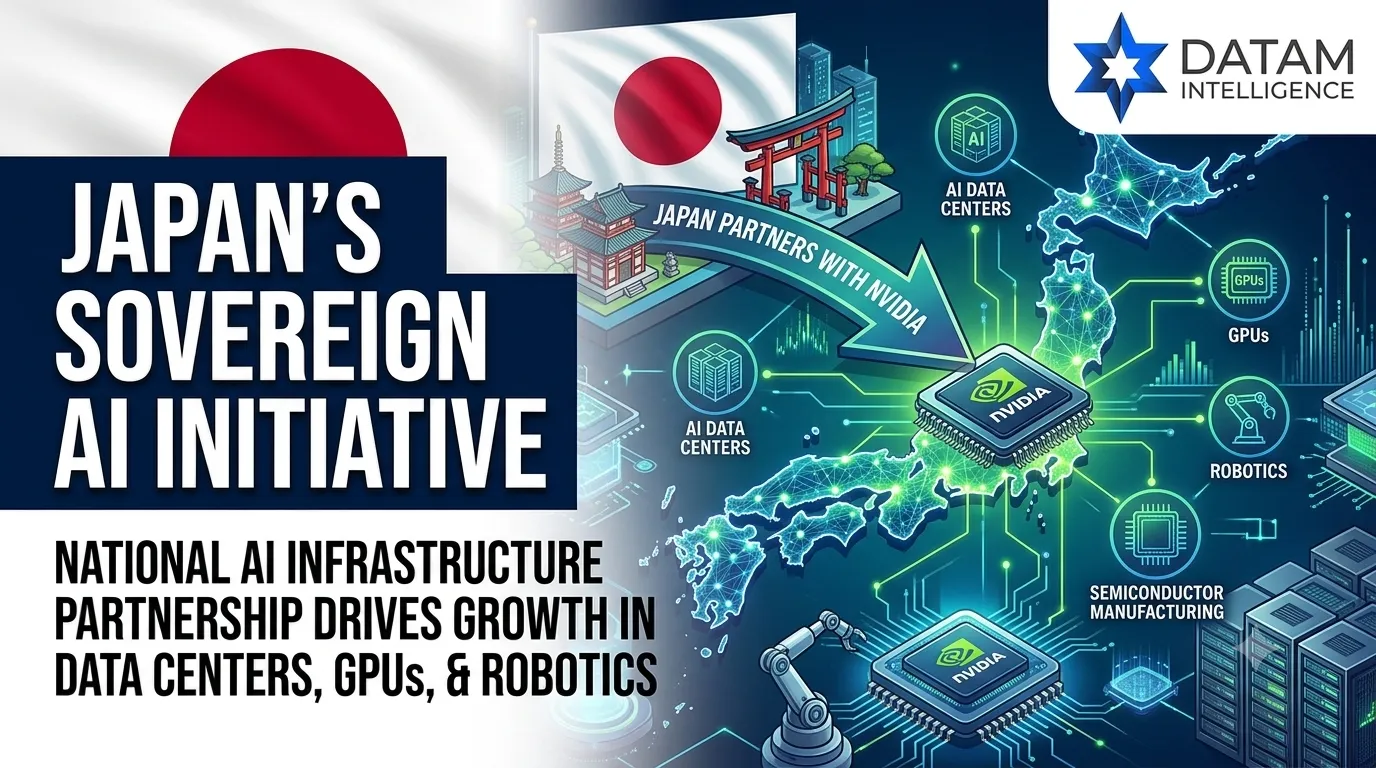
NVIDIA and Japan Advance Sovereign AI Infrastructure Development
NVIDIA’s collaboration with Japan’s AI and industrial ecosystem represents a broader move toward building sovereign AI capabilities allowing countries to develop and operate AI systems using locally controlled infrastructure and data resources.
The initiative involves the development of an NVIDIA-pow ered AI factory using next-generation computing platforms, including thousands of advanced AI processors designed to support large-scale AI workloads. The infrastructure will enable applications such as AI agents, digital twins, robotics, and physical AI systems.
Japan’s strong manufacturing base and leadership in robotics provide a strategic foundation for deploying AI technologies across industrial applications. Partnerships involving Japanese technology and robotics companies are expected to accelerate AI adoption in factories, automation systems, and intelligent machines.
Sovereign AI Trend Creates Demand for AI Infrastructure Investments
The NVIDIA - Japan partnership reflects a broader global shift toward sovereign AI, where governments and enterprises are investing in domestic AI capabilities to strengthen computing independence, improve data security, and reduce reliance on external technology infrastructure. As artificial intelligence becomes a strategic priority for economic growth, national competitiveness, and industrial transformation, countries are focusing on developing advanced AI ecosystems supported by high-performance computing, semiconductor technologies, and secure digital infrastructure.
The increasing adoption of generative AI, large language models (LLMs), autonomous systems, and industrial AI applications is driving demand for scalable AI infrastructure. Organizations across sectors are investing in AI-ready facilities that can support intensive model training, real-time inference, and large-scale AI deployments.
Key Areas Driving Sovereign AI Infrastructure Investments Include:
- AI Data Center Expansion:
Governments and enterprises are developing specialized AI data centers equipped with advanced computing systems, high-density infrastructure, optimized power management, and advanced cooling technologies to support growing AI workloads. - High-Performance Computing (HPC) Infrastructure:
Investment in HPC systems is increasing as organizations require greater computational capacity for AI model development, scientific research, industrial simulations, and advanced analytics. - Growing Demand for AI Accelerators and GPUs:
The rapid growth of AI applications is increasing demand for GPUs and AI accelerators that enable faster processing of complex workloads, including AI training, inference, and autonomous applications. - Semiconductor Manufacturing Capabilities:
Countries are strengthening semiconductor supply chains through investments in chip manufacturing, advanced packaging, and semiconductor research to ensure reliable access to critical AI hardware components. - Secure AI Cloud Platforms:
Businesses and governments are adopting secure AI cloud environments that provide scalable computing capabilities while addressing data privacy, regulatory compliance, and digital sovereignty requirements. - Industrial AI Applications:
Manufacturing, robotics, automotive, healthcare, and logistics sectors are leveraging AI infrastructure to deploy smart factories, digital twins, autonomous systems, and AI-powered automation solutions.
The global momentum toward sovereign AI is expected to create significant opportunities across the AI infrastructure market, including AI data centers, GPU computing, cloud AI platforms, and semiconductor technologies. As organizations transition from AI experimentation to large-scale deployment, demand for advanced infrastructure solutions and market intelligence will continue to grow.
Impact on the Global AI Data Center and GPU Market
The rapid expansion of sovereign AI initiatives is expected to accelerate growth across the global AI infrastructure ecosystem, creating significant opportunities for companies involved in AI data centers, GPUs, semiconductors, cloud computing, and industrial automation. As governments and enterprises invest in large-scale AI capabilities, demand is increasing for advanced computing infrastructure capable of supporting complex AI workloads, including generative AI models, large language models (LLMs), autonomous systems, and real-time AI applications.
The growing need for secure, scalable, and high-performance AI computing environments is reshaping investment strategies across the technology sector, driving innovation and partnerships throughout the AI infrastructure value chain.
Key Areas Impacted by Sovereign AI Growth Include:
- AI Data Center Providers:
The increasing deployment of AI applications is driving demand for specialized AI data centers designed to handle high-performance computing requirements. Unlike traditional data centers, AI-focused facilities require advanced cooling technologies, high-density computing architectures, optimized power management systems, and high-speed networking infrastructure to support intensive AI training and inference workloads. Data center operators are increasingly investing in AI-ready facilities to meet growing enterprise and government demand. - GPU and Semiconductor Companies:
The expansion of AI infrastructure is significantly increasing demand for GPUs, AI accelerators, and advanced semiconductor solutions. Governments, cloud providers, and enterprises are securing access to high-performance computing chips to support AI model development, deployment, and large-scale data processing. Semiconductor innovation, including next-generation AI processors and advanced chip manufacturing capabilities, will remain critical to the growth of the AI ecosystem. - Cloud Infrastructure Providers:
Organizations are increasingly adopting secure and scalable AI cloud platforms that enable access to advanced computing resources while addressing data privacy, regulatory compliance, and sovereignty requirements. Cloud providers are expanding AI infrastructure offerings through dedicated AI services, sovereign cloud solutions, and hybrid deployment models to support diverse industry needs. - Industrial Automation and Robotics Companies:
The growth of physical AI is expected to accelerate transformation across manufacturing, logistics, healthcare, automotive, and other industries. AI-powered robotics, autonomous systems, and intelligent machines require robust computing infrastructure to process real-time data, improve decision-making, and enable advanced automation capabilities.
Market Outlook
The convergence of sovereign AI strategies, increasing AI adoption, and rising demand for computational power is expected to create long-term growth opportunities across the AI data center and GPU markets. Companies that can provide scalable computing infrastructure, advanced semiconductor technologies, secure AI platforms, and industry-specific AI solutions are expected to play a critical role in shaping the future of the global AI ecosystem.
Japan’s AI Strategy Signals Global Shift Toward Physical AI
Japan’s focus extends beyond traditional artificial intelligence applications toward physical AIwhere intelligent systems interact with the real world through robotics, automation, and autonomous machines.
The country’s manufacturing expertise, robotics ecosystem, and industrial technology leadership create strong opportunities for AI-powered automation solutions.
As companies integrate AI into production environments, demand is expected to increase for:
- Industrial AI platforms
- Smart manufacturing solutions
- AI-powered robotics
- Digital twin technology
- Edge AI systems
Global AI Infrastructure Market Outlook
The rapid expansion of sovereign AI initiatives is expected to significantly reshape the competitive landscape of the global artificial intelligence infrastructure industry. Governments, enterprises, and technology providers are increasingly prioritizing investments in AI computing ecosystems to enhance digital sovereignty, strengthen data security, and build resilient technology infrastructure capable of supporting next-generation AI applications.
As generative AI, large language models (LLMs), autonomous systems, and industrial AI solutions continue to scale, organizations are moving beyond AI experimentation toward large-scale deployment. This transition is accelerating demand for advanced AI infrastructure, including high-performance computing systems, AI-optimized data centers, GPUs, AI accelerators, cloud platforms, networking solutions, and energy-efficient computing technologies.
Businesses, governments, and technology providers are increasingly evaluating key areas such as:
- AI Infrastructure Investment Opportunities:
Organizations are assessing opportunities across AI data centers, accelerated computing platforms, semiconductor technologies, cloud AI services, and enterprise AI infrastructure solutions to support growing AI workloads. - Regional AI Adoption Trends:
Countries and regions are developing AI strategies based on local priorities, including data sovereignty, industrial automation, research capabilities, and national computing capacity. Investments in AI infrastructure are expected to accelerate across North America, Europe, and Asia-Pacific as governments promote domestic AI ecosystems. - Competitive Market Positioning:
Technology companies are competing to strengthen their positions across the AI infrastructure value chain, including AI chips, cloud computing, data center infrastructure, networking technologies, and AI software platforms. Partnerships between semiconductor companies, cloud providers, governments, and industrial organizations are becoming increasingly important in shaping market dynamics. - Future Technology Developments:
Emerging technologies such as advanced AI accelerators, next-generation semiconductor architectures, liquid cooling systems, edge AI computing, quantum-inspired computing, and energy-efficient data center technologies are expected to influence the future evolution of AI infrastructure. - Infrastructure Deployment Strategies:
Enterprises and governments are focusing on scalable and secure AI infrastructure deployment models, including sovereign cloud platforms, private AI environments, hybrid cloud architectures, and industry-specific AI solutions to meet performance, security, and regulatory requirements.
The growing focus on AI sovereignty, data protection, computing independence, and domestic technology capabilities is expected to remain a key driver of the global AI infrastructure market. As organizations increasingly integrate AI into critical business operations and national digital strategies, demand for scalable, secure, and high-performance AI infrastructure solutions is projected to continue expanding in the coming years.
Get Comprehensive Insights into the AI Infrastructure Market
The rapid expansion of sovereign AI projects, AI data centers, and advanced computing infrastructure is creating new opportunities across technology and industrial sectors.
Access detailed market analysis covering market size, growth forecasts, competitive landscape, emerging technologies, and investment opportunities. Request a Sample Report Today