


Japan to Deploy 10 Million AI Robots by 2040 Under Noetra Robotics Strategy
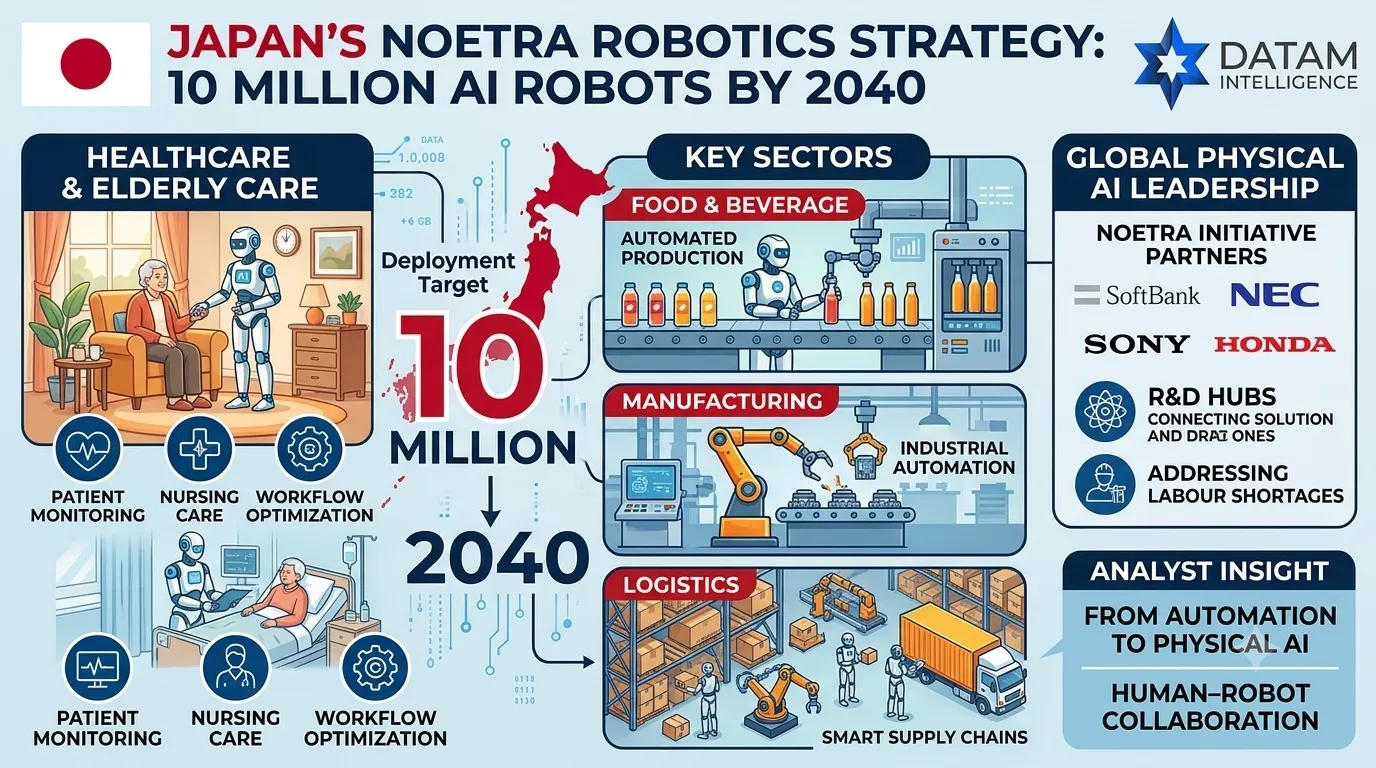
Japan is accelerating its transition toward a robotics-driven economy with a national strategy aimed at deploying approximately 10 million robots by 2040 across critical industries including healthcare, food manufacturing, beverage production, and industrial automation.
The initiative, known as Noetra, focuses on developing advanced AI-powered robotics capabilities that combine artificial intelligence, automation, and physical-world interaction. The strategy represents Japan’s broader effort to address workforce shortages caused by demographic challenges while strengthening its position in the global physical AI ecosystem.
Explore the Future of the Japan Robotic Nurses Market
Gain in-depth insights into the evolving Japan Robotic Nurses Market landscape, including market trends, growth opportunities, AI and robotics advancements, competitive analysis, and future outlook. Download a free sample of the Japan Robotic Nurses Market Report to understand key industry developments, emerging technologies, and strategic opportunities shaping the future of healthcare automation, elderly care solutions, and AI-powered robotic nursing systems in Japan.
AI Robots Expected to Transform Healthcare and Elderly Care
A major focus area of Japan’s robotics roadmap is healthcare and nursing support. With an ageing population and increasing demand for care services, AI-powered robots are expected to assist healthcare workers with routine tasks, patient support, and elderly care operations.
The adoption of robotics in nursing is expected to create opportunities for:
- AI-assisted patient monitoring
- Elderly care automation
- Hospital workflow optimization
- Healthcare workforce support
- Assistive robotic technologies
Industry analysts believe healthcare robotics could become one of the fastest-growing applications as countries worldwide face similar demographic challenges.
Robotics Expansion Across Food, Manufacturing and Industrial Sectors
Beyond healthcare, Japan’s Noetra strategy expands robotics applications into food production, manufacturing, logistics, and other industrial sectors.
AI robots are expected to improve:
- Production efficiency
- Workplace safety
- Manufacturing automation
- Supply chain operations
- Labour-intensive processes
The initiative highlights the growing shift from traditional automation toward physical AI, where robots can understand environments, learn tasks, and interact with humans more effectively.
Noetra Initiative Strengthens Japan’s AI Robotics Ecosystem
The Noetra project is supported by major Japanese technology and industrial companies, including SoftBank, NEC, Sony, and Honda, with the goal of building domestic AI capabilities and accelerating robotics innovation.
Japan also plans to establish robotics and AI development hubs focused on:
- Robotics research and development
- AI model training
- Workforce development
- Enterprise adoption support
Market Impact: Global Robotics Competition Intensifies
Japan’s 10 million robot deployment target reflects a broader global race to develop advanced humanoid robots and physical AI systems.
Countries and companies are investing heavily in robotics to improve productivity, address labour shortages, and create new automation-driven business models.
The expansion of AI robotics is expected to influence multiple industries:
| Industry | Expected Impact |
|---|---|
| Healthcare | AI-assisted nursing and elderly care |
| Manufacturing | Smart factories and autonomous production |
| Food & Beverage | Automated processing and packaging |
| Logistics | Intelligent warehouse operations |
| Retail | Service automation |
Analyst Insight
Japan’s Noetra strategy marks a pivotal transition from traditional automation systems toward a new era of AI-enabled physical intelligence. By integrating advanced AI models, robotics, sensors, and autonomous capabilities, the initiative has the potential to redefine how robots operate beyond structured industrial environments and expand their role into healthcare, commercial services, logistics, and everyday human interactions.
For enterprises and technology providers, this emerging robotics ecosystem presents significant opportunities across the value chain, including AI software development, robotic platforms, intelligent sensor technologies, automation infrastructure, and next-generation human–robot collaboration solutions. As global demand for workforce automation and intelligent systems accelerates, Japan’s approach could serve as a blueprint for the future adoption of AI-powered robotics worldwide.
What is Japan’s Noetra AI robotics plan?
Japan’s Noetra AI robotics plan is a government-backed initiative targeting the deployment of approximately 10 million AI-powered robots by 2040. The robots are expected to support industries including nursing care, manufacturing, food production, and industrial automation while helping address workforce shortages.
News source: https://www.techradar.com/pro/japan-reveals-new-noetra-plan-to-flood-the-country-with-10-million-robots-by-2040-including-work-in-the-nursing-food-and-drink-sectors