


Japan-India Critical Minerals Partnership Opens New Opportunities in E-Waste Recycling
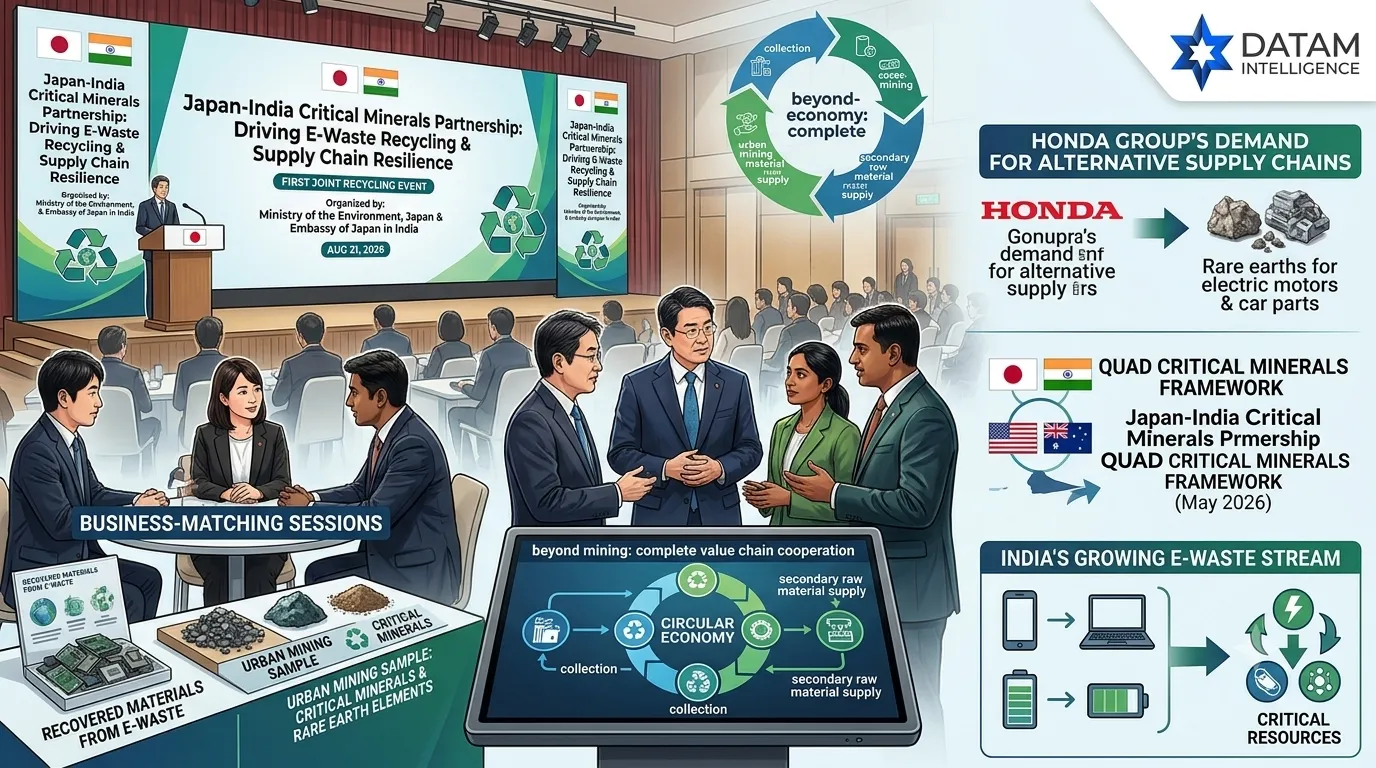
Japan and India are deepening cooperation on critical mineral recycling as both countries seek to diversify supply chains and reduce exposure to concentrated global sources. The two governments held their first joint event dedicated to recycling key minerals on August 21, 2026, at the Embassy of Japan in New Delhi.
The conference, organized by Japan's Ministry of the Environment and the Embassy of Japan in India, brought together more than 65 companies and approximately 130 participants from Japan, India and other partner countries. Discussions focused on critical-mineral recycling, e-waste recovery, supply-chain resilience and business collaboration.
Opportunities, Supply-Chain Risks & Investment Hotspots
Access actionable market intelligence covering Rare earth recycling market size and forecasts, permanent-magnet recycling, rare-earth recovery technologies, regional opportunities, competitive positioning, government-backed investments, and emerging white-space opportunities.
Understand where the next growth is coming from, evaluate key players and technologies, and identify opportunities across NdFeB magnet recovery, e-waste recycling, industrial waste recovery, closed-loop supply chains, and rare-earth refining.
Explore the full report to make data-driven investment, expansion, sourcing, and partnership decisions. Request a Sample Report Today!
Why Critical Minerals Recycling Matters for India and Japan
Critical minerals, including rare earth elements, are essential for electric vehicles, motors, electronics, renewable-energy technologies, semiconductors and other advanced industries. Their supply chains have become a major economic-security concern because production and processing are concentrated in a limited number of countries.
For Japan and India, recycling provides an additional route to secure mineral resources without relying exclusively on new mining projects.
India is particularly important because of its large and growing electronic-waste stream. Recovering valuable minerals from discarded electronics could transform e-waste from a waste-management challenge into a secondary resource for strategic industries.
Japan, meanwhile, has strong expertise in advanced recycling technologies, resource efficiency and high-value manufacturing. Cooperation with Indian recycling companies could therefore create opportunities across collection, processing, mineral recovery and technology development.
Japan-India Cooperation Moves Beyond Mining
The latest initiative signals a broader shift in critical-mineral strategy.
Instead of focusing only on securing mineral deposits, governments and companies are increasingly looking at the entire value chain:
- Collection of end-of-life electronics and industrial products
- E-waste processing and sorting
- Recovery of rare earths and other critical minerals
- Refining and processing of recovered materials
- Recycling technology development
- Secondary raw-material supply
- Cross-border technology partnerships
- Investment in circular-economy infrastructure
The Japanese Ministry of the Environment said that recovery and recycling of critical minerals contained in e-waste are gaining importance as an alternative source of supply. It also highlighted the need to establish an ecosystem in India that can support critical-mineral recovery and recycling.
Business Matching Could Accelerate Recycling Investment
One of the most commercially significant elements of the conference was the inclusion of business-matching sessions.
Representatives from Japanese and Indian companies were given opportunities to explore partnerships, indicating that the initiative is moving beyond government-level discussions toward potential commercial cooperation. More than 65 companies participated in the event.
This could create opportunities for companies involved in:
- E-waste collection
- Urban mining
- Rare-earth recovery
- Battery recycling
- Electronic-component recycling
- Hydrometallurgical processing
- Pyrometallurgical recovery
- Recycling equipment
- Waste-management technologies
- Critical-mineral refining
- Circular-economy solutions
Honda Highlights Demand for Alternative Rare-Earth Supply Chains
The commercial importance of recycling was also illustrated by Honda Trading.
According to the Japan Times, Joji Murakami, who heads the Indian unit of Honda Trading, said the Honda group is looking for Indian recycling partners as it seeks alternatives to Chinese supply chains. Rare earths are used in motors and other automotive components, making secure access increasingly important for the automotive industry.
This creates a potentially important opportunity for Indian recycling companies capable of recovering high-value minerals from end-of-life vehicles, electronics and industrial components.
India-Japan Critical Minerals Cooperation Aligns With Quad Strategy
The recycling initiative is part of a wider economic-security framework.
In May 2026, the Quad partners—Japan, India, the United States and Australia—affirmed cooperation on critical-mineral recovery and recycling. In July 2026, Japan and India also announced plans to establish an ecosystem for collecting and recycling e-waste to increase critical-mineral recovery across related supply chains.
The latest conference therefore represents an implementation-oriented step toward building more diversified and resilient mineral supply chains.
What This Means for the Critical Minerals Market
The India-Japan initiative could accelerate a structural change in the critical-minerals market: the growing importance of secondary mineral supply.
As governments seek to reduce supply-chain concentration, recycling could become an increasingly strategic source of rare earths and other critical materials.
For India, the opportunity extends beyond waste reduction. Developing a stronger critical-mineral recycling ecosystem could support domestic manufacturing, clean-energy technologies, electric vehicles and advanced electronics while creating new opportunities for recycling companies and technology providers.
For Japan, partnerships with Indian companies could provide access to a large e-waste resource base while supporting diversification of critical-mineral supply chains.
Outlook
The next phase will likely depend on whether the government-level cooperation translates into commercial projects, technology transfers, investment and scalable recycling infrastructure.
The participation of around 130 stakeholders and more than 65 companies demonstrates growing industry interest. If business matchmaking leads to long-term partnerships, India and Japan could establish a stronger recycling-based supply network for critical minerals in the Indo-Pacific.
The development also reinforces a broader market trend: critical-mineral security is increasingly becoming a recycling and circular-economy issue, not just a mining issue.
Related FAQs
What did Japan and India agree on regarding critical minerals recycling?
Japan and India are strengthening cooperation to recover and recycle critical minerals, particularly from e-waste, as part of efforts to diversify and improve the resilience of critical-mineral supply chains.
Why are Japan and India focusing on critical minerals recycling?
Both countries face strategic supply-chain challenges because critical-mineral production and processing are concentrated globally. Recycling can provide an additional source of minerals while reducing dependence on primary extraction and concentrated suppliers.
What role does e-waste play in critical minerals recycling?
E-waste contains recoverable materials that can serve as secondary sources of critical minerals. Developing collection, processing and recovery infrastructure can help convert discarded electronics into valuable resources.
How many companies participated in the Japan-India critical minerals recycling event?
More than 65 companies participated, with approximately 130 people attending the conference and related discussions.
What opportunities could India gain from critical minerals recycling?
India could develop new capabilities in e-waste processing, mineral recovery, recycling technology, secondary-material supply and circular-economy infrastructure while supporting industries such as electric vehicles, electronics and clean energy.
Why is Japan interested in Indian recycling partnerships?
Japanese companies are seeking ways to diversify critical-mineral supply chains. The Japan Times reported that Honda Trading is looking for Indian recycling partners as the Honda group seeks alternatives to Chinese supply chains.
Is the India-Japan initiative connected to the Quad critical minerals strategy?
Yes. The Japanese government said the initiative aligns with the May 2026 Quad Critical Minerals Initiative Framework, under which Japan, India, the United States and Australia committed to cooperation on critical-mineral recovery and recycling.
What industries could benefit from critical minerals recycling?
Potential beneficiaries include electric vehicles, automotive components, electronics, renewable energy, batteries, motors, semiconductors, recycling technologies and advanced manufacturing.
Can critical minerals recycling reduce dependence on China?
Recycling cannot eliminate dependence on China by itself, but it can create additional domestic and regional sources of critical minerals and contribute to supply-chain diversification and resilience.
News source: https://www.japantimes.co.jp/news/2026/08/23/japan/japan-india-key-minerals-recycle/