


Rare Earth Recycling Market Size and Overview
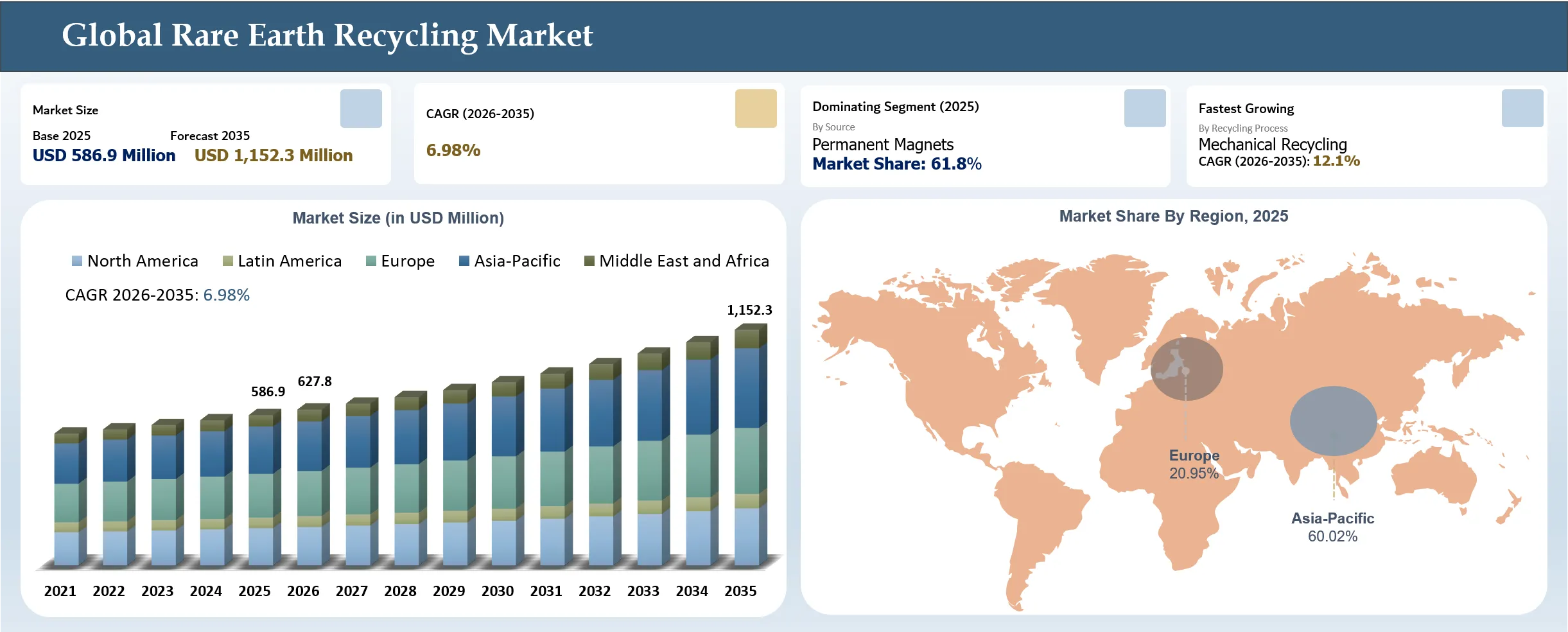
The global rare earth recycling market reached USD 586.9 million in 2025 and is expected to reach USD 1,152.3 million by 2035, growing with a CAGR of 6.98% during the forecast period 2026-2035. The market is gaining momentum as rare earth-containing permanent magnets get increasingly valuable for electric cars, wind energy, electronics, and other advanced applications.
According to the International Energy Agency (IEA) states that rare earth recycling can cut the demand for new rare earth supply by up to 35% by 2050. In January 2026, Cyclic Materials Company announced an investment exceeding USD 82 million into a rare earth recycling facility in South Carolina, with an annual capacity of 2,000 tonnes of magnet material, capable of being scaled up to 6,000 tonnes per year, and a production of 600 tonnes per year of recycled mixed rare earth oxides. In May 2026, the U.S. Department of Energy allocated USD 45.7 million for 19 projects involving critical minerals, including development of rare earth processing and recovery at the pilot scale using domestic sources like industrial waste and recycling. Despite all those investments, commercialization of secondary rare earth supply is still constrained by low rates of end-of-life collection, availability of feedstock, and high cost of separation and processing. According to the IEA, the rates of end-of-life permanent magnet recycling remain low, with no more than 15% collected to date.
There have been increasing efforts by the EU to promote rare earth recycling in an effort to ensure availability of critical raw materials domestically. In December 2025, according to Malay Mail, the European Commission intended to impose restrictions on the exportation of rare earths and battery scraps starting 2026 in order to reinforce Europe’s critical materials supply chain.
The recycling of rare earth waste could cover 20% of Europe’s demand for permanent magnets, which is about 20,000 metric tons annually. Also starting September 2026, waste lithium-ion batteries and black mass will be considered hazardous for exportation to non-OECD nations, as the EU intends to pump in €3 billion (USD 3.50 billion) within a year to expedite critical raw material projects and lower the dependence on a particular nation by up to 50% by 2029.
White-Space Opportunities Created by U.S. Government Investment in Rare Earth Recycling
In June 2026, according to the U.S. Department of Energy (DOE), the agency announced USD 134 million for two projects under its Rare Earth Elements Demonstration Facility Program to strengthen domestic rare-earth supply chains, creating wide-space opportunities primarily in rare-earth recovery and refining from waste-derived feedstocks, including mine tailings, electronic waste, red mud, and other industrial wastes. The highest-investment opportunity is integrated REE extraction, separation, and refining, with the funding supporting demonstration-scale facilities that can recover rare-earth elements and convert them into high-purity metals. Other opportunity areas include red-mud processing, mine-tailings recovery, electronic-waste processing, heavy rare-earth metal production, waste-feedstock separation, and commercial-scale REE demonstration facilities. The investment is intended to reduce U.S. dependence on foreign rare-earth sources while establishing commercially viable domestic recovery pathways.
The funding is expected to benefit companies and research organizations across different stages of the rare-earth recycling and recovery value chain. Colorado School of Mines is leading a project to develop an REE demonstration facility near the Gramercy alumina refinery in Louisiana, focusing on red-mud recovery, rare-earth oxide separation, and refining into rare-earth metals, with ElementUSA, Pacific Northwest National Laboratory, Principal Mineral, and Rare Earth Technologies Inc. supporting the project through extraction, processing, and technical development. Phoenix Tailings is leading the second project to produce high-purity heavy rare-earth metals from domestic industrial waste-derived feedstocks, with Massachusetts Institute of Technology (MIT) and the University of Minnesota providing research and technology support. The USD 134 million therefore creates opportunities across waste-derived REE recovery, separation, refining, heavy-REE production, and demonstration-scale commercialization.
Rare Earth Recycling Market Strategic Takeaways
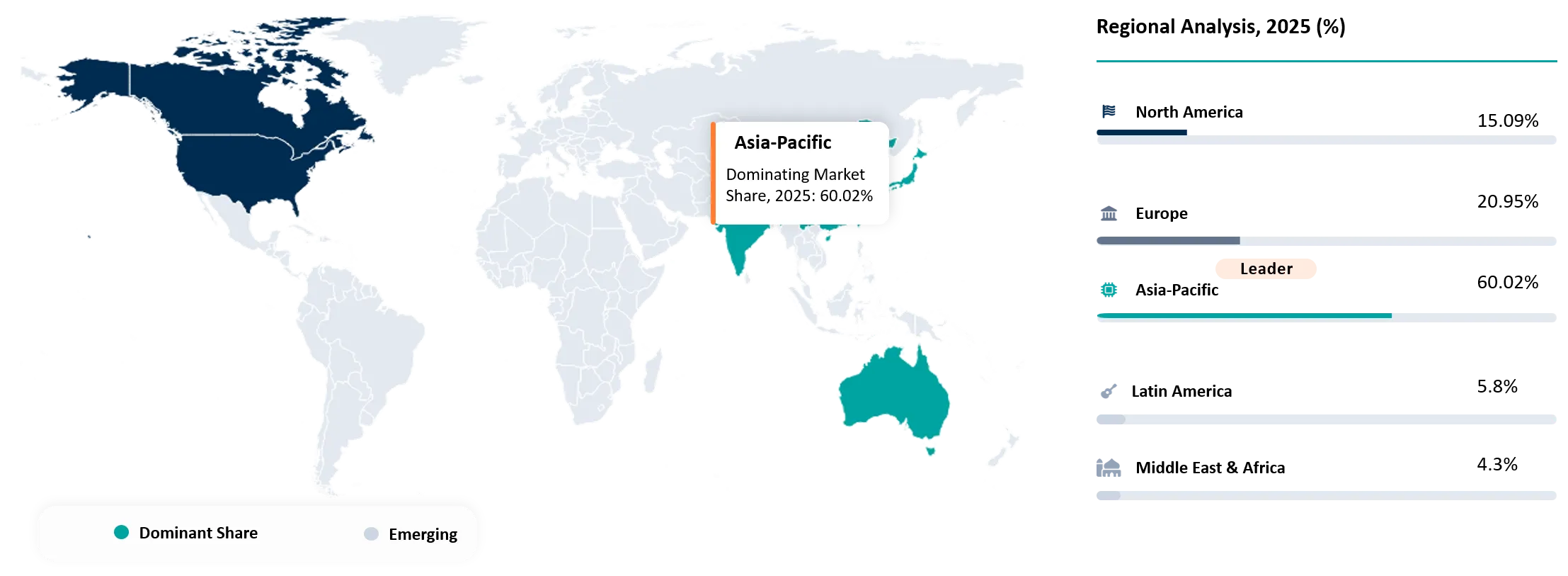
- Asia-Pacific is the dominating region in the global rare earth recycling market, holding an estimated 60.02% of the total market share in 2025, while North America held a 15.09% share.
- Permanent magnets represented the largest feedstock share at 61.8% of the global market in 2025.
- The International Energy Agency reports that rare earth recycling could reduce demand for new rare earth supplies by up to 35% by 2050. However, end-of-life recycling efficiency remains low, with no more than 15% of permanent magnets collected to date.
- The U.S. DOE allocated USD 45.7 million across 19 critical mineral projects in May 2026. This was followed in June 2026 by an additional USD 134 million dedicated to two demonstration facilities for recovering rare earth elements from industrial waste.
Rare Earth Recycling Market Industry Trends and Strategic Insight
- Permanent-magnet recycling is becoming the core commercial pathway, as NdFeB magnets from EV traction motors, wind-turbine generators, hard-disk drives, industrial motors, and electronic equipment provide concentrated secondary sources of neodymium, praseodymium, dysprosium, and terbium.
- Hydrometallurgical separation is moving toward more selective recovery, with developers focusing on improving impurity removal, reagent efficiency, solvent-extraction performance, and the production of high-purity rare earth oxides suitable for downstream magnet manufacturing.
- Manufacturing scrap remains an important near-term feedstock, while end-of-life magnets from EVs, wind turbines, electronics, and industrial equipment are becoming a longer-term strategic resource as larger quantities of these products retire.
- Supply-chain localization is becoming a primary strategic rationale for recycling. Recovered rare earths can provide an additional domestic feedstock stream and reduce exposure to disruptions in geographically concentrated mining, separation, and refining networks.
- Government policy is accelerating commercialization rather than simply supporting research. Recent programs in the U.S. and Europe increasingly target pilot-scale demonstration, commercial viability, domestic processing, and supply-chain resilience.
Rare Earth Recycling Market Scope
| Metrics | Details | |
| 2025 Market Size | USD 586.9 Million | |
| 2035 Projected Market Size | USD 1,152.3 Million | |
| CAGR (2026-2035) | 6.98% | |
| Largest Market | Asia-Pacific | |
| Fastest Growing Market | Europe | |
| By Recycling Process | Hydrometallurgical Recycling, Pyrometallurgical Recycling, Mechanical Recycling, Direct Recycling, Combined / Hybrid Processes, Others | |
| By Rare Earth Element | Neodymium (Nd), Praseodymium (Pr), Dysprosium (Dy), Terbium (Tb), Lanthanum (La), Cerium (Ce), Other Rare Earth Elements | |
| By Source | Permanent Magnets, Electronic Waste (E-Waste), Industrial Waste & Manufacturing Scrap, End-of-Life Products, Other Waste Sources | |
| By Recovered Material Form | Rare Earth Oxides, Rare Earth Metals, Rare Earth Salts, Rare Earth Alloys, Recycled Permanent Magnets, Others | |
| By Application | Permanent Magnets, Electric Motors, Wind Turbines, Consumer Electronics, Automotive, Industrial Equipment, Catalysts, Medical Equipment, Aerospace & Défense, Others | |
| By Region | North America | U.S., Canada, Mexico |
| Europe | Germany, UK, France, Spain, Italy, Poland | |
| Asia-Pacific | China, India, Japan, Australia, South Korea, Indonesia, Malaysia | |
| Latin America | Brazil, Argentina | |
| Middle East and Africa | UAE, Saudi Arabia, South Africa, Israel, Türkiye | |
| Report Insights Covered | Competitive Landscape Analysis, Company Profile Analysis, Market Size, Share, Growth | |
Rare Earth Recycling Market Disruption Analysis
Geopolitical Supply Restrictions Accelerating the Shift Toward Rare Earth Recycling
The disruption in the rare earth recycling market is primarily associated with tightening geopolitical restrictions on rare earths and permanent magnets that have exposed the fragility of the existing rare earth supply chains. As reported by IMF eLibrary on April 2025, China imposed licensing for export of seven rare earths and the associated permanent magnets, resulting in a rapid fall in magnet availability internationally. It was also highlighted that the Chinese export of permanent magnets had dropped by roughly 70% year-on-year, reaching its lowest in May 2025, after which the availability recovered through the rest of the year. The disruption demonstrated the vulnerability of auto, electronics, renewable energy, and other industries that rely on rare earths, which can be due to having supply chains that are highly centralized.
The disruption became more intense in 2026 due to continued use of export controls as an instrument of supply chain policy by China. According to S&P Global, in June 2026, China restricted ten U.S. firms from exporting any products from the list of dual-use products, including rare earths and associated magnets. In addition, according to reports from S&P Global, in 2024, China was responsible for 61% of worldwide mined rare earth supply and 91% of worldwide refining capacity for major rare earths, illustrating the inherent concentration that recycling would address. According to the International Monetary Fund (IMF), there is an estimation that an 80% cutback in rare earth supply could cause GDP loss of 1.5% in the U.S. and 1.2% in Germany due to low substitution possibilities. The risk associated with this supply is causing manufacturers and governments to look towards secondary sources for rare earths, recycling of permanent magnets, and infrastructure development for domestic supply.
Rare Earth Recycling Market BCG Matrix: Company Evaluation
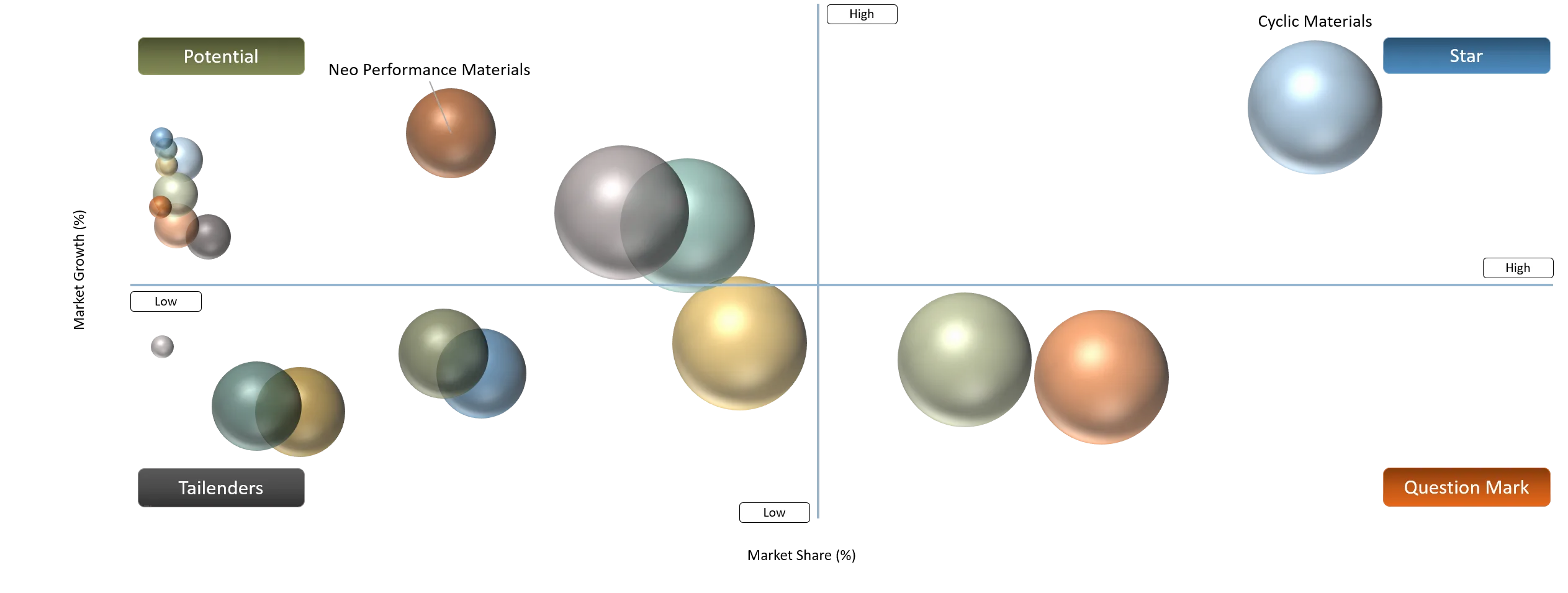
Stars include Cyclic Materials, Mkango Resources, Noveon Magnetics, and Carester because they have established strong positions in rare-earth recycling, particularly in NdFeB permanent-magnet recovery, direct magnet recycling, and closed-loop rare-earth supply chains. Cyclic Materials is expanding its commercial recycling footprint, while Mkango Resources is strengthening its position through HyProMag and Heraeus Remloy technologies. Question Marks include Solvay, Shin-Etsu Chemical, ReElement Technologies, Maginito Limited, and Geomega Resources, as these companies possess established rare-earth processing, separation, or recycling technologies but operate in a market where commercial-scale recycling capacity is still developing.
Potential includes Neo Performance Materials, Mitsubishi Materials, and RecycleKaro, which benefit from established materials-processing capabilities and exposure to growing critical-material recovery requirements but have comparatively less specialized positioning in dedicated rare-earth recycling than the leading companies. Tailenders: none of the 12 selected companies are classified as clear Tailenders because each has a direct technological, processing, recycling, or downstream-material connection to the rare-earth recycling value chain.
Rare Earth Recycling Market Dynamics
Driver Impact Analysis
| Driver | Market Growth Impact (%) | Demand Concentration | Impacted Use Case | Strategic Impact |
Rising demand for permanent magnets in EVs, wind turbines, industrial motors, and electronics is increasing the availability and strategic value of recyclable rare-earth materials. | 28% | High – Asia-Pacific, Europe, North America | EV traction motors, wind-turbine generators, industrial motors, electronics, robotics | Expands the future feedstock pool for magnet recycling and strengthens demand for recovered Nd, Pr, Dy, and Tb. |
Geopolitical restrictions on rare-earth exports are accelerating investment in recycling as a localized secondary source of critical materials. | 25% | High – North America, Europe, Japan, South Korea | Permanent magnets, EVs, automotive, electronics, defense, renewable energy | Reduces dependence on concentrated primary supply and increases the strategic value of domestic recycling, refining, and closed-loop supply chains. |
Government policies supporting critical-mineral supply security and circular material recovery are encouraging the development of domestic rare-earth recycling infrastructure. | 18% | High – Europe, North America, China, India, Japan | E-waste recovery, magnet recycling, critical-mineral processing, domestic REPM supply chains | Improves project economics through incentives, funding, recycling mandates, and supply-chain localization while accelerating commercial-scale recovery infrastructure. |
Growing investment in domestic permanent-magnet manufacturing is strengthening demand for recycled rare-earth feedstocks that can be reintegrated into magnet supply chains. | 16% | High – China, Europe, North America, India, Japan | NdFeB magnets, EV motors, wind turbines, industrial motors, electronics | Creates downstream offtake for recycled rare-earth materials and encourages integration of recycling with alloy and permanent-magnet manufacturing. |
Increasing emphasis on closed-loop supply chains is encouraging manufacturers to recover rare-earth magnets and return processed materials to downstream magnet production. | 13% | High – Europe, North America, Japan, South Korea | Magnet-to-magnet recycling, EV motors, wind turbines, electronics, industrial equipment | Shifts recycling from waste treatment toward circular material supply, improving feedstock security and increasing the value captured across the recycling chain. |
Government policies supporting critical-mineral supply security and circular material recovery are encouraging the development of domestic rare-earth recycling infrastructure
The rapid adoption of critical-mineral recycling policies has helped in reinforcing the growth of local rare-earth mineral recycling infrastructure through incorporation of secondary material recovery as part of the nation’s resource security strategy. In September 2025, the Government of India adopted a recycling program of critical minerals worth ₹1,500 crore that targets feedstocks such as e-waste, battery scrap, and end-of-life vehicle scrap, which will run between FY2025-26 and FY2030-31. The program seeks to enhance the recovery of critical minerals locally without having to rely on foreign raw material sources.
The UK Government is enhancing the security of rare earth supply within the country through investments in advanced magnet recycling facilities. In January 2026, according to the Newsletter, the UK Government provided a grant of £12 million (USD 16.4 million) in equity finance to Ionic Technologies for the establishment of the rare-earth magnet recycling plant on a commercial scale in Belfast, Northern Ireland. This is an £85 million project, which will use the long-loop recycling technology from Ionic Technologies to recover about 400 metric tonnes a year of high-purity (more than 99.5%) rare-earth oxides from recycled rare-earth magnets. The project is intended to strengthen the UK's domestic rare-earth supply chain and support the automotive and advanced-manufacturing sectors.
Restraint Impact Analysis
| Restraint | Drag on Market Growth (%) | Primary Impact Area | Impacted Use Case | Strategic Impact |
Complex separation and purification requirements increase processing costs because rare earth elements have chemically similar properties and often occur with multiple impurities. | 7% | Processing Cost & Recovery Efficiency | NdFeB Magnet Recycling | Drives investment toward advanced separation, solvent extraction, hydrometallurgical and purification technologies to improve recovery economics. |
Limited availability of standardized end-of-life magnet compositions complicates sorting and reduces the efficiency of direct recycling processes. | 6% | Feedstock Sorting & Process Standardization | EV Motors, Wind Turbines & Industrial Motors | Increases demand for magnet identification, composition databases, labeling and standardized dismantling processes to enable efficient direct recycling. |
Insufficient collection and reverse-logistics infrastructure restrict access to consistent secondary feedstock for commercial-scale recycling facilities. | 8% | Feedstock Availability & Collection Infrastructure | E-waste, EV Motors & Wind Turbine Magnets | Encourages investment in collection networks, take-back systems, regional aggregation hubs and reverse logistics; inadequate feedstock remains a major constraint on scaling recyclers. |
Immature industrial-scale recycling technologies limit the cost-effective recovery of high-purity rare earth elements from complex end-of-life products. | 7% | Technology Maturity & Recovery Economics | Permanent Magnets from EVs, Wind Turbines & Electronics | Favors technology development, pilot-to-commercial scale-up and integrated recycling-refining facilities to reduce processing costs and improve recovered-material quality. |
Insufficient collection and reverse-logistics infrastructure restrict access to consistent secondary feedstock for commercial-scale recycling facilities
One of the key restraints limiting the commercial-scale expansion of the rare earth recycling market on an industrial level is the lack of adequate collection and reverse logistics systems to ensure a steady flow of waste products and rare earth-containing scrap. In December 2025, according to the European Commission, the average collection rate for waste products in the EU stood at merely 40%, while only 1% of rare earths were recycled in the EU. It should be noted that substantial amounts of permanent magnet scraps and waste products are either exported from the EU, underused, or sent to landfills.
The limited availability of end-of-life resources is becoming a major constraint in developing reliable secondary sources of critical minerals. In June 2026, according to the British Geological Survey (BGS), the UK Critical Minerals Intelligence Centre determined that a lack of end-of-life material inventories can pose a risk of critical minerals shortage in the next decade due to an inability to produce secondary sources. The UK plans to recycle and recover 20% of critical minerals demand annually by 2035, and from 2040 to 2050, secondary materials can potentially meet up to 85% of the total demand for magnetic rare earth elements such as neodymium, praseodymium, and dysprosium. BGS highlighted the need for investment, recycling capacity, and integrated reverse supply chains to realize this long-term recycling potential.
Rare Earth Recycling Market Segment Analysis
The global rare earth recycling market is segmented based on recycling process, rare earth element, source, recovered material form, application, and region.
Permanent Magnets Driving Dominant Feedstock Demand in Rare Earth Recycling
The Permanent Magnets segment continues to dominate the source in the rare earth recycling market, with a market share of 61.8% in 2025, owing to the high content of precious rare earths like neodymium, praseodymium, dysprosium, and terbium in NdFeB magnets. These magnets find widespread usage in applications like electric vehicles, wind energy, consumer electronics, and industrial machinery and thus provide an excellent and strategically important material for recycling. In 2025, rare earth magnets continued to be essential for e-mobility and renewable energy sectors, whereas research in the industry sector established that NdFeB magnets were the best high-performance magnets commercially available.
The increasing emphasis on securing domestic sources of rare earths will only increase investments made into permanent magnet recovery and recycling efforts. In November 2025, the Government of India sanctioned a ₹7,280 crore (approximately USD 840 million) project aimed at creating the capacity to manufacture 6,000 metric tons per year of integrated sintered rare earth permanent magnets, which highlights the importance of NdFeB magnets to the clean energy and advanced manufacturing ecosystem. In December 2025, the European Commission said that with the right feedstock and incentives, EU rare earth recyclers would be able to produce 3,800 metric tons of rare earth magnets, or 20% of total demand.
Rare Earth Recycling Market Geographical Penetration
Rapid Recycling Capacity Expansion and Advanced Recovery Infrastructure in Asia-Pacific Region
Asia-Pacific holds the dominant position in the rare earth recycling market as the region is estimated to contribute about 60.02% of the market share in 2025. This is due to the availability of a well-established rare earth processing infrastructure in the region, along with an advanced permanent magnet industry, growth in electric vehicles, renewable energy, and resource recovery efforts backed by government initiatives. The governments of China, Japan, and many other countries in the Asian region are continuously improving their capability in rare earth recycling to ensure that secondary supplies of rare earths become available and dependence on the primary supply of rare earth metals can be reduced. In 2025, a new technical specification related to recyclable rare earth secondary resources, including rare earth magnets, catalysts, polishing powders, and others, was introduced by China. This standard came into effect from July 2026 onwards.
Strategic partnerships are driving domestic rare-earth magnet recycling technology and building circular supply chains in the Asia-Pacific region. In February 2025, Ionic Rare Earths Ltd., an Australia-based rare earth magnet technology company, entered into a non-binding MoU agreement with DNA Link Inc., a South Korean-based biotechnology and advanced material manufacturer, for the development of a magnet recycling process and rare earth oxides supply in South Korea. This agreement is to focus on the recycling of magnet manufacturing swarf and end-of-life magnets, whereas DNA Link intends to establish a 1,000-ton-per-year NdFeB permanent magnet manufacturing plant in Yesan, South Korea. South Korea, considered the third-largest magnet market in the world, imported more than 5,400 tonnes of permanent magnets from China in 2021.
China Rare Earth Recycling Market Trends
China holds a dominant position in the Asia-Pacific rare earth recycling market, due to the highly advanced infrastructure for rare earth mining, extraction, purification, permanent magnet production and recycling, along with the high demand in China from the electric vehicle industry, wind turbines, electronics and other industrial sectors. The well-developed rare earth supply chain in the country results in a significant volume of raw material availability for recycling, while recycling policies promote the reuse of rare earths.
Cooperation between state-owned rare-earth industries and recycling businesses in China has improved the circular supply chain for strategic raw materials in the country. In November 2025, China Rare Earth Group, a Chinese state-owned rare earth industry corporation, formed a strategic partnership with China Resources Recycling Group, a Chinese state-owned resources recycling corporation, aimed at enhancing rare earth recycling, secondary resources utilization, and strategic resources security. China Resources Recycling Group was founded in 2024 with CNY 10 billion (USD 1.4 billion) worth of registered capital, providing a national platform for resource recycling and reuse.
Japan Rare Earth Recycling Market Outlook
Japan is the fastest-growing country in the Asia Pacific rare earth recycling market, owing to its developed industry for the consumption of rare earths, advanced processing technologies, and intense desire to lessen its reliance on its concentrated foreign supply chains. Moreover, Japan has a special role to play in the permanent magnet sector, being responsible for manufacturing magnets and magnet components that are used in automobiles, electronics, and other industrial purposes. The two countries signed an agreement in March 2025 to cooperate in creating an alternative supply of heavy rare earths.
Japan is boosting rare-earth recycling by means of investments into its domestic sector with the goal of enhancing its collection and recovery process. In February 2026, Japan's Ministry of the Environment, a Japanese government environmental authority, was planning to give subsidies starting from fiscal 2026 for facilities that would handle recycling of rare earths and that would include transportation, storage, collection, and testing equipment. The ministry included an additional JPY 6 billion (equivalent to USD 38.8 million) in the budget for FY2026, where funds were supposed to be utilized in nationwide demonstrations in the recovery of rare earths from used motors of electric vehicles and e-waste. The program also targets increasing Japan's electronic-waste recycling volume to approximately 500,000 tonnes per year by 2030, representing a 50% increase from 2020 levels.
Strategic Recycling Investments and Supply-Chain Development in North America
North America is a major player in the rare earth recycling market, which comprises 15.09% of the global market share in 2025. This region, specifically the U.S., is building its recycling infrastructure due to increasing investments in domestic rare earth metal processing, permanent magnet recycling, and improving the supply chain of critical minerals. The region, specifically the U.S., has built its infrastructure in recycling in order to decrease its dependency on rare earth metal imports and in order to recycle metals from permanent magnets and electronic waste, among others.
Commercial-scale investments in rare-earth magnet recycling are expanding North America’s domestic capacity for recovering critical materials from end-of-life products. In December 2025, HyProMag USA LLC, a U.S.-based rare-earth recycling and processing company, finalized a long-term lease for a 128,000-square-foot rare-earth magnet recycling and manufacturing facility in Dallas-Fort Worth, Texas. HyProMag USA is a joint venture involving HyProMag Limited, headquartered in the United Kingdom, and CoTec Holdings Corp., headquartered in Canada, with the Texas facility planned to use patented Hydrogen Processing of Magnet Scrap (HPMS) technology developed by the University of Birmingham to recover and remanufacture NdFeB magnets from end-of-life products. The facility is targeted for commissioning by mid-2027 and is expected to create approximately 90–100 skilled jobs.
U.S. Rare Earth Recycling Market Trends
The U.S. holds a dominant position in the North American rare earth recycling market, due to increasing investments in the extraction of rare earths within the country, innovations in recycling processes, and the aim to lower reliance on external supplies. The U.S. is focusing on the development of the process of recycling rare earth metals from permanent magnets, electronic waste, mining tailings, and industrial scrap, whereas rising demand for recycled rare earths comes from the field of electric cars, defense, wind energy, and electronics.
Strategic technology partnerships are strengthening the U.S. rare-earth recycling ecosystem by integrating advanced refining technologies with secondary feedstock recovery. In May 2026, Nth Cycle Inc., a U.S.-based critical-mineral refining technology company, entered into a Joint Development and Licensing Agreement with Ionic Rare Earths Limited (IonicRE), an Australia-based rare-earth mining, refining, and recycling company, to develop integrated rare-earth refining operations in the U.S. and other Western markets. Under the agreement, Nth Cycle will integrate its proprietary electro-extraction technology into IonicRE’s rare-earth recycling process to convert recycled magnet swarf and spent magnets into high-purity rare-earth oxides while eliminating reliance on oxalic acid; integration into IonicRE’s Belfast facility is planned to begin in Q4 2026.
Rare Earth Recycling Market Competitive Landscape
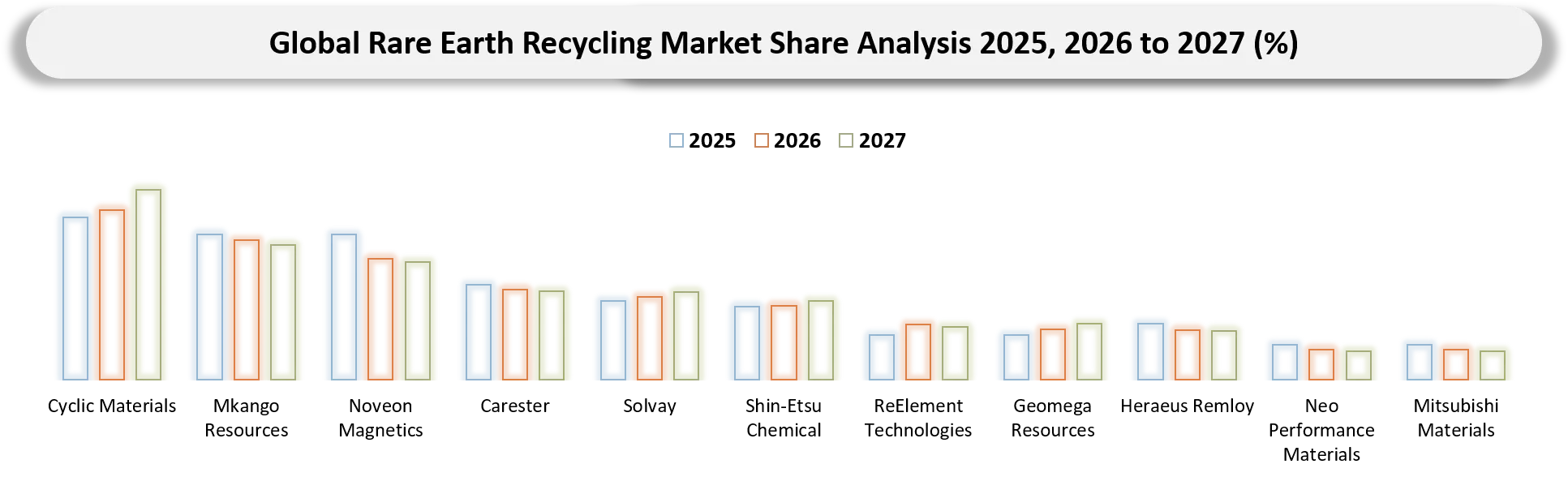
- The market is characterized by three key participant groups: established rare-earth materials and chemical companies, specialized rare-earth and permanent-magnet recycling companies, and emerging integrated circular-supply-chain developers. Solvay, Shin-Etsu Chemical, Neo Performance Materials, Mitsubishi Materials, and Heraeus Remloy leverage established rare-earth separation, refining, and advanced-materials capabilities; Cyclic Materials, Noveon Magnetics, Carester, ReElement Technologies, Geomega Resources, and Maginito Limited focus on rare-earth recovery, permanent-magnet recycling, and closed-loop processing; while Mkango Resources and RecycleKaro are expanding capabilities across secondary-resource recovery and rare-earth supply chains. This creates a technology- and ecosystem-driven landscape where recycling efficiency, feedstock availability, recovery purity, processing capacity, downstream integration, and secure offtake partnerships define competitiveness.
- Key players include Cyclic Materials, Mkango Resources, Noveon Magnetics, Carester, Solvay, Shin-Etsu Chemical, ReElement Technologies, Geomega Resources, Heraeus Remloy, Neo Performance Materials, Mitsubishi Materials, RecycleKaro, and Maginito Limited.
Key Developments in the Rare Earth Recycling Market
- January 2026: Korea Zinc Co., Ltd., a South Korea-based non-ferrous metals smelting and recycling company, entered into a strategic partnership with Alta Resource Technologies Inc., a U.S.-based critical-minerals separation technology company, to establish a U.S. joint venture focused on recycling end-of-life permanent magnets into high-purity rare-earth oxides.
- October 2025: Cyclic Materials, a Canada-based advanced rare-earth recycling company, expanded its partnership with VACUUMSCHMELZE (VAC), a Germany-based manufacturer of advanced magnetic materials and rare-earth permanent magnets, through a 10-year exclusive agreement to recycle 100% of the magnet-production by-products (swarf) generated at VAC’s new manufacturing facility in Sumter, South Carolina, which began operations at the end of 2025.
- January 2026: CoTec Holdings Corp., HyProMag Ltd., a UK-based rare-earth magnet recycling and manufacturing company, officially opened its commercial-scale rare-earth magnet recycling facility at Tyseley Energy Park, Birmingham, in collaboration with the University of Birmingham, a UK public research university.
- November 2025: Electronic Recyclers International (ERI), a U.S.-based electronics recycling and material-resource recovery company, entered into a commercial processing agreement with ReElement Technologies Corporation, a U.S.-based rare-earth and critical-mineral refining company, through ReElement’s parent company American Resources Corporation.
- May 2026: Mkango Resources Ltd., a Canada-based rare-earth exploration and development company, signed an asset acquisition agreement with Heraeus Amloy Technologies GmbH, a Germany-based advanced materials and technology company within the Heraeus Group, to acquire the Remloy rare-earth magnet recycling business for €8 million (USD 9.4 million).
Key Procurement Priorities and Buyer Evaluation Criteria
- Organizations investing in the Rare Earth Recycling Market prioritize suppliers with the ability to recover high-value rare earth elements from permanent magnets, electronic waste, industrial scrap, and end-of-life products while achieving high recovery efficiency, material purity, and consistent output quality.
- The procurement decision-making process is increasingly influenced by critical-mineral supply security, dependence on imported rare earths, growing demand for recycled permanent magnets, EV and wind-turbine deployment, and government initiatives supporting domestic rare-earth recycling and circular supply chains.
- Buyers evaluate suppliers based on factors such as rare-earth recovery rate, recovered-material purity, processing capacity, feedstock flexibility, recycling technology efficiency, environmental performance, operating costs, and the ability to consistently supply recycled rare-earth oxides, metals, alloys, or permanent magnets.
Why Choose DataM?
- Technological Innovations: Explores advancements in rare-earth recycling technologies, including hydrometallurgical, pyrometallurgical, mechanical, and direct recycling processes, enabling higher recovery rates, improved material purity, and efficient recovery of valuable elements such as neodymium, praseodymium, dysprosium, and terbium from permanent magnets, e-waste, and industrial scrap.
- Product Performance & Market Positioning: Evaluates how recycling companies differentiate through recovery efficiency, recycled-material purity, processing capacity, feedstock flexibility, operating efficiency, and closed-loop capabilities, highlighting competitive positioning across permanent magnets, electric motors, wind turbines, consumer electronics, automotive, and industrial applications.
- Real-World Evidence: Highlights the commercialization of rare-earth recycling technologies and their deployment across permanent-magnet manufacturing, electric vehicles, wind turbines, electronics, and industrial equipment, demonstrating benefits such as recovery of high-value rare earths, reduced dependence on primary materials, and improved supply-chain resilience.
- Market Updates & Industry Changes: Tracks key developments including recycling facility expansions, government funding, new recycling standards, permanent-magnet recovery projects, strategic partnerships, and investments across Asia-Pacific, North America, and Europe, supporting the transition toward more resilient circular rare-earth supply chains.
- Competitive Strategies: Analyzes how leading companies expand through recycling-capacity additions, proprietary recovery technologies, strategic partnerships, feedstock agreements, downstream integration, and closed-loop magnet-to-magnet recycling to address growing demand for secure supplies of critical rare-earth materials.
- Pricing & Market Access: Explains cost variations based on feedstock type, rare-earth concentration, recovery process, energy requirements, material purity, processing scale, and recovered product form, while evaluating access to recycled rare-earth oxides, metals, alloys, and permanent magnets through recyclers, processors, magnet manufacturers, and downstream industrial customers.
- Market Entry & Expansion: Identifies growth opportunities driven by rising permanent-magnet demand, electric-vehicle and wind-turbine deployment, electronic-waste generation, critical-mineral policies, and supply-chain diversification, while outlining strategies such as regional recycling capacity expansion, technology differentiation, feedstock partnerships, and integration with downstream rare-earth and magnet production.
Target Audience
- Rare Earth Recycling Companies & Processors
- Permanent Magnet Manufacturers
- Automotive & Electric Vehicle Manufacturers
- Wind Energy Companies
- Electronics & Electrical Equipment Manufacturers
- Mining & Rare Earth Processing Companies
- Chemical & Advanced Materials Companies


























































