


Solar Financing in India Gains Momentum with Rising Green Loans and Project Investments
India’s solar industry is entering a new phase of expansion in which access to competitive capital is becoming as important as project development and technology costs. Green loans, project debt, corporate credit facilities, acquisitions and other funding mechanisms are increasingly supporting solar developers, commercial and industrial consumers, and renewable energy platforms.
Recent developments across the solar finance and M&A landscape indicate that capital is flowing into multiple segments of the market, ranging from C&I rooftop solar and utility-scale projects to distributed generation, solar-plus-storage and renewable-energy acquisitions. Mercom India’s Finance and M&A coverage highlights several recent financing and transaction activities across the sector.
Explore the Battery Energy Storage System Market Outlook
Gain comprehensive insights into BESS market size, growth drivers, battery chemistry trends, competitive dynamics, regional opportunities, investment outlook, and emerging applications through 2035.
Explore the full report to make informed strategic and investment decisions.
Solar Financing Becomes a Critical Growth Enabler
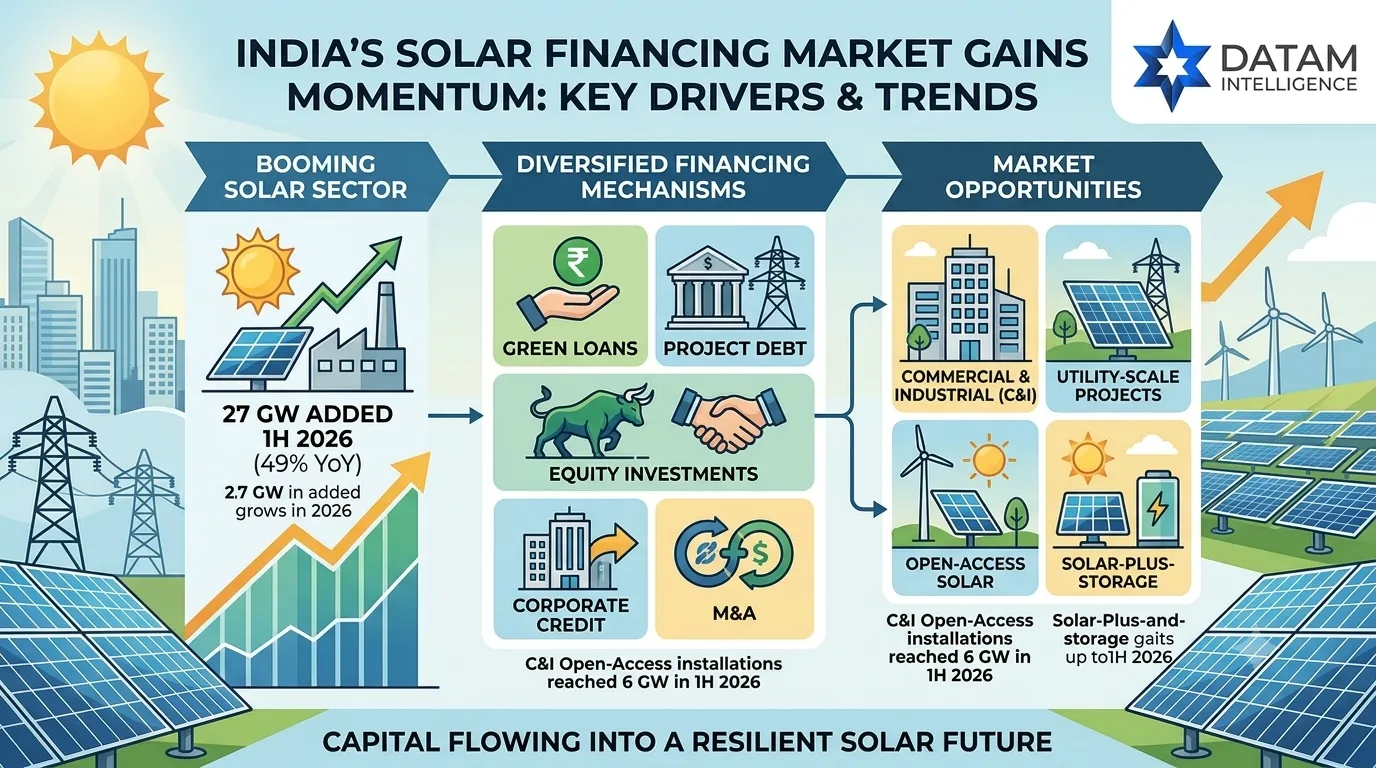
India's solar market continues to expand rapidly. The country added a record 27 GW of solar capacity during the first half of 2026, representing a 49% increase from the 18 GW added during the same period of 2025. Solar accounted for 76% of the new power capacity added during the period.
Such rapid deployment requires substantial capital across the project lifecycle. Developers need financing for land acquisition, equipment procurement, construction, transmission infrastructure, working capital and project commissioning.
As project pipelines become larger, financing structures are also becoming more sophisticated. Developers and investors are increasingly combining conventional debt with corporate facilities, green financing, tax-linked structures, equity investments and strategic partnerships.
Green Loans Open New Opportunities for C&I Solar
One of the emerging trends is the increasing availability of green financing for commercial and industrial solar installations.
Competitive green loans can reduce the upfront financial burden for businesses seeking rooftop solar and other renewable-energy solutions. This is particularly important for C&I consumers because financing costs can significantly influence project payback periods and investment decisions.
The growing availability of financing could therefore support broader adoption of distributed solar among businesses that may have previously considered capital expenditure a major barrier.
Project Finance Supports Large-Scale Solar Deployment
Project financing remains an important mechanism for utility-scale renewable-energy development.
Recent transactions tracked by Mercom India include Hindustan Power securing ₹11.35 billion in debt financing for a 435 MW solar project in Uttar Pradesh and AMPIN Energy Transition achieving financial closure for a $195 million PPA-backed wind-solar-storage project.
These transactions demonstrate how long-term contracted revenues and project structures can help developers obtain substantial debt capital for renewable infrastructure.
As India's solar pipeline grows, lenders are likely to place greater emphasis on project bankability, counterparty quality, transmission availability, power purchase agreements, equipment supply and regulatory certainty.
Solar M&A Creates Another Route to Scale
Financing is not limited to greenfield project development. Mergers and acquisitions are also allowing renewable-energy companies to expand their portfolios and capabilities.
Recent transactions in Mercom India's Finance and M&A coverage include Otovo's proposed $11 million acquisition of Green Panel Solar Energy Systems and Sun Drops Energia's proposed acquisition of renewable EPC company DMGEL for ₹558 million.
M&A can provide investors and strategic buyers with faster access to operating assets, project pipelines, engineering capabilities, customer bases and geographic markets.
For companies seeking to scale rapidly, acquiring established renewable-energy platforms can sometimes offer a faster route to growth than developing every project organically.
Solar-Plus-Storage Attracts Increasing Capital
The financing landscape is also expanding beyond conventional standalone solar.
Hybrid projects combining solar, wind and battery storage are becoming increasingly relevant as developers and power buyers focus on reliability, dispatchability and better alignment between renewable generation and electricity demand.
AMPIN's $195 million financing for a 100 MW wind-solar-storage project illustrates the growing role of structured project finance in hybrid renewable infrastructure.
This trend could become increasingly important as India's electricity system requires more flexible renewable capacity and energy storage to integrate variable generation.
Why Investors Are Increasing Their Focus on Solar
Several factors are strengthening the investment case for solar and renewable infrastructure:
- Rapid growth in solar installations
- Rising corporate demand for renewable electricity
- Expansion of C&I and open-access solar
- Increasing deployment of energy storage
- Long-term power purchase agreements
- Growing availability of green financing
- Expansion of domestic solar manufacturing
- Increasing M&A activity across renewable-energy assets
India's open-access solar market is also expanding rapidly. The country added 3 GW of solar open-access capacity in Q2 2026, while installations during 1H 2026 reached nearly 6 GW, up 42% year over year.
Financing Challenges Could Still Affect Project Economics
Despite the positive funding environment, solar developers continue to face financing risks.
Interest rates, currency movements, module and equipment prices, transmission constraints, policy changes and project execution delays can influence overall project economics.
Regulatory changes can also affect financing assumptions. Mercom India's latest solar market update notes that developers accelerated project commissioning ahead of changes involving ALMM List-II requirements and the phased reduction of the ISTS charge waiver.
Consequently, lenders and investors are increasingly evaluating renewable projects not only on their generation potential but also on their regulatory exposure, procurement strategy, transmission readiness and contracted revenue profile.
What This Means for India's Solar Market
The evolution of solar financing signals a broader transformation in India's renewable-energy ecosystem. Capital is moving beyond conventional project loans toward a wider combination of green lending, corporate financing, acquisitions, hybrid project finance and strategic investments.
For developers, access to competitively priced capital can improve the ability to execute larger project pipelines. For lenders, the expanding renewable-energy market creates opportunities to build diversified clean-energy portfolios. For investors, solar and associated infrastructure offer exposure to a rapidly expanding power-generation segment.
With India continuing to add solar capacity at record levels, financing will remain one of the key factors determining how quickly projects move from development pipelines to commercial operation.
Conclusion
India's solar financing market is becoming increasingly diversified as green loans, project debt, corporate credit facilities and M&A transactions support the next stage of renewable-energy expansion. The combination of strong solar capacity growth, rising C&I demand, open-access deployment and increasing integration of storage is creating new opportunities for developers, lenders and investors.
The next phase of India's solar growth is therefore likely to be shaped not only by technology and capacity additions, but also by the availability, structure and cost of capital.
Related FAQs
What is driving solar financing in India?
Rapid solar capacity additions, increasing C&I renewable-energy demand, open-access deployment, storage integration and growing investor interest are supporting demand for solar financing.
How are solar projects financed in India?
Solar projects can be financed through project debt, corporate loans, green loans, equity investment, infrastructure funds, strategic investment and other structured financing mechanisms.
What are green loans for solar projects?
Green loans are financing instruments designed to support projects with environmental benefits, including renewable-energy and solar installations.
Why is solar project finance important?
Project finance allows developers to fund large renewable-energy projects using the project's expected cash flows and contractual revenues as important components of the financing structure.
Is solar M&A increasing in India?
M&A is becoming an important expansion strategy across the renewable-energy sector, allowing companies to acquire project pipelines, operating assets, EPC capabilities and market access.
What is driving investment in India's solar industry?
Solar capacity growth, renewable-energy targets, corporate clean-energy demand, open-access opportunities, storage development and improving financing availability are among the major investment drivers.
What are the biggest risks in solar project financing?
Key risks include interest rates, equipment costs, foreign-exchange movements, regulatory changes, transmission availability, project delays and counterparty or PPA risks.
Will green financing increase solar adoption?
Greater availability of competitive green financing can reduce upfront capital barriers and potentially improve the economics of commercial, industrial and distributed solar projects.