


India is on track to significantly strengthen its electric vehicle (EV) manufacturing ecosystem, with industry projections indicating that the country could achieve 90 - 100% localisation in key EV components by 2030, excluding battery systems. The development marks a major milestone in India’s transition toward a self-reliant and globally competitive EV manufacturing hub.
The rapid localisation push is being driven by strong government policy support, rising domestic EV adoption, and increasing investments in automotive component manufacturing. Initiatives such as the Production-Linked Incentive (PLI) schemes for automobiles and advanced chemistry cell batteries are accelerating the development of a robust domestic supply chain.
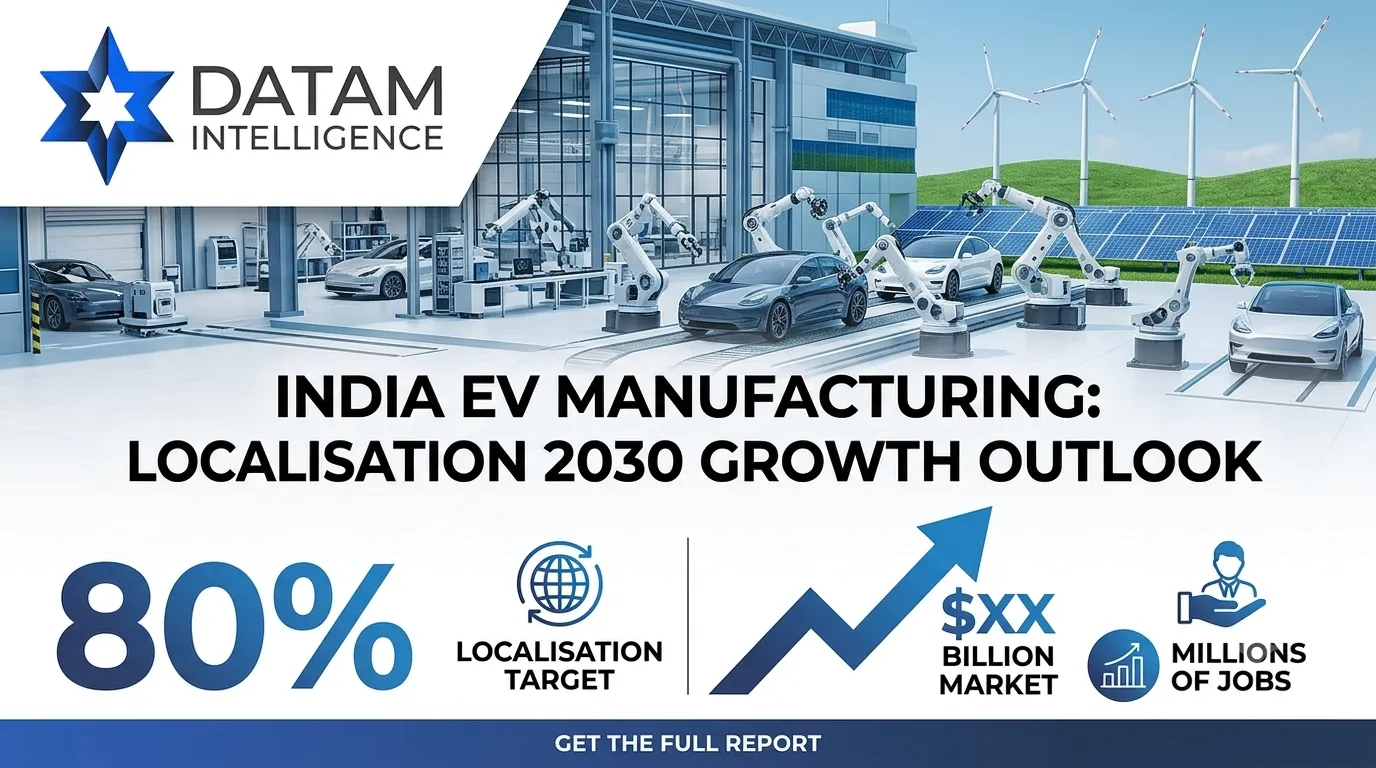
Download India Electric Vehicles Market Report
Gain a complete understanding of one of the fastest-growing mobility markets in the world. The India Electric Vehicles (EV) Market Report by DataM Intelligence delivers in-depth insights into market size, growth trends, segmentation, key drivers, competitive landscape, and future opportunities shaping India’s EV ecosystem.
Whether you are an investor, manufacturer, policymaker, or industry strategist, this report equips you with the data-driven intelligence needed to make informed decisions in a rapidly evolving market.
What You Get Inside the Report:
- Detailed market size & forecast (2026–2033)
- Comprehensive segmentation analysis (vehicle type, propulsion, region, and more)
- Key growth drivers and restraints
- Competitive landscape and leading company profiles
- Policy impact and government initiatives (FAME, PLI, EV policies)
- Emerging trends in EV adoption and infrastructure expansion
Why Download This Report?
India’s EV market is projected to witness exponential growth, driven by strong policy support, rising fuel costs, and rapid electrification across two- and three-wheelers. This report helps you identify high-growth opportunities and stay ahead of market shifts.
Get Full Access to the Report Now!
Download the complete India Electric Vehicles Market Research Report and unlock actionable insights that power strategic growth.
Strong Growth in Domestic EV Ecosystem
India’s EV sector has witnessed accelerated growth over the past few years, with expanding demand across two-wheelers, three-wheelers, and passenger vehicles. This surge is encouraging global and domestic manufacturers to localise production of critical components such as electric drivetrains, power electronics, vehicle control units, and charging infrastructure.
Industry experts note that while battery cells remain a key import-dependent segment, significant progress is being made in localising non-battery components, which form a substantial portion of EV value addition.
Key Drivers of Localisation
The shift toward higher localisation is supported by multiple structural factors:
- Expansion of domestic EV demand across urban and semi-urban markets
- Policy incentives under PLI schemes promoting domestic manufacturing
- Entry of global automotive companies into India-based production hubs
- Growth of Tier-1 and Tier-2 supplier ecosystems
- Increasing investments in EV charging infrastructure and electronics manufacturing
Strategic Industry Transition
India’s EV industry is gradually transitioning from assembly-based operations to deeper manufacturing integration. Components such as electric motors, battery management systems, thermal systems, and power electronics are increasingly being produced domestically.
However, challenges remain in areas such as semiconductor dependency and rare earth material imports, which continue to limit full end-to-end self-sufficiency.
Outlook for 2030
By 2030, India is expected to emerge as a major global EV manufacturing base, particularly in non-battery components. The country’s manufacturing ecosystem is likely to become highly integrated, supporting both domestic demand and export-oriented production.
Experts believe that sustained investment in advanced materials, semiconductor manufacturing, and research and development will be crucial for achieving full value chain independence in the EV sector.