


Hitachi Leads Japan’s Electronics Resurgence as Industry Giants Reshape Growth Strategies
Japan’s electronics industry is entering a new phase of transformation as companies that once operated as broad-based conglomerates increasingly focus on high-growth, high-margin businesses.
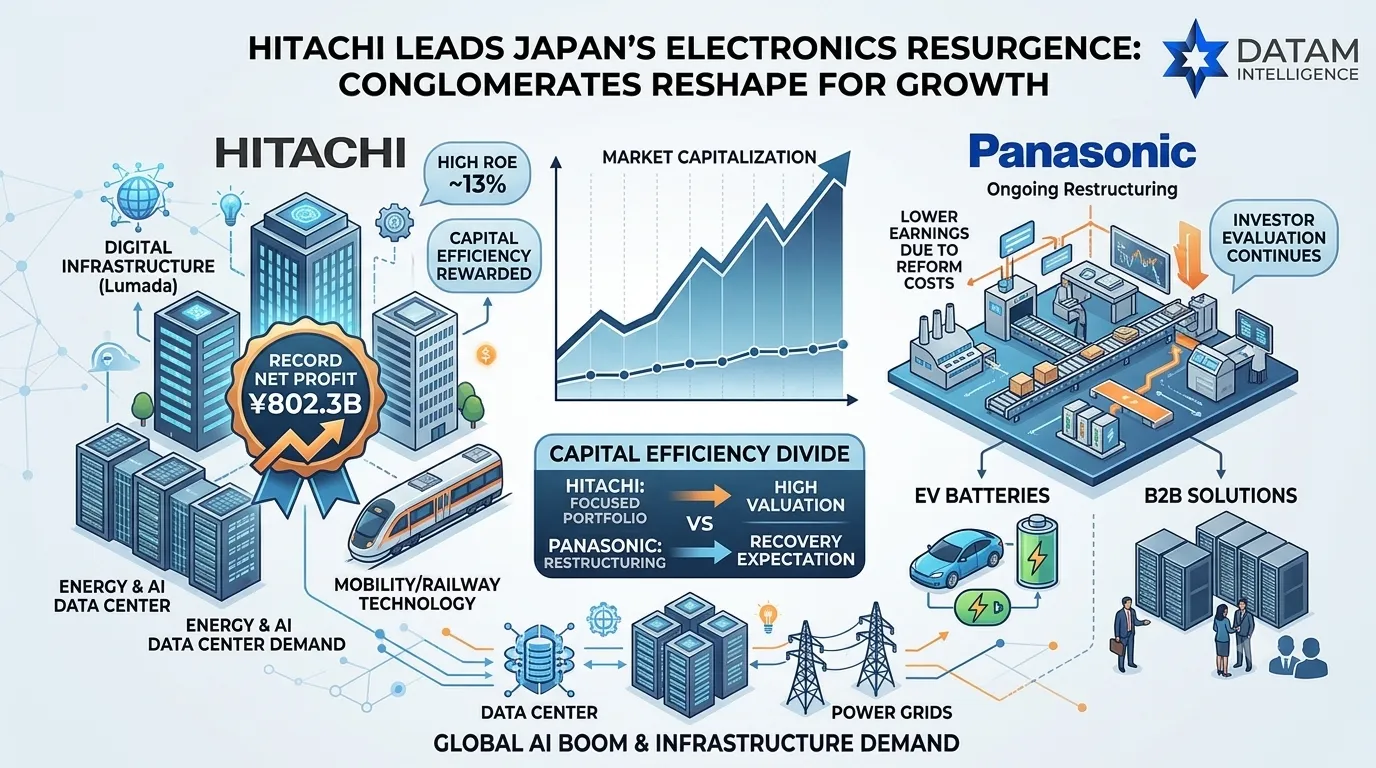
Among the biggest winners is Hitachi, which reported a record net profit of ¥802.3 billion ($4.9 billion) for the fiscal year ended March 2026. The company’s market capitalization has climbed to approximately ¥22 trillion ($134 billion), reflecting investor confidence in its shift toward digital infrastructure, energy systems, and mobility solutions.
Get the Complete Japan Electronics Market Analysis & Forecast
Looking to evaluate capital efficiency, high-margin market shifts, and emerging technology trends in Japan’s Electronics Industry sector? Request Your Free Sample Report Today and gain actionable market intelligence to inform your strategic decision-making.
Meanwhile, Panasonic Holdings is pursuing a major restructuring strategy aimed at improving profitability and capital efficiency. Although the company experienced lower earnings due to reform-related costs, investors are waiting for evidence that its transformation plan can deliver sustainable returns.
The widening valuation gap between Hitachi and Panasonic highlights a broader trend across Japan’s industrial sector: companies that successfully improve return on equity (ROE), simplify business structures, and focus on recurring revenue models are receiving stronger market recognition.
Hitachi’s Transformation Drives Record Profitability
Hitachi has completed one of the most significant corporate transformations among Japan’s traditional electronics manufacturers.
For the fiscal year ended March 2026:
- Revenue increased 8.2% year-on-year to ¥10.59 trillion
- Adjusted operating profit increased 23.4% to ¥1.2 trillion
- Net profit increased 30.3% to ¥802.3 billion
- ROE improved to approximately 13%
- Price-to-book ratio (PBR) reached around 3.3 times
The company’s success comes from moving away from its historical “everything electronics” model and concentrating resources on three strategic growth areas:
1. Digital Infrastructure Through Lumada
Hitachi’s digital business, powered by its Lumada platform, provides software, analytics, and IT solutions designed to improve industrial and social infrastructure efficiency.
The company is benefiting from rising enterprise demand for:
- Industrial AI solutions
- Digital transformation services
- Data-driven infrastructure management
- Smart city technologies
Recurring software and service revenue has become a key factor supporting earnings stability.
2. Energy Infrastructure and AI Data Center Demand
Global artificial intelligence expansion is creating significant electricity demand growth, especially from hyperscale data centers.
Hitachi’s energy business is positioned to benefit from:
- Power transmission systems
- Grid modernization
- Renewable energy integration
- Data center electricity infrastructure
As AI adoption accelerates worldwide, power infrastructure companies are increasingly becoming strategic technology suppliers.
3. Mobility and Railway Technology
Hitachi’s railway business remains another core growth pillar, supported by:
- Urban transportation demand
- Global railway modernization
- Smart mobility investments
The company has successfully combined industrial engineering expertise with digital technologies to create a more diversified growth platform.
Market Rewards Hitachi’s Capital Efficiency Strategy
Investors have strongly rewarded Hitachi’s transformation.
Based on the July 24 closing price of approximately ¥4,850:
- Forward P/E ratio: around 26 times
- PBR: approximately 3.3 times
- Estimated EPS: around ¥189
This valuation is significantly higher than the average Japanese market valuation, where companies traditionally trade closer to:
- P/E ratio: approximately 15 times
- PBR: around 1 time
The premium valuation reflects investor confidence that Hitachi can continue delivering:
- Higher profitability
- Stronger cash generation
- Sustainable growth
- Improved shareholder returns
Panasonic’s Restructuring Strategy Faces Investor Test
While Hitachi has already demonstrated the benefits of restructuring, Panasonic remains in the execution phase.
For the fiscal year ended March 2026:
- Revenue: ¥8.05 trillion
- Operating profit: ¥236.4 billion
- Net profit: ¥189.5 billion
- ROE: approximately 3.8%
The lower profitability was partly caused by restructuring expenses, including:
- Business portfolio adjustments
- Workforce reductions
- Divestment-related costs
For fiscal year 2027, Panasonic expects:
- Revenue: ¥7.6 trillion
- Operating profit: ¥550 billion
- Net profit: ¥420 billion
The company’s strategy is based on reducing low-margin businesses and concentrating investment on higher-growth areas.
Panasonic’s Growth Opportunities: EV Batteries and B2B Solutions
A major growth driver for Panasonic is its automotive battery business.
The company supplies battery technology to electric vehicle manufacturers, including Tesla, while also expanding in:
- Energy storage
- Air conditioning systems
- Industrial solutions
- Business-to-business technology services
If Panasonic successfully improves operational efficiency and focuses resources on profitable segments, the company could significantly improve its ROE.
However, investors remain cautious due to:
- Slower-than-expected EV market growth
- Battery industry competition
- Execution risks during restructuring
Hitachi vs Panasonic: The Capital Efficiency Divide
The difference between Hitachi and Panasonic is not simply about revenue size or technology capability.
The market is increasingly rewarding companies that demonstrate:
| Factor | Hitachi | Panasonic |
|---|---|---|
| Business strategy | Focused portfolio | Ongoing restructuring |
| Core growth areas | Digital, energy, mobility | Batteries, B2B solutions |
| ROE | ~13% | ~3.8% |
| Investor confidence | High | Under evaluation |
| Market valuation | Premium | Recovery expectation |
The key question for investors is whether management teams can consistently convert assets into higher returns.
AI Infrastructure Growth Creates New Opportunities for Industrial Technology Leaders
The global AI boom is reshaping industrial technology markets.
Companies supporting AI infrastructure including:
- Power systems providers
- Data center equipment suppliers
- Industrial automation companies
- Digital infrastructure firms
are positioned to benefit from long-term demand growth.
Hitachi’s combination of digital platforms and energy infrastructure places it directly within this emerging investment theme.
Outlook: Japan’s Electronics Sector Moves From Scale to Efficiency
The transformation of Hitachi and Panasonic reflects a broader shift in Japan’s corporate landscape.
Traditional electronics giants are moving away from diversified conglomerate structures and toward focused, high-return business models.
Hitachi represents a completed transformation story, where strategic divestments and digital investments have created stronger profitability.
Panasonic represents the next test case: whether restructuring efforts can translate into higher returns and renewed investor confidence.
For global investors, the key metric is no longer simply company size it is whether management can create sustainable value through capital discipline, innovation, and operational efficiency.
Analyst Insight: Japan’s Electronics Sector Enters a New Era of AI-Driven Industrial Transformation
Japan’s electronics industry is undergoing a strategic transformation as companies shift from traditional diversified manufacturing models toward technology-driven, high-value businesses. The next phase of growth will be shaped by AI infrastructure expansion, industrial automation, and energy modernization.
Key investment themes shaping the sector include:
- AI Infrastructure Growth: Rising demand for data centers, power systems, and digital infrastructure is creating new opportunities for industrial technology leaders.
- Industrial Digitalization: Companies integrating software, automation, analytics, and connected solutions are moving toward higher-margin and recurring revenue business models.
- Energy Transformation: Grid modernization, renewable energy integration, and increasing electricity demand from AI applications are strengthening the outlook for energy technology providers.
- Capital Efficiency Focus: Investors are prioritizing companies that improve ROE, streamline portfolios, and allocate capital toward high-growth business areas.
- Future Market Leaders: Companies that successfully combine technological innovation, operational excellence, and disciplined capital management are expected to command stronger valuations in the global technology market.