


Foxconn AI Server Demand Emerges as a Major Growth Engine
Foxconn is strengthening its position in the global artificial intelligence infrastructure market as accelerating demand for AI servers and data center hardware drives a sharp improvement in profitability.
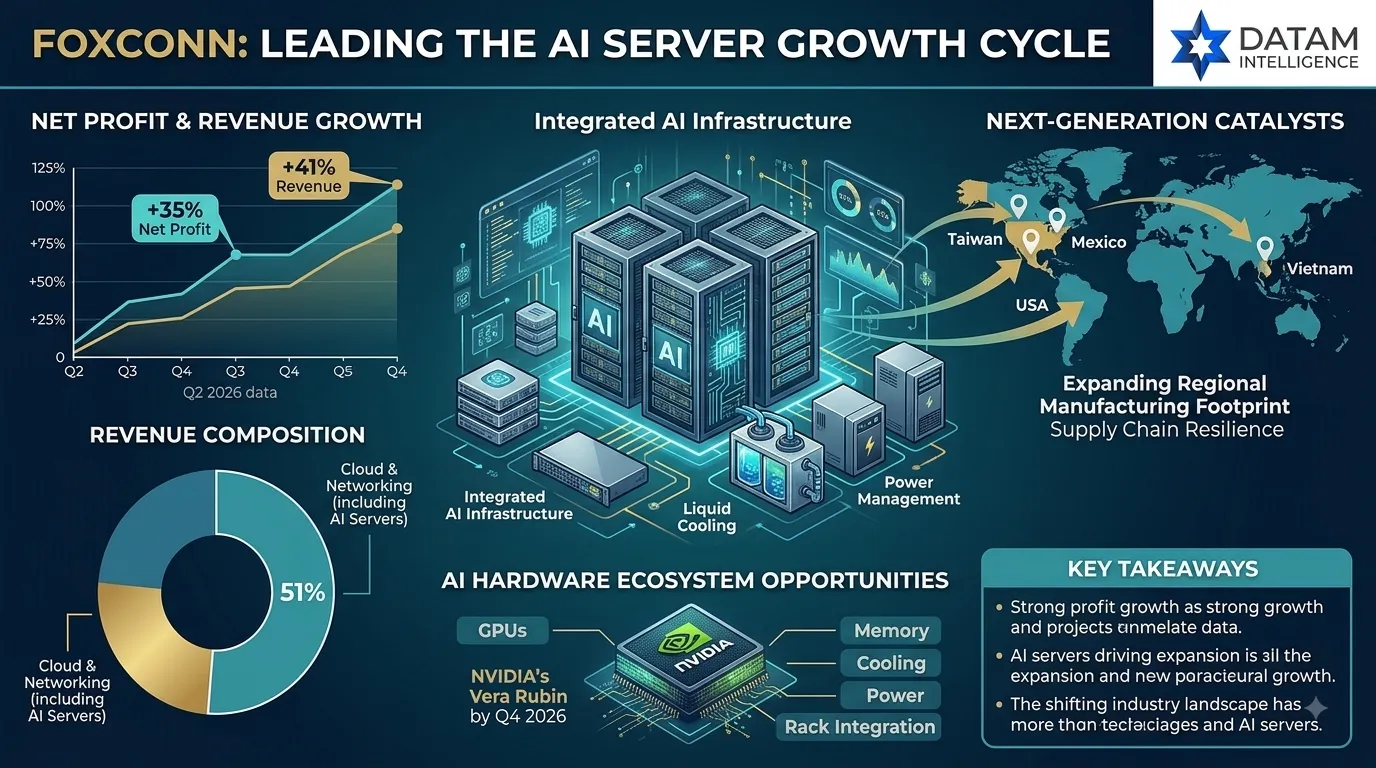
The Taiwan-based electronics manufacturing giant reported a 35% year-over-year increase in second-quarter net profit to NT$59.97 billion (approximately US$1.86 billion), while revenue increased 41% to NT$2.526 trillion. The company's cloud and networking products, which include AI servers, accounted for 51% of total revenue, exceeding half of quarterly sales for the first time.
Explore the Heat Pipe Market: Identify High-Growth Thermal Management Opportunities
Get a comprehensive view of the Heat Pipe Market, including market size, growth outlook, product and technology trends, AI server and data center applications, competitive landscape, investment opportunities, regional analysis, and emerging thermal-management technologies.
Explore the full report to identify growth opportunities across vapor chambers, loop heat pipes, electronics cooling, aerospace, data centers, and advanced thermal management. Request a Sample Report Today!
The results provide an important supply-chain indicator for the broader AI server market, demonstrating that the AI investment cycle is increasingly benefiting companies involved in server manufacturing, rack integration, networking, power management and data center infrastructure not only semiconductor designers and GPU suppliers.
Why Is Foxconn's AI Server Business Growing So Quickly?
The primary growth driver is continued investment by cloud service providers and hyperscalers in AI computing infrastructure.
Foxconn has become a major manufacturing partner for AI server platforms, including systems based on NVIDIA technologies. The company is increasing production capacity across multiple regions as customers expand deployments of high-performance computing infrastructure.
The current expansion reflects a structural shift in enterprise technology spending. Generative AI, large-scale language models, AI agents and increasingly sophisticated workloads require significantly greater computing capacity, creating demand for high-density servers, advanced networking, liquid cooling, power systems and rack-level integration.
TrendForce has also raised its 2026 global server shipment outlook, citing strong AI server demand from cloud service providers and enterprises, with AI server shipments expected to grow by more than 28% year over year. The research firm identified Foxconn and other major original design manufacturers as key participants in the expansion of rack-level production.
AI Infrastructure Is Becoming More Resilient Than Consumer Electronics
Foxconn's latest performance highlights an important difference between AI infrastructure and traditional consumer electronics.
Consumer electronics demand can be highly sensitive to product cycles, discretionary spending and seasonal fluctuations. AI infrastructure investment, by contrast, is increasingly linked to long-term data center expansion strategies and the computing requirements of enterprises, governments and cloud platforms.
Foxconn management has indicated that AI infrastructure demand remains strong and expects continued growth through 2026 and 2027. The company is therefore expanding its manufacturing footprint and strengthening localized production capabilities across markets including Taiwan, Mexico, Vietnam and the United States.
This creates an increasingly important opportunity for suppliers across the AI hardware ecosystem.
Foxconn Expands AI Server Manufacturing Capacity
Foxconn's strategy is moving beyond conventional electronics assembly toward higher-value, system-level AI infrastructure manufacturing.
The company is expanding operations across multiple geographic markets while developing capabilities spanning AI server racks, networking, power systems and related components. Its broader manufacturing model allows it to integrate multiple components into complete infrastructure solutions.
Foxconn has also indicated that its AI server market position remains strong as the industry moves toward increasingly standardized AI hardware platforms. Its scale, automation capabilities and vertical integration could provide advantages as hyperscalers and technology companies seek suppliers capable of delivering large volumes of complex rack-scale systems.
The company's strategy is particularly relevant as AI infrastructure becomes more geographically distributed.
Instead of relying exclusively on centralized Asian manufacturing, AI hardware companies are increasingly evaluating regional production to improve supply-chain resilience, reduce logistics exposure and address geopolitical and trade risks.
NVIDIA Vera Rubin Production Adds Another Growth Catalyst
Another potential catalyst for Foxconn is the transition to next-generation AI server platforms.
Reuters reported that Foxconn is preparing for mass production of NVIDIA's Vera Rubin AI server racks, with shipments expected to begin in the fourth quarter of 2026. The ramp-up could provide an additional source of demand as hyperscalers transition toward next-generation AI computing architectures.
However, the expansion of AI server production is not without constraints.
Advanced semiconductor packaging capacity, particularly CoWoS technology, remains an important potential bottleneck for next-generation AI infrastructure. Foxconn's ability to increase system production ultimately depends on the availability of critical components upstream in the semiconductor supply chain.
This highlights a broader characteristic of the AI hardware market: demand may be exceptionally strong, but production growth remains dependent on a complex network of GPUs, advanced packaging, high-bandwidth memory, networking components, power electronics and thermal-management technologies.
AI Server Market Expansion Creates Opportunities Across the Supply Chain
Foxconn's results have implications beyond the company itself.
As AI infrastructure investment accelerates, opportunities are expanding across multiple segments of the technology ecosystem, including:
- AI server manufacturing and rack integration
- GPU and AI accelerator supply
- High-bandwidth memory and advanced memory technologies
- High-speed networking equipment
- Liquid cooling and thermal-management systems
- Power-management and electrical infrastructure
- Advanced semiconductor packaging
- Data center construction and expansion
- AI cloud infrastructure
- Edge AI computing hardware
TrendForce expects AI server growth to continue into 2027, while increasing computing density is driving greater adoption of liquid cooling and system-level thermal solutions.
For B2B technology suppliers, this means the addressable opportunity is expanding beyond processors into the broader physical infrastructure required to operate AI workloads at scale.
What Does Foxconn's Profit Growth Mean for the AI Infrastructure Market?
Foxconn's earnings provide a useful real-world indicator of AI infrastructure demand because the company operates relatively deep within the hardware supply chain.
A strong increase in AI server-related revenue suggests that investment announced by cloud providers and technology companies is translating into physical orders for servers, racks and associated infrastructure.
This distinction is important for investors and market participants evaluating whether the AI boom is generating sustainable infrastructure demand.
Foxconn's results indicate that the current cycle is not limited to AI software or semiconductor valuations. It is also creating measurable demand across manufacturing and data center infrastructure.
The company's continued capacity expansion further indicates that manufacturers are preparing for sustained demand rather than treating AI servers as a short-term product cycle.
Analyst View: AI Infrastructure Enters a Scale-Up Phase
From a market perspective, Foxconn's latest results reinforce the view that AI infrastructure is moving from an initial deployment phase toward a broader scale-up cycle.
The strongest opportunity may increasingly shift from individual AI chips toward complete infrastructure ecosystems capable of supporting higher computing density, faster networking, greater power consumption and increasingly sophisticated cooling requirements.
For B2B technology companies, the strategic opportunity is therefore expanding from supplying individual components to participating in integrated AI infrastructure platforms.
Foxconn's manufacturing expansion also highlights the growing importance of regionalized AI hardware supply chains. Production capacity in the United States, Mexico, Taiwan and other strategic locations could become increasingly important as hyperscalers seek greater supply-chain resilience and governments encourage domestic or regional AI infrastructure development.
At the same time, supply constraints involving advanced packaging, memory, power and thermal management could influence the pace at which AI server capacity can be deployed.
Outlook for Foxconn and the AI Hardware Market
Foxconn's Q2 2026 performance strengthens the outlook for the global AI hardware and AI server ecosystem.
With cloud and networking products now accounting for more than half of quarterly revenue, the company is undergoing a significant business transformation. AI infrastructure is becoming a central growth engine rather than a secondary manufacturing opportunity.
The company is also increasing capital expenditure and expanding manufacturing operations in markets including India, Mexico and Texas, supporting its strategy to localize production closer to customers.
For investors, technology manufacturers and infrastructure providers, Foxconn's performance offers a broader market signal: AI spending is increasingly translating into physical infrastructure demand across the global technology supply chain.
As AI workloads continue to scale, demand for servers, accelerators, networking, memory, power systems and advanced cooling is likely to remain central to the next stage of the AI infrastructure buildout.
Key Takeaways
- Foxconn's Q2 2026 net profit increased 35% year over year to NT$59.97 billion.
- Cloud and networking products, including AI servers, represented 51% of quarterly revenue.
- AI server demand is becoming a major driver of Foxconn's revenue and manufacturing expansion.
- NVIDIA's next-generation Vera Rubin server platform could support another wave of AI infrastructure demand.
- AI server growth is creating opportunities across GPUs, memory, networking, cooling, power and rack-level integration.
- Supply-chain constraints, particularly advanced semiconductor packaging, remain a potential limitation on AI hardware expansion.
- Regional AI hardware manufacturing is becoming increasingly important as companies seek resilient and localized supply chains.
News source: https://www.wsj.com/tech/foxconns-ai-hardware-sales-drive-profit-beat-58d9bac3