


Heat Pipe Market Size and Overview
The global heat pipe market reached an estimated US$ 3.55 billion in 2025 and is expected to reach US$ 6.85 billion by 2035, growing at a CAGR of 6.8% during 2026-2035. The market includes conventional heat pipes, vapor chambers, loop heat pipes, oscillating heat pipes, variable-conductance devices and thermal assemblies used to spread or transport heat without mechanical pumping. Electronics remains the largest volume base, while AI servers, power semiconductors, satellites, avionics and electric vehicles are increasing demand for higher-capacity and more orientation-tolerant designs.
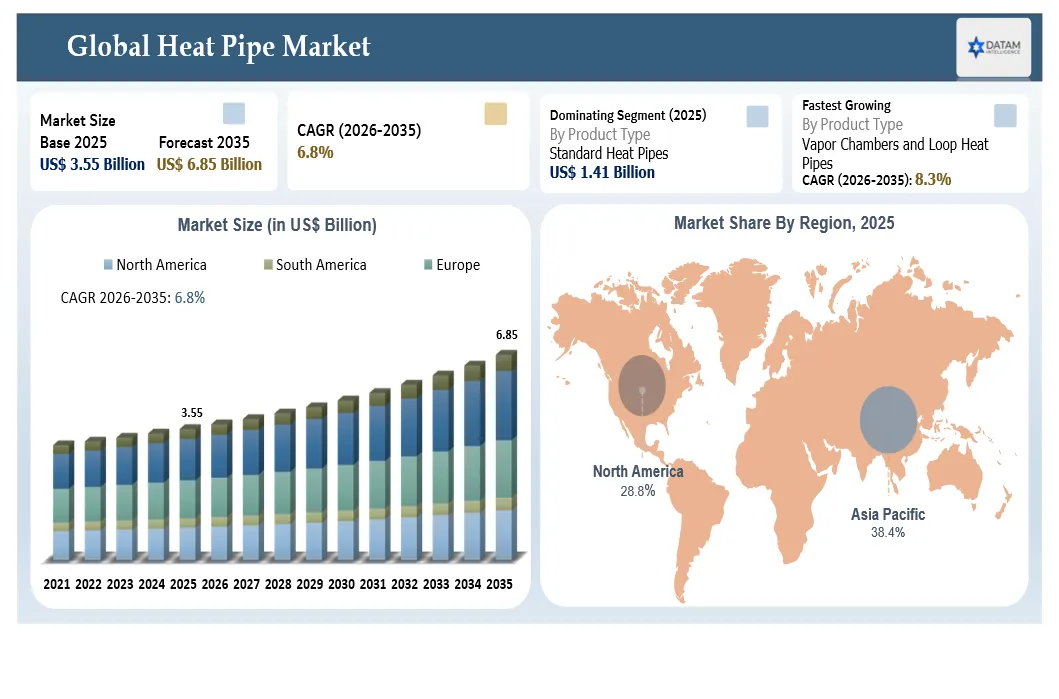
Heat pipes have moved from a hidden component inside notebooks and telecom equipment into a strategic thermal architecture. Rising chip power, thinner device packages and multi-die processors require low thermal resistance across larger footprints. Vapor chambers and embedded heat spreaders are gaining value in high-performance computing, while loop and oscillating heat pipes are expanding in aerospace, defense and harsh-environment systems where reliability and weight are critical.
Asia-Pacific leads through electronics manufacturing, component supply chains and large-scale thermal-module production. North America is expected to grow fastest due to AI infrastructure, defense electronics, spacecraft programs and advanced cooling investment. Competition centers on wick engineering, manufacturing yield, fluid cleanliness, vacuum integrity, thermal performance, package thickness and the ability to co-design assemblies with OEM platforms.
| Metric | 2025 | 2035 | Strategic Reading |
| Market size | US$ 3.55 Billion | US$ 6.85 Billion | Passive two-phase cooling moves from specialist applications into broader thermal infrastructure. |
| CAGR | - | 6.8% | Growth is strongest where heat density rises faster than conventional air-cooling capability. |
| Largest region | Asia-Pacific, 38.4% | Asia-Pacific | Manufacturing scale and electronics demand support leadership. |
| Fastest-growing region | North America | North America | AI data centers, power electronics and advanced thermal engineering support premium demand. |
| Largest product | Standard Heat Pipes | Standard Heat Pipes | Established design base and broad industrial use preserve scale. |
| Fastest-growing product | Vapor Chambers and Loop Heat Pipes | Vapor Chambers and Loop Heat Pipes | Flexible layouts and higher transport capacity improve adoption in compact systems. |
Heat Pipe Market Key Takeaways
- Asia-Pacific held the largest share in 2025 because China, Taiwan, Japan and South Korea concentrate notebook, smartphone, server and thermal-module manufacturing.
- Standard cylindrical heat pipes remain the largest product category, while vapor chambers and loop heat pipes are growing faster in high-power applications.
- AI accelerators and dense server platforms are increasing demand for larger vapor chambers, embedded spreaders and hybrid heat-pipe assemblies.
- Aerospace and space applications favor high-reliability loop, variable-conductance and oscillating heat pipes with extensive qualification requirements.
- Copper-water systems dominate mainstream electronics, while aluminum-ammonia, stainless-steel and alkali-metal combinations serve specialized temperature ranges.
- Thermal design wins occur early in the OEM development cycle, making co-engineering and prototype speed important commercial advantages.
- Competition from cold plates and direct liquid cooling is increasing, but heat pipes remain valuable for local spreading, backup heat transport and hybrid architectures.
- Future leadership will depend on thin-form-factor manufacturing, orientation tolerance, higher heat flux, automated testing and regional supply resilience.
Heat Pipe Industry Trends and Strategic Insights
- Vapor chambers are replacing multiple discrete heat pipes where uniform spreading across CPUs, GPUs, memory and power stages is required.
- Oscillating heat pipes are moving from research into space, defense and high-flux electronics because they can offer lightweight, orientation-flexible thermal transport.
- Data center designs increasingly combine heat pipes or vapor chambers at the device level with cold plates, coolant distribution units and facility water loops.
- Additive manufacturing, topology optimization and advanced wick fabrication are enabling shapes that were difficult to produce with conventional tubing and brazing.
- Suppliers are increasing automated leak testing, fluid charging, vacuum processing and thermal validation to improve yields at higher production volumes.
- OEMs are evaluating graphite, aluminum, titanium and composite structures to reduce weight while maintaining thermal performance and mechanical durability.
Heat Pipe Market Scope
| Metrics | Details |
| 2025 Market Size | US$ 3.55 Billion |
| 2035 Projected Market Size | US$ 6.85 Billion |
| CAGR (2026-2035) | 6.8% |
| Largest Market | Asia-Pacific |
| Fastest-Growing Market | North America |
| By Product Type | Standard Heat Pipes, Vapor Chambers, Loop Heat Pipes, Oscillating/Pulsating Heat Pipes, Variable-Conductance and Other Heat Pipes |
| By Wick Structure | Sintered Powder, Grooved, Mesh/Screen, Composite/Fiber and Wickless Designs |
| By Working Fluid | Water, Ammonia, Methanol/Acetone/Methanol, Acetone and Hydrocarbons, Alkali Metals and Specialty Fluids |
| By Material | Copper, Aluminum, Stainless Steel/Nickel Alloys, Titanium, Graphite and Composites |
| By Application | Electronics, Data Centers, Aerospace and Spacecraft Thermal Control, Refrigeration, Geothermal, Solar Thermal and Others |
| Report Insights Covered | Market Size, Share, Growth, Technology, Competitive Landscape and Country-Level Opportunity |
Why does this report matter in 2026?
The year 2026 is an important transition point for the heat pipe market because thermal-management requirements are changing faster than traditional cooling architectures can be redesigned. AI data centers are increasing rack and component heat density, power electronics are moving toward more compact packages and industrial users are seeking lower auxiliary power consumption. Heat Pipes offer a way to move heat through phase change and gravity rather than continuous pumping, making them relevant to both energy efficiency and reliability.
The report matters because heat pipe demand is not a single homogeneous market. Product economics differ sharply between low-cost tubular devices, precision electronics assemblies, large industrial heat exchangers, geothermal installations and data center systems. Each application has a different operating temperature, orientation, pressure, fluid, material, certification and lifetime requirement. The study separates these opportunity pools so suppliers can identify where standardized products are sufficient and where engineering-intensive custom systems create higher value.
Strategic timing is also important. Decisions made in 2026 on refrigerant platforms, brazing and welding capability, simulation tools, data center partnerships and regional manufacturing will influence competitive position for the remainder of the decade. The market remains fragmented enough for specialists to build strong niches, but qualification expectations are rising. This report supports portfolio prioritization, partner selection, technology investment and country-level market entry.
Heat Pipe Market White Space & Investment Opportunities
- Ultra-thin vapor chambers for foldable devices, edge AI hardware and compact industrial electronics.
- High-capacity loop heat pipes for satellite constellations, lunar systems and long-duration defense platforms.
- Oscillating heat-pipe spreaders for multi-chip modules, power electronics and orientation-variable equipment.
- Hybrid device-level solutions that combine vapor chambers with cold plates or immersion-compatible thermal interfaces.
- Regional manufacturing, and qualification capacity in North America and Europe for defense, aerospace and sovereign compute supply chains.
- High-temperature heat pipes for waste heat recovery, nuclear systems, concentrated solar and advanced industrial processes.
Heat Pipe Future Market Transformation
The market is expected to transform from a collection of specialist passive components into a broader two-phase thermal-management ecosystem. Data center and electronics customers will increasingly evaluate heat pipes as part of integrated heat pathways that include cold plates, manifolds, heat exchangers, controls and heat rejection. Product selection will therefore move beyond nominal thermal resistance to include transient behavior, orientation tolerance, serviceability, leak detection, and compatibility with facility infrastructure.
Manufacturing will become more data driven. Suppliers will use simulation, automated charge control, inline leak testing and digital quality records to reduce variation. Additive manufacturing and advanced joining may enable complex evaporator geometries, thinner walls and integrated manifolds. At the same time, working-fluid regulation will accelerate redesign toward lower environmental impact without compromising pressure safety, flammability limits or material compatibility.
By 2035, competitive portfolios are likely to combine standard components with application engineering, thermal modeling and qualification services. Large HVAC and heat-exchanger companies may acquire or partner with specialist heat pipe developers to broaden data center and industrial offerings. The strongest suppliers will own the pathway from heat-source characterization to validated field performance rather than competing only on the unit price of a tube or module.
Heat Pipe Market Buyer Decision-Making Criteria
Buyers prioritize thermal capacity, operating range, orientation sensitivity, startup behavior, pressure containment and long-term leak integrity. In electronics and data centers, products must control component temperature under variable load while fitting within strict space, weight and maintenance constraints. Industrial users additionally consider corrosion, fouling, cleanability, process isolation and compatibility with plant safety systems.
Total cost of ownership is determined by more than acquisition price. Buyers assess whether passive operation can reduce pump energy, maintenance, downtime and spare-part inventory. They also evaluate supplier responsiveness, prototype lead time, validation data, customization, regulatory documentation and ability to scale production. For critical systems, proven field references and transparent failure-mode analysis may outweigh a small price advantage.
Heat Pipe Market Economic & Investment Analysis
Economic value in the heat pipe market is created by converting thermal performance into lower energy use, higher equipment density, reduced maintenance or longer asset life. A passive device may carry a higher initial cost than a basic heat sink, yet it can eliminate pumps, controls and service requirements. In data centers and electronics, improved heat removal can protect expensive computing or power devices and support greater output from the same footprint. In industrial systems, heat recovery can reduce fuel demand and operating cost.
Investment models should distinguish component volume from engineered-system value. Standard copper or aluminum devices compete on manufacturing efficiency and channel reach, while loop systems, pressure-rated heat exchangers and geothermal installations require application engineering and project execution. Suppliers that combine hardware with simulation, testing and integration can achieve stronger margins and customer retention. Capital priorities include precision fabrication, vacuum charging, leak detection, joining, pressure testing and low-GWP fluid handling.
Market forecasts should also separate new equipment from replacement and retrofit demand. Data center and electronics growth is linked to new platforms, whereas industrial and refrigeration markets include maintenance-driven replacement. Geothermal and infrastructure projects can be lumpy and require milestone-adjusted forecasting. Investors should evaluate customer concentration, qualification duration, working-fluid exposure, raw-material sensitivity and the ability to reuse a core technology across multiple applications.
Strategic value is highest for companies that own differentiated geometry, application data, process control and customer design relationships. Intellectual property can support advantage, but repeatable manufacturing and validation are equally important. Partnerships with OEMs, universities, test laboratories and heat-exchanger firms can reduce commercialization risk. Long-term returns will favor platforms that address multiple heat-load ranges and can be manufactured regionally near major electronics, data center and industrial customers.
Heat Pipe Investment Trends in the Market
- Capital is moving toward vapor chamber capacity for AI servers, gaming systems and high-performance consumer devices.
- Aerospace and defense suppliers are investing in clean manufacturing, welding, charging and test infrastructure for mission-critical heat pipes.
- Oscillating heat-pipe companies are receiving greater commercial attention after accumulating flight heritage and demonstrating orientation tolerance.
- Material investment is focused on thin copper, aluminum, graphite composites, sintered wick powders and corrosion-resistant alloys.
- Thermal suppliers are expanding co-design teams and regional application laboratories to shorten OEM qualification cycles.
- Partnerships increasingly link component specialists with automotive, data center and industrial thermal-system integrators.
Strategic Indicators for Heat Pipe Market
High Regulation Impact
Pressure equipment rules, refrigerant regulation, flammability classifications, transport requirements and industry-specific certification influence product design. Suppliers must document working-fluid charge, maximum allowable pressure, joining quality, material compatibility and safe end-of-life handling. Low-GWP transitions create opportunity, but they also require new testing and customer requalification.
High Investment Activity
Investment is rising around data center liquid cooling, power electronics and thermal-management integration. Heat Pipe specialists can benefit where passive two-phase transport complements cold plates and facility loops. Capital remains selective, favoring platforms with validated performance, manufacturable designs and clear OEM partnerships.
Supply Chain Disruption
Copper, aluminum, stainless steel, specialty tubing, valves and refrigerants can face price or availability changes. Production also depends on skilled joining, vacuum equipment and testing capacity. Suppliers are qualifying alternate materials, regional vendors and flexible production cells to reduce delivery risk.
Pricing Volatility
Pricing varies from standardized heat-pipe components to customized pressure-rated systems. Raw-material movements influence basic products, while engineering hours, testing and low-volume fabrication dominate custom-system economics. Multi-year supply agreements and design standardization can reduce volatility.
Procurement Pressure
Large OEMs seek cost reduction, shorter qualification cycles and regional supply. Critical infrastructure buyers demand documentation, service support and proven reliability. Suppliers must balance customization with modular platforms that reduce engineering cost and lead time.
New Technology Adoption
Advanced simulation, additive manufacturing, microstructured evaporators, low-GWP fluids, multi-evaporator loops and embedded sensing are changing the market. Adoption is fastest when new technology improves heat density without creating unfamiliar maintenance or safety requirements.
Regional Expansion Opportunity
Asia-Pacific provides scale in electronics and manufacturing, North America offers premium data center and defense demand, while Europe supports industrial efficiency and refrigerant transition. Local engineering support is important because heat pipe design remains application specific.
Government Policy Support
Energy-efficiency standards, data center sustainability targets, industrial decarbonization programs and geothermal incentives can expand demand. Policy support is indirect but meaningful because heat pipes reduce auxiliary power and improve heat recovery.
Pricing Intelligence
Suppliers should segment pricing by thermal capacity, working fluid, material, pressure class, customization, testing and annual volume. Value-based pricing is strongest where passive cooling prevents downtime or eliminates mechanical equipment.
AI Impact Analysis of Heat Pipe Market
AI can accelerate heat pipe design by combining computational fluid dynamics, experimental data and optimization algorithms. Models can evaluate geometry, filling ratio, working fluid, orientation and condenser conditions across thousands of design combinations. This reduces prototype cycles and helps suppliers identify operating limits such as dry-out, flooding, startup delay and unstable circulation before physical testing.
AI-enabled monitoring can also support field reliability. Temperature, pressure and vibration data can be used to detect performance drift, refrigerant loss, fouling or abnormal heat load. In data centers and industrial systems, digital twins can connect component behavior to facility conditions and improve control of hybrid passive-active cooling systems. Adoption will depend on validated models, high-quality sensor data and protection of customer design information.
Disruption Analysis of Heat Pipe Market
Heat Pipes are disrupting conventional thermal systems by moving heat without continuous mechanical pumping. This can reduce auxiliary energy, eliminate moving parts and simplify maintenance. The effect is strongest in sealed electronics, remote equipment, geothermal installations and systems where reliability is more valuable than active control flexibility.
The market is also being disrupted by higher heat density and low-GWP regulation. Data center cooling is moving toward direct liquid and two-phase architectures, creating opportunities for loop heat pipes while increasing competition from pumped cold plates, immersion systems and advanced refrigeration cycles. Suppliers must therefore demonstrate where passive phase-change transport creates a superior combination of performance, cost and reliability.
Heat Pipe Market BCG Matrix: Company Evaluation
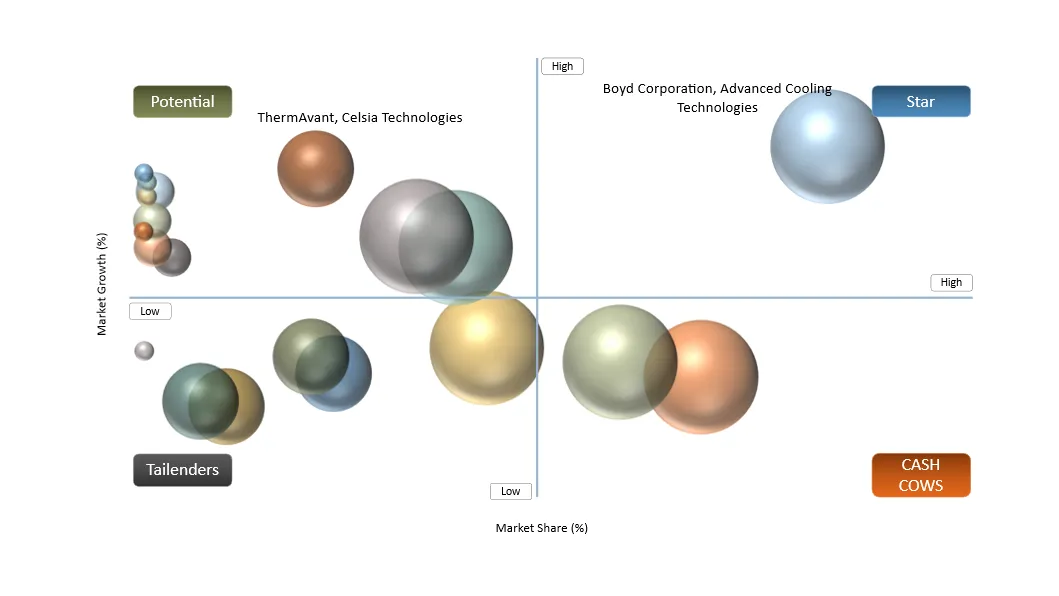
| BCG Position | Illustrative Companies | Rationale |
| Stars | Boyd Corporation, Advanced Cooling Technologies, Fujikura | Strong thermal-engineering capability, broad application reach and exposure to high-growth electronics and data center demand. |
| Potential | ThermAvant, Celsia Technologies, Calyos, Noren Thermal | Specialized materials or thermal platforms with opportunities to scale into higher-value integrated systems. |
| Cash Cows | Delta Electronics, Cooler Master, Parker Hannifin | Established heat-transfer and industrial customer bases provide stable revenue and channel strength. |
| Tailenders | Small regional fabricators and single-application suppliers | Limited scale, narrow qualification base and high dependence on local project demand constrain growth. |
Boyd Corporation and Advanced Cooling Technologies are positioned as Stars because they combine specialist two-phase thermal knowledge with access to electronics, aerospace, defense and data center customers. Established heat-exchanger companies are Cash Cows because their broad installed base and manufacturing scale create recurring demand, although heat pipes may represent only part of their portfolios. Potential players can move upward by integrating materials, simulation and application engineering into qualified systems.
Heat Pipe Market Dynamics
Driver Impact Analysis
| Driver | Market Growth Impact | Demand Concentration | Impacted Use Case | Strategic Impact |
Rising chip and power density | High | AI servers, GPUs and power electronics | Heat spreading and passive transport | Expands demand for loop and integrated two-phase systems. |
| Device miniaturization | High | Consumer and medical electronics | Ultra-thin vapor chambers | Improves lifecycle economics and sustainability positioning. |
Space and defense investment | Medium-High | Satellites, radar and avionics | Loop and variable-conductance heat pipes | Favors systems with no moving parts and long service life. |
EV power electronics growth | Medium | Inverters and charging systems | Compact, vibration-resistant cooling | Creates requalification demand and new product platforms. |
Driver: Rising Heat Density Creates a New Thermal-Management Requirement
The most important driver is the increase in heat generated within a smaller footprint. AI accelerators, optical networking equipment, power semiconductors, batteries and industrial electronics can exceed the practical capability of conventional air cooling. Heat Pipes use latent heat to move large thermal loads with a small temperature difference. Loop designs allow evaporators to be placed directly at the heat source while condensers connect to remote air or liquid heat sinks. This supports denser equipment and can reduce fan or pump energy.
Restraint Impact Analysis
| Restraint | Drag on Market Growth | Primary Impact Area | Impacted Use Case | Strategic Impact |
Qualification and design-win cycles | High | OEM commercialization | Custom thermal integration | Requires orientation-tolerant designs or alternative cooling methods. |
Heat-transport limits | High | Extreme heat flux | Dry-out and boiling management | Lengthens sales cycles and raises engineering cost. |
Material and yield pressure | Medium-High | Manufacturing economics | Thin vapor chambers and aerospace parts | Requires redesign around pressure, flammability and environmental rules. |
Competition from active cooling | Medium | Technology selection | Cold plates, immersion and pumped loops | Limits adoption where precise control or heat rejection requires pumping. |
Restraint: Qualification Complexity and Competition from Active Cooling
Gravity return is central to many heat pipe designs, which means performance can decline when equipment is tilted, horizontal or exposed to varying acceleration. Loop and capillary-assisted designs can reduce this limitation, but they add engineering complexity. OEMs also require validation across startup, shutdown, transient load, transport, shock, vibration and lifetime conditions. Each new working fluid, geometry or material combination may require extensive testing. These factors extend design cycles and favor suppliers with strong laboratories and application engineering.
Heat Pipe Market Segment Analysis
The global heat pipe market is segmented by product type, wick structure, working fluid, material, application, end-use industry, and region.
By Product Type
Standard Heat Pipes Will Retain the Largest Volume Base
Standard cylindrical heat pipes will remain the largest product segment because they are cost-effective, scalable and widely integrated into notebooks, desktops, telecom equipment, industrial controls and power electronics. Their mature copper-water architecture supports high manufacturing yields and broad supplier availability. Vapor chambers will gain share where heat must be spread across larger areas, while loop and oscillating heat pipes will grow faster in aerospace, AI and high-flux applications. Product selection depends on geometry, temperature range, orientation, heat transport distance and allowable thickness.
By Wick Structure
Sintered Powder Wicks Will Lead High-Performance Applications
Sintered powder wicks will lead high-performance electronics because their fine pore structure produces strong capillary pressure and supports operation across variable orientations. Grooved wicks remain attractive for lower cost and low pressure drop, while mesh and composite structures provide design flexibility. Wick engineering is increasingly important as devices become thinner and heat flux rises. Suppliers must balance permeability, capillary pressure, vapor space, manufacturing consistency and fluid compatibility to avoid dry-out or startup instability.
By Working Fluid
Water Will Remain the Largest Working-Fluid Segment
Water will remain the dominant working fluid because copper-water heat pipes provide excellent latent heat transport across common electronics temperature ranges. Ammonia is important in aluminum space and cold-environment systems, while methanol, acetone and hydrocarbons serve lower-temperature applications. Sodium, potassium and other alkali metals support high-temperature industrial and energy systems. Fluid selection must consider vapor pressure, freezing behavior, compatibility, toxicity, flammability and long-term stability.
By Material
Copper Will Retain Leadership in Electronics and Compact Systems
Copper will retain leadership due to its high thermal conductivity, manufacturability, compatibility with water and established electronics supply chain. Aluminum provides lower weight and is important in aerospace, automotive and larger vapor chambers, though fluid compatibility and joining require careful control. Stainless steel, nickel alloys and titanium serve corrosive, high-pressure or high-temperature environments. Graphite and composite structures are emerging where weight and in-plane spreading are critical.
By Application
AI Servers and High-Performance Electronics Will Record the Fastest Growth
AI servers and high-performance electronics will record the fastest growth as processor power rises and thermal spreading becomes a primary design constraint. Vapor chambers, embedded heat pipes and hybrid assemblies distribute heat from GPUs, CPUs, memory and power components toward cold plates or air-cooled fin stacks. Consumer electronics will remain the largest volume application. Aerospace, EV power electronics and medical equipment offer higher-value opportunities because reliability, weight and qualification requirements support premium pricing.
By End-Use Industry
Data Centers and Aerospace Will Become the Most Strategic Growth Sintered Powder Wicks
Data centers and aerospace will become the most strategic growth verticals. Data center demand is driven by AI accelerators and dense compute platforms, while aerospace demand reflects satellite constellations, radar, avionics and long-duration missions. Consumer electronics remains the largest shipment base, automotive adoption expands with inverters and onboard chargers, and industrial systems use heat pipes to protect controls and improve heat recovery. Suppliers with both high-volume manufacturing and mission-critical qualification capabilities will have the strongest portfolio resilience.
Heat Pipe Market Geographical Penetration
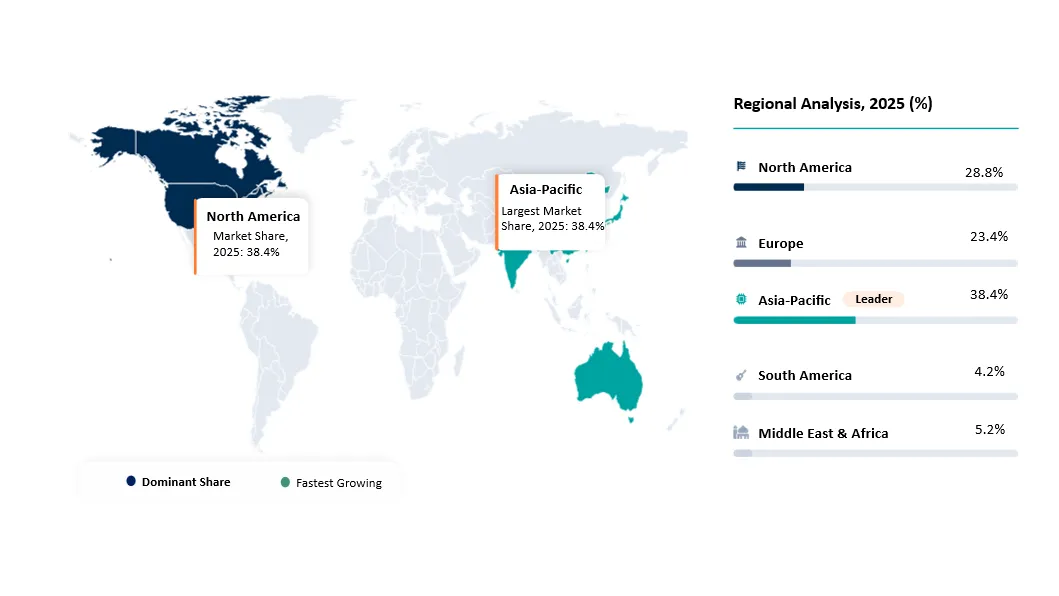
Heat Pipe Market Regional Share by 2025
| Region | Market Share 2025 | Growth Position | Primary Demand Drivers |
| North America | 28.8% | Fastest Growing | AI data centers, aerospace, defense electronics and advanced manufacturing |
| Europe | 23.4% | Established | Industrial electronics, automotive engineering and aerospace programs |
| Asia-Pacific | 38.4% | Largest | Consumer electronics, servers, telecom and component manufacturing |
| South America | 4.2% | Emerging | Industrial electronics, mining equipment and telecom expansion |
| Middle East and Africa | 5.2% | Emerging | Data centers, defense, telecom and energy infrastructure |
U.S. Heat Pipe Market Landscape
The U.S. is the largest national premium market because it combines hyperscale data center investment, defense and aerospace electronics, power-semiconductor development and advanced thermal-engineering suppliers. Demand is moving from conventional heat pipes toward loop and integrated two-phase systems for servers, optics and power conversion. The country also supports geothermal and industrial heat-recovery applications. Growth depends on OEM qualification, domestic manufacturing, low-GWP design and integration with liquid-cooling infrastructure.
Germany Heat Pipe Market Outlook
Germany is a leading European market through industrial automation, chemicals, power electronics, automotive engineering and energy-efficiency investment. Heat Pipe heat exchangers can support waste-heat recovery and enclosure cooling, while low-GWP rules influence working-fluid selection. Buyers expect strong technical documentation, pressure compliance and long service life. Opportunity is strongest for suppliers that can partner with machinery, refrigeration and process-equipment OEMs.
Japan Heat Pipe Market Trends
Japan has deep expertise in electronics thermal management, heat pipes, refrigeration and precision manufacturing. Demand is supported by semiconductor equipment, telecom systems, transportation electronics and compact industrial machinery. Local customers value miniaturization, quality consistency and long-term reliability. Partnerships with Japanese OEMs can create durable positions, but qualification standards and established supplier relationships raise entry barriers.
China Heat Pipe Market Outlook
China is the largest manufacturing base for many heat pipe components and integrated thermal products. Electronics, data centers, EV power systems, refrigeration and industrial equipment generate substantial volume. Competition is intense in standardized products, while higher-value opportunities are emerging in loop systems, advanced materials and liquid-cooled AI infrastructure. Suppliers must balance cost, intellectual-property protection, local engineering and rapid production scale.
India Heat Pipe Market Outlook
India is an emerging growth market supported by data center construction, telecom expansion, industrial refrigeration, power electronics and renewable-energy investment. Local manufacturing remains fragmented, creating opportunity for technology partnerships and regional assembly. Price sensitivity is high, but energy savings and reduced maintenance can support adoption in critical applications. Engineering support and local testing capability will be important for market development.
Middle East and Africa Heat Pipe Market Outlook
The region offers opportunities in data centers, oil and gas, refrigeration, solar thermal, remote equipment and geothermal resources. High ambient temperatures increase the need for effective heat rejection, which means heat pipes often operate within hybrid systems rather than as standalone solutions. Gulf countries provide premium infrastructure demand, while East African geothermal development creates specialized project opportunities. Local service capacity and environmental qualification remain important constraints.
Heat Pipe Market Competitive Landscape
- Competition is fragmented across heat-pipe specialists, heat-exchanger manufacturers, HVAC companies, materials suppliers and custom thermal-engineering firms.
- Boyd Corporation and Advanced Cooling Technologies have strong positions in engineered two-phase solutions for electronics, aerospace, defense and data center applications.
- Large heat-exchanger companies such as Alfa Laval, Kelvion and Modine benefit from manufacturing scale, industrial channels and system-integration capability.
- Asian suppliers compete effectively in standardized copper and aluminum components, while premium markets depend on qualification data, customization and reliability evidence.
- Differentiation increasingly depends on operating envelope, orientation tolerance, working-fluid compliance, leak integrity, simulation capability and prototype speed.
- Partnerships with server OEMs, cooling-system integrators, semiconductor companies and industrial EPC firms are becoming central to market access.
Competitive intensity will increase as data center thermal management becomes a strategic growth market for large HVAC and infrastructure groups. Specialist heat pipe firms can defend their position through application knowledge, proprietary designs and rapid customization. Larger companies can scale complete systems and global service. This creates a likely pattern of partnerships, acquisitions and technology licensing. Market share will remain application specific rather than concentrated in one global leader.
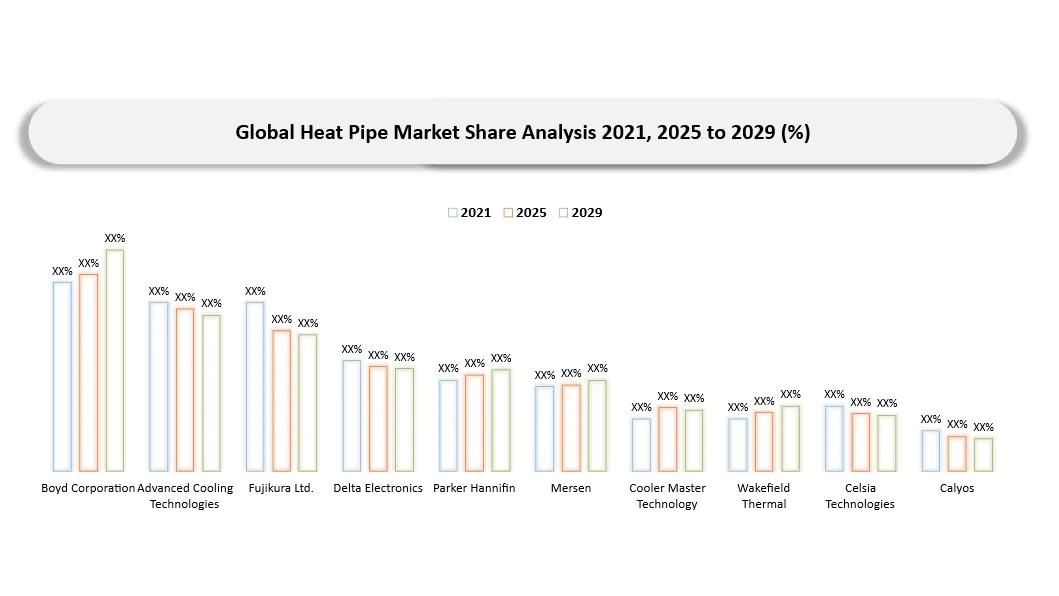
Key Companies of Heat Pipe Market
- Boyd Corporation
- Advanced Cooling Technologies
- Fujikura Ltd.
- Delta Electronics
- Cooler Master Technology
- ThermAvant Technologies
- Wakefield Thermal
- Celsia Technologies
- Noren Thermal Solutions
- Aavid Thermalloy
- Parker Hannifin
- Mersen
- DAU GmbH & Co. KG
- Novark Technologies
- Acrolab Ltd.
- Atherm
- Innergy Tech
- Nanjing Shengnuo Heat Pipe
- Rego Electronics
- Calyos
Heat Pipe Market Major Pain Points
- High sensitivity to wick quality, fluid purity and vacuum integrity.
- Long OEM design-win and qualification cycles for custom assemblies.
- Dry-out, sonic, entrainment and boiling limits at extreme heat loads.
- Orientation and startup constraints in certain geometries and working fluids.
- Copper and specialty-material price volatility affecting margins.
- Competition from cold plates, immersion cooling and thermoelectric solutions.
- Difficulty producing ultra-thin vapor chambers with consistent yield.
- Need for traceable testing and long-life reliability in aerospace and defense.
Heat Pipe Market Recent Developments
- July 2026: Advanced Cooling Technologies announced more than US$ 5 million of capital investment in Lancaster, Pennsylvania, including expanded constant-conductance heat-pipe production and capacity for space, defense and AI data center programs.
- June 2026: Valeo and Calyos signed an agreement to develop and industrialize passive two-phase loop heat-pipe cooling for data center chips and mobility power electronics.
- April 2026: ThermAvant Technologies reported that its oscillating heat pipes had surpassed ten million cumulative on-orbit operating hours across commercial, defense and government missions.
- January 2026: NASA TechPort reported completion of a development project using pulsating heat-pipe thermal planes for modular space power electronics, with the design offering lower weight than conventional spreaders.
- March 2026: Research published in the International Journal of Heat and Mass Transfer demonstrated a topology-optimized flat-plate oscillating heat pipe that reduced evaporator temperature by 13.1°C versus a solid aluminum plate at high heat flux.
Analyst View / Opinion on Heat Pipe Market
The heat pipe market is entering a durable expansion phase because thermal loads are increasing while customers seek lower energy use and fewer mechanical failure points. The strongest near-term opportunity is not a universal replacement of pumped cooling. It is the use of passive two-phase transport within hybrid systems where heat pipes move heat from difficult locations to larger facility or equipment-level heat sinks.
- Two-phase closed heat pipes will preserve the largest installed base, while loop systems will capture the fastest growth in data centers and power electronics.
- Application engineering will remain the central source of competitive advantage because performance depends on geometry, orientation, fluid, material and operating conditions.
- Low-GWP fluid transition will create redesign demand and favor suppliers with testing, pressure-safety and regulatory capability.
- Asia-Pacific will lead volume, while North America will provide high-value growth through AI infrastructure and advanced electronics.
- Suppliers should build modular platforms that shorten qualification without eliminating customization.
- Long-term leadership will depend on validated reliability, scalable manufacturing and integration into broader thermal-management ecosystems.
Heat Pipe Market Target Audience
| Industry | Who Should Buy This Report? | Reason to Buy This Report |
| Thermal Equipment | Product leaders, engineering teams and strategy executives | Assess product segments, technologies, pricing and growth applications. |
| Data Centers | Cooling architects, operators and infrastructure suppliers | Evaluate passive and hybrid two-phase cooling opportunities. |
| Electronics OEMs | Thermal engineers, sourcing teams and platform designers | Compare wick structures, materials, working fluids and supplier capability. |
| Industrial & Energy | Plant managers, EPC firms and process engineers | Identify heat-recovery, refrigeration and reliability opportunities. |
| Materials & Refrigerants | Metal suppliers, fluid producers and component makers | Understand design shifts, compliance and qualification requirements. |
| Investors & Consulting | Private equity, venture capital and strategy consultants | Evaluate market size, competition, investment themes and white spaces. |
| Government & Research | Energy agencies, laboratories and academic institutions | Assess efficiency, geothermal, low-GWP and technology-development priorities. |
Why Choose DATAM?
- Data-driven insights combining market sizing, installed-base analysis, project demand, pricing and country-level opportunity.
- Post-purchase analyst consultations for technology assessment, partner identification and market-entry planning.
- Annual report updates covering product launches, acquisitions, regulation, projects and competitive changes.
- Specialized focus on emerging applications and regional manufacturing ecosystems rather than generalized summaries.
- Actionable analysis linking heat pipe technology with customer qualification, manufacturing and investment decisions.
What DATAM Uniquely Provides
- Ten-year forecasts across product type, wick structure, working fluid, material, application, end-use industry and region.
- Application-specific analysis separating electronics, data centers, industrial heat recovery, refrigeration and geothermal demand.
- Buyer-focused assessment of thermal capacity, orientation, pressure, materials, fluid compliance and lifetime reliability.
- Competitive analysis covering specialists, industrial heat-exchanger companies and large thermal-management groups.
- Country-level views connecting manufacturing capability, end-use investment and technology adoption.
- Strategic recommendations for partnerships, qualification, regional expansion and portfolio development.
Questions This Report Answers
- How will the global heat pipe market evolve from 2025 through 2035?
- Which heat-pipe types, wick structures and applications offer the strongest growth?
- How will AI servers, aerospace platforms and EV power electronics reshape passive two-phase cooling demand?
- Which material, fluid and qualification requirements will influence product design?
- Where are the strongest opportunities in vapor chambers, loop heat pipes and oscillating heat pipes?
- How should suppliers balance standard products with application-specific co-design?
- Which regions offer the best combination of manufacturing scale and premium demand?


























































