


The FDA’s planned January 2027 expansion comes as Sandoz, Samsung Bioepis, Celltrion and other pharmaceutical manufacturers intensify competition in next-generation biosimilars, bringing development costs, regulatory efficiency and international commercialization into sharper focus.
The US Food and Drug Administration (FDA) has announced its Global Reliance Disclosure Program (GRDP), a significant regulatory initiative that could reshape how pharmaceutical companies approach international drug approvals, market expansion and patient access.
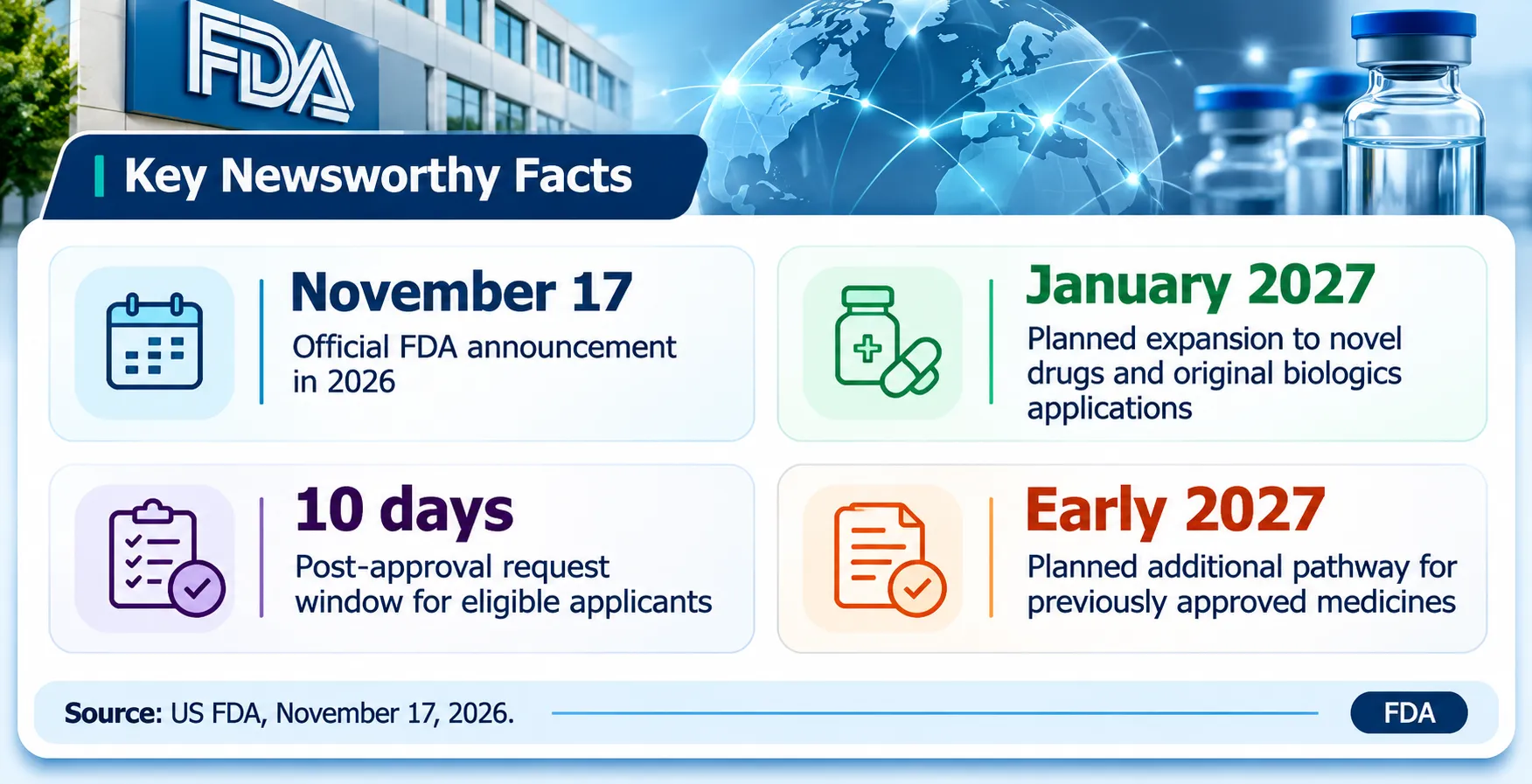
Announced on November 17, 2026, the program enables pharmaceutical companies to share detailed FDA regulatory assessments with foreign health authorities, potentially reducing duplication in regulatory reviews and improving international approval efficiency.
The FDA intends to expand the initiative in January 2027 to eligible novel drugs and original biologics, creating new opportunities for pharmaceutical companies pursuing international commercialization.
Although biosimilars are not explicitly included in the announced expansion, the initiative arrives at a particularly important time for the global biosimilars industry. Separate regulatory reforms, upcoming biologic patent expirations, manufacturing investments and cross-border licensing agreements are already reshaping competitive dynamics across the United States, Japan and South Korea.
For pharmaceutical executives, the emerging question is whether increasingly coordinated regulatory frameworks could eventually change the economics of global biosimilar development and commercialization.
Request Executive Sample: https://www.datamintelligence.com/download-sample/biosimilars-market
FDA Global Reliance Disclosure Program: What Changes in January 2027?
The GRDP began on October 30, 2026, with a tentative approval involving lenacapavir under the President’s Emergency Plan for AIDS Relief (PEPFAR).
The initiative is intended to make detailed FDA approval documentation available to eligible applicants for use in international marketing applications. Foreign regulators can consider the FDA’s assessments while retaining independent authority over their approval decisions.
| Regulatory Parameter | Program Details |
| Official announcement | 17-Nov-26 |
| Initial launch | 30-Oct-26 |
| First participating medicine | Lenacapavir |
| Planned expansion | Jan-27 |
| Expanded eligibility | New molecular entity drugs and Section 351(a) biologics |
| Participation request window | Within 10 calendar days of approval |
| Additional pathway | Planned for previously approved medicines in early 2027 |
| Section 351(k) biosimilars | Not explicitly included in the announced January expansion |
Source: US FDA, November 17, 2026.
For multinational pharmaceutical companies, greater access to regulatory assessments could support more coordinated submission strategies and potentially reduce repetitive regulatory work.
However, the program does not establish automatic international drug approval, nor does it eliminate country-specific evidence, safety, quality or market-access requirements.
Are Biosimilars Included in the FDA’s Global Reliance Disclosure Program?
The distinction between original biologics and biosimilars is central to understanding the commercial implications of the announcement.
Original biological products generally receive FDA licensure through Section 351(a) of the Public Health Service Act. Biosimilars follow the abbreviated Section 351(k) pathway, which requires manufacturers to demonstrate biosimilarity to an existing reference biological product.
The FDA’s announced January 2027 GRDP expansion specifically identifies new molecular entity applications and Section 351(a) biologics applications.
Section 351(k) biosimilar applications have not been explicitly included.
Nevertheless, the broader movement toward regulatory reliance raises important strategic questions for biosimilar developers, particularly as scientific advances and accumulated regulatory experience support the reassessment of traditional development requirements.
Any future inclusion of biosimilars would require additional regulatory clarification. Companies should therefore distinguish current regulatory opportunities from potential future policy developments when planning investments and international submissions.
FDA Biosimilar Regulatory Reforms: Could Development Costs Fall by Millions of Dollars?
The GRDP announcement follows several separate FDA initiatives aimed at improving biosimilar development efficiency.
In March 2026, the FDA issued draft recommendations intended to reduce unnecessary clinical pharmacokinetic (PK) testing where supported by scientific evidence.
The agency estimated that the proposed changes could reduce relevant PK study expenditure by up to 50%, equivalent to approximately USD 20 million in potential savings.
The recommendations address the circumstances under which developers may use internationally generated clinical evidence and non-US-licensed comparator products without conducting certain additional comparative studies.
These estimated savings relate specifically to the FDA’s separate biosimilar development initiative and should not be attributed to the GRDP.
Key Numbers Reshaping the Global Biosimilars Industry
| Key Indicator | Strategic Significance |
| Up to USD 20 million | Potential PK study cost savings under FDA proposals |
| Up to 50% | Potential reduction in relevant PK study expenditure |
| USD 998 million | Sandoz biosimilar sales in Q3 2026 |
| 17% | Sandoz Q3 biosimilar sales growth at constant currencies |
| 100+ biosimilars | Sandoz portfolio ambition by 2040 |
| Up to six candidates | Scope of Samsung Bioepis and Teva’s expanded October partnership |
| Jan-27 | Planned expansion of the FDA Global Reliance Disclosure Program |
Sources: US FDA, Sandoz and Samsung Bioepis, 2026.
For biotechnology companies, potential development efficiencies could influence the commercial feasibility of pursuing smaller specialty biologics, complex molecules and therapeutic areas previously considered less attractive because of development expenditure.
However, lower clinical study expenditure does not eliminate the need for robust analytical characterization, manufacturing consistency, regulatory compliance and product quality.
Global Biosimilar Competition Accelerates Ahead of 2027
The FDA’s announcement comes amid significant competitive activity across the international biosimilars industry.
Leading manufacturers are expanding their pipelines beyond established oncology and immunology products into ophthalmology, respiratory diseases, bone health and complex specialty biologics.
Recent financial results, product approvals and licensing agreements indicate that competition is increasingly shifting toward molecule selection, manufacturing efficiency and international commercial execution.
Purchase This Exclusive Report: https://www.datamintelligence.com/buy-now-page?report=biosimilars-market
Additional Benefits:
✅ Get Interactive Dashboard Access (With No Additional Cost)
✅ Three months of analyst support to answer queries related to the report
Recent Biosimilars Industry Developments
| Date | Company or Organization | Development |
| 17-Nov-26 | US FDA | Announced the Global Reliance Disclosure Program and planned expansion |
| 6-Nov-26 | Samsung Bioepis | Presented Phase 3 findings for SB27, a proposed pembrolizumab biosimilar |
| 3-Nov-26 | Samsung Bioepis and Teva | Announced US commercialization rights agreement for two approved immunology biosimilars |
| 28-Oct-26 | Sandoz | Reported USD 998 million in quarterly biosimilar sales, up 17% at constant currencies |
| Oct-26 | US FDA / Xbrane Biopharma | Approved Lucamzi, a ranibizumab biosimilar referencing Lucentis |
| 1-Oct-26 | Samsung Bioepis and Teva | Expanded strategic partnership covering up to six potential biosimilar candidates |
These developments are independent of the FDA’s newly announced reliance program, but collectively illustrate the growing commercial importance of biosimilar portfolio expansion.
Sandoz’s ambition to build a portfolio exceeding 100 biosimilars by 2040 demonstrates the industry's increasingly long-term approach to molecule selection, development investment and international commercialization.
Meanwhile, Samsung Bioepis and Teva’s expanding partnership highlights the importance of combining technical development and manufacturing expertise with established regional pharmaceutical distribution capabilities.
Beyond Humira and Herceptin: Which Molecules Will Define the Next Biosimilar Race?
Historically, much of the biosimilars industry has focused on established reference biologics such as adalimumab, trastuzumab, bevacizumab and rituximab.
The next phase of competition is expanding toward newer high-value oncology, immunology, respiratory and specialty biologics.
Emerging Biosimilar Molecule Opportunity Watchlist
| Reference Molecule | Original Brand | Originator | Therapeutic Area |
| Pembrolizumab | Keytruda | Merck & Co. | Immuno-oncology |
| Nivolumab | Opdivo | Bristol Myers Squibb | Immuno-oncology |
| Dupilumab | Dupixent | Sanofi / Regeneron | Immunology |
| Benralizumab | Fasenra | AstraZeneca | Respiratory diseases |
| Canakinumab | Ilaris | Novartis | Inflammatory disorders |
| Vedolizumab | Entyvio | Takeda | Gastroenterology |
| Omalizumab | Xolair | Genentech / Novartis | Allergy and immunology |
| Aflibercept | Eylea | Regeneron / Bayer | Ophthalmology |
| Denosumab | Prolia / Xgeva | Amgen | Bone health and oncology |
| Eculizumab | Soliris | AstraZeneca / Alexion | Rare diseases |
The watchlist includes molecules with existing biosimilar competition as well as emerging development opportunities. It does not represent a uniform patent-expiry or launch schedule.
Samsung Bioepis’s November 2026 presentation of Phase 3 findings for SB27, its proposed pembrolizumab biosimilar, illustrates the growing industry interest in next-generation immuno-oncology products.
The company is also collaborating with Teva on investigational biosimilars referencing benralizumab and canakinumab, broadening its potential commercial reach beyond traditional oncology and immunology portfolios.
For pharmaceutical strategy leaders, the challenge is not simply identifying biologics approaching loss of exclusivity. It is determining which molecules offer commercially sustainable opportunities after accounting for patent protection, development complexity, competitor density, manufacturing expenditure and expected price erosion.
USA: Regulatory Efficiency Could Shift the Competitive Advantage Toward Commercial Execution
The United States remains a strategically important destination for international biosimilar manufacturers because of its biologic treatment expenditure, established regulatory framework and expanding range of approved products.
Separate FDA initiatives to streamline biosimilar development could potentially reduce certain development barriers, allowing manufacturers to reconsider their portfolio investment strategies.
However, regulatory approval represents only one stage of US commercialization.
Patent litigation, payer negotiations, pharmacy benefit manager relationships, formulary placement, physician confidence and distribution capabilities continue to influence commercial performance.
Samsung Bioepis and Teva’s November agreement involving etanercept and infliximab biosimilars demonstrates how international manufacturers are using partnerships to strengthen their US market presence.
For companies such as Amgen, Pfizer, Sandoz, Celltrion and Samsung Bioepis, future competitive differentiation could increasingly depend on securing sustainable market access rather than simply achieving earlier regulatory approval.
Japan: PMDA’s Biosimilar Regulatory Developments Create New Strategic Opportunities
Japan is also reassessing aspects of biosimilar development in response to advances in analytical technologies and accumulated regulatory experience.
On May 18, 2026, Japan’s Pharmaceuticals and Medical Devices Agency (PMDA) published considerations concerning the necessity of comparative efficacy studies when demonstrating biosimilarity.
Under scientifically justified circumstances, comparative efficacy studies may not be necessary when other evidence sufficiently establishes biosimilarity. Developers are encouraged to engage with PMDA on a case-by-case basis.
This development creates a reason for international pharmaceutical companies to reassess Japanese clinical development strategies, local evidence requirements and regional licensing opportunities.
Japanese companies such as Nippon Kayaku, JCR Pharmaceuticals, Mochida Pharmaceutical, Kyowa Kirin and Fujifilm have relevant capabilities across pharmaceutical commercialization, biologics development and manufacturing.
Potential opportunities include localized licensing, analytical development services, manufacturing partnerships and commercialization of emerging specialty biosimilars.
Japan has not been confirmed as adopting a new GRDP-based approval pathway. Domestic regulatory requirements, National Health Insurance pricing and commercial access considerations remain essential.
South Korea: Samsung Bioepis and Celltrion Expand the Global Biosimilar Competitive Landscape
South Korea has established a significant international presence in biosimilar development, supported by advanced biotechnology manufacturing, clinical development capabilities and global commercialization networks.
Samsung Bioepis and Celltrion are among the country's most prominent biosimilar developers, while companies such as Samsung Biologics contribute to the broader biologics manufacturing ecosystem.
The expansion of Samsung Bioepis’s partnership with Teva demonstrates how South Korean manufacturers are combining product development and manufacturing capabilities with established international sales networks.
Future opportunities for Korean biotechnology companies could increasingly emerge from:
- Next-generation oncology and immunology biosimilars.
- International licensing and commercialization partnerships.
- Complex monoclonal antibody development.
- Manufacturing capacity and process optimization.
- Geographic diversification and export expansion.
- Strategic portfolio positioning around future biologic patent expirations.
For South Korean pharmaceutical executives, regulatory evolution in the United States and Japan could influence global development priorities and commercial partnerships.
Nevertheless, South Korean regulatory authorization remains subject to Ministry of Food and Drug Safety requirements. The FDA’s GRDP announcement does not establish automatic approval or direct regulatory reliance in South Korea.
Global Biosimilars Market Projected to Reach USD 129.29 Billion by 2035
According to DataM Intelligence’s Biosimilars Market assessment, the global industry was valued at USD 34.57 billion in 2025 and is projected to reach USD 129.29 billion by 2035, growing at a CAGR of 14.1% during 2026–2035. Monoclonal antibody biosimilars accounted for 56.8% of the market in 2025, while ophthalmology is projected to grow at a CAGR of 24.5%. Upcoming biologic patent expirations, evolving regulatory requirements and international licensing agreements are expected to create new commercial opportunities, making molecule-level forecasting, competitive pipeline intelligence and country-specific market-access assessment increasingly important for pharmaceutical investment decisions.
What Comes Next for the Global Pharmaceutical Industry?
The FDA’s Global Reliance Disclosure Program introduces another dimension to the international discussion surrounding pharmaceutical regulatory efficiency.
While its announced expansion does not explicitly cover biosimilars, the initiative comes alongside separate developments that could change how biosimilar manufacturers evaluate clinical evidence requirements, development expenditure and international expansion strategies.
Over the coming years, pharmaceutical CEOs, CTOs, regulatory affairs leaders and portfolio strategy executives should closely monitor five developments:
- January 2027 regulatory expansion: Confirmation of the GRDP’s operational scope and international application procedures.
- Biosimilar clinical development requirements: Progress toward finalizing scientifically justified approaches to comparative efficacy and pharmacokinetic studies.
- Next-generation oncology biosimilars: Clinical and regulatory developments involving pembrolizumab and other high-value reference biologics.
- International licensing activity: New commercialization agreements connecting biotechnology developers with regional pharmaceutical distribution networks.
- Manufacturing and market-access economics: The influence of development expenditure, production scale, pricing pressure and reimbursement on future biosimilar profitability.
The next decade of biosimilar competition may be defined less by the number of products receiving approval and more by the ability of manufacturers to identify commercially attractive molecules, develop them efficiently and establish sustainable positions across multiple healthcare markets.
As the FDA prepares for its January 2027 program expansion, the global pharmaceutical industry faces an important strategic question: could greater international regulatory cooperation eventually extend to biosimilars, and which manufacturers would be best positioned to capitalize on such a development?
Frequently Asked Questions
What is the FDA Global Reliance Disclosure Program?
The Global Reliance Disclosure Program is a US FDA initiative that facilitates the sharing of FDA regulatory approval assessments with foreign health authorities to potentially improve international regulatory efficiency and access to medicines.
When will the FDA Global Reliance Disclosure Program expand?
The FDA intends to expand the program in January 2027 to eligible new molecular entity drug applications and original biologics applications submitted under Section 351(a).
Are biosimilars included in the FDA Global Reliance Disclosure Program?
Biosimilars submitted under Section 351(k) have not been explicitly included in the announced January 2027 expansion. Any future extension to biosimilars would require additional regulatory clarification.
Is the FDA reducing biosimilar development costs?
Through a separate draft guidance announced in March 2026, the FDA proposed streamlining certain pharmacokinetic testing requirements. The agency estimated potential savings of up to 50% of relevant PK study costs, or approximately USD 20 million.
Which companies are leading next-generation biosimilar development?
Sandoz, Samsung Bioepis, Celltrion, Amgen, Biocon Biologics, Alvotech and Pfizer are among the prominent participants in the broader biosimilars industry. Their competitive positions vary by therapeutic area, reference molecule and geographic market.
Which biosimilar molecules are attracting pharmaceutical investment?
Emerging development and commercial opportunities include biosimilars referencing pembrolizumab, nivolumab, dupilumab, benralizumab, canakinumab and other high-value biologics. Development feasibility and potential launch dates vary by molecule and jurisdiction.
How could the FDA’s regulatory initiative affect Japan and South Korea?
The initiative could encourage broader discussions concerning international regulatory cooperation. However, Japan and South Korea retain independent regulatory authority, and the FDA announcement does not establish automatic approvals or confirmed new reliance pathways in either country.