


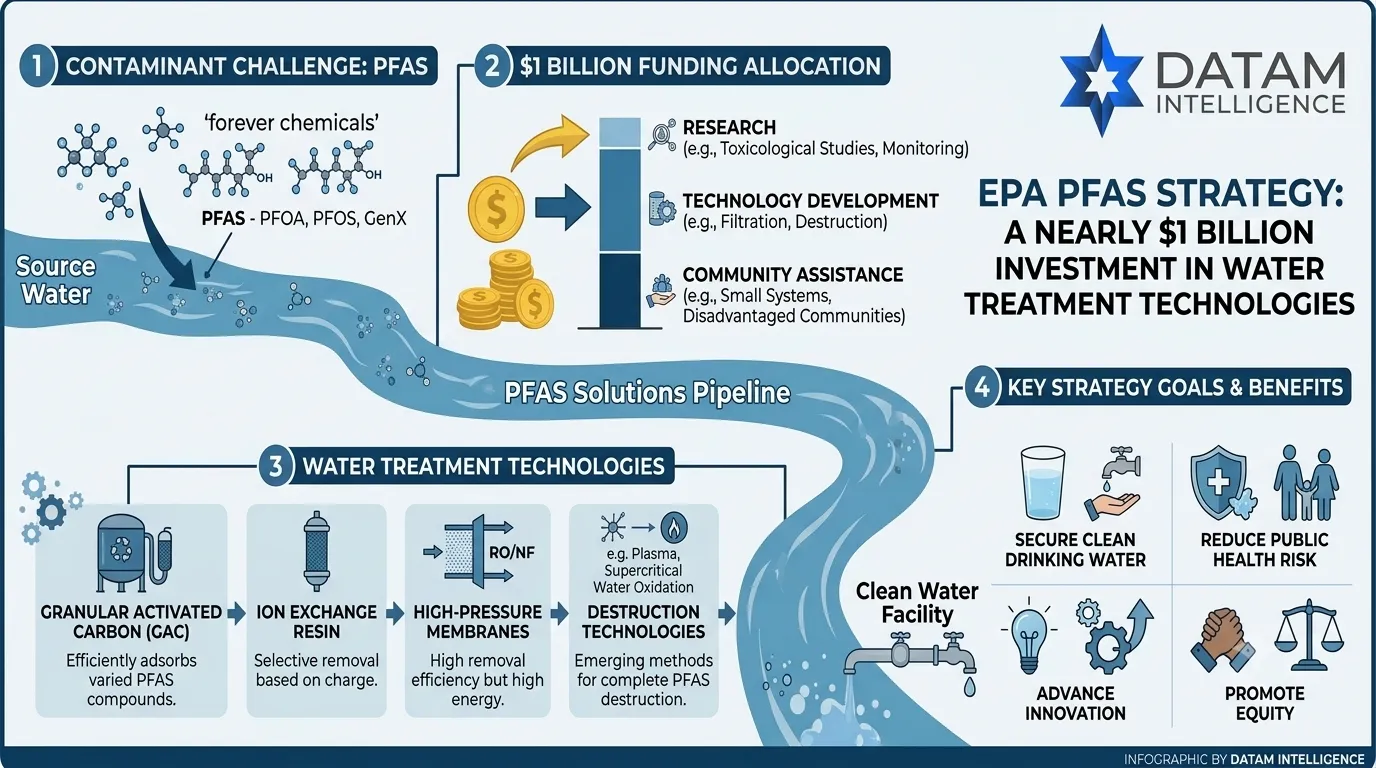
The U.S. Environmental Protection Agency (EPA) has unveiled a comprehensive strategy to address per- and polyfluoroalkyl substances (PFAS), committing nearly $1 billion in funding to support communities, strengthen drinking water protection, and accelerate the adoption of advanced PFAS management technologies.
The initiative represents a major shift toward a lifecycle-based approach to managing PFAS contamination, focusing on preventing pollution at its source, improving treatment capabilities, and helping water systems achieve regulatory compliance through practical implementation frameworks.
PFAS, commonly known as “forever chemicals,” are a large group of synthetic compounds widely used in industrial and consumer applications because of their resistance to heat, water, and chemical degradation. Their environmental persistence has increased demand for effective detection, treatment, and destruction technologies across municipal, industrial, and commercial sectors.
Capitalize on a 14.1% CAGR: Unlock Exclusive Insights into the PFAS Testing Boom
Driven by a surging demand for drinking water monitoring and industrial process testing, the PFAS testing sector represents one of the fastest-growing segments in environmental services. Download our comprehensive market study report to analyze competitive landscapes, regional growth pockets, and multi-matrix testing opportunities.
EPA’s PFAS Strategy Focuses on Source Control, Compliance, and Technology Innovation
According to the EPA announcement, the agency’s updated PFAS approach emphasizes three major priorities:
- Strengthening scientifically supported drinking water protections
- Providing realistic compliance pathways for water systems
- Expanding investment in PFAS removal and destruction technologies
The agency highlighted that existing enforceable limits for PFOA and PFOS remain at 4 parts per trillion (ppt) under the National Primary Drinking Water Regulation, while additional regulatory actions are being evaluated through established legal processes.
For water utilities and industrial operators, the strategy signals continued demand for scalable PFAS treatment infrastructure, including advanced filtration, adsorption, separation, and destruction technologies.
Nearly $1 Billion Investment to Support PFAS Remediation
A key component of the initiative is the allocation of nearly $1 billion through programs supporting small, rural, and disadvantaged communities impacted by PFAS contamination.
The funding aims to help communities implement:
- PFAS detection and monitoring programs
- Drinking water treatment upgrades
- Technical assistance initiatives
- Operator training programs
- Infrastructure planning support
The investment is expected to accelerate market opportunities for companies providing environmental engineering services, water purification systems, analytical testing solutions, and PFAS remediation technologies.
Growing Market Opportunity for PFAS Treatment Technology Providers
The EPA’s expanded PFAS focus is expected to influence demand across the global environmental technology ecosystem.
Companies operating in areas such as:
Advanced Filtration Systems
Technologies including activated carbon adsorption, membrane filtration, and ion exchange systems are becoming increasingly important for removing PFAS compounds from water streams.
PFAS Destruction Technologies
Emerging solutions designed to permanently eliminate PFAS rather than transfer contaminants into waste streams are gaining attention from regulators and industrial users.
Environmental Monitoring and Testing
Growing compliance requirements are increasing demand for PFAS analytical testing services, laboratory capabilities, and contamination mapping technologies.
The regulatory momentum is creating opportunities for technology developers, engineering firms, and environmental service providers supporting PFAS compliance programs.
Impact on Industries and Water Utilities
The updated PFAS framework is expected to have significant implications for multiple industries, including:
- Municipal water utilities requiring treatment upgrades
- Manufacturing sectors managing PFAS-related wastewater risks
- Chemical companies adapting production processes
- Semiconductor and electronics manufacturers reviewing chemical usage
- Environmental service providers expanding remediation capabilities
Organizations will increasingly need integrated PFAS management strategies combining monitoring, prevention, treatment, and regulatory reporting.
Analyst View: PFAS Regulation Driving Long-Term Environmental Technology Growth
The EPA’s nearly $1 billion PFAS initiative highlights the transition of PFAS management from a regulatory challenge into a major environmental technology investment opportunity.
As governments worldwide increase focus on emerging contaminants, demand is expected to grow for:
- Cost-efficient PFAS removal systems
- Sustainable destruction technologies
- Real-time water quality monitoring
- Industrial wastewater treatment solutions
- Compliance management platforms
Companies capable of delivering scalable, cost-effective PFAS solutions are positioned to benefit from expanding regulatory requirements and infrastructure modernization programs.
Key Takeaways
- EPA launched a comprehensive PFAS strategy supported by nearly $1 billion in funding.
- The initiative focuses on protecting drinking water, controlling PFAS at the source, and improving compliance pathways.
- Demand for PFAS treatment, testing, and remediation technologies is expected to increase.
- Water utilities and industrial operators are likely to accelerate investments in contamination management solutions.
- Environmental technology companies may see expanded opportunities in PFAS monitoring and treatment markets.