


Short Intro
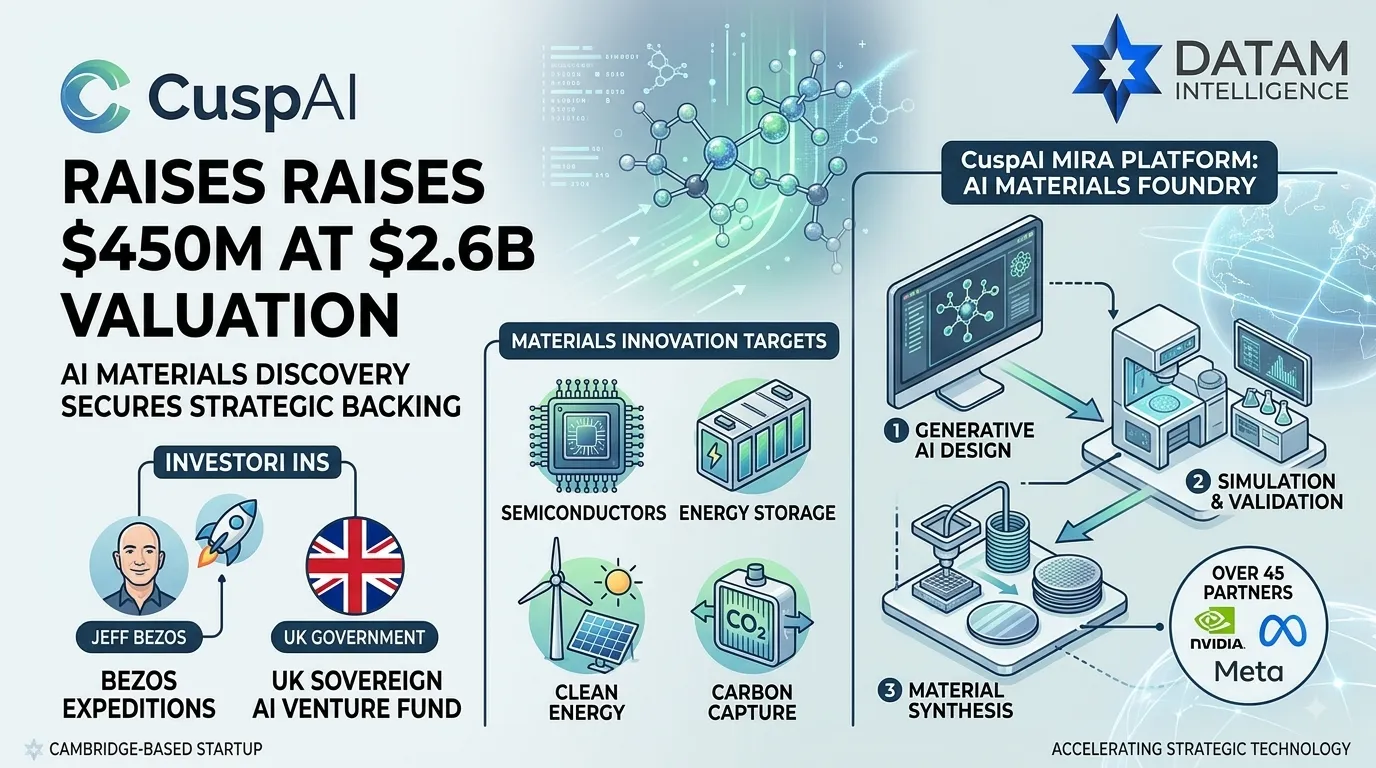
CuspAI has raised $450 million in Series B funding at a $2.6 billion valuation, with backing from Jeff Bezos’ investment vehicle and the UK government’s Sovereign AI Venture Fund. The Cambridge-based AI startup is developing technology designed to accelerate the discovery of new materials for semiconductors, energy storage, carbon capture and advanced manufacturing.
Jeff Bezos and UK Government Investment Signals Rising Strategic Value of AI Materials Discovery
The intersection of artificial intelligence and materials science is emerging as a strategically important technology segment after Cambridge-based CuspAI secured $450 million in Series B funding at a $2.6 billion valuation. The round includes participation from Bezos Expeditions and the UK government’s Sovereign AI Venture Fund, alongside leading institutional and technology-focused investors.
Explore the Semiconductor and IC Packaging Materials Market
Gain a comprehensive view of the evolving semiconductor packaging ecosystem with DataM Intelligence’s Semiconductor and IC Packaging Materials Market report. Access detailed analysis of market dynamics, emerging technologies, growth opportunities, competitive developments, investment trends, and regional outlooks to support informed business and strategic decisions. Request a Free Sample Market Report Today!
The investment highlights a broader shift in AI capital toward technologies capable of addressing physical-world constraints rather than focusing exclusively on software applications. CuspAI is developing AI systems designed to identify and design new materials with targeted properties, potentially shortening parts of the traditionally lengthy materials discovery cycle.
The company was founded in 2024 by Chad Edwards and Professor Max Welling and is headquartered in Cambridge, UK. CuspAI's technology is focused on materials discovery for sectors including semiconductors, clean energy, energy storage, carbon capture and advanced manufacturing.
CuspAI Funding Round Targets the Materials Bottleneck in Advanced Technology
Materials availability and performance have become increasingly important constraints across high-growth technology markets. Semiconductor manufacturing, next-generation batteries, renewable energy systems and carbon-management technologies all require materials that can meet increasingly demanding performance, cost and sustainability requirements.
CuspAI's approach uses AI to search and generate candidate materials based on desired characteristics. Its MIRA platform is designed to support an end-to-end workflow covering generative materials design, simulation, synthesis planning and experimental validation.
This approach could change how companies evaluate materials opportunities. Instead of relying solely on conventional trial-and-error experimentation, AI models can help researchers narrow candidate materials computationally before laboratory validation.
Why AI Materials Discovery Matters
The commercial opportunity extends beyond faster research. AI-enabled materials discovery could help companies:
- Identify alternatives to scarce or strategically important raw materials.
- Develop materials with improved electrical, thermal or chemical performance.
- Accelerate semiconductor materials research.
- Improve battery and energy-storage technologies.
- Support carbon capture and other climate technologies.
- Reduce the time and cost associated with early-stage materials development.
- Expand the range of materials considered by industrial R&D teams.
CuspAI's own strategic positioning reflects this broader opportunity: the company describes its objective as building an AI-powered system capable of designing new materials for specific properties rather than simply searching existing databases.
AI Materials Foundry Brings NVIDIA, Meta and Industrial Partners Into the Ecosystem
Alongside the funding announcement, CuspAI launched its AI Materials Foundry, a collaborative network bringing together computing resources, data, laboratories and scientific expertise.
The Foundry includes more than 45 partners, with NVIDIA and Meta among the technology companies participating. The initiative is intended to combine computational capabilities and scientific resources to accelerate materials discovery and validation.
The significance of the initiative extends beyond CuspAI itself. Materials discovery requires a combination of AI models, high-performance computing, simulation, experimental facilities and domain-specific scientific knowledge. Building an ecosystem around these capabilities could therefore become an important competitive advantage for AI materials companies.
Semiconductor Industry Could Become a Major Beneficiary of AI Materials Discovery
The semiconductor industry is one of the clearest potential beneficiaries of AI-driven materials research.
As chip architectures become more advanced, manufacturers face increasingly demanding requirements around conductivity, thermal management, dielectric performance, fabrication compatibility and energy efficiency. The search for new materials is therefore becoming increasingly important to semiconductor innovation.
CuspAI's focus on materials that could support chip technologies positions the company within the broader AI and semiconductor value chain. Reuters reported that the startup's materials-discovery ambitions cover applications including chips, clean energy and advanced manufacturing.
For semiconductor companies, AI-assisted materials discovery could eventually complement existing investments in advanced process technologies, packaging, memory, chiplets and specialized computing architectures.
Jeff Bezos Investment Adds High-Profile Capital to AI Materials Sector
Jeff Bezos' participation gives additional visibility to the emerging AI materials category.
The Series B was led by Kleiner Perkins and NEA, with additional participation from investors including Glade Brook Capital Partners, Lux Capital, AMD Ventures and Invest-NL, alongside the UK government's Sovereign AI Venture Fund and Bezos Expeditions.
The investor mix is notable because it combines venture capital, government-backed capital and strategic technology investment. This suggests that AI-powered scientific discovery is increasingly being evaluated not only as a software opportunity but also as strategic infrastructure for industrial innovation.
UK Government Investment Strengthens Britain's AI Technology Ecosystem
The UK government's participation also reflects growing policy interest in retaining and scaling strategically important AI companies.
CuspAI is the fourth company to receive backing from the UK's Sovereign AI Venture Fund, according to reporting surrounding the investment. The government-backed investment is intended to support the development of high-potential British AI companies and strengthen the UK's position in advanced AI technologies.
CuspAI's Cambridge base also connects the company with the UK's established research ecosystem. Imperial College London reported that materials scientist Professor Aron Walsh is involved with CuspAI, highlighting the company's link between academic materials research and industrial AI development.
CuspAI Expands Globally as AI Materials Market Gains Momentum
The new funding is expected to support CuspAI's international expansion across the United States, Asia-Pacific and Europe. The company has also been building its U.S. operations, including the appointment of former Apple and Google executive John Giannandrea to help establish U.S. Foundry operations.
CuspAI's global expansion reflects the international nature of materials R&D. Semiconductor manufacturing, battery production, clean-energy technologies and advanced manufacturing rely on supply chains spanning multiple regions.
The company's current footprint extends beyond the UK, with operations across locations including London, Amsterdam, Berlin, Tokyo, Singapore and the United States, according to CuspAI.
Analyst View: AI Materials Discovery Could Become a New Layer of Industrial AI
DataM Intelligence analysis: The CuspAI investment illustrates an important evolution in the AI investment landscape: the transition from AI applications that optimize existing workflows toward AI systems designed to discover new physical assets, materials and technologies.
The long-term commercial opportunity will depend on whether AI-generated materials can consistently move from computational predictions to commercially viable laboratory results and scalable industrial production. Model accuracy alone will not determine success. Access to proprietary materials data, high-performance computing, laboratory infrastructure, manufacturing partnerships and domain expertise will be equally important.
The strongest opportunities are likely to emerge where materials innovation directly addresses industrial bottlenecks, including semiconductor performance, energy density, critical-mineral substitution, carbon capture and advanced manufacturing.
Investment Outlook for AI-Powered Materials Discovery
The CuspAI funding round may encourage additional investment across the broader AI for science and materials informatics ecosystem.
Potential investment areas include:
- AI-powered materials discovery platforms
- Generative materials design
- Computational chemistry and materials simulation
- Semiconductor materials innovation
- Battery materials and energy storage
- Critical-mineral alternatives
- Carbon capture materials
- Advanced manufacturing materials
- AI-enabled laboratory automation
- Scientific AI and autonomous R&D platforms
The sector is still at an early stage, meaning commercial scalability, reproducibility and regulatory or manufacturing integration remain important considerations for investors and industrial buyers.
What CuspAI's $2.6 Billion Valuation Means for the AI Materials Market
CuspAI's $2.6 billion valuation demonstrates that investors are assigning substantial value to AI platforms capable of addressing physical-world technology constraints.
The development could also accelerate competition among startups and established technology companies working at the intersection of AI, computational science and industrial R&D.
For B2B technology buyers and corporate R&D organizations, the emerging market creates an opportunity to evaluate AI not only as an automation tool but also as a potential engine for new-material discovery, product development and industrial differentiation.
Key Takeaways
- CuspAI raised $450 million in a Series B funding round.
- The funding round valued the company at approximately $2.6 billion.
- Jeff Bezos' Bezos Expeditions and the UK's Sovereign AI Venture Fund participated in the financing.
- CuspAI is developing AI technology for materials discovery and design.
- Its potential applications include semiconductors, energy storage, carbon capture and advanced manufacturing.
- The company launched the AI Materials Foundry, involving more than 45 partners, including NVIDIA and Meta.
- The funding is expected to support CuspAI's international expansion across the U.S., Asia-Pacific and Europe.
- The investment highlights the growing strategic importance of AI for science, materials informatics and industrial R&D.
Conclusion
CuspAI's latest funding round marks a significant development in the convergence of artificial intelligence and materials science. Backing from Jeff Bezos, the UK government and major venture investors indicates growing confidence that AI-powered materials discovery could address some of the most difficult bottlenecks facing semiconductors, energy, climate technology and advanced manufacturing.
As AI moves deeper into scientific discovery, the competitive advantage may increasingly depend on the ability to connect algorithms with proprietary data, computational infrastructure, laboratory validation and industrial-scale manufacturing. CuspAI's progress could therefore serve as an important indicator of how quickly AI materials discovery moves from research capability to commercial industrial technology.