


Automotive Memory Chip Market Intensifies as AI-Powered Vehicles Drive Semiconductor Competition
The automotive industry is becoming a major growth frontier for memory semiconductor companies as vehicles evolve into intelligent computing platforms. Increasing adoption of artificial intelligence (AI) chips, advanced driver-assistance systems (ADAS), autonomous driving technologies, and software-defined vehicles is accelerating demand for high-performance automotive memory solutions.
Traditional vehicle architectures are being replaced by centralized computing platforms that require significantly higher memory capacity for real-time data processing, sensor management, infotainment systems, and AI-based decision-making. This transformation is encouraging global memory chip manufacturers to compete for a larger share of the automotive semiconductor market.
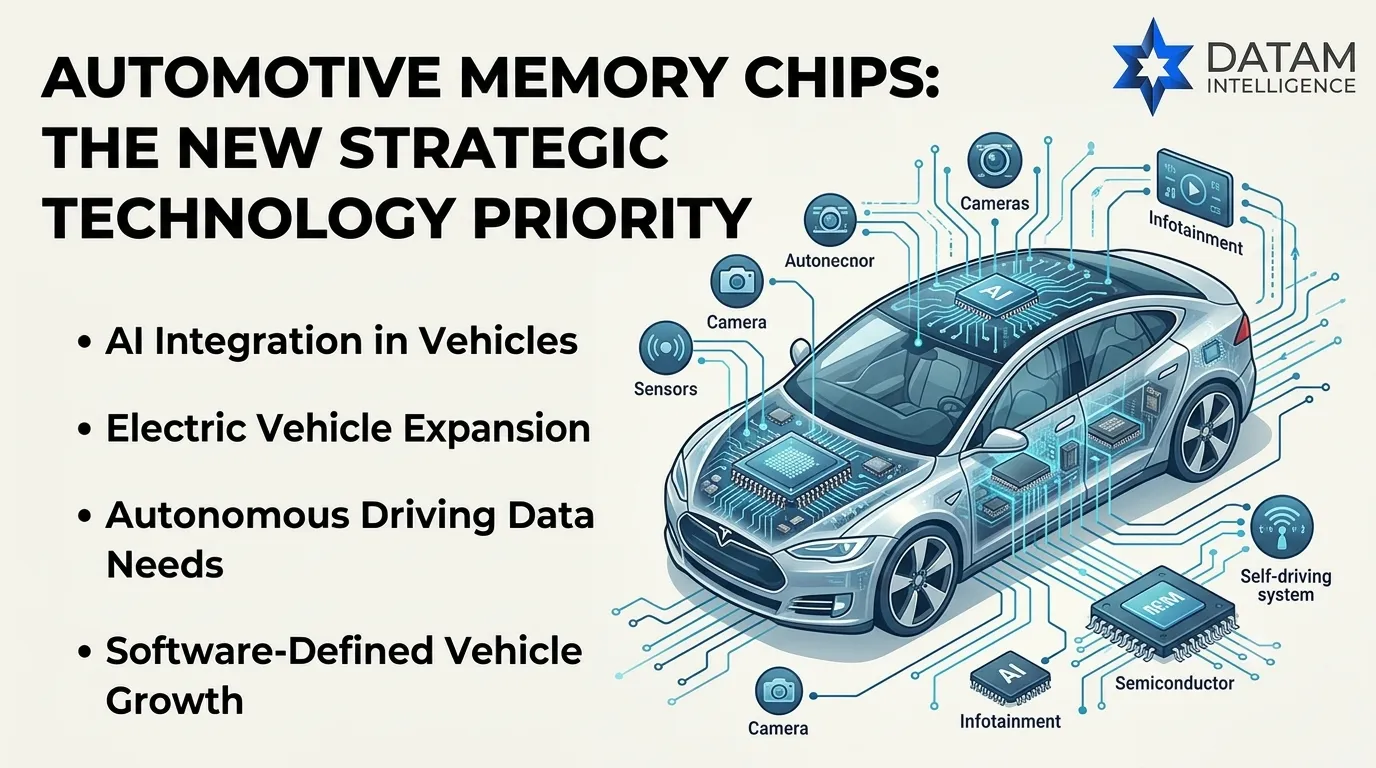
AI and Autonomous Driving Reshape Automotive Memory Demand
Modern vehicles generate massive volumes of data from cameras, radar sensors, LiDAR systems, navigation platforms, and connected services. Automotive memory components such as DRAM, NAND flash, and emerging high-performance memory technologies are becoming critical infrastructure for next-generation vehicles.
The growth of AI-powered automotive systems is also increasing demand for memory products capable of supporting faster processing, lower latency, and improved reliability. Semiconductor suppliers are focusing on automotive-grade memory solutions designed for long operating lifecycles and harsh environmental conditions.
Semiconductor Companies Expand Automotive Strategies
Leading memory chip manufacturers are increasing investments in automotive applications as demand from AI infrastructure, electric vehicles, and intelligent mobility platforms continues to rise.
Automotive applications are becoming strategically important because vehicles require long-term semiconductor supply agreements compared with consumer electronics markets, creating opportunities for stable revenue growth.
The increasing competition comes as global memory supply remains under pressure due to rising AI infrastructure demand. Industry players are balancing capacity allocation between data centers, consumer electronics, and automotive customers.
Software-Defined Vehicles Create New Semiconductor Opportunities
The transition toward software-defined vehicles (SDVs) is transforming cars into continuously upgradeable computing platforms. These vehicles require advanced semiconductor architectures capable of supporting:
- Autonomous driving functions
- AI-based driver assistance
- Real-time vehicle analytics
- Connected infotainment systems
- Over-the-air software updates
As automotive OEMs increase electronic content per vehicle, memory chips are becoming a strategic component of vehicle performance and differentiation.
Analyst Insight
The automotive memory chip market is moving from a supporting semiconductor category to a strategic technology segment. AI-enabled vehicles will require higher memory bandwidth, increased storage capacity, and automotive-specific reliability standards.
For semiconductor companies, automotive applications represent a long-term growth opportunity beyond traditional computing markets. Companies that can deliver scalable memory solutions, secure supply chains, and AI-ready architectures are positioned to capture emerging opportunities in electric mobility and autonomous transportation.
The next competitive advantage in automotive technology will not only depend on processing power but also on how efficiently vehicles store, manage, and analyze massive volumes of real-time data.
Industry Analysis: Why Automotive Memory Chips Are Becoming a Strategic Technology Priority
The automotive semiconductor industry is undergoing a fundamental transformation as vehicles evolve from traditional mechanical systems into intelligent, software-driven computing platforms. The increasing integration of artificial intelligence, electrification, advanced connectivity, and autonomous driving technologies is significantly accelerating demand for high-performance automotive memory solutions.
Unlike conventional vehicles, next-generation vehicles require the ability to process, store, and analyze massive volumes of real-time data generated by cameras, sensors, radar systems, infotainment platforms, battery management systems, and AI-based applications. As a result, memory technologies such as DRAM, NAND flash, and emerging automotive-grade memory solutions are becoming critical components in modern vehicle architectures.
Automotive memory demand is primarily being shaped by three major industry trends:
1. Artificial Intelligence Integration Driving Higher Memory Requirements
The integration of artificial intelligence into vehicles is creating new requirements for faster data processing and advanced memory capabilities. AI-powered features such as driver monitoring systems, predictive maintenance, intelligent navigation, voice assistants, and real-time decision-making require rapid access to large volumes of data.
Advanced driver-assistance systems (ADAS) and AI computing platforms depend on high-bandwidth memory solutions to process information from multiple sensors simultaneously. As vehicles become more intelligent, semiconductor manufacturers are focusing on developing memory products that deliver higher speed, lower latency, improved energy efficiency, and enhanced reliability for automotive applications.
2. Electric Vehicle Expansion Increasing Semiconductor Content per Vehicle
The global transition toward electric mobility is significantly increasing the role of semiconductors in vehicles. Electric vehicles depend on sophisticated electronic systems for battery management, power conversion, energy optimization, connectivity, and vehicle control functions.
Compared with traditional internal combustion engine vehicles, EVs typically require greater semiconductor integration, including advanced memory components that support battery analytics, charging systems, infotainment platforms, and connected vehicle applications.
As automakers accelerate EV development, demand is rising for automotive-grade memory solutions designed to operate reliably under demanding conditions while supporting longer vehicle lifecycles.
3. Autonomous Mobility Accelerating Data Processing Needs
The development of autonomous driving technologies is creating unprecedented demand for automotive memory capacity and performance. Self-driving systems rely on continuous data streams from cameras, LiDAR, radar, GPS, and other sensors to understand road conditions and make real-time driving decisions.
Managing this constant flow of information requires advanced memory architectures capable of supporting high-speed processing, data storage, and communication between multiple vehicle systems. As autonomous capabilities progress from basic driver assistance toward higher levels of automation, memory technology will become an increasingly important factor in vehicle performance and safety.
Future Outlook for Automotive Memory Solutions
The growth of software-defined vehicles and intelligent transportation systems is expected to further strengthen demand for automotive memory technologies. Future vehicles will increasingly function as connected computing platforms, requiring scalable semiconductor solutions that support continuous software updates, AI workloads, and advanced mobility services.
For semiconductor companies, automotive memory represents a long-term growth opportunity beyond traditional consumer electronics markets. Companies capable of delivering reliable, high-performance, and automotive-specific memory solutions are positioned to play a key role in shaping the future of intelligent transportation.
Why are automotive memory chips gaining importance?
Automotive memory chips are gaining importance because vehicles now require advanced computing capabilities for AI processing, autonomous driving, infotainment, connectivity, and real-time data management. Software-defined vehicles need higher memory capacity and faster data access, making automotive memory a strategic semiconductor market.
News source: https://www.datamintelligence.com/research-report/memory-chip-market