


The pharmaceutical industry is undergoing a structural shift in regulatory operations as artificial intelligence (AI), including generative AI and agentic automation systems, becomes deeply integrated into compliance and submission workflows. Regulatory teams, traditionally dependent on manual documentation, are now adopting AI-driven platforms to streamline regulatory intelligence, reduce submission timelines, and improve accuracy across global compliance frameworks.
Industry analysts indicate that AI-enabled regulatory systems are emerging as a critical enterprise capability, helping pharmaceutical companies navigate increasing regulatory complexity across agencies such as the FDA and EMA.
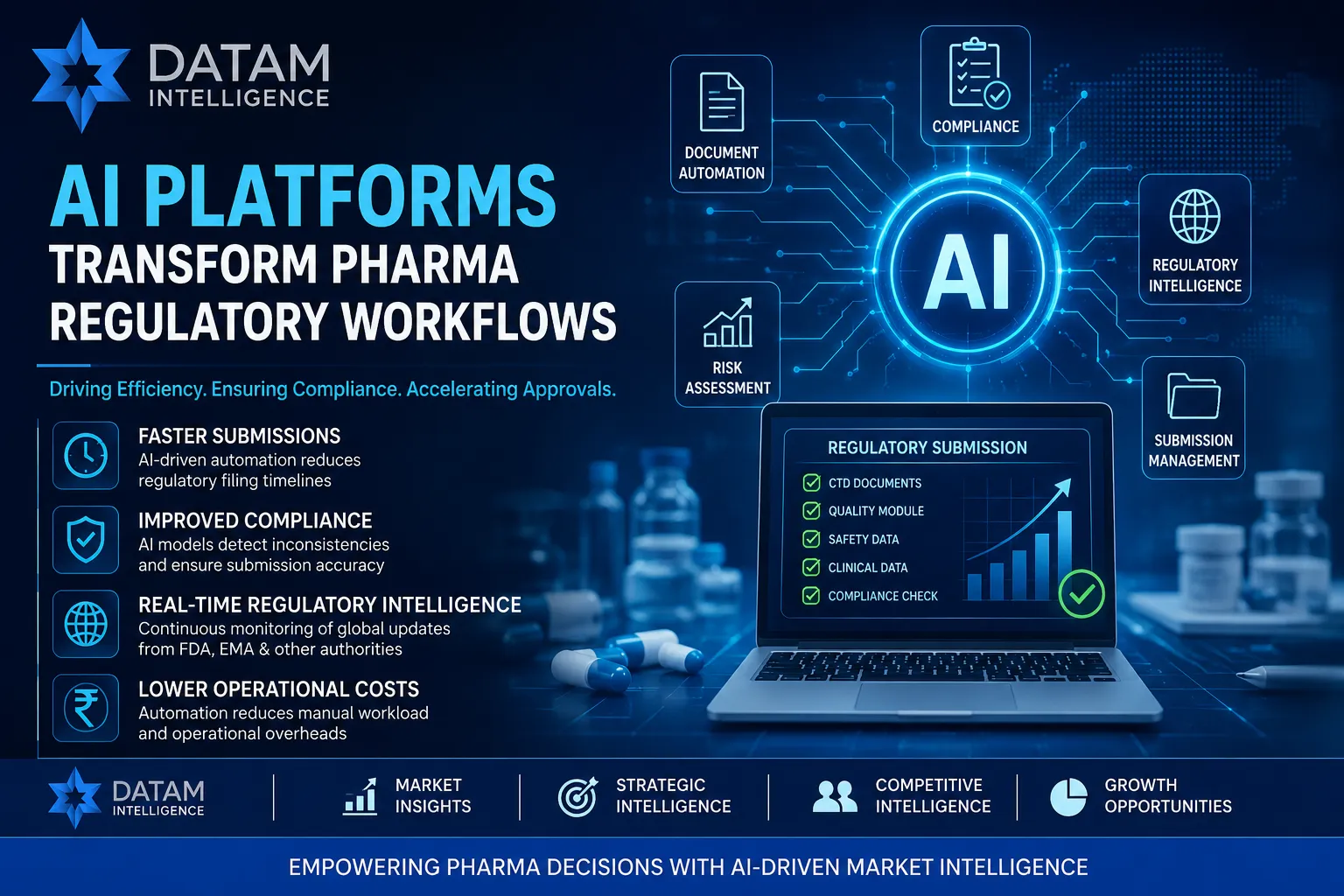
AI Adoption Accelerates in Pharma Regulatory Operations
Pharmaceutical regulatory affairs teams are facing rising complexity due to:
- Expanding global regulatory requirements
- Increased documentation burden
- Faster drug development cycles
- Cross-border compliance demands
AI platforms are addressing these challenges through:
- Automated regulatory document drafting
- Intelligent classification and tagging of submissions
- Real-time regulatory intelligence monitoring
- AI-assisted compliance gap analysis
Recent industry developments highlight a shift from basic automation tools to AI-native regulatory ecosystems powered by machine learning and natural language processing.
Generative AI & Agentic Systems Transform Compliance Workflows
The next phase of transformation is being driven by Generative AI and Agentic AI systems, which go beyond automation and introduce autonomous decision-support capabilities.
Key capabilities include:
- Context-aware regulatory document generation
- Automated regulatory impact assessment
- Intelligent workflow orchestration across departments
- Continuous monitoring of regulatory updates
According to industry research trends in 2026, agentic AI systems are increasingly being explored for end-to-end regulatory intelligence, enabling organizations to reduce manual intervention and improve audit readiness through traceable decision pathways.
Explore more information for Generative AI in Healthcare Market Size, Share Analysis, Growth Trends & Report.
Market Impact: Efficiency, Cost Reduction & Faster Submissions
The integration of AI-driven regulatory platforms is reshaping pharmaceutical enterprise operations by delivering measurable improvements across submission speed, compliance quality, regulatory intelligence, and cost structures. As regulatory environments become more complex and data-intensive, AI is emerging as a critical infrastructure layer that directly impacts both operational efficiency and commercial competitiveness.
✔ Reduced Submission Timelines
One of the most immediate and high-impact benefits of AI in regulatory affairs is the significant reduction in submission timelines. Traditionally, regulatory submission processes involve extensive manual drafting, cross-functional document reviews, and iterative validation cycles across global regulatory standards.
AI-powered document generation systems now streamline these workflows by:
- Automatically drafting structured regulatory documents from clinical and CMC data
- Mapping content to region-specific regulatory templates (FDA, EMA, PMDA, etc.)
- Reducing repetitive manual formatting and reconciliation tasks
- Enabling real-time collaboration across regulatory, clinical, and quality teams
As a result, pharmaceutical companies are increasingly able to compress regulatory submission cycles from months to significantly shorter timelines, improving speed-to-approval and accelerating time-to-market for new therapies.
✔ Improved Compliance Accuracy
Regulatory compliance is one of the most error-sensitive areas in pharmaceutical operations, where even minor inconsistencies can lead to submission delays, regulatory queries, or complete rejection cycles.
Machine learning-based validation engines are now enhancing submission quality by:
- Detecting inconsistencies across clinical, safety, and manufacturing datasets
- Identifying missing or misaligned regulatory requirements before submission
- Flagging deviations from region-specific regulatory guidelines
- Learning from historical approval and rejection patterns to improve future outputs
This shift from manual validation to AI-assisted compliance assurance significantly reduces human error while improving audit readiness and regulatory confidence. In highly regulated markets, this improvement translates directly into reduced resubmission cycles and improved approval probability.
✔ Enhanced Regulatory Intelligence
Modern AI platforms are evolving beyond document automation into continuous regulatory intelligence systems that monitor global regulatory changes in real time.
These systems provide pharmaceutical enterprises with:
- Automated tracking of updates from agencies such as FDA, EMA, MHRA, and CDSCO
- Real-time alerts on guideline revisions, policy updates, and submission requirements
- Semantic analysis of regulatory documents to extract actionable insights
- Cross-market comparison of regulatory expectations for faster global alignment
This capability enables regulatory affairs teams to shift from reactive compliance management to proactive regulatory strategy planning, improving decision-making and reducing regulatory uncertainty in global markets.
✔ Lower Operational Costs
AI-driven automation is also delivering significant cost optimization across regulatory operations. Traditionally, regulatory affairs departments require large teams of specialists responsible for documentation, validation, submission management, and regulatory tracking.
With AI-enabled platforms:
- Repetitive documentation tasks are automated
- Workflow orchestration reduces manual coordination overhead
- Fewer resources are required for baseline regulatory documentation
- Teams can focus on high-value strategic and scientific tasks
This results in a structural shift in cost distribution, where enterprises can maintain or improve regulatory output while reducing dependency on scaling large operational teams. Over time, this contributes to improved margins and more efficient allocation of R&D and regulatory budgets.
Strategic Industry Impact: A Competitive Differentiator
Industry analysts indicate that AI-driven digital transformation in regulatory affairs is no longer optional but increasingly a strategic competitive differentiator for global pharmaceutical companies.
Organizations that adopt advanced regulatory AI systems are gaining advantages in:
- Faster drug approval timelines
- Improved global market entry speed
- Reduced regulatory risk exposure
- Enhanced portfolio scalability across multiple geographies
In an industry where time-to-market directly influences revenue capture and patient access, regulatory AI adoption is becoming a critical lever for commercial success. As competition intensifies, companies with mature AI-enabled regulatory infrastructures are expected to outperform peers in both operational efficiency and regulatory agility.
Enterprise Adoption Expands Across Pharma Leaders
Leading pharmaceutical companies are increasingly investing in AI-driven regulatory infrastructure as part of broader digital transformation strategies.
Key adoption areas include:
- Clinical trial documentation automation
- Pharmacovigilance reporting systems
- Regulatory submission lifecycle management
- Quality and compliance data integration
This shift reflects a broader industry trend toward end-to-end digital regulatory ecosystems, where AI systems act as decision-support engines across the product lifecycle.
Regulatory Compliance, Governance & AI Trust Frameworks
As AI adoption expands, regulatory bodies are also advancing governance frameworks to ensure safe and compliant usage of AI in drug development and submissions.
Key focus areas include:
- Model transparency and explainability
- Data traceability and auditability
- Validation of AI-generated outputs
- Human-in-the-loop verification mechanisms
This balance between automation and oversight is expected to define the future of AI in pharmaceutical regulatory operations.
Analyst Insight: Future of Regulatory Intelligence
From a market intelligence perspective, AI is expected to evolve regulatory affairs from a manual compliance function into a strategic intelligence-driven operation.
Future systems will likely feature:
- Fully autonomous regulatory agents
- Predictive compliance risk detection
- Real-time global regulatory mapping
- Integrated enterprise AI compliance layers
This evolution positions AI not just as a productivity tool, but as a core infrastructure layer for pharmaceutical regulatory ecosystems.
DataM Intelligence Perspective
The integration of AI platforms into regulatory workflows represents a major inflection point for the life sciences industry. As regulatory complexity continues to rise globally, AI-powered compliance systems will become essential for ensuring speed, accuracy, and regulatory alignment across markets.
Organizations that adopt AI-driven regulatory intelligence early are likely to gain significant advantages in operational efficiency, submission speed, and regulatory risk mitigation.
News source: https://www.pharmaceutical-technology.com/features/ai-platforms-grow-to-improve-pharmas-regulatory-workflows/?cf-view