


Cobalt Recycling Market Company Research Insight
For years, cobalt was mainly discussed through mining risk, the Democratic Republic of Congo, price swings, and battery chemistry exposure. That is still part of the story, but recycling has changed the conversation. Used batteries, production scrap, industrial catalysts, superalloys, electronics waste and cobalt-bearing metal scrap are now being treated as feedstock for battery materials and industrial supply chains.
According to DataM Intelligence, the global Cobalt Recycling Market reached US$ 1,600 million in 2025 and is expected to reach US$ 5,777.3 million by 2035, growing at a CAGR of 13.7% during 2026 to 2035. Asia Pacific dominated the market with a 56.1% share in 2025, while hydrometallurgical recycling led by technology type with a 58.0% share. DataM also identifies companies such as Umicore, Glencore, Redwood Materials and GEM Co., Ltd. as leading players because of their recycling capability, refining capacity and battery material integration.
The market is being pulled by two opposing forces. EV and battery manufacturing growth is creating more battery scrap and future end-of-life battery supply. At the same time, the rise of lower cobalt chemistries, especially LFP, means recyclers cannot depend only on cobalt-rich feedstock forever. That makes the sector more complicated than a simple battery growth story.
The strongest companies are not only the ones that can collect used batteries. Collection is important, but it is only the start. The real advantage comes from black mass processing, hydrometallurgical refining, cobalt sulfate production, customer qualification, OEM partnerships, and the ability to recover more than one metal. In cobalt recycling, single metal thinking feels outdated. Nickel, lithium, manganese, copper and graphite recovery all matter.
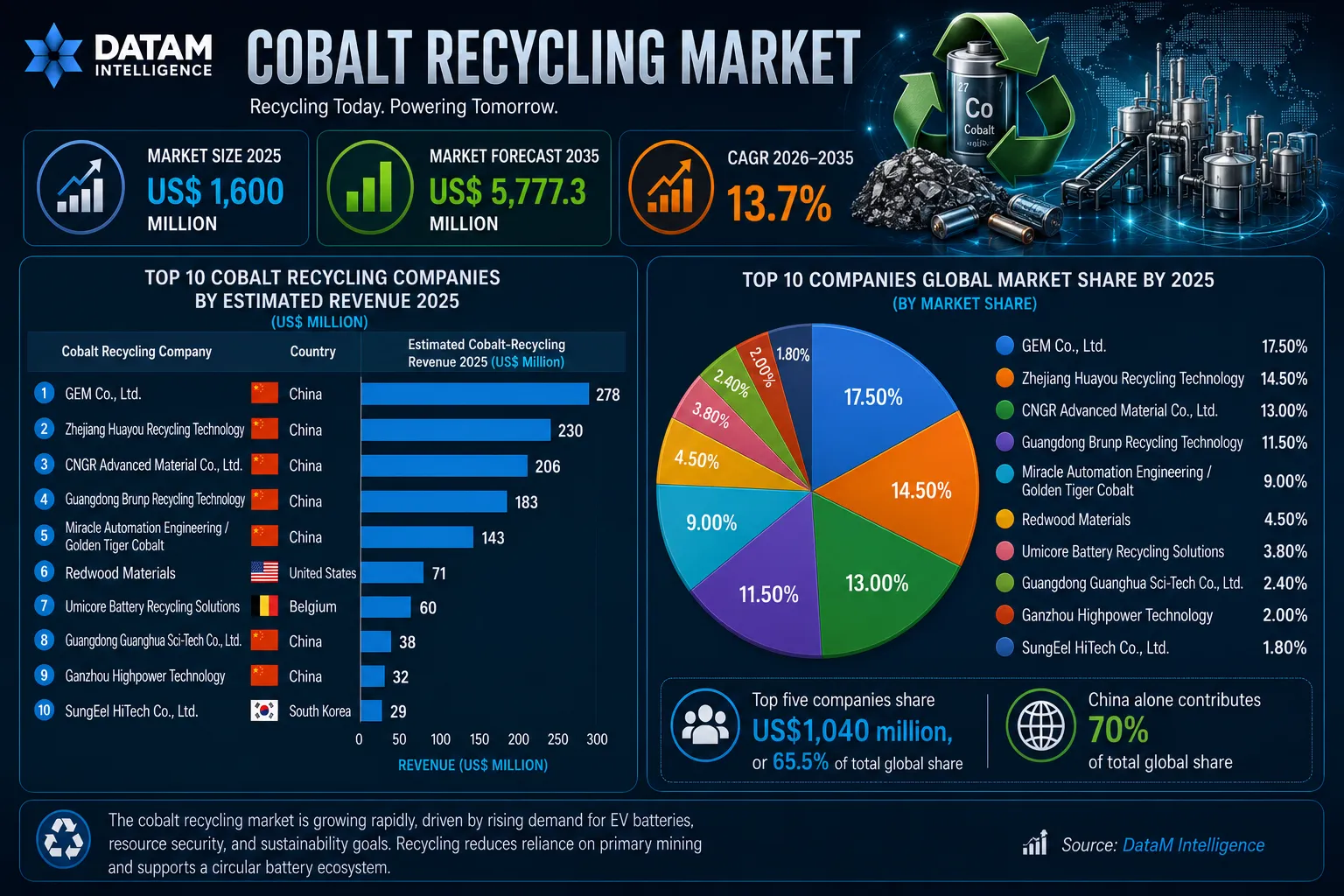
Request For Exclusive Sample: https://www.datamintelligence.com/download-sample/cobalt-recycling-market
Top 10 Companies Analysis
GEM Co., Ltd.
GEM is one of the most important cobalt recycling companies globally and one of China’s strongest circular battery material players. The company operates large recycling networks and hydrometallurgical recovery systems that process end-of-life batteries, electronics waste, and cobalt-bearing materials into battery material products.
Its advantage is integration. GEM is not only recycling waste. It is connected to China’s battery material ecosystem, which gives it access to feedstock, processing infrastructure and downstream customers. That is difficult to replicate quickly. In a market where battery makers need reliable recycled cobalt sulfate and precursor materials, GEM has scale and operating depth.
The risk is that global buyers are also trying to reduce overdependence on China-linked supply chains. GEM remains a leader, but geopolitical diversification could shift some demand toward regional competitors over time.
Brunp Recycling
Brunp Recycling, linked to CATL, is one of the most strategically important battery recyclers in the world. Its position is strong because it sits close to the largest battery manufacturing ecosystem globally. That proximity matters.
Battery recycling is not only about technology. It is about feedstock control. Brunp benefits from connections to battery production scrap, used batteries and downstream cathode material demand. That gives it a closed-loop advantage that many independent recyclers would like to have.
Its strength is practical, not theoretical. It can connect collection, recycling, material recovery and battery production within the same industrial network. In cobalt recycling, that is close to the ideal model.
Zhejiang Huayou Cobalt
Huayou Cobalt has a strong position across cobalt mining, refining, battery materials and recycling. That gives it a broad role in the cobalt value chain. The company is important because it can combine primary cobalt supply with recycled cobalt recovery and downstream material production.
This matters because customers want stable cobalt supply, but they also want lower risk and better traceability. Huayou’s recycling activity strengthens its battery material position by adding circular feedstock to an already integrated cobalt platform.
The company’s scale is a major advantage. The sensitivity is obvious as well. Cobalt sourcing remains politically and ethically scrutinized, and companies with broad cobalt exposure need to manage responsible sourcing expectations carefully.
Umicore
Umicore is one of the most established names in battery recycling and precious metals recovery. It brings something different from many newer recyclers: long operating experience, industrial refining capability and deep knowledge of complex material streams.
That matters because recycling is often harder than pitch decks suggest. Battery packs, black mass, catalysts and metal scrap do not arrive in neat, uniform forms. Umicore’s strength lies in handling complexity and recovering valuable materials through established processing routes.
The company is also well positioned in Europe, where regulation, traceability and circular material use are becoming stronger. Its challenge is cost and competition. European recycling assets need steady feedstock and strong utilization to remain competitive against Asian integrated players.
Glencore
Glencore is not a pure recycling company, but it is one of the most important players in cobalt recycling because of its metals trading, smelting, refining and battery material exposure. It has the scale and market reach that smaller recyclers often lack.
The company’s advantage is flexibility. Glencore understands primary cobalt, recycled cobalt, industrial scrap flows and customer demand. It can operate across both mined and secondary material markets, which gives it a stronger commercial position when prices move.
Glencore also became more visible in battery recycling after acquiring Li Cycle out of distress in 2025, according to reporting on the global battery recycling sector. That move showed how difficult the recycling business can be for standalone firms, but also how valuable the assets can become when attached to a stronger metals platform.
Redwood Materials
Redwood Materials is one of the most closely watched US battery recycling companies. Its role is important because North America wants more domestic battery material recovery and less dependence on imported critical minerals.
The company’s model goes beyond recycling collection. Redwood is trying to build a closed-loop battery material system that recovers lithium, nickel, cobalt and copper and feeds them back into battery supply chains. That broader model is important because cobalt alone is not enough to carry the economics of recycling as battery chemistries change.
Redwood’s strength is strategic positioning. Its test is industrial scale. Recycling companies can attract attention quickly, but customers care about consistent output, qualification and cost.
Li Cycle
Li Cycle became one of the best-known names in lithium-ion battery recycling because of its spoke and hub model. The concept was simple enough to understand: collect and process batteries closer to source, then refine black mass into usable materials at hub facilities.
The execution was harder. Li Cycle’s financial distress and Glencore’s 2025 takeover showed how capital-intensive and unforgiving the battery recycling market can be.
Still, Li Cycle remains relevant. Its assets, process knowledge and network can matter under stronger ownership. The company is a useful reminder that demand growth does not automatically create profitable recycling businesses. Feedstock, utilization, capex control and refining execution decide the outcome.
Fortum Battery Recycling
Fortum Battery Recycling is an important European player because it aligns closely with the region’s circular economy and battery localization goals. Europe wants recycled battery materials, but it also wants traceability and lower environmental impact. Fortum fits that direction.
Its strength is regional relevance. European automakers and battery producers need recycling partners that understand local compliance requirements and can support closed-loop systems. Fortum’s hydrometallurgical recycling focus gives it a role in recovering cobalt, nickel and lithium from battery waste.
The challenge is scale. Europe has strong regulation, but recycling economics still need feedstock volume and efficient refining. Policy can support the market. It cannot replace operating discipline.
Cirba Solutions
Cirba Solutions is one of the important North American battery recycling and materials recovery companies. It has a broad recycling footprint and handles multiple battery chemistries, including lithium-ion batteries that contain cobalt and nickel.
Its advantage is collection and network depth. That matters because feedstock access is one of the biggest constraints in recycling. A recycler without steady material input is only half a business.
Cirba’s relevance should grow as North America builds more battery manufacturing and as end-of-life battery volumes rise. The company’s challenge is moving from collection strength into higher value material recovery and refining.
Ascend Elements
Ascend Elements became well known for its battery recycling and cathode precursor production ambitions. Its technology focus was interesting because it aimed to recover battery materials and move them back into higher value cathode supply chains.
The company’s story also shows the pressure in the sector. Reporting on the battery recycling industry noted that Ascend Elements filed for Chapter 11 in 2026 after raising significant capital.
That does not erase the relevance of its model. It does show that the market is harsh. Battery recycling requires more than good technology. It needs feedstock, customers, financing discipline, and timing that matches real battery waste availability.
Competitor Analysis: Top Cobalt Recycling Market Players
| Company | Core Position | Strategic Focus | Main Feedstock Exposure | Competitive Strength |
| GEM Co., Ltd. | Large scale Chinese cobalt and battery material recycler | Closed loop battery material recovery | End of life batteries, electronics waste and industrial scrap | Scale, hydrometallurgical capacity and battery ecosystem integration |
| Brunp Recycling | CATL linked battery recycling platform | Battery scrap recycling and cathode material circularity | Battery manufacturing scrap and used EV batteries | Strong feedstock access and battery customer integration |
Zhejiang Huayou Cobalt | Integrated cobalt, battery material and recycling company | Primary and recycled cobalt supply | Cobalt bearing scrap, batteries and industrial streams | Broad cobalt value chain and refining depth |
| Umicore | Established battery and metals recycler | Complex material recovery and circular battery materials | Batteries, catalysts, industrial scrap and precious metal streams | Refining experience and European regulatory alignment |
| Glencore | Metals producer, trader and recycler | Secondary cobalt recovery and battery material supply | Industrial scrap, black mass and cobalt bearing materials | Global metals reach, refining capability and trading strength |
| Redwood Materials | US battery recycling and material recovery company | Closed loop North American battery materials | EV batteries, consumer batteries and production scrap | Domestic supply chain positioning and multi metal recovery |
| Li Cycle | Lithium ion battery recycling network | Black mass processing and hub based refining | Battery scrap and end of life lithium ion batteries | Existing recycling network and Glencore backed restructuring relevance |
Fortum Battery Recycling | European battery recycler | Hydrometallurgical recovery for EU battery supply chains | Lithium ion batteries and black mass | Regional compliance fit and circular economy positioning |
| Cirba Solutions | North American battery recycling network | Battery collection, processing and material recovery | Mixed batteries, lithium ion batteries and industrial batteries | Collection network and North American footprint |
| Ascend Elements | Battery recycling and precursor material developer | Cathode precursor recovery from recycled batteries | Black mass and lithium ion battery scrap | Technology focus and cathode material ambition |
Request Exclusive Sample: https://www.datamintelligence.com/download-sample/cobalt-recycling-market
The competitive split is not neat. GEM, Brunp and Huayou benefit from China’s integrated battery supply chain. Umicore, Fortum and Glencore bring refining experience and European industrial credibility. Redwood, Cirba and Li Cycle are tied to North American localization. Ascend Elements shows both the promise and the financial strain of trying to move recycling into higher-value cathode materials.
Who Are Other Companies Influencing the Market?
Several other companies influence the cobalt recycling market even if they are not always listed among the first group of leaders. CNGR Advanced Material is important because precursor cathode material production is closely tied to recycled cobalt and nickel use. Guangdong Guanghua Sci Tech and Ganzhou Highpower Technology also appear in cobalt recycling manufacturer lists, especially in relation to Chinese battery material recovery and cobalt-bearing waste processing.
TES is relevant through electronics recycling and battery-related recovery. Ecobat Technologies influences the broader battery recycling space through collection and processing experience. Accurec Recycling and Duesenfeld are European players that matter because Europe is trying to build more regional battery recycling capacity. SK Tes and SungEel HiTech are also important in Asia because electronics, battery scrap, and lithium-ion battery recycling are closely linked.
Apple is not a recycler, but it influences the market from the demand side. The company has committed to using 100% recycled cobalt in batteries, which adds pressure on the supply chain to deliver traceable recycled material.
Battery manufacturers also shape the market even when they do not appear as recyclers. CATL, LG Energy Solution, Samsung SDI, Panasonic and BYD influence recycling economics because their cell production creates manufacturing scrap and their battery designs affect future recoverable cobalt content.
What Is Driving Competition in the Market?
Competition is being driven by feedstock first. That is the part that deserves more attention.
A recycling plant without steady battery scrap or end-of-life batteries is an underused asset. Battery manufacturing scrap is attractive because it is cleaner, more consistent, and easier to collect. End-of-life EV batteries are the larger long-term opportunity, but they are more difficult to collect, transport, sort, and process.
Hydrometallurgy is another major competitive line. DataM identifies hydrometallurgical recycling as the leading technology type in cobalt recycling, with a 58.0% share in 2025. The reason is straightforward. It can recover cobalt, nickel, and lithium at high purity levels and supports battery-grade material production.
The chemistry shift is the awkward part. LFP batteries reduce cobalt use, and DataM notes that LFP’s share of global EV batteries may rise meaningfully through 2029. That does not kill cobalt recycling, but it changes the economics. Recyclers need to recover multiple materials well, not rely only on cobalt-rich chemistries.
Regional policy is also reshaping competition. Asia Pacific has scale. Europe has regulation. North America has localization pressure. Each region favors a different kind of player. China rewards integrated battery material recyclers. Europe rewards traceable, compliant recovery systems. North America rewards companies that can help localize battery material supply.
The market will likely favor companies that combine feedstock access, refining capability, customer qualification, and multi-metal recovery. Cobalt recycling is a strong growth market, but it is not a forgiving one. The winners will be the companies that can turn messy battery waste into reliable, qualified material that battery and industrial customers actually want to buy.
Read Complete Research Report: https://www.datamintelligence.com/cobalt-recycling-market