


Top Cobalt Market Companies Analysis: Leading Producers & Competitive Landscape
The cobalt market is not as clean as the battery story makes it sound. EVs matter. Battery cathodes matter. But cobalt also sits inside superalloys, industrial chemicals, catalysts, medical implants, aerospace components and specialty metals. That makes the market more resilient in some places and more exposed in others.
According to DataM Intelligence, the global Cobalt Market reached US$ 18.43 billion in 2025 and is expected to reach US$ 34.12 billion by 2035, growing at a CAGR of 7.1% during 2026 to 2035. The market is segmented by product into cobalt sulfate, cobalt oxide, cobalt metal and other products, with end users across electric vehicles, batteries, industrial metals, industrial chemicals, superalloys and other applications. DataM lists China Molybdenum Co., Ltd., Eurasian Resources Group, Freeport McMoRan, Umicore, Glencore, Sumitomo Metal Mining, Norilsk Nickel, Huayou Cobalt, Jinchuan Group and Vale as major global players.
The competitive landscape is shaped by a difficult supply chain. The Democratic Republic of the Congo remains the largest mined cobalt producer, while Indonesia is becoming more important because cobalt is produced as a byproduct of nickel. The Cobalt Institute’s 2025 market report says total cobalt supply reached 295 kt in 2025, with mined cobalt production broadly flat at 270 kt. The DRC’s production share fell from 77% in 2024 to 73% in 2025, while Indonesia’s share rose from 11% to 14%.
That shift matters. The market is still concentrated, but the shape of concentration is changing. The DRC remains central. Indonesia is rising. China remains critical in refining and battery material conversion. Buyers are trying to diversify, yet the actual alternatives are limited and often expensive.
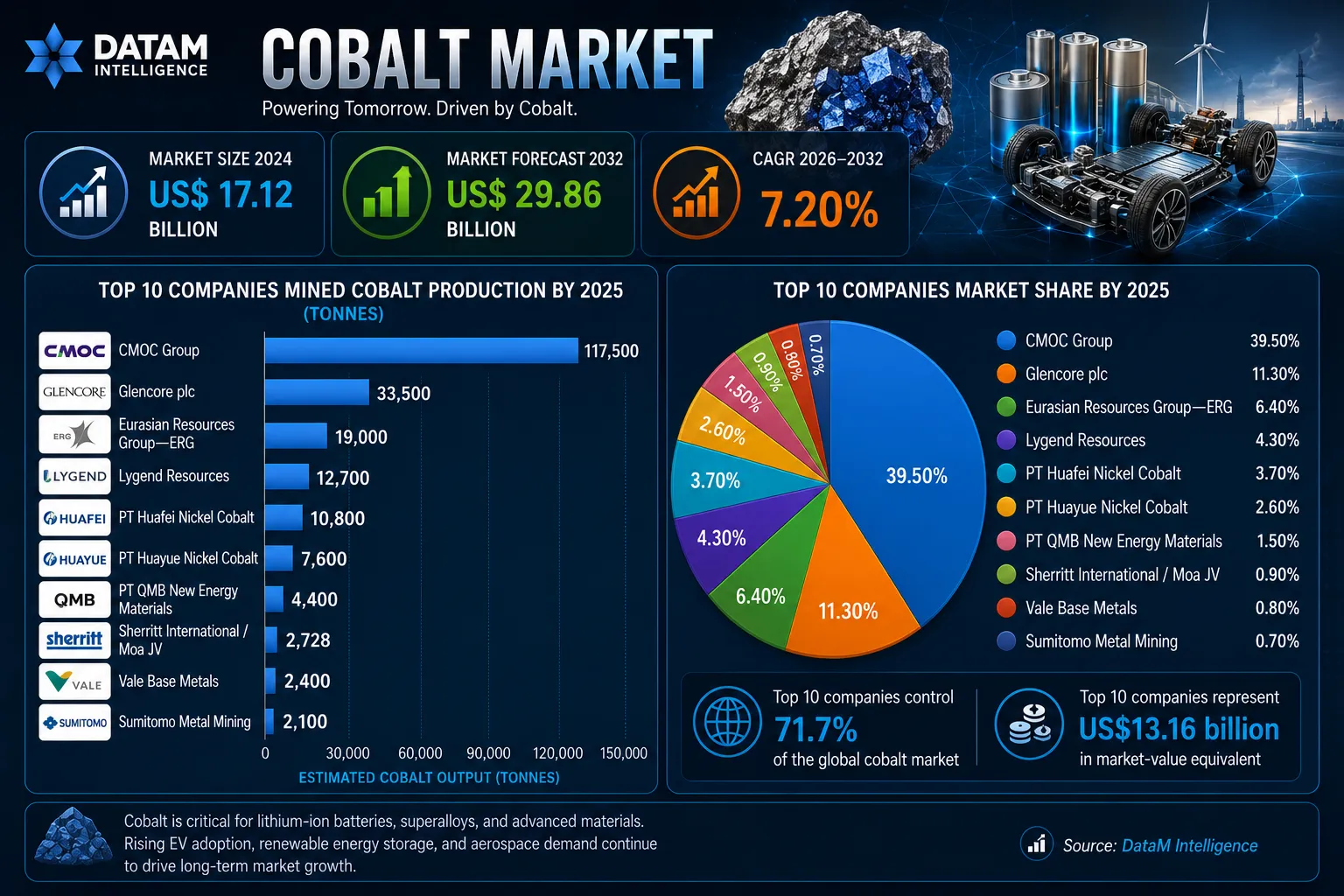
Request for Exclusive Sample: https://www.datamintelligence.com/download-sample/cobalt-market
Top 10 Companies Analysis
China Molybdenum Co., Ltd.
CMOC has become one of the most influential cobalt companies in the world because of its copper cobalt operations in the DRC. The company’s rise has changed the competitive balance. For years, Glencore was treated as the default cobalt leader. CMOC has made that assumption less comfortable.
The company benefits from large scale production, strong Chinese market access and exposure to copper as well as cobalt. That copper link matters because cobalt is often produced alongside copper or nickel, so the economics of the main metal can shape cobalt output. CMOC’s strength is scale. Its challenge is the same challenge facing every DRC exposed producer: geopolitical risk, export controls, social scrutiny and regulatory uncertainty.
Glencore
Glencore remains one of the most important cobalt players because of its DRC operations, refining links and trading strength. It is not just a miner. It is also a major commercial force in metals markets, which gives it flexibility when prices move or supply gets disrupted.
Glencore’s advantage is market reach. It understands cobalt as a mined product, a traded material and a battery input. That helps in a market where buyers care about both physical availability and contract structure. The company also has exposure to recycling through battery material recovery and secondary metals flows, which gives it a broader cobalt position than pure mining companies.
The risk is obvious. DRC exposure brings scrutiny. Cobalt sourcing remains politically sensitive, and customers increasingly want clearer ESG assurance.
Zhejiang Huayou Cobalt
Huayou Cobalt is one of the strongest Chinese cobalt companies, with activities across cobalt refining, battery materials and recycling. Its position is important because it sits close to the downstream battery supply chain. That is where much of the market value is moving.
Huayou benefits from integration. It can connect cobalt feedstock, refining, precursor materials and battery customers. In a market where cobalt sulfate and cathode material supply matter more than raw cobalt alone, this gives the company a practical advantage.
Its global position also reflects China’s strength in battery material processing. For Western buyers, Huayou is an important supplier. It is also part of the diversification concern.
Eurasian Resources Group
Eurasian Resources Group is a major cobalt and copper producer, with important assets in the DRC. ERG’s role in the market comes from its upstream production base and its connection to the broader copper cobalt supply chain.
The company matters because cobalt supply is still highly dependent on large DRC producers. ERG is one of the names that buyers and analysts watch when assessing supply risk. Its advantage lies in asset scale and resource exposure.
The hesitation is familiar. DRC operations can be commercially attractive, but they carry regulatory, infrastructure and ESG challenges. In cobalt, location is both a strength and a risk.
Umicore
Umicore is not a cobalt miner in the same way as CMOC or Glencore. Its role is downstream. That does not make it less important.
The company has strong positions in battery materials, refining, recycling and specialty materials. It understands how cobalt becomes usable in advanced applications, from rechargeable battery materials to catalysts and industrial products. This technical depth is valuable because cobalt buyers increasingly care about purity, performance and traceability.
Umicore also benefits from Europe’s push toward circular battery materials. Its challenge is cost competitiveness, especially against more integrated Asian battery material producers.
Sumitomo Metal Mining
Sumitomo Metal Mining is an important cobalt refiner and battery material supplier, with strong links to Japan’s advanced materials and battery ecosystem. The company has long experience in nickel and cobalt processing, which gives it technical credibility.
Its strength is reliability. That may sound plain, but in battery materials it matters. Cell makers and cathode producers do not take unnecessary risks with qualified supply. Sumitomo’s position is built on process discipline, customer trust and high quality material production.
The company is less dramatic than some mining names. That is probably part of its appeal.
Jinchuan Group
Jinchuan Group is a major Chinese nickel and cobalt producer with a strong role in refining and industrial metals. Its importance comes from China’s broader position in processing and battery material supply chains.
Jinchuan’s cobalt exposure is tied closely to nickel and copper operations, which reflects the broader market reality. Cobalt is often not mined as a standalone product. It arrives through the economics of other metals. That can make supply less responsive to cobalt prices alone.
The company’s strength is processing scale and domestic industrial demand. Its challenge is international diversification as buyers outside China look for alternative supply chains.
Vale
Vale is better known for iron ore and nickel, but cobalt matters in its portfolio because it is produced alongside nickel. This gives Vale exposure to battery material demand without making cobalt the center of the company.
That can be useful. Vale is not dependent on cobalt pricing in the way smaller cobalt focused companies might be. Its nickel assets give it a route into battery supply chains, and cobalt byproduct production adds value.
The risk is that cobalt output depends heavily on nickel market dynamics. If nickel production shifts, cobalt supply can shift with it. In cobalt, byproduct supply cuts both ways.
Norilsk Nickel
Norilsk Nickel is one of the major global producers of nickel, palladium, copper and cobalt. Its cobalt position is linked to its broader base metals operations, particularly nickel production.
The company’s advantage is resource depth and integrated operations. It supplies cobalt into industrial and battery related markets, but its broader metals portfolio means it is not only a cobalt story.
There is a geopolitical layer. Russian supply exposure creates complications for some buyers, especially those with sanctions, compliance or reputational concerns. That does not erase Norilsk’s market importance, but it affects how accessible its material is for certain customers.
Freeport McMoRan
Freeport McMoRan is primarily a copper company, but it appears in cobalt market coverage because cobalt can be tied to copper operations and broader critical mineral supply chains. Its relevance is not as direct as CMOC, Glencore or Huayou, but it still belongs in the market discussion.
Freeport’s competitive strength is copper scale. Cobalt is secondary. That secondary position is exactly the point. Much of cobalt supply depends on decisions made for copper and nickel markets. Freeport’s role reflects how cobalt is often shaped by adjacent metals rather than cobalt demand alone.
Competitor Analysis: Top Cobalt Market Players
| Company | Core Position | Strategic Focus | Main Demand Exposure | Competitive Strength |
China Molybdenum Co., Ltd. | Large scale copper cobalt producer in the DRC | Copper cobalt expansion and battery material supply | EV batteries, cobalt sulfate, industrial metals | Scale, DRC assets and China downstream links |
| Glencore | Major cobalt miner, trader and refiner | Primary cobalt supply, trading and recycling links | Batteries, alloys, industrial users | Mining scale, trading reach and customer access |
Zhejiang Huayou Cobalt | Cobalt refiner and battery material producer | Cobalt chemicals, precursors and recycling | EV batteries, cathode materials, electronics | Integrated refining and battery material position |
Eurasian Resources Group | Copper cobalt producer with DRC exposure | Upstream cobalt and copper supply | Batteries, industrial metals and chemicals | Resource scale and DRC production base |
| Umicore | Battery materials, recycling and specialty metals company | Refined cobalt materials and circular supply | Batteries, catalysts, specialty materials | Technical capability and recycling experience |
Sumitomo Metal Mining | Nickel, cobalt refining and battery materials | High quality battery material supply | Batteries, electronics, industrial materials | Processing discipline and customer trust |
| Jinchuan Group | Chinese nickel cobalt producer and refiner | Nickel cobalt processing and industrial supply | Batteries, stainless steel, industrial metals | Refining scale and China market integration |
| Vale | Nickel producer with cobalt byproduct exposure | Battery metals and industrial supply | Batteries, superalloys, stainless steel | Nickel base and byproduct cobalt exposure |
| Norilsk Nickel | Nickel, copper and cobalt producer | Integrated base metals supply | Batteries, alloys, industrial users | Resource depth and integrated operations |
| Freeport McMoRan | Copper producer with cobalt relevance | Copper led critical mineral exposure | Industrial metals and adjacent cobalt supply | Copper scale and global mining base |
Request for Exclusive Sample: https://www.datamintelligence.com/download-sample/cobalt-market
The table shows why cobalt competition is difficult to simplify. CMOC, Glencore and ERG sit closest to mined cobalt supply. Huayou, Jinchuan, Sumitomo and Umicore matter because refining and battery chemicals are where much of the value is created. Vale, Norilsk and Freeport show another reality: cobalt is often shaped by nickel and copper decisions.
Who Are Other Companies Influencing the Market?
Several companies outside the top group still influence cobalt supply, refining and demand. Sherritt International matters through nickel and cobalt processing experience. Gécamines remains important because of its role in the DRC mining sector. Chemaf has also been watched in relation to DRC cobalt supply, although project execution and financing have been recurring issues.
Jervois Global is relevant because it represents the kind of non DRC, non China cobalt supply story buyers often say they want. The hard part is cost and market timing. Smaller cobalt developers can struggle when prices weaken or when financing becomes difficult.
Battery material and recycling companies also influence the market even when they are not primary cobalt producers. GEM, Brunp Recycling and Redwood Materials affect the circular cobalt story. CATL, LG Energy Solution, Samsung SDI, Panasonic and BYD influence demand through battery chemistry decisions and production planning.
Indonesia linked nickel companies are becoming harder to ignore. As Indonesia’s nickel industry grows, cobalt byproduct supply can increase. The Cobalt Institute notes that Indonesia is expected to be the largest source of cobalt supply growth over the next five years, outpacing the DRC.
What Is Driving Competition in the Market?
Competition is being driven by supply concentration first. The DRC still dominates mined supply, even though its share fell in 2025. The Cobalt Institute says the DRC export ban and later quota system cut global cobalt availability to 183 kt, while Indonesia became the largest effective supplier to the market because Indonesian supply exceeded DRC exports during the restriction period.
Battery demand is the second driver, but it is not straightforward. The IEA says the energy sector accounted for 85% of demand growth for battery metals such as lithium, nickel, cobalt and graphite, although supply increases from China, Indonesia and the DRC also put downward pressure on prices. That captures the tension well. Cobalt demand can grow, while prices still struggle if supply expands faster.
Chemistry substitution is another pressure point. LFP batteries reduce cobalt exposure in some EV segments. Nickel rich cathodes can also lower cobalt intensity. That does not kill cobalt demand, but it forces suppliers to focus on applications where cobalt adds enough value, such as performance batteries, aerospace superalloys, defense systems, industrial chemicals and medical alloys.
Refining access is a major competitive line. Cobalt mined in the DRC or produced as a nickel byproduct in Indonesia still needs to be processed into usable material. China’s role in refining and battery materials gives Chinese companies an advantage, while North America and Europe are trying to build alternative supply routes through recycling, allied sourcing and domestic processing.
ESG pressure is not going away. Cobalt sourcing carries reputational risk because of artisanal mining, labor concerns and governance issues in parts of the supply chain. Companies that can show traceability, responsible sourcing and lower risk feedstock will have an advantage with automotive, electronics and defense customers.
The next phase of competition will probably favor companies that can combine mined supply, refining access, customer qualification, recycling links and responsible sourcing. Cobalt is still a battery metal. It is also an aerospace metal, a defense material and a difficult supply chain problem. That is why the strongest players will be those that manage both the commercial cycle and the trust problem.
Read Complete Research Report: https://www.datamintelligence.com/research-report/cobalt-market