


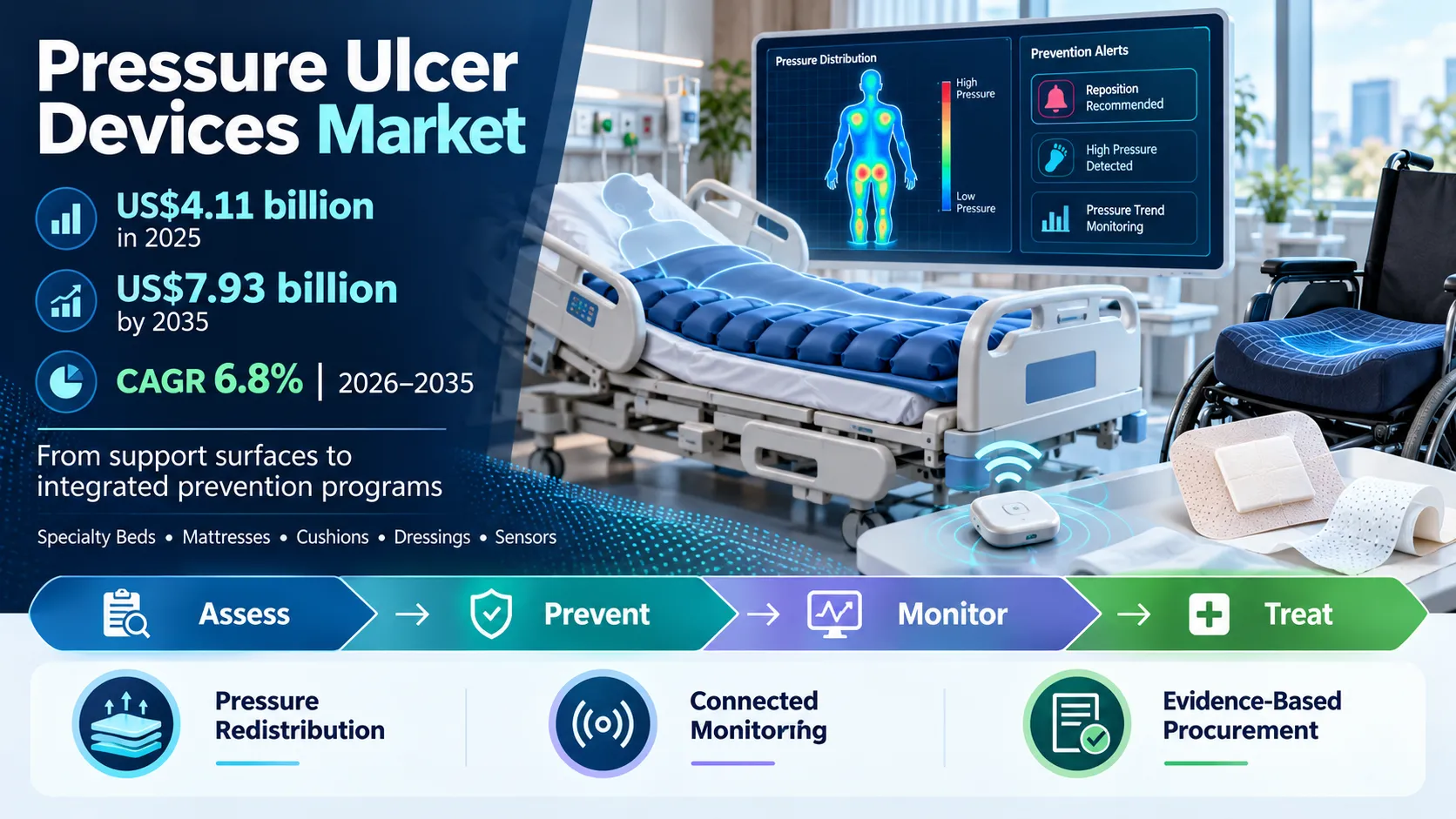
Pressure ulcer devices are shifting from individual mattresses and wound products toward integrated prevention programs. The market includes therapeutic pressure-relief mattresses, specialty beds, wheelchair cushions, positioning accessories, advanced wound dressings and sensor-enabled monitoring. Hospitals increasingly buy against measurable pressure-injury outcomes, caregiver workflow, patient comfort and the total cost of care.
DataM Intelligence values the global Pressure Ulcer Devices Market at US$4.11 billion in 2025 and projects US$7.93 billion by 2035, representing a 6.8% forecast CAGR. Pressure-relief mattresses account for 30.81% of 2025 demand, while North America holds 42.17% of the global market. Asia-Pacific offers the fastest regional expansion. Demand is supported by aging populations, immobility, patient-safety measures and growing homecare use.
The competitive field spans Stryker, Baxter/Hillrom, Arjo and LINET in support surfaces and specialty beds, alongside Smith+Nephew, Mölnlycke, Convatec and Coloplast in advanced dressings and wound-treatment systems. Connected monitoring is adding another layer of competition. At the June 2026 launch of Smith+Nephew’s next-generation LEAF platform, the company described the system as “a data-driven pressure injury prevention platform,” highlighting the shift to monitoring-led prevention. In July 2026, Arjo CEO Andréas Elgaard said, “We grew by 4.7% organically in the quarter,” reflecting demand for patient-care solutions and renewed focus on execution. These comments underscore the market’s twin priorities of clinical outcomes and operating performance.
Request Sample: https://www.datamintelligence.com/download-sample/pressure-ulcer-devices-market
Top 10 Companies Analysis
Stryker
Stryker’s IsoAir, Isolibrium and associated acute-care surfaces extend pressure management across bed fleets, critical care, stretchers and patient transfers. Its 2025 consolidated sales were approximately US$25.1 billion. Broad procurement relationships are a major advantage, although the figure includes many businesses beyond pressure-ulcer devices.
Baxter / Hillrom
Baxter’s Hillrom platform competes through specialty beds, support surfaces and connected hospital workflows. Its ability to coordinate equipment, patient positioning and nursing workflows is relevant to large integrated delivery networks. Baxter does not separately report a comparable 2025 pressure-ulcer-device revenue figure.
Arjo
Arjo offers Nimbus, Auralis Plus and related therapeutic support surfaces, complemented by patient-handling and mobility systems. Its 2025 sales were SEK 11.0 billion, equivalent to approximately US$1.15 billion using an indicative annual exchange conversion. Its own annual report identifies pressure-injury prevention as 16% of 2025 sales, highlighting unusual category visibility.
Smith+Nephew
Smith+Nephew combines ALLEVYN advanced dressings, PICO and RENASYS wound therapy with LEAF repositioning monitoring. The group reported US$6.164 billion of 2025 revenue. Its competitive strength lies in connecting prevention, early identification and wound management into the same clinical pathway.
Mölnlycke Health Care
Mölnlycke’s Mepilex Border and related silicone foam dressings support skin protection, prophylaxis and exudate management. The company has strong wound-care relationships, but a consistent publicly verified 2025 standalone revenue figure is not included here. Its differentiation is clinical familiarity and evidence-led dressing selection.
Convatec
Convatec’s AQUACEL and ConvaFoam technologies position the business in advanced dressings for chronic and acute wound management. Its recurring consumables model complements durable support surfaces supplied by other vendors. A verified 2025 group sales figure is not presented here, avoiding an inconsistent fiscal-year comparison.
Coloplast
Coloplast’s wound and skin-care offerings address moisture management, exudate control and broader care of fragile skin. Its portfolio provides a connection between hospital care and community nursing, though pressure-ulcer devices are only part of the wider company business.
LINET Group
LINET competes through hospital beds and anti-decubitus support surfaces, supported by equipment integration and care-facility service. Its commercial advantage is the ability to package therapeutic mattresses with the bed platform; comparable 2025 group revenue was not verified.
Joerns Healthcare
Joerns specializes in therapeutic support surfaces, medical beds and equipment for post-acute care. Its fit with skilled nursing, homecare and rental channels provides a different customer mix from acute-care equipment leaders. Standalone 2025 revenue is not publicly verified.
Medline
Medline provides pressure-injury prevention and wound-care supplies through large healthcare distribution relationships. Its advantage is coordinated procurement of consumables, positioning products and support equipment. The private company does not provide a directly comparable audited 2025 pressure-ulcer-device revenue figure.
Competitor Analysis: Leading Pressure Ulcer Device Players
| Company | 2025 Revenue (USD) | Core position | Strategic focus |
| Stryker | $25.1 billion | Beds, mattresses, transfer surfaces | Hospital fleet integration |
| Baxter / Hillrom | $11.4 billion | Specialty beds, support surfaces | Connected acute-care workflow |
| Arjo | $1.15 billion | Therapeutic surfaces and repositioning | Mobility plus prevention |
| Smith+Nephew | $6.164 billion | Dressings, LEAF, wound therapy | Prevention-treatment continuum |
| Mölnlycke | $2.27 billion | Silicone foam dressings | Skin protection |
| Convatec | $2.44 billion | Advanced wound dressings | Recurring consumable demand |
| Coloplast | $4.13 billion | Wound and skin care | Community-care reach |
| LINET | $398.0 million | Beds and anti-decubitus surfaces | Integrated equipment |
| Joerns Healthcare | $321.0 million | Support surfaces, post-acute beds | Rental and post-acute care |
| Medline | $28.4 billion | Wound products and distribution | Systemwide procurement |
Request Sample: https://www.datamintelligence.com/download-sample/pressure-ulcer-devices-market
Who Are the Rising Companies Influencing the Market?
- SYST’AM — Strategic focus: specialized pressure-redistribution seating, mattresses and rehabilitation surfaces.
- Direct Healthcare Group (DHG) — Strategic focus: therapeutic surfaces and pressure-care programs across post-acute and long-term care.
- XSENSOR — Strategic focus: pressure-mapping technology to make seating and mattress selection more measurable.
- Bruin Biometrics — Strategic focus: early risk assessment through tissue assessment and prevention workflow.
- Wheelchair-cushion innovators — Strategic focus: portable alternating-pressure systems for homecare and long-duration seated patients.
Major Mergers, Acquisitions and Portfolio Restructuring — 2026
- 14 July 2026 — Arjo reported commercial and management changes, adding five regional managers to sharpen market execution. This is an operating-model change, not an acquisition.
- 4 August 2026 — Smith+Nephew reported continued expansion of its connected LEAF pressure-injury prevention business and advanced wound-care portfolio during first-half results. This represents portfolio development rather than M&A.
- September 2026 — Arjo outlined a renewed corporate strategy and leadership priorities at its Capital Markets Day, with relevance to therapeutic surfaces and care settings beyond hospitals.
No material completed acquisition directly specific to pressure-ulcer devices was independently confirmed in the reviewed June–October 2026 announcements. Strategic changes are identified as such rather than labeled M&A.
Recent Innovations and Their Potential Impact: June–October 2026
- 1 June 2026 — Smith+Nephew launched the next-generation LEAF Patient Monitoring System in the US. Potential impact: wearable mobility tracking and documented turning status may improve protocol adherence and support prevention audits.
- 14 July 2026 — Arjo reported ongoing demand for capital equipment and service alongside commercial-organization changes. Potential impact: more consistent implementation and servicing of therapeutic surfaces across care facilities; this is a commercial development, not a new product launch.
- 4 August 2026 — Smith+Nephew reported double-digit growth in LEAF and early commercial traction for ALLEVYN COMPLETE CARE. Potential impact: a combined monitoring-and-dressing proposition could increase supplier influence over hospital prevention pathways.
- 4 September 2026 — Research by David M. Brienza and Michele A. Deppisch in Journal of Wound Care proposed standardized engineering-performance criteria for support-surface selection. Potential impact: more evidence-based mattress procurement and stronger differentiation for clinically validated products.
What Is Driving Competition in the Market?
Hospital-acquired pressure injuries impose clinical burdens and avoidable care costs. Buyers increasingly seek products backed by evidence on pressure redistribution, shear reduction, microclimate control, patient mobility and staff adherence. Connected devices may command a premium only if they demonstrate meaningful improvements rather than simply adding dashboards and alerts.
Procurement is also fragmenting across settings. Intensive care favors integrated beds and high-acuity therapeutic surfaces. Nursing homes need easy-to-service mattresses that fit staff capacity. Homecare increasingly requires compact cushions, quiet pumps and reliable distributor support. Leading companies must therefore tailor products and service economics to setting-specific requirements.
Competition will increasingly favor suppliers able to connect preventive mattresses and cushions with documentation, wound dressings, training and ongoing service. Clinical evidence, reimbursement fit and full-life equipment costs will remain as important as technological novelty.