


A study published in Scientific Reports in October 2026 evaluated a spray-type probiotic powder applied to underwear or panty liners as a possible approach to vaginal health. The findings add an unusual delivery format to research on the vaginal microbiome, but they do not show that the product prevents or treats bacterial vaginosis (BV). The study was small, lasted four weeks and had no control group.
That distinction matters for the women’s health probiotic supplements category. The product was not a conventional oral supplement: participants applied the powder to fabric that would contact the vulvovaginal area. Its relevance is therefore less about demonstrating a new product standard and more about raising questions for research and formulation teams: could a defined strain blend and a different delivery route be studied against measurable vaginal health outcomes?
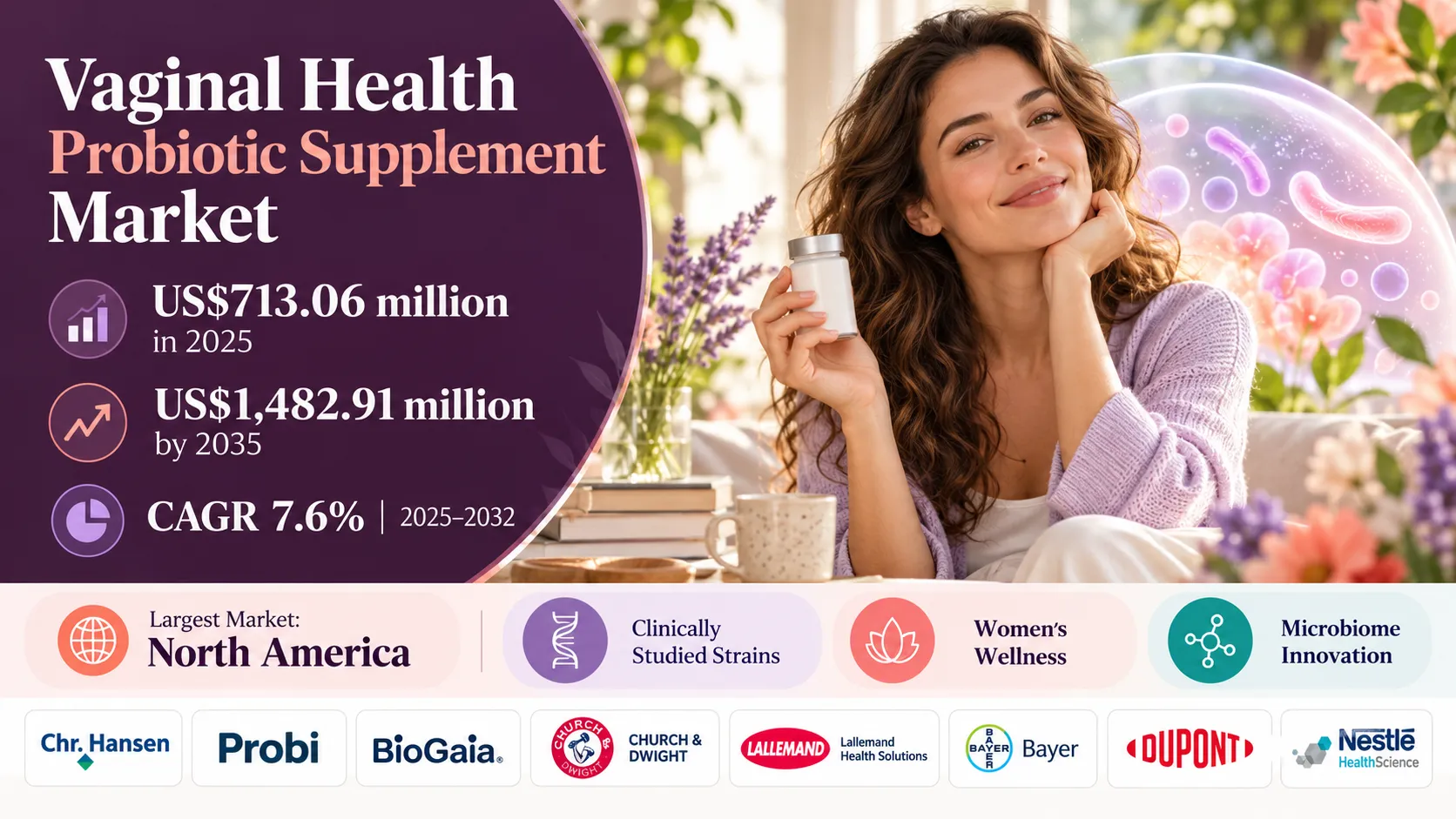
Request For Exclusive Sample: Womens Health Probiotics Supplements Market
What the Researchers Studied
The single-arm exploratory study was conducted at Ewha Womans University Hospital between December 2023 and June 2025. It enrolled 60 premenopausal women aged 19-55 who were considered at risk for BV. Participants were instructed to apply the powder once daily to underwear or panty liners in contact with the vulvovaginal area for four weeks. The formulation contained four Lactobacillus strains: L. plantarum, L. rhamnosus, L. paracasei and L. crispatus.
Forty-five participants completed the study, a completion rate of 75%. Researchers assessed vaginal symptoms and Nugent scores, alongside microbiome composition. A Nugent score is based on bacterial patterns seen in a vaginal Gram stain. Scores of 0-3 are consistent with a Lactobacillus-predominant microbiota, 4-6 indicate an intermediate profile and 7-10 are consistent with BV.
What the results showed-and what they did not
Overall, improvement in vaginal symptoms approached, but did not reach, conventional statistical significance (p = 0.051). The study reported a more notable change in the higher-risk subgroup, defined by a baseline Nugent score of 4 or higher. Among the 16 participants in that group, the mean score fell from 6.13 to 4.63; eight participants had a lower score at follow-up. The reported subgroup result was statistically significant (p < 0.001).
The findings were not uniformly positive across the measured outcomes. Overall Lactobacillus abundance and beta diversity did not change significantly. Three mild adverse events were reported, and the researchers observed no serious safety concerns during the study. These observations describe what happened in this small group over four weeks; they do not establish long-term safety or clinical effectiveness.
Because there was no control group, the study cannot determine whether the changes were caused by the powder. Symptoms and microbiome measures may change for reasons unrelated to the intervention. The authors also describe the work as exploratory and call for larger randomized controlled trials. The higher-risk subgroup result may help shape future research, but it is not a reliable basis for claiming that the product prevents BV.
Why delivery format is a product-development question
Oral capsules, vaginal suppositories and a powder applied to fabric differ in where and how they are used. A fabric-applied product raises practical questions that the study does not answer: how consistently the powder transfers during wear, how long live organisms remain viable after application, how storage affects potency, and whether users find the method comfortable and convenient.
These are formulation and usability questions, not findings from the trial. Product developers would need to assess them directly, including through stability testing and carefully designed user research. They would also need to define the intended use and document the strain identity and viable count over the product’s shelf life. A list of species alone does not establish that two products with different strains, quantities or delivery routes will have the same effects.
What this could signal for the women’s probiotic category
The study highlights a more specific research proposition than broad “women’s wellness” positioning: a defined group of strains, a defined use setting and outcomes measured in relation to vaginal microbiota. That specificity can help researchers formulate testable questions. It does not demonstrate consumer demand, commercial adoption or category-wide growth.
For companies developing women’s health probiotic supplements, the distinction between product type and evidence is especially important. The powder in this study was applied externally to fabric; it should not be described as an oral probiotic or treated as evidence for oral supplements. Nor does the result establish that the same strains, used in another product or format, would have the same effect.
A credible product concept would need to connect the formulation to evidence from research on that formulation and route of use. Brand language, ingredient familiarity and a plausible mechanism cannot substitute for product-specific clinical evidence.
Evidence gaps that matter
Several gaps need to be addressed before the findings can support strong clinical or commercial conclusions:
- A comparator group: Randomization and a control group would help distinguish a product effect from natural variation, expectation or other influences.
- More participants: Only 45 of the 60 enrolled women completed the study; the higher-risk subgroup included 16 participants.
- Longer follow-up: Four weeks cannot show whether any changes persist or relate to BV recurrence over time.
- Clear outcome priorities: Future trials should prespecify key clinical and microbiological outcomes and report them consistently.
- Replication across populations: This study took place at one hospital in South Korea. Further research would be needed to understand whether results apply to other populations, including women in the United States and Japan.
A result measured over a short period in a single-arm study is a starting point for further research, not a substitute for evidence that tests the product against an appropriate comparator.
U.S. and Japan: evidence and claims need local review
For a U.S. audience, product classification depends in part on how a product is intended to be used and represented. FDA defines dietary supplements as products intended for ingestion; it states that topical products are not dietary supplements under that definition. The study’s application method therefore should not be casually equated with an oral dietary supplement. FDA also says a product represented as treating, preventing or curing a disease is regulated as a drug, while the FTC expects health-related advertising claims to be truthful, not misleading and supported by adequate evidence.
In Japan, foods with health claims operate within defined labeling systems, and the Consumer Affairs Agency states that these foods are not intended to diagnose, treat or prevent disease. A study of a fabric-applied powder does not establish how a product would be classified or what claims could be used in Japan. Those questions would require product-specific regulatory review.
A more credible way to position innovation
Scientific specificity may help women’s health products communicate what they contain and what has actually been studied. That means identifying strains accurately, explaining the delivery method plainly and distinguishing laboratory rationale from clinical results. It also means describing limitations in a way readers can understand.
For commercial teams, the central questions are straightforward: What use case is the product designed for? Is the route supported by product-specific evidence? Are strain identity, quantity and stability documented? Which claims are supported by controlled human research, and which remain hypotheses? Answering those questions can produce more credible product positioning than relying on broad promises about “balance” or “wellness.”
Frequently Asked Questions
What did the October 2026 study test?
It evaluated a spray-type probiotic powder containing four Lactobacillus strains. Participants applied it once daily to underwear or panty liners for four weeks.
Was the product an oral probiotic?
No. The powder was applied to fabric in contact with the vulvovaginal area. It was not taken as an oral capsule.
How many participants completed the study?
Forty-five of the 60 enrolled participants completed the four-week study. The higher-risk subgroup analysis included 16 participants.
Did the study prove that the product prevents or treats BV?
No. The study was exploratory and single-arm, with no control group. The results do not establish that the powder prevents or treats BV.
What evidence is still needed?
Larger randomized controlled trials with comparator groups, longer follow-up and clearly defined clinical outcomes would help determine whether the findings can be reproduced and whether they have clinical relevance.