


U.S. Data Center Power Market: Why Grid Capacity and Cost Allocation Matter for AI Infrastructure
AI infrastructure is turning electricity capacity into a strategic input while regulators decide how much of the grid buildout should sit with hyperscalers, utilities and ordinary ratepayers.
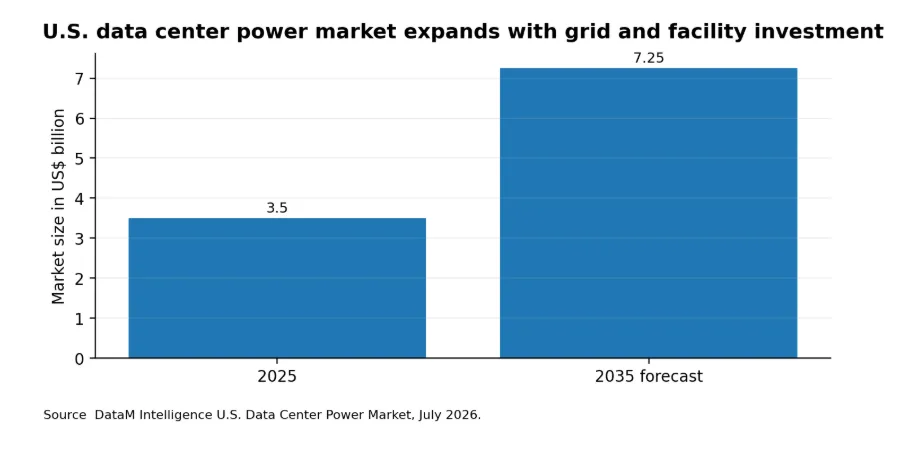
The next phase of the AI data center boom is increasingly being decided outside the server hall. Electricity supply, transmission capacity and the allocation of grid investment costs are becoming central constraints on where new campuses can be built and how quickly they can reach commercial operation. DataM Intelligence estimates that the U.S. Data Center Power Market reached US$ 3.50 billion in 2025 and could reach US$ 7.25 billion by 2035, reflecting rising spending on power distribution, backup systems, intelligent monitoring and grid connected infrastructure.
The conflict is becoming more visible because AI campuses can add hundreds of megawatts of concentrated demand in locations where generation and transmission were planned for a very different load profile. Utilities must expand substations, transmission corridors, generation capacity and storage before the revenue from a new campus is fully proven. Regulators are therefore asking a more difficult question than whether data centers should connect to the grid. They are deciding which customer should carry the financial risk if projected demand arrives late, scales more slowly than expected or disappears.
Request a Free Sample of the U.S. Data Center Power Market Report
Explore the latest market size, growth trends, competitive landscape, power infrastructure solutions, and investment opportunities shaping the U.S. data center power market. Get a free sample market report with exclusive analyst insights, market forecasts, segmentation analysis, charts, tables, and the detailed research methodology before purchasing the full report.
U.S. Load Growth Is Turning Grid Cost Allocation Into a Public Policy Issue
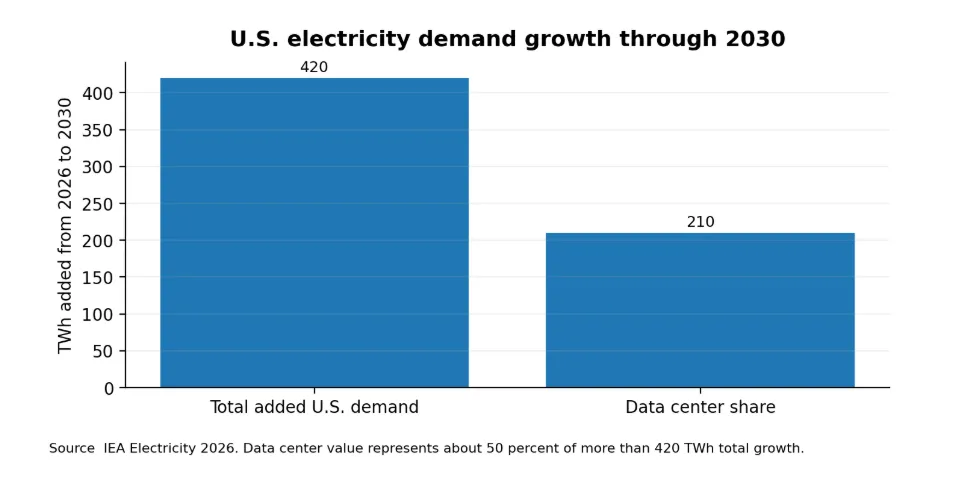
The scale of the U.S. demand shift explains why cost allocation is now moving into state regulatory proceedings. The International Energy Agency expects U.S. electricity consumption to add more than 420 TWh between 2026 and 2030. Data center expansion is expected to account for about half of that increase. This is a major reversal from the relatively flat electricity demand environment that shaped utility planning across much of the previous decade.
The challenge is concentrated demand rather than national energy availability alone. New campuses tend to cluster around fiber routes, cloud regions, favorable tax regimes and existing data center ecosystems. Northern Virginia, Texas, Georgia and parts of the Pacific Northwest therefore face infrastructure pressure that can be much larger than national averages suggest. Grid planners may need new transmission lines, substations and generation years before a data center has reached full utilization.
Virginia has moved furthest toward separating hyperscale customers from the broader rate base. The State Corporation Commission created a GS 5 rate class for large load customers so that the costs of serving hyperscale data centers can be recovered separately. New large load customers contracting from January 2027 will face a minimum service obligation of at least 14 years. These customers must also pay at least 85 percent of monthly transmission and distribution costs incurred to serve them, even when actual electricity use is lower. Customers with insufficient credit can be required to provide financial support covering up to 60 percent of minimum charges over the contract term.
| 14 years Minimum contract obligation | 85 percent Minimum monthly transmission and distribution cost recovery | Up to 60 percent Potential collateral coverage of minimum charges |
Texas is moving in the same direction. In June 2026, Governor Greg Abbott directed the Public Utility Commission and ERCOT to require data centers to fully fund the electric infrastructure needed to serve their operations. The directive also called for measures that reduce residential transmission costs and for future legislation requiring large campuses to add electric capacity as they expand demand. Georgia Power has adopted a different structure with similar economics. Large users of 100 MW or more can be required to pay local infrastructure costs upfront, sign contracts lasting 15 to 25 years, maintain minimum bills and provide termination protection.
The Core Conflict Is Who Carries the Risk of Building Ahead of Demand
Traditional utility regulation spreads many network investments across a broad customer base because transmission and generation assets serve the system for decades. AI data center development challenges that model because a single customer can trigger infrastructure commitments comparable with those created by an entire city. If a hyperscale project changes location or delays its buildout, the utility can be left with infrastructure that must still be paid for.
This is why minimum demand charges, long term contracts, collateral requirements and direct infrastructure contributions are becoming central to data center tariffs. These mechanisms shift stranded asset risk toward the customer creating the demand. They also create a more credible signal for utility planners because developers have a financial incentive to request only the capacity that they expect to use.
The issue also reaches generation planning. A 2026 grid expansion study modeled data centers reaching 17.5 percent of annual demand in an ERCOT like system and found that the least cost response required an 83.6 percent increase in generation capacity over the planning horizon. The study highlighted construction timing as a critical variable because slow transmission and generation projects can force earlier spending or increase reliance on faster resources such as solar, storage and flexible thermal generation.
Explore the Data Center Construction Market Report
Gain deeper insights into the global Data Center Construction Market, including market size and forecasts, growth drivers, infrastructure trends, competitive landscape, investment opportunities, and regional developments. Understand how AI workloads, hyperscale expansion, liquid cooling, modular construction, and sustainability are reshaping data center development through 2033. Request a Sample Report Today!
Global Markets Are Moving Toward Conditional Grid Access
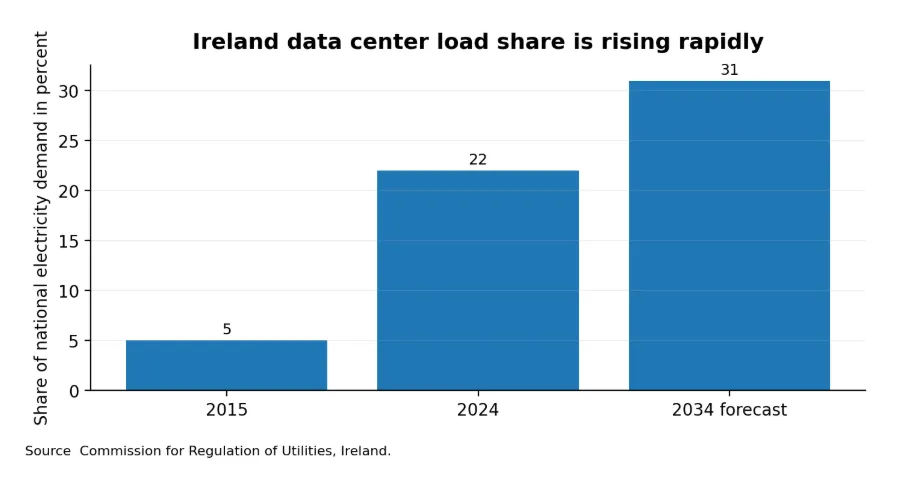
The debate extends well beyond the United States. Ireland demonstrates how concentrated digital infrastructure can reshape national electricity planning. Data centers represented about 5 percent of national electricity demand in 2015 and 22 percent in 2024. The Commission for Regulation of Utilities expects the share to reach about 31 percent by 2034 under currently contracted demand. New connection rules now require data centers to provide generation or storage capacity near the requested load and to match at least 80 percent of annual demand with additional renewable electricity developed in Ireland.
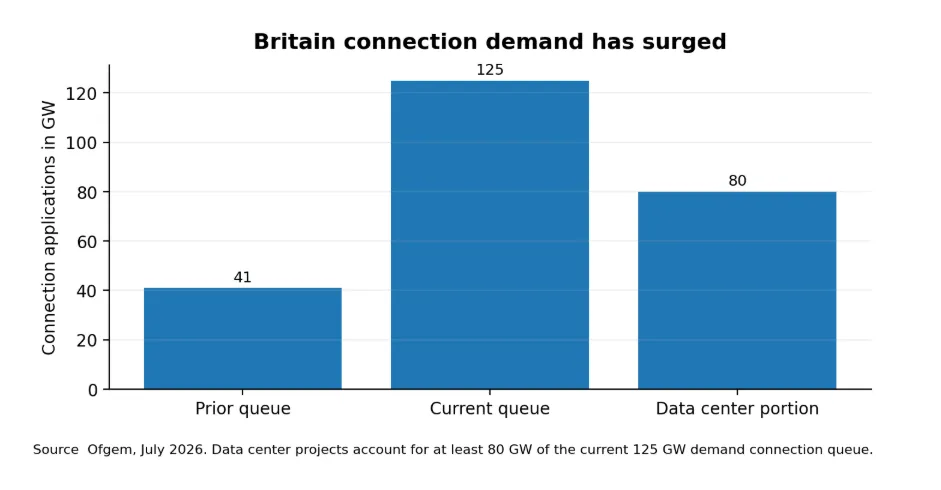
Britain is facing a different version of the same capacity problem. Ofgem reported in July 2026 that demand connection applications had surged from 41 GW to 125 GW in less than a year, with data center projects accounting for at least 80 GW. The regulator is considering commitment fees and project milestones to remove speculative projects from the queue and preserve scarce grid capacity for developments that are ready to connect.
These policies point toward a global shift in grid access. Large data center operators will increasingly be expected to arrive with credible power strategies that include firm capacity, storage, renewable procurement, flexible demand and financial commitments. Regions with limited transmission headroom are likely to impose stronger conditions than markets where generation and grid capacity can expand more quickly.
Power Flexibility Could Become the Compromise Between Data Center Growth and Ratepayer Protection
The cost conflict becomes easier to manage when data centers can behave as flexible grid participants rather than fixed loads. Battery energy storage can reduce peak demand, provide ride through power and support grid services. Onsite generation can reduce dependence on constrained transmission corridors. Workload management can move selected computing activity across time or geography when system conditions tighten.
This creates a growing investment opportunity around infrastructure that allows AI campuses to absorb more of their own power risk. DataM Intelligence estimates that the AI Data Center BESS Market could increase from US$ 1.65 billion in 2025 to US$ 31.97 billion by 2035. The expansion reflects demand for backup power, peak management, renewable firming and grid services across high density AI facilities.
The same investment cycle is expanding opportunities for busways, substations, transformers, switchgear and intelligent power distribution. DataM Intelligence projects the global Data Center Busway Market to rise from US$ 2.38 billion in 2025 to US$ 5.76 billion by 2035. These systems become increasingly important as power density rises and operators need modular distribution that can be reconfigured across rapidly changing AI halls.
The Winning Regions Will Link Data Center Permitting to Power Capacity Earlier
Regional competitiveness in AI infrastructure is becoming tied to the quality of power planning. Fast permitting has limited value when transmission upgrades take years. Low electricity prices provide less advantage when a site cannot obtain firm capacity. Tax incentives can also lose political support when households believe they are subsidizing grid assets for technology companies with very large balance sheets.
The strongest markets are therefore moving toward earlier coordination between utilities, regulators, data center developers and generation providers. Developers will need to secure credible demand forecasts and provide more financial assurance. Utilities will need transparent connection processes and faster infrastructure delivery. Regulators will increasingly test whether tariffs prevent cost shifting while still allowing strategically important digital infrastructure to grow.
The question of who pays for the grid will shape which projects are financeable through the rest of the decade. Data centers that can bring capital, flexibility and power supply solutions alongside compute capacity will have an advantage in constrained markets. Regions that create clear cost allocation rules can expand AI infrastructure without forcing households and smaller businesses to absorb uncertain development risk.
About DataM Intelligence
DataM Intelligence is a global market research and consulting firm that empowers organizations with actionable market intelligence, competitive insights and strategic advisory services. Serving clients across 100 plus countries and 35 plus industries, the company delivers syndicated reports, custom research, competitive intelligence and virtual research support to help businesses identify growth opportunities, assess market trends and make confident data driven decisions. Its expertise spans healthcare, life sciences, chemicals, energy, ICT, automotive, food and beverage, packaging and advanced materials.