


Virtual PLC & Software-Defined Automation Perspective 2026
| PARADIGM SHIFT | Control logic is separating from dedicated PLC hardware and moving into containers, edge servers and standardized computing infrastructure. |
| PRODUCTION SIGNAL | Audi has progressed from 2023 lab tests to small-series production and, in 2026, large-volume body-shop deployment at Neckarsulm. |
| COMMERCIAL QUESTION | Which manufacturers, machine builders and PLC vendors are most exposed to a transition from device-centric automation to centrally managed software-defined control? |
The PLC Is No Longer Defined by the Box
For decades, programmable logic controllers were inseparable from dedicated industrial hardware. The control logic, processor, communications stack and vendor ecosystem arrived as one physical device. Virtual PLCs break that model. The runtime becomes software that can be deployed in a virtualized environment - on industrial PCs, edge servers or centralized data-center infrastructure - while the field I/O remains distributed close to the machine.
IoT Analytics describes this as a paradigm shift because control logic is decoupled from specific hardware. The commercial implication is larger than controller replacement. Once PLC runtimes can be instantiated, updated and scaled as software, automation starts to inherit the operating model of enterprise IT: centralized deployment, version control, remote lifecycle management and infrastructure consolidation.
Request Executive Sample: https://www.datamintelligence.com/download-sample/virtual-plc-market
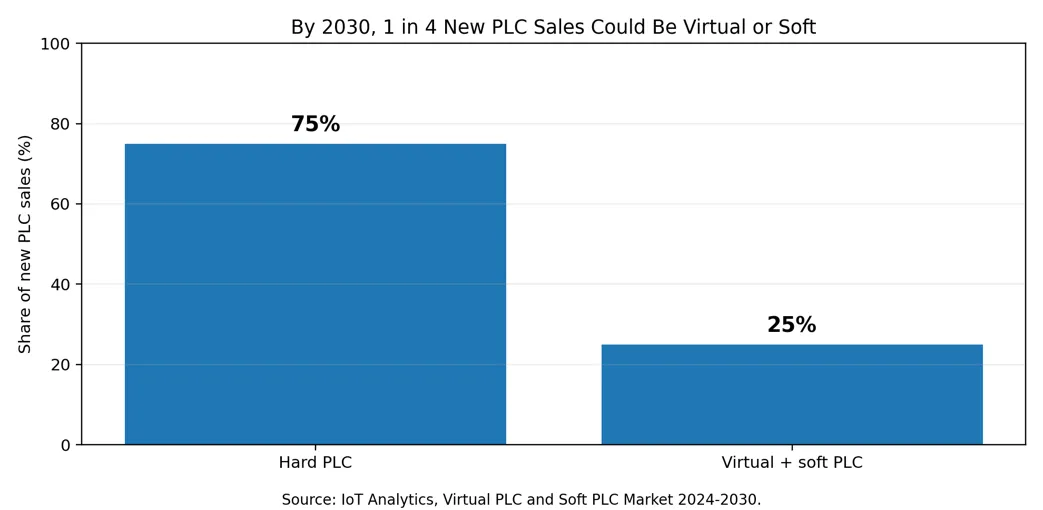
IoT Analytics estimates that virtual and soft PLCs could represent roughly one quarter of new PLC sales by 2030. That does not mean hard PLCs disappear. It means a material portion of new automation investment could shift from proprietary controller hardware toward runtime software, licenses and standardized compute.
Audi Has Turned vPLC Into a Production Architecture
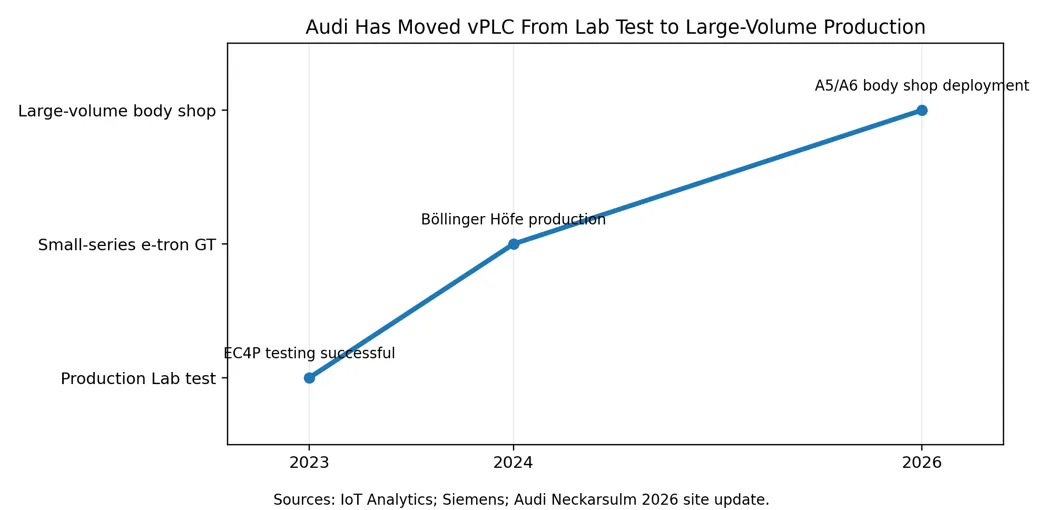
Audi is the clearest proof that this architecture is moving beyond lab demonstrations. Edge Cloud 4 Production was tested successfully in 2023. The virtual PLC then entered production for the e-tron GT at Bollinger Hofe in 2024. Audi’s 2026 Neckarsulm site update says centralized Edge Cloud control is now being introduced in the highly automated body shop for the A5 and A6 series, marking the first use in large-volume production.
This matters because automotive body shops are demanding control environments. They combine robots, conveyors, safety zones, vision, welding cells and synchronized material flow. If vPLC can move from a small-series line into large-volume body production, it becomes much harder to dismiss software-defined control as an edge-only or noncritical automation experiment.
The Maturity Gap Is Closing - But Not Evenly
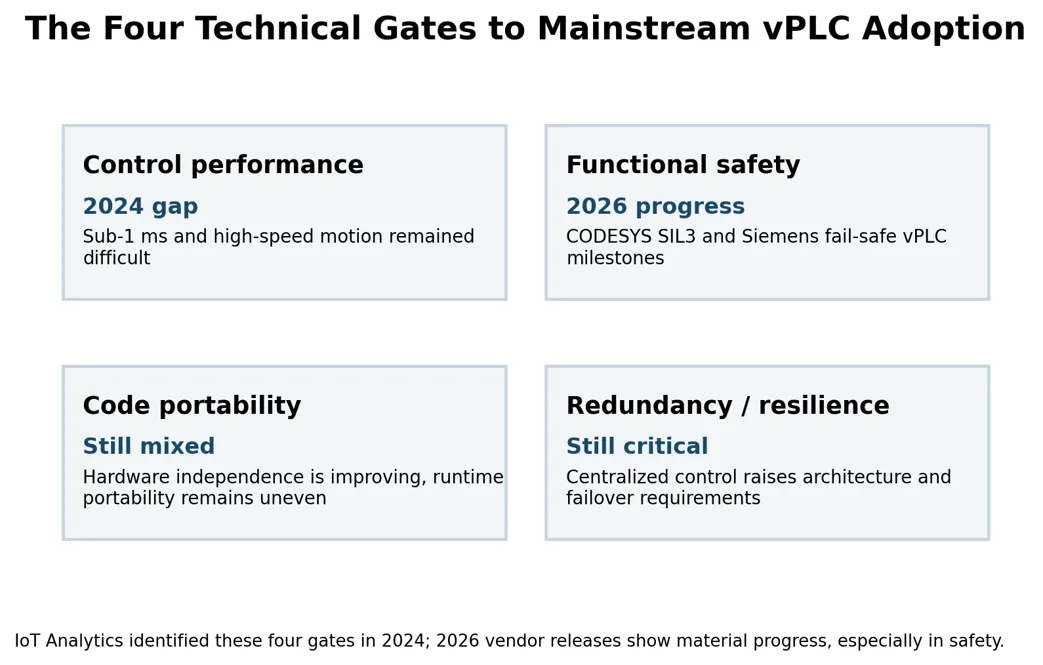
IoT Analytics identified four technical gates that had to be solved before vPLCs could challenge hard PLCs broadly: control performance, functional safety, code portability and redundancy. In 2024, the market was still immature across all four. By 2026, the picture is more differentiated.
Safety is the clearest area of progress. CODESYS now markets Virtual Safe Control SL as an IEC 61508 SIL3-compliant virtual safety controller, and Siemens describes its fail-safe virtual PLC as TÜV-certified. CODESYS also supports multiple independent instances on standard x86 or Arm 64-bit hardware, while Phoenix Contact has commercialized OCI-container virtual controllers across several performance tiers.
The remaining challenges are architectural. Centralizing many control workloads creates new resilience requirements. Runtime portability is improving, but true vendor-to-vendor code portability remains incomplete. And the fastest motion-control tasks still place tighter demands on deterministic latency than basic logic, sequencing or supervisory control.
Why Manufacturers Want the Shift
| Centralized lifecycle | Hardware consolidation |
Deploy and update controller software remotely instead of touching individual devices on the line. | Run multiple control instances on shared compute rather than adding a dedicated PLC for every function. |
| Faster reconfiguration | IT-style engineering |
Add or modify control capacity through software when product mix or line requirements change. | Bring Git, DevOps, text-based engineering and standardized infrastructure deeper into automation. |
Audi explicitly cites long hardware delivery times, manual updates, maintenance cost and growing energy consumption from distributed hardware as reasons for moving toward Edge Cloud 4 Production. Siemens says software deployment removes delays associated with hardware delivery and allows updates to be rolled out centrally. These are operating-model benefits, not just hardware-cost savings.
Vendor Momentum Is Expanding the Addressable Use Cases
Request a Customized Report According to Your Business Strategy: https://www.datamintelligence.com/customize/virtual-plc-market
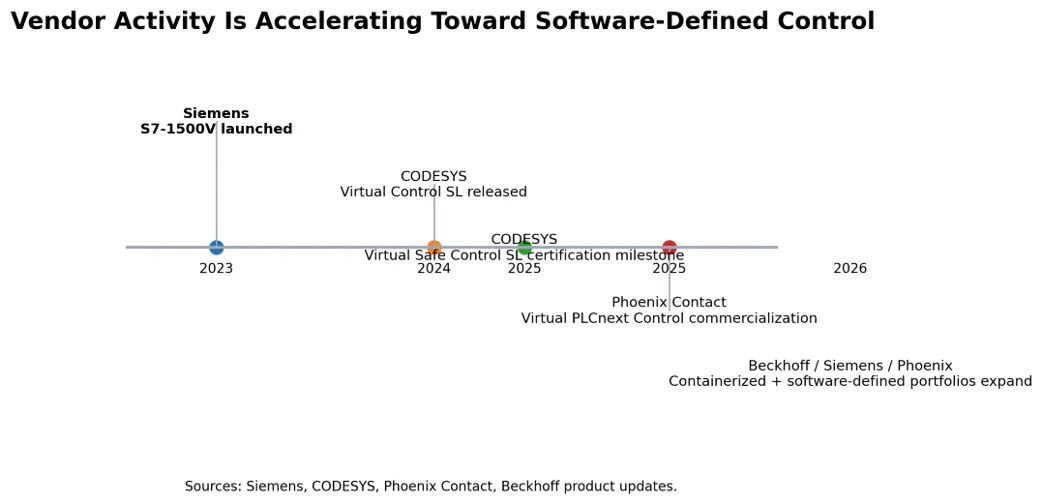
The ecosystem is widening quickly. Siemens is extending software-defined engineering with Simatic AX into motion control and global Logic Control availability. CODESYS is positioning Virtual Control SL for compact control, motion and high-performance PLC use cases with license-scaled performance. Phoenix Contact now offers OCI-container virtual controllers for industrial PCs, edge systems and servers. Beckhoff is enabling TwinCAT PLC runtimes and functions to run as Linux containers locally or in data-center environments.
This is significant because vPLC adoption depends on more than a single controller product. It needs engineering tools, deployment orchestration, safety, industrial networking, real-time Linux, cybersecurity, diagnostics and lifecycle support. The competitive unit is increasingly the software-defined automation stack.
Where the Commercial Opportunity Is Forming
| Signal | What it means for the market | Commercial question |
| Automotive production rollout | Body-shop deployment validates vPLC in highly automated, high-availability manufacturing. | Which OEMs and Tier 1s are preparing centralized control architectures next? |
| Safety certification advances | Virtual control can address a larger share of machine and production applications. | Which use cases are now technically qualified versus still restricted? |
| Containerized vendor portfolios | Controller instances can scale on standardized x86/Arm infrastructure. | Which vendors capture software licenses, orchestration and support revenue? |
| IT-style engineering | Git, DevOps and centralized deployment move into PLC engineering. | Which plants have the skills and architecture to migrate without increasing operational risk? |
The Market Is Not Just PLC Hardware Moving Into Software
The strategic mistake would be to model virtual PLCs as a simple substitution ratio against hard PLC shipments. The value pool is moving across several layers at once: controller runtimes, industrial compute, edge orchestration, real-time operating environments, cybersecurity, industrial Ethernet, safety software, engineering tools and lifecycle services.
That creates a new competitive map. Traditional PLC leaders must protect installed hardware franchises while building recurring software revenue. Hardware-independent automation suppliers can expand into control without owning the box. Industrial PC and server vendors gain exposure to workloads previously locked inside controllers. System integrators gain a larger role because support responsibility now spans IT and OT infrastructure.
What Buyers Need From a Virtual PLC Market Report
• Virtual PLC vs soft PLC vs hard PLC definitions and adoption boundaries
• 2026-2035 market sizing by runtime type, deployment architecture, industry and region
• Automotive, electronics, machine-building, food & beverage, chemicals and process-industry adoption readiness
• Vendor mapping across Siemens, CODESYS, Phoenix Contact, Beckhoff, Schneider Electric and emerging software-defined automation players
• Safety certification, real-time performance, redundancy, portability and cybersecurity comparison
• Installed-base migration scenarios and the risk to traditional hardware PLC revenue
• Audi and other lighthouse deployments, with use-case and architecture analysis
• Commercial models: perpetual license, subscription, runtime instance, orchestration, support and automation-as-a-service
The key market question is no longer whether PLC logic can be virtualized. It is how quickly manufacturers will trust software-defined control with larger portions of production - and which vendors capture the new software and lifecycle revenue.