


Virtual PLC Market Overview
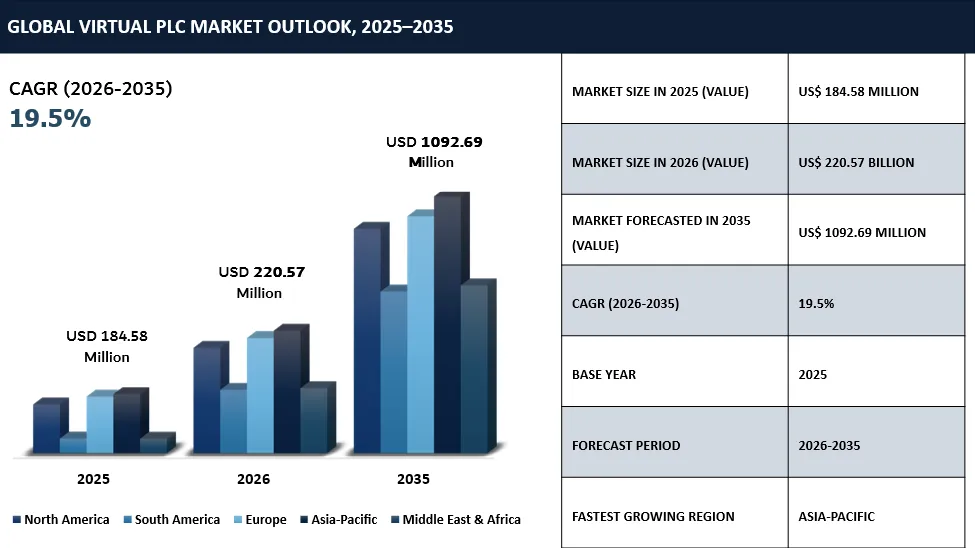
Demand for Virtual PLCs is gaining momentum owing to the increasing requirement for scalable and hardware-free industrial control solutions in various sectors such as manufacturing, automotive, electronics & semiconductors, pharmaceuticals, food & beverages, energy and logistics industries. With the growing adoption of software-defined automation, industrial edge computing and IT/OT convergence, manufacturers have started migrating from traditional hardware-driven programmable logic controllers to software-based control systems. Virtual PLCs allow manufacturers to leverage industrial control functionalities with the help of compatible industrial PCs, edge servers and virtualized computing platforms in order to make the most out of their computing resources while simplifying the process of automation system management. Furthermore, investments in smart manufacturing, industry 4.0 efforts and industrial digitalization are driving innovations in the area of containerized and virtual machine-based control systems. Providers of industrial automation solutions like Siemens, Beckhoff Automation, Phoenix Contact and CODESYS are developing software-based control solutions to fulfill the emerging requirements of the manufacturing industry. Increasing demand for flexible production lines, distributed automation and scalable industrial control infrastructure will create an opportunity for Virtual PLCs adoption. But deterministic performance constraints, functional safety certification, security issues and interoperability with legacy systems continue to pose significant barriers to adoption.
Virtual PLC Market Strategic Insights
- Commercialization of Hardware-Independent PLC Platforms: The Virtual PLC market is shifting from traditional control systems that rely on hardware to commercially viable software controllers. The SIMATIC S7-1500V from Siemens allows for PLC applications to be deployed as software through computing platforms that are capable of supporting such solutions with centralized management and deployment through Industrial Edge. Phoenix Contact launched their Virtual PLCnext Control in September 2026, adding to this competitive market with container-based control on industrial PCs, edge systems and server platforms. These developments show increasing commercialization and product diversification in the Virtual PLC market.
- Containerization and Multi-Instance Controller Deployment: Container-based Virtual PLC architectures are creating opportunities to operate multiple control instances on shared computing infrastructure rather than relying exclusively on individual physical controllers. Phoenix Contact's Virtual PLCnext Control supports parallel virtual control instances, scalable computing resources and application portability across compatible hardware platforms. This architecture can improve infrastructure utilization and simplify controller deployment, updates and lifecycle management, making containerization an important competitive differentiator.
- Safety-Certified Virtual Control as a Differentiation Opportunity: Functional safety is becoming a key differentiator for products as Virtual PLCs find their way into applications that require reliable and certified control systems. Two examples that demonstrate the growing trend towards safety-related virtual controllers are CODESYS Virtual Control SL and Siemens SIMATIC S7-1500V F. Appropriately certified virtual controllers can increase the application potential in safety-critical industries such as automotive manufacturing and machinery. Yet certification and real-time performance validation are important obstacles to successful commercialization.
- Industrial Deployment and Legacy-System Migration: The early industrial deployments have provided the practical proof of the evolution from hardware-centric to software-driven automation. The example of Audi's deployment of SIMATIC S7-1500V by Siemens shows the application of virtual controllers in an actual production environment where the controllers are centrally managed and integrated into the IT-oriented factory infrastructure. These deployments serve as an example for the manufacturer who seeks to consolidate their controllers, reduce reliance on special hardware, manage them remotely during their entire lifecycle and update their automation systems. Migration needs compatibility with current engineering software, industry networking, input/output (I/O) and deterministic control capabilities.
WHY CHOOSE DATAM?
- Accelerated Customer Identification – Target 2.0× Qualified Sales Leads: Assist Virtual PLC companies to double their pool of qualified leads using industrial OEM identification, machine builder profiling, system integrator mapping and manufacturing end user segmentation. DataM makes it possible for companies to identify high potential industrial customers, prioritize adoption opportunities, improve lead qualification and accelerate customer acquisition.
- Faster Market Entry & Business Expansion – Target 25% Reduction in Market Entry Time: Assist Virtual PLC companies to shorten market entry time through regional opportunity assessment, industrial automation eco-system mapping, regulatory information and technology partner identification. DataM enables fast market entry and growth through strategic partnerships and business growth in manufacturing and process industries.
- Stronger Competitive Positioning – Target 25% Improvement in Sales Win Rate: Assist Virtual PLC companies to increase sales win rate through competitor benchmarking, product capability assessment, price intelligence and technology portfolio analysis. DataM helps in identifying competitive advantages, improving differentiation between containerized and VM based control platforms and improve customeracquisition strategies.
- Higher Customer Revenue & Account Expansion – Target 1.25× Revenue per Key Account: Assist Virtual PLC companies in increasing revenue by 25% from their key customers through analysis of customer applications, runtime licensing, controller instance opportunities and cross-selling opportunities. DataM can assist in identifying ways to expand the reach of Virtual PLCs, safe control systems and industrial automation software while at the same time building customer relationships.
- Improved Pricing & Profitability – Target 2 Percentage-Point Gross Margin Improvement: Help Virtual PLCs enhance their gross margin through pricing intelligence, software licensing, subscription benchmarking and customer willingness-to-pay assessments. DataM will help to make better pricing decisions, optimize software licensing, conduct effective commercial negotiations and ultimately drive greater profitability.
- Strategic Partnerships & Channel Expansion – Target 1.5× Customer Acquisition: Help Virtual PLC firms grow their channel customer acquisitions through industrial system integration maps, identification of automation technology partners and analysis of the industrial computing ecosystem. DataM helps with greater partnerships with machine builders, industrial PCs firms, cloud-edge infrastructure companies and automation distributors to enhance commercial opportunities.
- Improved Demand Forecasting & Revenue Protection – Target 25% Reduction in Forecast Errors: Help Virtual PLC firms reduce demand forecasting errors through Virtual PLC adoption maps, software licensing demand forecasts, industrial automation investment assessments and regional deployments scenarios. DataM helps with better sales forecasting, efficient resource allocation, better subscription/licensing revenue forecasts and stronger commercial decision-making.
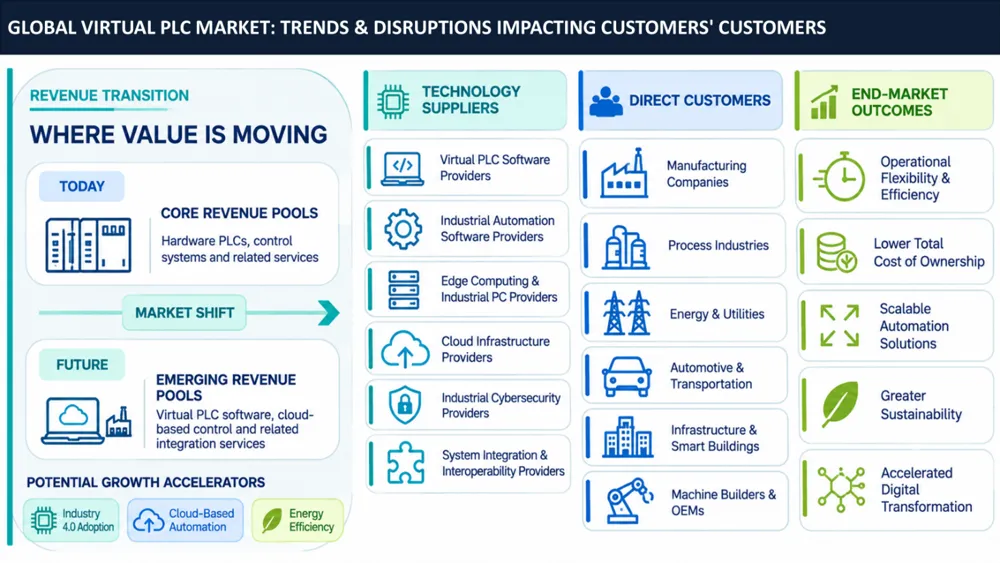
Virtual PLC Market: Trends & Disruption Impacting Client Customers
Virtual PLC Market: Commercial Use Cases Across Industries
| COMPANY | USE CASE DESCRIPTION | BENEFITS |
 | SIMATIC S7-1500V enables virtualized PLC execution for machine automation, production line control and industrial applications on compatible computing infrastructure. | Hardware-independent control execution; flexible deployment; simplified automation system scalability and lifecycle management. |
 | TwinCAT software-based control supports machine automation, motion control and production systems through deployment on industrial PCs and compatible computing environments. | Reduced dependence on dedicated controller hardware; flexible computing resource allocation; integrated motion and machine control. |
 | Virtual PLCnext Control enables container-based automation for distributed industrial control applications across compatible industrial edge computing environments. | Containerized control deployment; hardware flexibility; scalable industrial edge automation and application integration. |
 | CODESYS Virtual Control SL provides software-based PLC runtimes for industrial automation applications on standard computing hardware and virtualized infrastructure. | Hardware-independent PLC execution; flexible runtime deployment; reduced controller hardware dependency. |
 | logiccloud CONTROL provides virtual PLC functionality for developing and deploying software-defined industrial control applications across connected computing environments. | Flexible control deployment; centralized engineering and management; reduced dependence on conventional PLC hardware. |
Global Virtual Plc Market Ecosystem
The global Virtual PLC market ecosystem comprises Virtual PLC software developers, industrial automation and control technology providers, industrial computing hardware manufacturers, virtualization and cloud infrastructure providers, system integrators and industrial end users. Together, these stakeholders support the development, deployment, integration and management of software-based industrial control systems across manufacturing, automotive, electronics and semiconductor, pharmaceuticals, energy and logistics applications.
VIRTUAL PLC SOFTWARE AND PLATFORM PROVIDERS | INDUSTRIAL AUTOMATION AND CONTROL TECHNOLOGY PROVIDERS | INDUSTRIAL COMPUTING, VIRTUALIZATION AND CLOUD INFRASTRUCTURE PROVIDERS |
| Siemens AG (Germany) | Beckhoff Automation (Germany) | Advantech Co., Ltd. (Taiwan) |
| CODESYS Group (Germany) | Phoenix Contact (Germany) | Dell Technologies (USA) |
| logiccloud (Germany) | Schneider Electric (France) | Hewlett Packard Enterprise (USA) |
| OTee (Norway) | Emerson Electric Co. (USA) | Intel Corporation (USA) |
| Autonomy Logic – OpenPLC (USA) | HollySys Automation Technologies (China) | Microsoft Corporation (USA) |
Virtual PLC Market: BCG Matrix Analysis
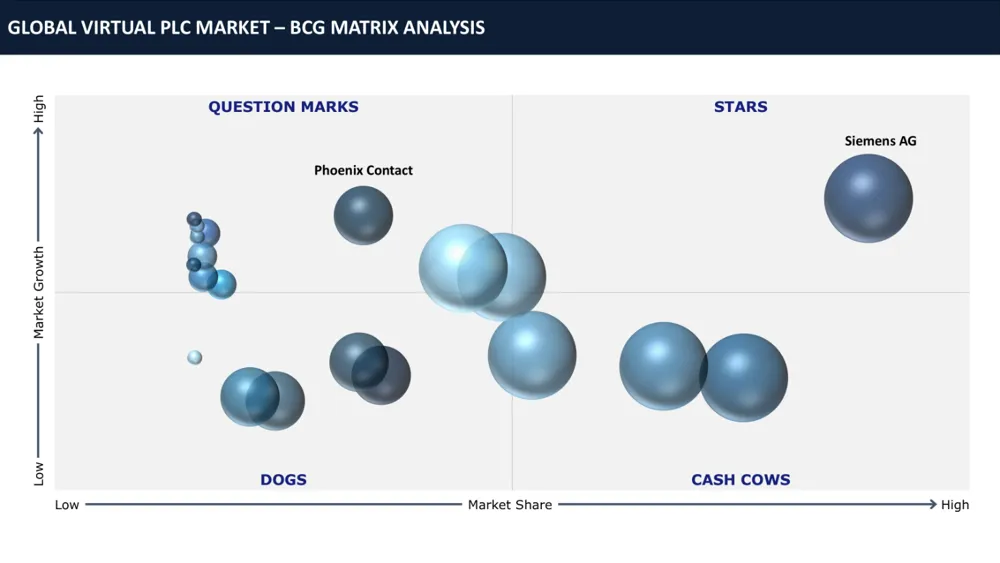
- Stars: Siemens SIMATIC S7-1500V, container-based Virtual PLCs and software-defined automation platforms exhibit strong growth potential.
- Cash Cows: Established industrial automation platforms and conventional PLC systems generate stable revenues through mature installed bases and recurring customer demand.
- Question Marks: Phoenix Contact Virtual PLCnext Control, CODESYS Virtual Control SL, logiccloud CONTROL and emerging Virtual PLC platforms represent developing market opportunities.
- Dogs: Legacy proprietary control architectures with limited virtualization capabilities face competitive disadvantages as software-defined automation adoption increases.
Virtual PLC Market: Key Market Players
- Beckhoff Automation (Germany)
- CODESYS Group (Germany)
- logiccloud (Germany)
- OTee (Norway)
- Phoenix Contact (Germany)
- Siemens AG (Germany)
- HollySys Automation Technologies (China)
- Schneider Electric (France)
- Emerson Electric Co. (USA)
- OPENLOGIC Automation
- Autonomy Logic (USA)
Global Virtual PLC Market Recent Developments
- logiccloud - November 2026: logiccloud introduced an enhanced version of the CONTROL platform on November 20, 2026, which facilitates Virtual PLC operations on Kubernetes with the help of the MARGO Kubernetes Agent. This enhancement brings additional capabilities of supporting Weidmüller u-OS, Revolution Pi and EtherCAT, along with being deployable on OpenShift, MicroShift and k3s platforms. The company claims that hundreds of Virtual PLCs can run on the same Kubernetes infrastructure, emphasizing the scalability capabilities of containerized industrial control.
- Phoenix Contact - November 2026: Security Advisory VDE-2026-084 published by Phoenix Contact on November 4, 2026, outlined a series of vulnerabilities within licensing validation of the CodeMeter Runtime used in PLCnext devices and Virtual Controls, which could potentially lead to unauthorized access to sensitive information, as well as licensing system destruction. Phoenix Contact recommended appropriate network protection and a firmware fix scheduled for Q4 2026. This is an indication of the significance of security licensing, vulnerability management and cybersecurity resilience in business Virtual PLC implementations.
- CODESYS Group – October 2026: Virtual Control SL version 4.23.0.0 by CODESYS was released on October 22, 2026, with updated runtime software and enhanced Virtual Safety Runtime from CODESYS. The corresponding upgrade of the Virtual Safe Control SL is compatible with both the ARM64 and x64 CPU architectures, making it possible to run safety applications of SIL 3 level in containers together with functional CODESYS controllers. The development increases compatibility and flexibility in the implementation of safety-oriented virtualized industrial control systems.
- Phoenix Contact - September 2026: Phoenix Contact developed a new Virtual PLCnext Control software controller, which allows the separation of control functionalities from PLC hardware. This container-based technology makes possible to install the controller on industrial PCs, edge computers and servers. The controller has IEC 61131-3 programming capabilities, as well as C++ and C# development and industrial communication such as PROFINET, OPC UA, Modbus/TCP, MQTT and REST API. The release adds to a portfolio of commercial Virtual PLC solutions independent of specific PLC hardware.
- CODESYS Group - August 2026: CODESYS released Version 4.22.0.0 of Virtual Control SL on August 18, 2026. The update incorporates Runtime SDK V3.5 SP22 Patch 3, along with improved robustness and bug fixes for the Control SL Deployment Tool. These enhancements strengthen runtime reliability and simplify the deployment and management of software-based PLC applications across compatible industrial computing environments.
Virtual PLC Market: Delivered Customization
| CLIENT REQUEST | CUSTOMIZATION DELIVERED | VALUE ADDS |
| Industrial Automation Software Provider |
|
|
| Virtual PLC Technology Developer |
|
|
| Traditional PLC Manufacturer |
|
|
| Industrial System Integrator |
|
|
| Industrial Computing and Cloud Provider |
|
|
| Industrial End User / Manufacturing Company |
|
|
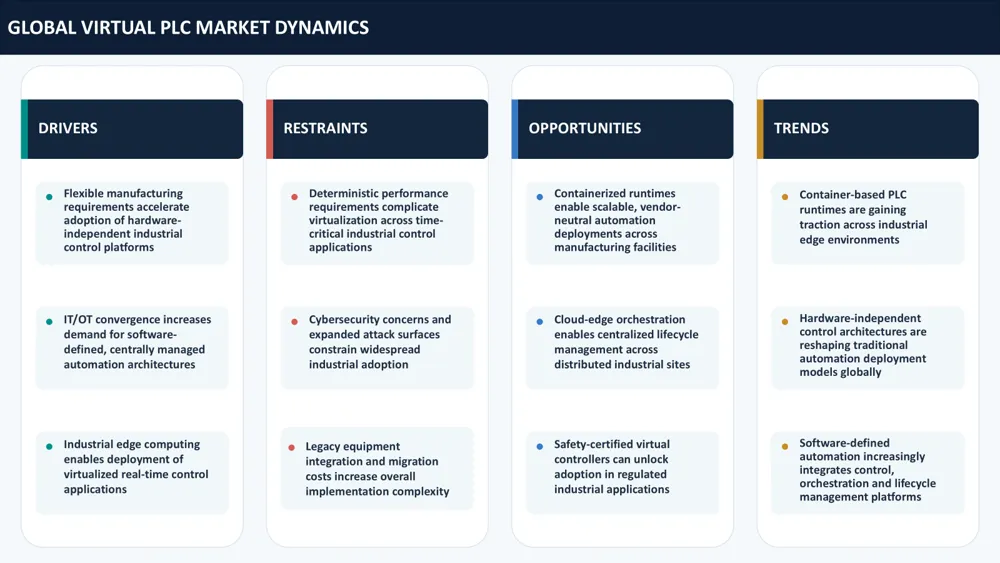
Virtual PLC Market: Market Dynamics
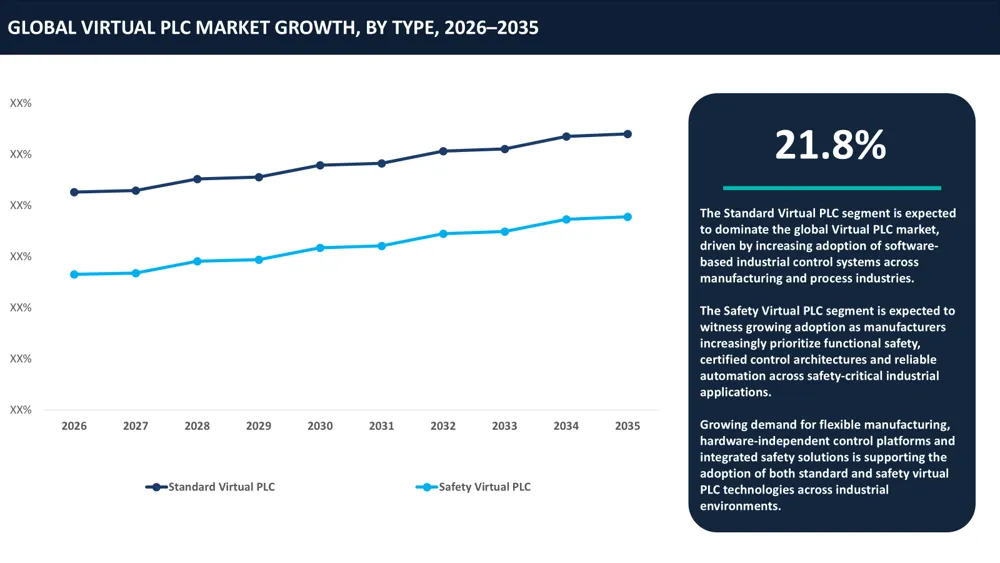
Virtual PLC Market: Market Segment Analysis
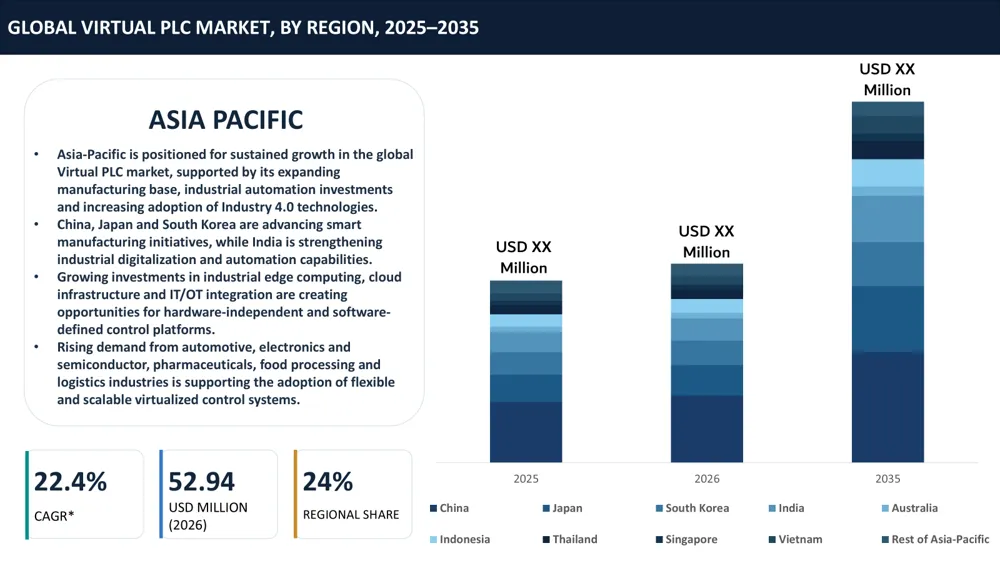
Global Virtual PLC Market: Region Wise Analysis
Virtual PLC Market: Market Scope
| Metrics | Details | |
| Market Size in 2025 (Value) | USD 184.58 Million | |
| Market Size in 2026 (Value) | USD 220.57 Million | |
| Market Forecasted in 2035 (Value) | USD 1092.69 Million | |
| CAGR (2026-2035) | 19.5% | |
| Years Considered | 2024-2035 | |
| Base Year | 2025 | |
| Forecast Period | 2026-2035 | |
| By Type | Standard Virtual PLC Safety Virtual PLC | |
| By Virtualization Technology | Container-Based Virtual PLC Virtual Machine (VM)/Hypervisor-Based Virtual PLC | |
| By Deployment Environment | Industrial Edge On-Premises Server Private Cloud Public and Hybrid Cloud | |
| By Application | Machine-Level Control Production Line and Assembly Control Process Control Material Handling and Intralogistics Control Motion and Robotics Control | |
| By End-Use Industry | Automotive and Transportation Electronics and Semiconductor Food and Beverage Pharmaceuticals and Life Sciences Chemicals and Petrochemicals Oil and Gas Energy and Utilities Logistics and Warehousing General Manufacturing Other Industries | |
| By Region | North America | U.S., Canada, Mexico |
| Europe | Germany, UK, France, Spain, Italy, Poland | |
| Asia-Pacific | China, India, Japan, Australia, South Korea, Indonesia, Malaysia, Singapore, Vietnam, Thailand, Philippines, Taiwan | |
| South America | Brazil, Argentina | |
| Middle East and Africa | UAE, Saudi Arabia, South Africa, Israel, Turkiye | |
| Report Insights Covered | Competitive Landscape Analysis, Company Profile Analysis, Market Size, Market Share, Market Growth | |
GLOBAL VIRTUAL PLC MARKET: TARGET AUDIENCE
| INDUSTRY | WHO SHOULD BUY THIS REPORT? | REASON TO BUY THIS REPORT |
| VIRTUAL PLC SOFTWARE PROVIDERS | Virtual PLC developers, software platform providers and industrial control software companies | Assess competitive positioning, product development opportunities, licensing models, technology adoption and market expansion strategies. |
| INDUSTRIAL AUTOMATION PROVIDERS | PLC manufacturers, automation technology providers and programmable automation controller (PAC) developers | Evaluate the transition toward software-defined automation, virtualized control architectures and hardware-independent automation platforms. |
| SYSTEM INTEGRATORS | Industrial automation system integrators, engineering service providers and control-system consultants | Identify deployment opportunities, integration requirements, customer demand and emerging virtualized control applications. |
| MACHINE BUILDERS AND OEMs | Industrial machinery manufacturers, equipment manufacturers and original equipment manufacturers (OEMs) | Evaluate Virtual PLC applications in machine control, motion automation, robotics and flexible equipment configurations. |
| INDUSTRIAL COMPUTING PROVIDERS | Industrial PC, edge server and embedded computing manufacturers | Understand hardware requirements, computing infrastructure demand and opportunities arising from Virtual PLC deployment. |
| CLOUD AND VIRTUALIZATION PROVIDERS | Cloud service providers, hypervisor developers, container platform providers and infrastructure software companies | Evaluate opportunities in industrial cloud-edge computing, containerized control, virtualization infrastructure and distributed automation management. |
| DISCRETE MANUFACTURING | Automotive OEMs, Tier-1 suppliers, electronics manufacturers, semiconductor fabrication facilities and industrial equipment producers | Assess applications in production automation, assembly operations, robotics, precision manufacturing and flexible production systems. |
| PROCESS INDUSTRIES | Chemical, petrochemical, pharmaceutical, oil and gas and food and beverage companies | Evaluate Virtual PLC suitability for process automation, operational flexibility, system integration and industrial control modernization. |
| ENERGY AND UTILITIES | Power generation companies, renewable energy operators, utilities and electrical equipment manufacturers | Assess applications in distributed control, energy infrastructure automation, remote monitoring and industrial edge deployments. |
| LOGISTICS AND WAREHOUSING | Warehouse operators, logistics companies, intralogistics solution providers and material handling equipment manufacturers | Identify opportunities in automated material handling, conveyor systems, robotics and scalable warehouse control architectures. |
| INVESTORS AND STRATEGIC ADVISORS | Private equity firms, venture capital investors, institutional investors and management consultants | Assess market attractiveness, competitive positioning, investment opportunities, technology risks and regional growth potential. |
| VIRTUAL PLC SOFTWARE PROVIDERS | Virtual PLC developers, software platform providers and industrial control software companies | Assess competitive positioning, product development opportunities, licensing models, technology adoption and market expansion strategies. |
Why Does This Report Matter In 2026?
The global Virtual PLC market is at a critical growth stage in 2026 due to growing investments in software-defined automation, industrial digitalization and hardware-free control systems by industrial equipment manufacturers, automation technology vendors and computing system vendors. Higher adoption of Industry 4.0 technologies, industrial edge computing, IT/OT integration and smart manufacturing is driving manufacturers to shift from the traditional hardware-oriented programmable logic controllers to software-oriented control systems. The transition is redefining industrial control systems with their flexible application on industrial PCs, edge servers and virtualized computing systems, offering new business prospects for automation vendors in the United States, Germany, Japan, China and other manufacturing countries.
On the other hand, Virtual PLC vendors and industrial customers are under increasing demands for providing determinism in their control systems, functionality for safety, security, interoperability and compatibility with existing automation infrastructures. Developments in the field of containerized control runtime systems, virtual machine/hypervisor-based PLCs, multi-instance implementations and virtual controllers designed for safety have changed the competitive landscape of the industrial automation industry. Market participants need to know about Virtual PLC solutions, software licensing, deployment environments, applications among industrial users, competitive position, partnerships in technology and regional adoption trends. This report will be helpful for determining the available business prospects, analyzing the developing technological trends, formulating effective business strategies and making informed investment decisions in the developing Virtual PLC environment.
Global Virtual PLC Market: Analyst View / Opinion
The global Virtual PLC market is defined by the shift from traditional hardware-based industrial automation to software-based control technologies. The traditional PLC technology is still widely used for standard machine and process control tasks, while the Virtual PLC technology becomes increasingly popular among manufacturing companies that need flexibility of implementation, centralized management and hardware-free control execution. These technologies should not be evaluated based on the same adoption assumptions. Standard Virtual PLCs cater to traditional automation needs while safety Virtual PLCs cater to automation needs that need properly validated and certified safety control functions. Similarly, container-based and VM/hypervisor-based platforms differ in deployment architecture, resource utilization and isolation requirements.
There are three competitive issues which must be taken into consideration. Firstly, the performance of deterministic control is very important, since the issues of scheduling for processors, virtualization overhead, network latency and resource allocation for computing may impact the timely industrial operation. It is necessary to prove the reliability of execution of the system in case of particular operating conditions. Secondly, the integration with legacy PLCs, industrial networks, sensors and input/output systems may lead to additional difficulties and expenses of migration. Thus, it is crucial to use open communication protocols, engineering compatibility and cooperation in system integration. Thirdly, there are new validation and certification responsibilities connected with cybersecurity and functional safety. In this case, virtual PLC manufacturers need to improve their security architecture, lifecycle management and specific application compliance while developing their products further. Virtual PLC vendors which ensure reliable control implementation, interoperability, deployment flexibility and industrial partnership can take advantage of these opportunities in the changing market of Virtual PLCs.
QUESTIONS THIS REPORT ANSWERS
- What are the principal demand drivers, market restraints, technological challenges and investment opportunities shaping the global Virtual PLC market through 2035?
- How do Standard Virtual PLCs and Safety Virtual PLCs differ in functionality, industrial applications, certification requirements and commercial opportunities?
- How do container-based and virtual machine (VM)/hypervisor-based Virtual PLC technologies differ in architecture, deployment flexibility, computing resource utilization and control execution?
- What are the advantages and limitations of deploying Virtual PLCs across industrial edge devices, on-premises servers, private cloud and public and hybrid cloud environments, particularly for real-time control execution and centralized management?
- Which applications support Virtual PLC adoption across machine-level control, production line automation, process control, material handling and motion and robotics control?
- How do automotive, electronics and semiconductor, food and beverage, pharmaceutical, chemical, oil and gas, energy and logistics industries differ in Virtual PLC adoption requirements?
- How will software-defined automation, industrial edge computing, IT/OT convergence, smart manufacturing and Industry 4.0 initiatives influence Virtual PLC commercialization and market expansion?
- What challenges arise from deterministic control performance, real-time operating requirements, cybersecurity, functional safety, interoperability and integration with legacy PLC infrastructure?
- Which manufacturers and technology providers offer commercially relevant Virtual PLC platforms, differentiated runtime capabilities, safety-oriented solutions, competitive deployment architectures and distinct software licensing, subscription and pricing models?
- What additional quantitative inputs and assumptions are required to establish credible 2035 market forecasts, segment-level revenue estimates and a 2026–2035 CAGR?