


Executive Summary
The United States is experiencing an unprecedented surge in data center power demand driven by the rapid expansion of artificial intelligence (AI), cloud computing, edge computing, and digital transformation initiatives. As hyperscale operators race to deploy next-generation AI infrastructure, power availability has emerged as one of the most significant constraints on data center expansion.
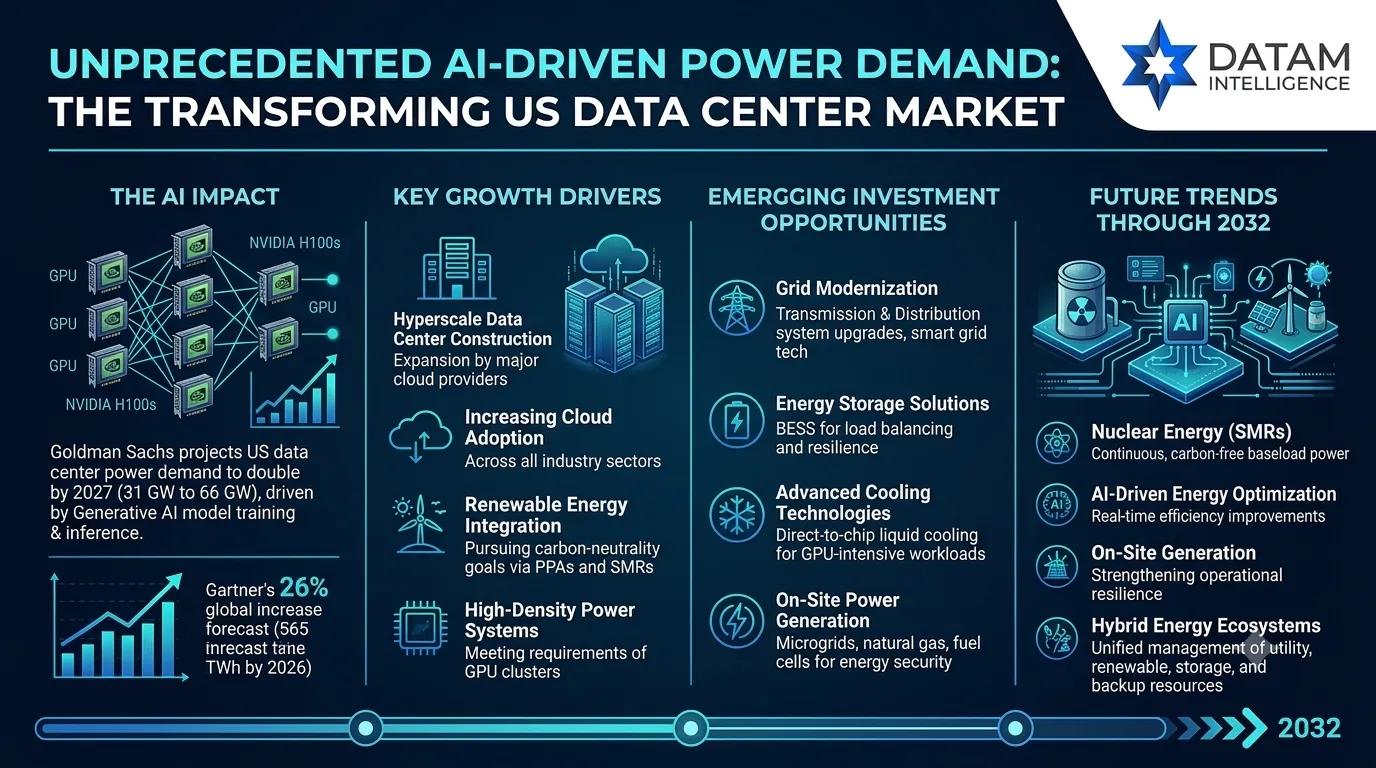
Industry analysts project that data center electricity consumption will continue growing at a rapid pace throughout the decade, transforming energy procurement, grid planning, and infrastructure investment strategies. Gartner forecasts global data center electricity consumption will reach 565 TWh in 2026, representing a 26% year-over-year increase, largely fueled by AI workloads. AI-optimized servers alone are expected to account for nearly one-third of total data center power consumption.
This accelerating demand is creating substantial opportunities across power generation, transmission infrastructure, energy storage, cooling systems, and renewable energy sectors.
Explore the Full US Data Center Power Market Analysis
Gain deeper insights into market size, growth forecasts, competitive benchmarking, investment opportunities, technology trends, and regional outlooks in the comprehensive US Data Center Power Market Report from DataM Intelligence.
Request a Sample Report Today and identify emerging opportunities shaping the future of AI-powered digital infrastructure.
Understanding the US Data Center Power Market
The US Data Center Power Market encompasses the infrastructure, technologies, and services required to supply reliable electricity to data centers, including:
- Utility power supply
- Backup power systems
- Uninterruptible power supply (UPS) systems
- Power distribution units (PDUs)
- Renewable energy integration
- Energy storage systems
- Grid interconnection solutions
- Smart energy management platforms
With AI applications requiring significantly higher computing power than traditional workloads, electricity consumption per facility is rising dramatically.
Modern AI-focused hyperscale facilities often require hundreds of megawatts of dedicated power capacity, creating unprecedented challenges for utilities and grid operators.
Why AI Is Transforming Data Center Power Demand
The AI Infrastructure Boom
The rapid commercialization of generative AI is fundamentally changing power requirements across the data center ecosystem.
AI model training, inference processing, and large-scale GPU clusters consume significantly more energy than traditional enterprise computing environments.
According to Goldman Sachs Research, US data center power demand is projected to more than double from 31 GW in 2025 to 66 GW by 2027, primarily due to AI infrastructure deployment. Data centers are expected to account for 8.5% of total US peak summer electricity demand by 2027.
This shift is driving substantial investment in:
- Hyperscale data centers
- AI-ready infrastructure
- High-density power systems
- Advanced cooling technologies
- Dedicated energy generation projects
AI Data Centers Require Higher Power Density
Traditional enterprise data centers typically operate at lower rack densities. AI facilities, however, require:
- High-performance GPU clusters
- Liquid cooling systems
- Advanced power distribution architectures
- High-capacity electrical infrastructure
These requirements significantly increase electricity demand while creating new opportunities for infrastructure suppliers.
Key Growth Drivers of the US Data Center Power Market
1. Rising Hyperscale Data Center Construction
Major cloud providers continue expanding their US footprints to support growing demand for digital services and AI applications.
The growth of hyperscale facilities is driving demand for:
- Grid connections
- Backup generation systems
- Renewable power procurement
- Battery storage infrastructure
Energy availability is increasingly becoming a primary site-selection criterion for new facilities.
2. Increasing Cloud Adoption
Cloud computing remains a major growth engine for the data center industry.
Enterprises across healthcare, financial services, manufacturing, retail, and government sectors continue migrating workloads to cloud platforms, requiring expanded data center capacity and supporting infrastructure.
3. Expansion of Digital Infrastructure Investments
Federal initiatives supporting semiconductor manufacturing, AI innovation, and digital transformation are encouraging large-scale investments in supporting infrastructure, including data center power networks.
4. Renewable Energy Integration
Sustainability goals are driving hyperscale operators toward:
- Solar power purchase agreements (PPAs)
- Wind energy contracts
- Battery energy storage systems
- Green hydrogen initiatives
- Small modular nuclear reactor (SMR) projects
Organizations are increasingly pursuing carbon-neutral operations while ensuring long-term energy security.
Emerging Investment Opportunities in the US Data Center Power Market
Grid Modernization
The rapid expansion of AI-driven and hyperscale data centers is placing unprecedented pressure on the United States' aging power infrastructure. To meet rising electricity demand while maintaining grid reliability, utilities and grid operators are accelerating investments in modernization initiatives.
Key areas of investment include:
- Transmission network expansion to support growing power loads
- Distribution system upgrades for enhanced capacity and reliability
- Smart grid technologies that enable real-time monitoring and optimization
- Grid resilience projects designed to mitigate outages and improve energy security
As data center operators seek reliable and scalable power sources, grid modernization is emerging as a critical investment area for utilities, infrastructure developers, engineering firms, and technology providers.
Energy Storage Solutions
Energy storage is becoming a cornerstone of modern data center energy strategies. As facilities require uninterrupted power availability and greater integration of renewable energy sources, advanced battery storage systems are gaining widespread adoption.
Key benefits of energy storage include:
- Peak demand management and load balancing
- Enhanced backup power capabilities
- Improved integration of renewable energy resources
- Increased grid stability and operational resilience
The growing deployment of battery energy storage systems (BESS) is expected to create substantial opportunities for energy technology providers and infrastructure investors throughout the forecast period.
Advanced Cooling Technologies
Cooling systems are emerging as one of the most critical components of next-generation data center infrastructure. The rise of high-density AI workloads and GPU-intensive computing environments is significantly increasing thermal management requirements.
To address these challenges, operators are investing in advanced cooling technologies such as:
- Direct-to-chip liquid cooling
- Immersion cooling systems
- AI-powered thermal management platforms
- Intelligent energy optimization solutions
These innovations help improve energy efficiency, reduce operational costs, and support the deployment of increasingly power-intensive AI infrastructure. As data center power densities continue to rise, advanced cooling technologies are expected to become a major focus area for capital investment.
Renewable Energy Infrastructure
Sustainability objectives and long-term energy procurement strategies are driving significant investments in renewable energy infrastructure. Leading hyperscale operators are increasingly securing long-term power purchase agreements (PPAs) to ensure access to reliable, cost-effective, and low-carbon energy sources.
Major investment areas include:
- Utility-scale solar energy projects
- Onshore and offshore wind farms
- Large-scale energy storage facilities
- Renewable energy transmission infrastructure
As organizations pursue carbon reduction goals while expanding digital infrastructure, renewable energy investments will play a pivotal role in supporting the future growth of the US data center power market.
Regional Hotspots Driving US Data Center Power Market Expansion
Northern Virginia: The Epicenter of Data Center Growth
Northern Virginia, widely known as "Data Center Alley," remains the most significant data center hub in the United States and one of the largest digital infrastructure clusters globally. The region hosts a substantial concentration of hyperscale, colocation, and enterprise data centers that support cloud computing, artificial intelligence (AI), and internet traffic worldwide.
As AI workloads and cloud adoption continue to accelerate, electricity demand across Northern Virginia is reaching unprecedented levels. To accommodate future capacity requirements, utilities, grid operators, and policymakers are investing heavily in transmission upgrades, substation development, and new power generation resources. These infrastructure investments are expected to play a critical role in sustaining the region's leadership position while creating opportunities for energy providers, equipment manufacturers, and infrastructure investors.
For stakeholders across the digital infrastructure value chain, Northern Virginia remains a strategic market for long-term investment and expansion.
Texas: Emerging as a Leading Data Center Power Hub
Texas has rapidly become one of the most attractive destinations for large-scale data center development. The state's business-friendly environment, competitive electricity markets, abundant land availability, and expanding renewable energy capacity continue to attract significant investments from hyperscale operators and colocation providers.
Major metropolitan areas such as Dallas-Fort Worth, Austin, and San Antonio are witnessing increased demand for data center capacity as organizations seek scalable infrastructure to support AI, cloud computing, and enterprise digital transformation initiatives.
At the same time, the rapid growth of power-intensive AI facilities is placing additional pressure on the state's electricity grid. This is driving investments in transmission infrastructure, energy storage systems, renewable energy projects, and grid modernization initiatives. As a result, Texas is expected to remain a critical growth market for both data center operators and power infrastructure providers throughout the forecast period.
Midwest and Mid-Atlantic Regions: The Next Wave of Expansion
The Midwest and Mid-Atlantic regions are emerging as attractive alternatives to traditional data center markets due to their access to power resources, favorable operating costs, and growing availability of developable land.
States across these regions are increasingly attracting data center investments as operators seek new locations capable of supporting large-scale AI and cloud infrastructure deployments. Utilities and regional grid operators are proactively planning for substantial increases in electricity demand driven by hyperscale facilities, advanced manufacturing projects, and other energy-intensive industries.
Significant investments are being directed toward transmission expansion, grid resilience improvements, and new generation capacity to ensure long-term reliability and energy security. As power availability becomes a key determinant of data center site selection, the Midwest and Mid-Atlantic regions are well-positioned to capture a growing share of future digital infrastructure investments.
Strategic Outlook
Regional power availability is becoming one of the most important factors influencing data center development decisions across the United States. While established markets such as Northern Virginia continue to dominate capacity deployment, emerging regions including Texas, the Midwest, and the Mid-Atlantic are attracting increased attention from hyperscalers, investors, utilities, and infrastructure developers.
Organizations that closely monitor regional energy trends, grid expansion projects, and infrastructure investment activity will be better positioned to capitalize on the evolving opportunities within the US Data Center Power Market.
Challenges Facing the US Data Center Power Market
Grid Constraints
Power availability has become a major challenge for developers.
The US Department of Energy notes that growing AI-related electricity demand is placing increasing pressure on existing power infrastructure and accelerating the need for new generation and transmission capacity.
Lengthy Interconnection Timelines
Many projects face delays due to:
- Grid connection backlogs
- Regulatory approvals
- Infrastructure upgrades
Rising Electricity Costs
As demand increases, power prices may rise in certain regions, affecting operational costs and project economics.
Sustainability Requirements
Operators must balance reliability, cost, and sustainability objectives while meeting aggressive decarbonization targets.
Future Trends Shaping the US Data Center Power Market Through 2032
Nuclear Energy Adoption: A Long-Term Solution for Growing Power Demand
As artificial intelligence (AI), cloud computing, and high-performance computing workloads continue to drive unprecedented electricity consumption, nuclear energy is emerging as a strategic solution for meeting the long-term power requirements of next-generation data centers.
Hyperscale operators and energy providers are increasingly evaluating Small Modular Reactors (SMRs) and advanced nuclear technologies as reliable, carbon-free energy sources capable of delivering continuous baseload power. Unlike intermittent renewable energy sources, nuclear power offers consistent generation capacity that can support large-scale AI data centers operating around the clock.
Growing investments, supportive policy initiatives, and advancements in reactor technology are expected to position nuclear energy as a critical component of the future US data center power ecosystem. For investors, utilities, and infrastructure developers, the commercialization of SMRs represents a significant opportunity within the evolving digital infrastructure landscape.
AI-Driven Energy Optimization: Transforming Data Center Efficiency
Artificial intelligence is not only driving data center demand but is also becoming a key enabler of energy efficiency and operational optimization. As facilities become increasingly complex, operators are leveraging AI-powered analytics and automation platforms to improve performance while reducing operational costs.
Key applications include:
- Real-time optimization of energy consumption
- Predictive maintenance and equipment failure forecasting
- Intelligent cooling and thermal management
- Dynamic workload allocation for improved efficiency
- Enhanced grid interaction and demand-response participation
By improving infrastructure utilization and minimizing energy waste, AI-driven energy management solutions are expected to play a pivotal role in helping operators achieve both sustainability objectives and profitability targets. This trend is creating new opportunities for software providers, energy technology companies, and digital infrastructure investors.
On-Site Power Generation: Strengthening Energy Security
Power availability has become one of the most significant challenges facing data center developers across the United States. In response to grid constraints, lengthy interconnection timelines, and increasing electricity demand, many operators are exploring on-site power generation strategies to enhance reliability and accelerate project deployment.
Emerging solutions include:
- Natural gas-based generation systems
- Renewable energy microgrids
- Hydrogen-powered generation technologies
- Fuel cell systems
- Integrated energy storage solutions
On-site generation provides greater control over energy supply, improves resilience against grid disruptions, and reduces dependence on constrained utility infrastructure. As energy security becomes a competitive advantage, this approach is expected to gain traction among hyperscale operators and large colocation providers.
Hybrid Energy Ecosystems: The Future of Data Center Power Infrastructure
The next generation of data centers will increasingly rely on hybrid energy ecosystems designed to maximize reliability, sustainability, and operational flexibility. Rather than depending on a single energy source, operators are expected to integrate multiple power resources into a unified energy management framework.
Key components of future hybrid energy systems include:
- Utility-supplied electricity
- Renewable energy sources such as solar and wind
- Battery energy storage systems (BESS)
- Backup generation assets
- AI-powered energy management platforms
These integrated ecosystems enable operators to balance energy costs, improve resilience, support decarbonization goals, and optimize power availability during periods of peak demand. As sustainability regulations and corporate ESG commitments continue to evolve, hybrid energy architectures are expected to become a defining feature of future data center developments.
Strategic Outlook for Industry Stakeholders
The US Data Center Power Market is entering a period of significant transformation driven by AI adoption, increasing digital infrastructure investments, and the growing importance of energy security. Emerging technologies such as advanced nuclear power, AI-enabled energy optimization, on-site generation, and hybrid energy ecosystems will reshape how power is generated, distributed, and managed across the data center sector.
For hyperscale operators, utilities, infrastructure developers, technology providers, and institutional investors, understanding these trends will be essential for identifying growth opportunities and maintaining a competitive advantage. Organizations that invest in innovative power solutions today will be better positioned to capitalize on the next phase of expansion in the US Data Center Power Market through 2032.
Strategic Outlook for Investors and Industry Stakeholders
The US Data Center Power Market is rapidly evolving into one of the most critical segments within the digital infrastructure ecosystem.
Organizations that can provide reliable, scalable, and sustainable power solutions will be positioned to capitalize on:
- AI infrastructure expansion
- Hyperscale data center growth
- Grid modernization investments
- Renewable energy integration
- Energy storage deployment
As power availability becomes the defining factor in data center expansion, stakeholders across utilities, infrastructure development, renewable energy, and technology sectors are expected to benefit from sustained market growth through 2032.
Conclusion
The convergence of AI adoption, cloud computing expansion, and digital transformation is reshaping the US Data Center Power Market. Rising electricity demand, increasing infrastructure investment, and the urgent need for energy security are creating significant opportunities across the value chain.
Businesses, investors, utilities, and policymakers that proactively address power availability, sustainability, and grid resilience challenges will be best positioned to capitalize on the next phase of growth in the US data center industry.