


Uranium Mining Market Trends: Why the Nuclear Fuel Sector Is Entering a New Growth Cycle
The global uranium mining market is entering a transformational phase as nuclear energy returns to the center of global energy strategies. Rising electricity demand, energy security concerns, decarbonization goals, and increasing investments in advanced nuclear technologies are reshaping the uranium industry landscape.
Unlike previous commodity cycles driven mainly by short-term price movements, the current uranium market growth is supported by structural factors including reactor expansion, government-backed nuclear programs, supply diversification strategies, and long-term uranium procurement agreements.
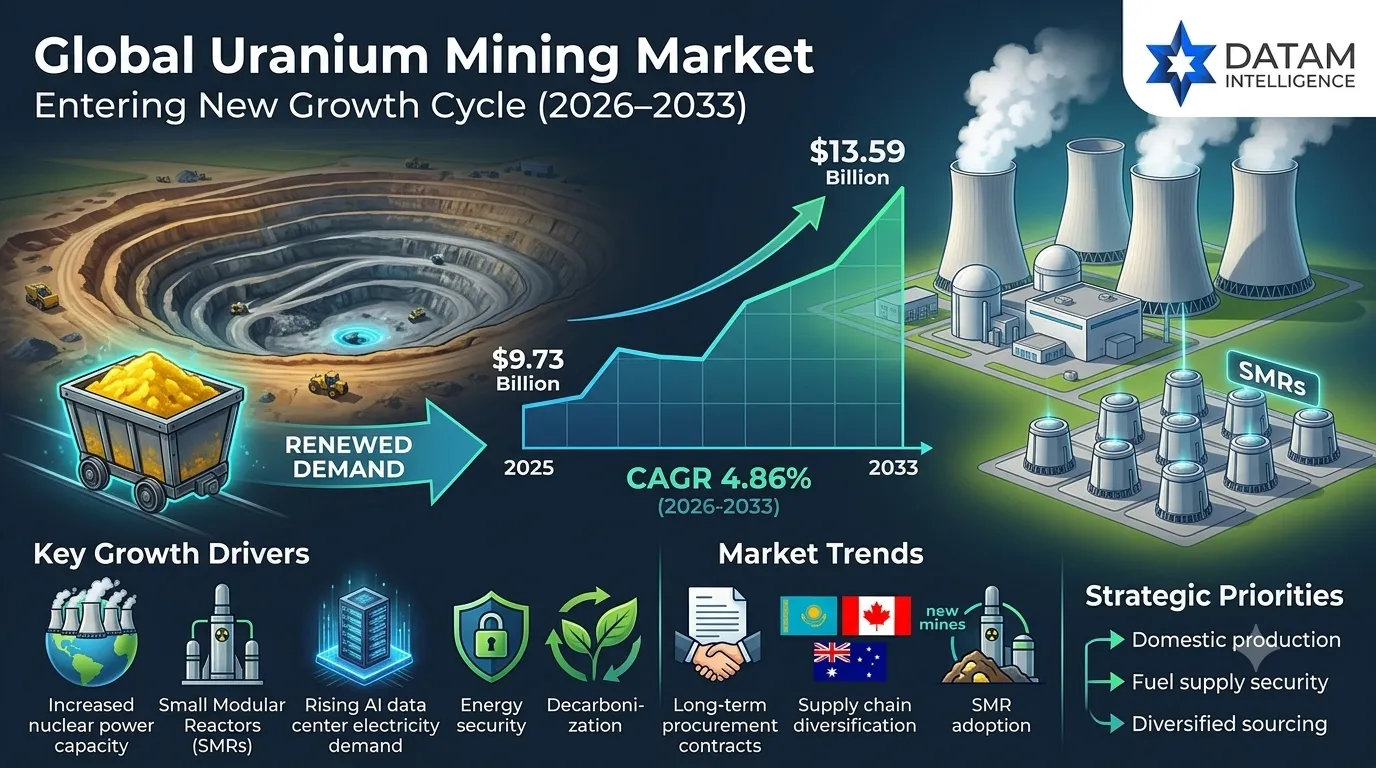
According to DataM Intelligence analysis, the global Uranium Market was valued at US$9.73 billion in 2025 and is projected to reach US$13.59 billion by 2033, expanding at a CAGR of 4.86% during 2026 - 2033.
Unlock Comprehensive Insights into the Global Uranium Market
The uranium industry is entering a new growth phase driven by nuclear energy expansion, supply chain restructuring, energy security priorities, and increasing investments in advanced reactor technologies.
Get access to the Uranium Market Report by DataM Intelligence to explore:
✓ Global uranium market size, growth outlook, and forecast through 2033
✓ Key market trends shaping the nuclear fuel industry
✓ Uranium supply-demand dynamics and pricing factors
✓ Regional growth opportunities across North America, Asia Pacific, and Africa
✓ Investment opportunities across mining, processing, and nuclear fuel supply chains
✓ Competitive landscape and strategic insights for industry stakeholders
Download the Sample Report Today and Gain Actionable Intelligence for Strategic Decision-Making
The uranium mining market is expected to grow steadily as global nuclear power capacity expands, utilities secure long-term fuel supplies, and governments invest in energy security. Key growth drivers include new nuclear reactor construction, small modular reactors (SMRs), rising electricity demand from AI data centers, and supply chain diversification.
Key Takeaways: Uranium Mining Market Outlook
- Global uranium demand is increasing due to renewed nuclear energy expansion.
- Supply constraints and geopolitical risks are encouraging new uranium mining investments.
- Nuclear power is gaining importance as a reliable low-carbon energy source.
- Small modular reactors (SMRs) are creating new long-term uranium demand opportunities.
- Mining companies with advanced projects and secure resources are positioned for growth.
- Investors are increasingly viewing uranium as a strategic energy commodity.
What Is Driving Growth in the Uranium Mining Market?
1. Nuclear Energy Revival Is Increasing Uranium Demand
The strongest growth driver for uranium mining is the global resurgence of nuclear power.
Countries are expanding nuclear capacity to achieve three major objectives:
- Reduce dependence on fossil fuels
- Improve energy security
- Meet carbon reduction targets
Nuclear energy provides continuous baseload electricity with low operational carbon emissions, making it increasingly attractive alongside renewable energy sources.
Global nuclear expansion plans, reactor life extensions, and new-generation nuclear technologies are expected to create sustained uranium demand over the next decade.
Why is uranium demand increasing?
Uranium demand is increasing because countries are expanding nuclear power generation, building new reactors, developing small modular reactors, and seeking reliable low-carbon electricity sources to support energy security and decarbonization goals.
2. Supply Constraints Are Creating Investment Opportunities in Uranium Mining
The uranium market faces a supply-demand imbalance due to limited new mine development and increasing reactor fuel requirements.
Major uranium-producing countries such as Kazakhstan, Canada, and Australia dominate global production, creating supply concentration risks.
Developing a new uranium mine requires:
- Geological exploration
- Environmental approvals
- Regulatory compliance
- Significant capital investment
- Long project timelines
Because of these barriers, supply cannot quickly respond to rising demand.
This supply challenge is encouraging:
- Exploration investments
- Mine restart projects
- Strategic partnerships
- Government support programs
Uranium Mining Market Trends Shaping the Industry
Trend 1: Growing Adoption of Long-Term Uranium Supply Contracts
The uranium industry is witnessing a significant shift toward long-term supply agreements as nuclear utilities seek greater supply stability amid evolving global energy dynamics. With increasing nuclear power generation targets and concerns over future uranium availability, utilities are prioritizing secure procurement strategies to minimize exposure to supply disruptions and price volatility.
Historically, the uranium market experienced periods of oversupply, resulting in subdued mining investments and delayed exploration activities. However, current market conditions are transitioning toward a supply-constrained environment, driven by rising reactor demand, limited new mine development, and growing emphasis on energy security.
Nuclear utilities are increasingly focusing on:
- Reliable long-term uranium supply partnerships to ensure uninterrupted reactor operations
- Strategic relationships with established uranium producers to reduce procurement risks
- Geographically diversified supply sources to strengthen resilience against geopolitical uncertainties
This growing preference for long-term contracting is improving revenue visibility for uranium mining companies while encouraging new investments in exploration, mine expansion, and production capacity.
Trend 2: Small Modular Reactors (SMRs) Creating New Uranium Demand Opportunities
Small Modular Reactors (SMRs) are emerging as a transformative technology within the nuclear energy sector and represent a significant future growth opportunity for the uranium market. Unlike traditional large-scale nuclear reactors, SMRs are designed to provide flexible, scalable, and cost-effective nuclear power solutions across diverse applications.
The increasing adoption of SMR technologies is expected to create additional demand for uranium fuel as countries explore reliable low-carbon energy solutions to support industrial growth, energy transition goals, and rising electricity consumption.
Key advantages driving SMR development include:
- Reduced construction complexity and shorter deployment timelines
- Flexible installation options for remote and distributed energy applications
- Potential use in industrial facilities, mining operations, and energy-intensive sectors
- Enhanced integration with future clean energy infrastructure
Furthermore, the rapid expansion of artificial intelligence (AI), cloud computing, and digital infrastructure is significantly increasing global electricity demand. This has strengthened interest in nuclear power as a dependable baseload energy source, creating additional long-term opportunities for uranium suppliers.
Trend 3: Uranium Emerging as a Strategic Energy Resource
Uranium is increasingly being recognized as a critical strategic resource rather than simply a conventional commodity. As nations focus on energy independence, decarbonization, and secure fuel supply chains, uranium has gained importance in national energy strategies.
Growing geopolitical uncertainties and supply chain vulnerabilities have encouraged governments to strengthen domestic nuclear fuel capabilities and reduce dependence on concentrated uranium supply sources.
Key strategic priorities include:
- Increasing domestic uranium production capacity
- Enhancing nuclear fuel supply chain security
- Developing diversified uranium sourcing strategies
- Expanding alternative enrichment and fuel processing capabilities
Governments and energy organizations are increasingly supporting uranium exploration, mining projects, and nuclear fuel initiatives to ensure long-term energy security.
This strategic shift is expected to drive continued investment across the uranium value chain, creating new opportunities for mining companies, technology providers, investors, and other stakeholders involved in the global nuclear energy ecosystem.
Uranium Mining Investment Opportunities
The evolving global energy landscape is creating new investment opportunities across the uranium value chain. Growing nuclear energy adoption, increasing demand for low-carbon power sources, and concerns around long-term fuel security are encouraging investments in uranium exploration, mining, processing, and nuclear fuel infrastructure.
Investors are increasingly evaluating opportunities across different segments of the uranium ecosystem, from early-stage exploration projects to established producers and downstream nuclear fuel services.
1. Uranium Exploration Companies: Unlocking Future Resource Potential
Early-stage uranium exploration companies are gaining attention as the industry seeks to address future supply requirements. With rising uranium demand and limited development of new mining assets, companies focused on discovering and advancing new uranium resources may benefit from favorable market conditions.
Investment opportunities are emerging in:
- High-grade uranium deposits: Projects with superior uranium concentrations can offer improved economic potential due to lower extraction costs and higher production efficiency.
- Underexplored regions: Emerging uranium districts with untapped resource potential present opportunities for exploration companies seeking new discoveries.
- Brownfield expansion projects: Existing mining sites with additional resource potential may provide faster development pathways compared with completely new projects.
As global utilities seek reliable uranium supply sources, exploration companies with strategically located and economically viable resources are positioned to play an important role in future market growth.
2. Established Uranium Producers: Benefiting from Rising Demand and Supply Constraints
Existing uranium producers with operational mines and proven resource bases are positioned to benefit from the increasing demand for nuclear fuel. As utilities expand long-term procurement strategies and uranium supply remains constrained, established producers may experience improved market opportunities.
Key growth drivers for uranium producers include:
- Increasing uranium contract prices supported by stronger long-term demand outlook
- Growing utility requirements as global nuclear power capacity expands
- Supply shortages and limited new mine development, creating favorable conditions for existing operators
Investors typically assess uranium producers based on several critical factors, including:
- Production capacity and growth potential
- Quality and scale of uranium resources
- Operational efficiency and production costs
- Geographic diversification of mining assets
Companies with strong operational capabilities, sustainable production models, and diversified asset portfolios may be better positioned to capture long-term growth opportunities in the uranium market.
3. Uranium Processing and Nuclear Fuel Supply Chain Opportunities
The uranium investment landscape extends beyond mining activities into the broader nuclear fuel supply chain. As countries strengthen nuclear energy infrastructure and focus on fuel security, opportunities are emerging across multiple stages of the nuclear fuel cycle.
The nuclear fuel value chain includes:
- Uranium mining: Extraction and production of uranium ore from mineral deposits
- Conversion: Processing uranium concentrate into a chemical form suitable for enrichment
- Enrichment: Increasing uranium isotope concentration required for reactor fuel
- Fuel fabrication: Manufacturing nuclear fuel assemblies for reactor operations
- Reactor supply and services: Supporting nuclear power generation through fuel delivery and related technologies
Companies operating across these segments may benefit from increasing nuclear investment, government initiatives, and efforts to build more resilient nuclear fuel supply chains.
As nuclear energy continues to gain strategic importance globally, investment opportunities are expected to expand across the entire uranium ecosystem, creating potential growth avenues for mining companies, technology providers, infrastructure developers, and energy investors.
Regional Analysis: Global Uranium Mining Market Opportunities
The global uranium market is experiencing a strategic transformation as countries accelerate nuclear energy investments, strengthen energy security initiatives, and diversify nuclear fuel supply chains. Regional market dynamics are being shaped by nuclear reactor expansion plans, government policies, uranium resource availability, and investments across the nuclear fuel ecosystem.
According to DataM Intelligence analysis, North America represents a leading region in the global uranium market, supported by nuclear energy expansion strategies, domestic supply initiatives, and efforts to enhance fuel security. Meanwhile, Asia Pacific is emerging as a major growth engine due to rapid nuclear capacity expansion, rising electricity demand, and industrial development, while Africa continues to attract attention due to its significant uranium resource potential and growing international investment activity.
North America: Strengthening Domestic Uranium Supply and Nuclear Energy Security
North America is expected to remain a significant market for uranium due to increasing investments in nuclear energy infrastructure, supply chain resilience initiatives, and government efforts to strengthen domestic uranium capabilities.
The region is witnessing renewed interest in uranium production as countries seek to reduce dependence on concentrated global supply sources and establish more secure nuclear fuel pathways.
Key growth opportunities in North America include:
- Expansion of domestic uranium production capabilities
- Development of new mining and exploration projects
- Investment in nuclear fuel supply chain infrastructure
- Support for advanced nuclear technologies, including Small Modular Reactors (SMRs)
The United States is placing greater emphasis on strengthening its uranium supply chain by supporting domestic production, expanding enrichment capabilities, and reducing reliance on external suppliers. Growing electricity demand from industries such as artificial intelligence, data centers, and advanced manufacturing is further increasing interest in reliable nuclear power generation.
For uranium mining companies and investors, North America presents opportunities in resource development, mine restart projects, fuel-cycle infrastructure, and strategic partnerships.
Asia Pacific: Accelerating Nuclear Expansion and Long-Term Uranium Demand
Asia Pacific is emerging as one of the fastest-growing regions for uranium demand, supported by expanding nuclear power programs, rising electricity consumption, industrial growth, and long-term energy transition strategies.
Rapid economic development and increasing energy requirements are encouraging countries across the region to invest in nuclear power as a stable, low-carbon electricity source.
Major growth drivers include:
- Construction of new nuclear reactors
- Expansion of existing nuclear power capacity
- Growing electricity demand from industrialization and urbanization
- Government initiatives supporting low-carbon energy development
China continues to expand its nuclear power capacity as part of its broader energy strategy, while India is also increasing its focus on nuclear energy development to support long-term electricity demand growth.
The region’s expanding nuclear fleet is expected to create sustained uranium demand, increasing opportunities for:
- Uranium mining companies
- Long-term supply partnerships
- Nuclear fuel suppliers
- Exploration and resource development projects
As Asia Pacific countries continue to strengthen nuclear infrastructure, the region is expected to remain a key contributor to future uranium market growth.
Africa: Unlocking Uranium Resource Potential Through Strategic Investments
Africa represents an important emerging opportunity within the global uranium mining landscape due to its substantial uranium resource availability and increasing interest from international mining companies.
The region offers significant potential for future uranium supply growth through exploration activities, new mining projects, and cross-border investment partnerships.
Key opportunities in Africa include:
- Development of new uranium mining projects
- Exploration of underutilized uranium resources
- International investment collaborations
- Expansion of mining infrastructure and processing capabilities
Countries with established uranium resources are attracting global attention as companies seek to diversify supply chains and reduce dependence on limited production regions.
The development of African uranium assets could play an increasingly important role in supporting future global nuclear fuel demand while creating opportunities for mining investment, technology partnerships, and regional economic development.
Regional Outlook: Strategic Opportunities Across the Uranium Value Chain
The global uranium market is moving toward a more diversified and strategically driven ecosystem. Regional opportunities are no longer limited to uranium extraction but extend across the broader nuclear fuel value chain, including exploration, mining, processing, enrichment, and fuel supply services.
Key regional investment themes include:
- North America: Domestic uranium production and nuclear fuel security
- Asia Pacific: Nuclear capacity expansion and rising uranium consumption
- Africa: Resource development and new supply diversification opportunities
As governments and energy companies prioritize reliable, low-carbon electricity sources, regional investments in uranium infrastructure are expected to accelerate, creating long-term growth opportunities across the global uranium industry.
Challenges Affecting the Uranium Mining Industry
Despite the positive long-term outlook for the uranium market, the industry faces several challenges that can influence project development, investment decisions, supply stability, and overall market growth. From regulatory requirements and capital-intensive operations to geopolitical uncertainties and commodity price fluctuations, uranium mining companies must navigate a complex operating environment.
Understanding these challenges is essential for investors, mining companies, utilities, and other stakeholders involved in the global nuclear fuel supply chain.
1. Regulatory Complexity and Environmental Compliance
Uranium mining is subject to some of the most stringent regulatory frameworks within the mining industry due to the radioactive nature of uranium and the importance of environmental protection, worker safety, and community engagement.
Mining companies must obtain multiple approvals related to:
- Environmental impact assessments
- Radiation protection and worker safety standards
- Mine development and operational permits
- Waste management and reclamation plans
- Community and stakeholder consultations
These regulatory processes can significantly extend project development timelines and increase operational complexity. Additionally, evolving environmental standards and regulatory requirements may require companies to invest further in advanced mining technologies, safety systems, and sustainable practices.
2. High Capital Requirements and Long Project Development Cycles
Developing a uranium mine requires substantial upfront investment, extensive exploration activities, advanced technical studies, and long permitting timelines before commercial production can begin.
Major investment requirements typically include:
- Geological exploration and resource evaluation
- Feasibility studies and mine planning
- Construction of mining and processing facilities
- Infrastructure development
- Environmental management systems
The long development cycle of uranium projects creates financial challenges, particularly for early-stage exploration companies that require significant funding before generating revenue.
As a result, access to capital, strategic partnerships, and long-term market visibility are critical factors influencing the success of uranium mining projects.
3. Geopolitical Risks and Supply Chain Concentration
The global uranium market is influenced by geopolitical factors due to the concentration of uranium production and processing capabilities in a limited number of countries.
Dependence on specific regions for uranium supply can create vulnerabilities related to:
- Trade restrictions and policy changes
- Supply disruptions
- Transportation challenges
- International relations
To address these risks, governments and nuclear utilities are increasingly focusing on supply diversification, domestic uranium production, and stronger nuclear fuel supply chains.
The shift toward geographically diversified uranium sourcing is expected to encourage new mining investments in regions with significant resource potential.
4. Uranium Price Volatility and Market Uncertainty
Although long-term uranium market fundamentals remain positive due to growing nuclear energy demand and limited new supply development, uranium prices can experience short-term fluctuations.
Price volatility may be influenced by factors such as:
- Changes in nuclear energy policies
- Global reactor demand
- Production levels from major uranium suppliers
- Inventory levels held by utilities and market participants
- Geopolitical developments
For mining companies, uranium price movements directly impact project economics, investment decisions, and production strategies.
To manage market uncertainty, producers are increasingly focusing on long-term supply agreements with nuclear utilities, which provide greater revenue visibility and reduce exposure to short-term price fluctuations.
Future Outlook: Uranium Mining Market Forecast 2026–2033
The global uranium mining market is expected to enter a sustained growth phase during 2026 - 2033, supported by expanding nuclear energy adoption, increasing demand for reliable low-carbon electricity, and growing emphasis on energy security. As countries accelerate their transition toward cleaner energy systems while maintaining stable power generation capacity, uranium is becoming an increasingly important strategic resource within the global energy landscape.
Unlike traditional commodity markets that are primarily influenced by short-term supply and demand cycles, the future uranium market is expected to be shaped by long-term structural trends, including nuclear reactor expansion, government-backed energy initiatives, advanced reactor technologies, and efforts to strengthen global nuclear fuel supply chains.
According to DataM Intelligence analysis, the global uranium market is projected to grow from US$9.73 billion in 2025 to US$13.59 billion by 2033, expanding at a CAGR of 4.86% during 2026–2033, reflecting increasing investments across uranium exploration, mining, processing, and nuclear fuel infrastructure.
Key Factors Shaping the Future of the Uranium Mining Market
1. Expansion of Nuclear Energy Capacity
The continued expansion of nuclear power generation will remain one of the primary drivers of uranium demand through 2033. Governments worldwide are increasing investments in nuclear energy to support growing electricity consumption, reduce dependence on fossil fuels, and achieve long-term decarbonization objectives.
The development of new nuclear reactors, life-extension programs for existing facilities, and increasing adoption of advanced nuclear technologies are expected to create sustained demand for uranium fuel.
2. Clean Energy Transition and the Role of Nuclear Power
As global energy systems transition toward lower-carbon sources, nuclear power is gaining importance as a reliable complement to renewable energy technologies.
While renewable energy sources such as solar and wind provide significant clean energy potential, nuclear power offers consistent baseload electricity generation with low operational carbon emissions.
This growing recognition of nuclear energy’s role in achieving climate goals is expected to support long-term uranium consumption and encourage investment across the nuclear fuel value chain.
3. Growing Focus on Energy Security and Supply Chain Resilience
Energy security has become a critical priority for governments and utilities amid geopolitical uncertainties and supply chain disruptions.
Countries are increasingly focusing on:
- Developing domestic uranium production capabilities
- Diversifying uranium supply sources
- Establishing secure nuclear fuel supply chains
- Reducing dependence on concentrated production regions
These initiatives are expected to encourage new uranium mining projects, exploration activities, and strategic partnerships between mining companies and nuclear utilities.
4. Advanced Reactor Technologies Creating New Market Opportunities
The emergence of advanced nuclear technologies, particularly Small Modular Reactors (SMRs), is expected to create additional growth opportunities for the uranium industry.
SMRs offer advantages such as:
- Flexible deployment options
- Reduced construction complexity
- Applications across industrial, remote, and distributed energy systems
- Potential integration with future clean energy infrastructure
The increasing development of SMRs, along with rising electricity demand from artificial intelligence, data centers, and digital infrastructure, is expected to strengthen future demand for nuclear fuel resources.
5. Supply Chain Restructuring and New Investment Opportunities
The uranium industry is undergoing a transformation as market participants focus on building more resilient and diversified supply chains.
Future market growth will depend on investments across the entire uranium ecosystem, including:
- Uranium exploration and resource development
- Mine expansion and production capacity
- Uranium conversion and enrichment infrastructure
- Nuclear fuel manufacturing capabilities
- Strategic supply agreements
Companies that successfully establish reliable resources, develop cost-efficient operations, and secure long-term partnerships are expected to gain competitive advantages in the evolving uranium market.
Uranium Mining Market Transition: From Commodity Cycle to Strategic Resource Market
The uranium industry is gradually shifting from a traditional commodity-driven market toward a strategically important energy resource sector. Increasing nuclear energy demand, supply limitations, and government efforts to strengthen energy independence are changing how uranium is viewed by investors, utilities, and policymakers.
Uranium is no longer considered only a fuel commodity; it is increasingly recognized as a critical component of global energy security and clean energy strategies.
Long-Term Opportunities for Uranium Industry Stakeholders
Companies operating across the uranium value chain are expected to benefit from emerging opportunities driven by:
- Rising global nuclear power capacity
- Increasing long-term uranium procurement agreements
- Development of new uranium mining projects
- Expansion of nuclear fuel infrastructure
- Growing investment in advanced reactor technologies
Mining companies with high-quality uranium resources, sustainable operational models, strong financial capabilities, and diversified asset portfolios are likely to be better positioned to capture future market opportunities.
Conclusion: Positive Growth Outlook for the Uranium Mining Market
The uranium mining market is entering a new phase of strategic growth as nuclear energy becomes increasingly important for global energy security and decarbonization goals.
Between 2026 and 2033, market expansion will be influenced by the combined impact of nuclear capacity growth, clean energy transition initiatives, advanced reactor development, and global efforts to build secure uranium supply chains.
Organizations that successfully develop reliable uranium assets, establish strategic partnerships, and strengthen their position across the nuclear fuel ecosystem will be well positioned to benefit from the long-term growth potential of the global uranium market.
Frequently Asked Questions
What is driving uranium mining market growth?
Uranium mining market growth is driven by increasing nuclear power generation, reactor construction, energy security initiatives, SMR development, and rising electricity demand.
Is uranium a good investment opportunity?
Uranium investment opportunities are increasing due to supply constraints, growing nuclear energy demand, and long-term utility contracting. However, investors should evaluate market risks, regulations, and company fundamentals.
Which countries dominate uranium production?
Kazakhstan, Canada, and Australia are among the leading uranium-producing countries globally, contributing significantly to global supply.
What is the future of uranium mining?
The future of uranium mining is expected to remain positive as nuclear energy expansion increases fuel demand and governments prioritize secure nuclear supply chains.
Conclusion: Uranium Mining Market Is Positioned for Long-Term Growth
The uranium mining market is entering a new investment cycle driven by nuclear energy expansion, supply constraints, and global energy security priorities.
As countries accelerate nuclear development and seek reliable low-carbon electricity sources, uranium is becoming a strategically important resource.
For investors, mining companies, energy stakeholders, and policymakers, understanding uranium market trends will be critical for identifying emerging opportunities across the nuclear fuel value chain.
Download the complete Uranium Market Report by DataM Intelligence to access detailed insights on market size, competitive landscape, regional analysis, growth forecasts, and investment opportunities.