


United States Mobile Crane Market Growth in 2026: Rising Demand Across Construction, Energy, and Industrial Projects
The United States mobile crane market is witnessing strong momentum in 2026 as construction companies, infrastructure developers, energy providers, and industrial operators increasingly rely on flexible and efficient lifting equipment. Mobile cranes have become essential for large-scale projects because they offer faster deployment, improved mobility, and operational flexibility compared with traditional fixed lifting systems.
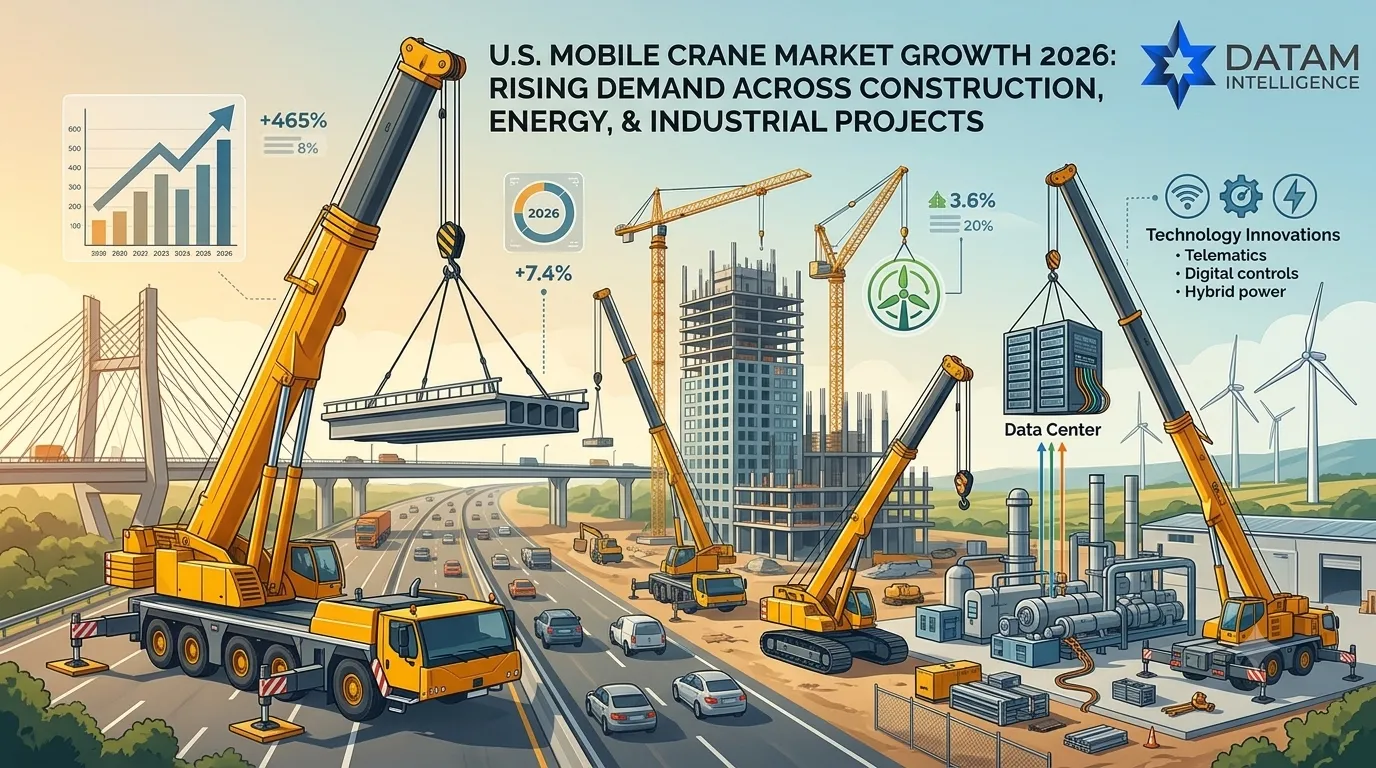
Growing investments in transportation infrastructure, renewable energy installations, manufacturing facilities, data centers, utilities, and urban development projects are creating new opportunities for mobile crane manufacturers, rental companies, contractors, and technology providers.
According to industry analysis, the broader crane industry continues to benefit from infrastructure expansion, industrial investment, and increasing demand for advanced construction equipment.
Unlock Strategic Insights Into the Future of the Mobile Crane Market
Discover key Mobile Crane Market trends, emerging opportunities, competitive developments, and growth strategies driving the mobile crane industry. Access expert analysis designed to support informed business decisions, investments, and market expansion plans.
What Is Driving the Growth of the U.S. Mobile Crane Market in 2026?
1. Infrastructure Development Is Increasing Mobile Crane Demand
One of the strongest growth drivers for the U.S. mobile crane market is ongoing infrastructure modernization. Government-funded transportation projects, bridge construction, road development, ports, and utility upgrades require reliable lifting equipment capable of operating across multiple locations.
Mobile cranes are preferred in infrastructure projects because they can be transported easily between job sites, reducing project delays and improving construction efficiency.
Infrastructure investments under long-term development programs continue supporting demand for construction equipment across the United States.
2. Construction Industry Expansion Supports Market Growth
The U.S. construction sector remains a major contributor to mobile crane adoption. Increasing commercial construction, industrial facilities, residential developments, and large-scale engineering projects are creating demand for cranes with higher lifting capacity and improved maneuverability.
Key construction applications include:
- Commercial buildings
- Industrial plants
- High-rise developments
- Transportation infrastructure
- Manufacturing facilities
- Urban redevelopment projects
Mobile cranes provide contractors with the flexibility required for complex construction environments where speed and mobility are critical.
3. Renewable Energy and Power Infrastructure Projects Create New Opportunities
The expansion of renewable energy projects is creating additional demand for mobile cranes across the United States.
Major applications include:
- Wind turbine installation
- Solar infrastructure development
- Power transmission projects
- Grid modernization
- Energy storage facilities
As energy infrastructure becomes larger and more complex, contractors require advanced lifting solutions capable of handling heavy components safely and efficiently.
4. Data Center Construction and Industrial Investment Boost Crane Demand
The rapid expansion of data centers in the United States is becoming an emerging growth opportunity for construction equipment suppliers, including mobile crane providers.
Large-scale data center projects require:
- Heavy equipment installation
- Structural assembly
- Electrical infrastructure development
- Cooling system installation
- Power facility construction
Recent industrial investment trends show strong construction equipment demand linked to data center and power infrastructure development.
5. Technology Advancements Are Transforming Mobile Cranes
Technology innovation is reshaping the mobile crane industry. Manufacturers are introducing smarter equipment solutions focused on safety, productivity, and operational efficiency.
Key technology trends include:
Telematics and Remote Monitoring
Connected systems allow fleet operators to monitor:
- Equipment performance
- Maintenance schedules
- Fuel efficiency
- Operating conditions
Automation and Digital Controls
Advanced control systems improve:
- Precision lifting
- Operator safety
- Load management
- Project productivity
Electrification and Hybrid Technologies
Sustainable construction initiatives are encouraging development of lower-emission crane solutions.
Key Market Trends Shaping the United States Mobile Crane Industry in 2026
Growing Preference for Crane Rental Services
Many construction companies are shifting toward equipment rental models to reduce capital investment and improve fleet flexibility.
Rental solutions allow contractors to access:
- Advanced crane technologies
- Specialized lifting equipment
- Flexible project-based capacity
Increasing Demand for High-Capacity Mobile Cranes
Large infrastructure and industrial projects require cranes capable of handling heavier loads while maintaining mobility.
Demand is increasing for:
- All-terrain cranes
- Truck-mounted cranes
- Crawler cranes
- Rough-terrain cranes
Focus on Safety and Operator Efficiency
Safety regulations and workforce challenges are encouraging adoption of cranes equipped with:
- Intelligent safety systems
- Digital load monitoring
- Operator assistance technologies
Challenges Impacting the U.S. Mobile Crane Market
Despite the positive growth outlook for the United States mobile crane market, several challenges continue to influence market expansion, investment decisions, and operational efficiency. Factors such as high capital requirements, skilled labor shortages, and supply chain uncertainties remain key considerations for manufacturers, contractors, rental companies, and end users.
1. High Equipment and Maintenance Costs
One of the major challenges affecting mobile crane adoption is the significant investment required for purchasing and maintaining advanced equipment. Modern mobile cranes are equipped with sophisticated technologies, higher lifting capacities, enhanced safety systems, and improved operational features, which contribute to higher acquisition costs.
For small and medium-sized construction contractors, the high upfront capital requirement can impact equipment purchasing decisions and encourage greater reliance on crane rental services. Additionally, ongoing expenses related to maintenance, inspections, spare parts, operator training, and compliance requirements add to the overall cost of ownership.
As a result, companies are increasingly evaluating flexible ownership models, including equipment leasing and rental solutions, to improve cost efficiency while maintaining access to advanced lifting equipment.
2. Shortage of Skilled Crane Operators
The availability of qualified and experienced crane operators remains a significant challenge for the U.S. mobile crane industry. As construction, infrastructure, and industrial projects continue to expand, demand for skilled operators is increasing faster than workforce availability.
Operating modern mobile cranes requires specialized training, technical expertise, and strong understanding of safety regulations. The shortage of trained professionals can lead to:
- Project execution delays
- Increased labor costs
- Reduced equipment utilization
- Higher operational risks
To address this challenge, companies are investing in operator training programs, certification initiatives, and technology-enabled crane systems that improve ease of operation and enhance workplace safety.
3. Supply Chain Disruptions and Equipment Availability Issues
Supply chain pressures continue to impact the mobile crane market by affecting the availability of critical components, manufacturing timelines, and equipment delivery schedules. Mobile cranes depend on complex mechanical, hydraulic, electronic, and structural components, making reliable supply networks essential for production efficiency.
Delays in sourcing components such as engines, hydraulic systems, control systems, and specialized parts can impact:
- New crane deliveries
- Fleet expansion plans
- Equipment replacement cycles
- Project timelines
Manufacturers are increasingly focusing on strengthening supply chain resilience, developing regional sourcing strategies, and improving inventory management to reduce disruptions and ensure consistent equipment availability.
Overall Market Impact
While these challenges may create short-term constraints, ongoing innovation, rental market growth, workforce development initiatives, and advancements in crane technology are expected to help industry participants overcome these barriers. Companies that adopt efficient fleet management strategies, invest in digital solutions, and build stronger operational capabilities will be better positioned to benefit from long-term growth opportunities in the U.S. mobile crane market.
Competitive Landscape and Industry Opportunities
Leading crane manufacturers and equipment suppliers are focusing on:
- Product innovation
- Digital transformation
- Rental partnerships
- Sustainable equipment development
- After-sales service expansion
Companies that provide connected, efficient, and environmentally optimized mobile crane solutions are expected to gain competitive advantages.
Future Outlook: What to Expect From the U.S. Mobile Crane Market After 2026?
The United States mobile crane market is expected to maintain steady growth beyond 2026 as infrastructure modernization, industrial expansion, energy transition initiatives, and technological advancements continue to reshape the construction and heavy equipment landscape. Increasing investments in transportation networks, renewable energy projects, manufacturing facilities, data centers, and utility infrastructure are expected to create sustained demand for versatile and high-performance lifting solutions.
As construction projects become larger, more complex, and increasingly focused on efficiency and sustainability, mobile cranes will play a vital role in improving project execution timelines, enhancing operational flexibility, and supporting safer lifting operations across diverse industries.
Key Growth Opportunities Shaping the Future of the U.S. Mobile Crane Market
1. Rising Adoption of Smart Crane Technologies
The integration of digital technologies is expected to become a major growth factor for the mobile crane industry. Manufacturers are increasingly developing connected crane solutions equipped with telematics, real-time monitoring systems, predictive maintenance capabilities, and advanced data analytics.
These smart technologies enable fleet operators and construction companies to:
- Monitor crane performance remotely
- Improve equipment utilization rates
- Reduce unexpected downtime
- Optimize maintenance schedules
- Enhance operational safety
The shift toward data-driven equipment management will support greater productivity and cost efficiency across construction and industrial projects.
2. Increasing Automation and Advanced Control Systems
Automation is expected to transform mobile crane operations by improving precision, safety, and efficiency. Advanced control systems, intelligent load management technologies, and operator-assistance features are helping reduce operational risks while improving lifting accuracy.
Future mobile cranes are likely to incorporate:
- Automated lifting assistance
- Collision avoidance systems
- Digital load monitoring
- Remote operation capabilities
- AI-enabled operational insights
These advancements will become increasingly important as industries face skilled labor shortages and demand higher productivity from construction equipment.
3. Growing Demand for Sustainable Lifting Solutions
Sustainability is becoming a critical priority across the construction and industrial sectors. Mobile crane manufacturers are focusing on developing environmentally efficient equipment that reduces emissions and improves energy performance.
Future market growth will be supported by:
- Hybrid-powered mobile cranes
- Electric crane technologies
- Fuel-efficient engine systems
- Lower-emission construction equipment
As companies adopt greener construction practices and comply with evolving environmental standards, demand for sustainable mobile crane solutions is expected to increase.
4. Infrastructure Modernization and Large-Scale Construction Projects
Infrastructure renewal will remain one of the strongest demand drivers for mobile cranes in the United States. Aging bridges, transportation networks, energy infrastructure, and public facilities require continuous investment and modernization.
Mobile cranes will continue supporting major projects such as:
- Highway and bridge construction
- Railway infrastructure development
- Airport expansion projects
- Port modernization
- Utility and power infrastructure upgrades
Their mobility, adaptability, and ability to operate across multiple job sites make them essential for large-scale infrastructure development.
5. Industrial Expansion and New Construction Opportunities
The expansion of manufacturing facilities, semiconductor plants, battery production sites, warehouses, and data centers is expected to generate additional demand for mobile crane equipment.
As companies invest in domestic production capabilities and advanced industrial facilities, contractors will require reliable lifting solutions for:
- Heavy machinery installation
- Structural assembly
- Equipment relocation
- Facility expansion projects
This industrial growth trend will create new opportunities for crane manufacturers, rental providers, and service companies.
6. Expansion of Equipment Rental and Fleet Services
The equipment rental model is expected to gain further traction as businesses seek cost-effective alternatives to purchasing expensive machinery. Mobile crane rental services allow contractors to access advanced equipment without significant upfront capital investment.
Rental market expansion will be supported by:
- Increasing project-based construction activity
- Demand for specialized cranes
- Reduced equipment ownership costs
- Greater fleet flexibility
Rental companies that invest in modern, technology-enabled crane fleets are expected to benefit from rising demand among construction firms and infrastructure contractors.
Conclusion
The future of the U.S. mobile crane market beyond 2026 will be shaped by a combination of infrastructure growth, technological innovation, sustainability initiatives, and evolving construction requirements. As industries move toward smarter, safer, and more efficient project execution, mobile cranes will remain a fundamental asset across construction, energy, manufacturing, and industrial sectors.
Companies that embrace digital transformation, sustainable equipment development, and flexible service models will be well positioned to capitalize on emerging opportunities in the evolving U.S. mobile crane landscape.
Frequently Asked Questions (FAQ)
What is driving the growth of the U.S. mobile crane market in 2026?
The U.S. mobile crane market is growing in 2026 due to rising infrastructure investments, construction activity, renewable energy projects, industrial expansion, data center development, and increasing demand for flexible lifting equipment.
Why are mobile cranes preferred in construction projects?
Mobile cranes are preferred because they provide high mobility, faster setup, operational flexibility, and the ability to support multiple project locations without permanent installation.
Which industries use mobile cranes in the United States?
Mobile cranes are widely used in construction, energy, utilities, manufacturing, transportation infrastructure, oil and gas, mining, and industrial maintenance sectors.
What technologies are influencing the mobile crane market?
Major technologies influencing the market include telematics, automation, remote monitoring, intelligent safety systems, and hybrid or electric crane solutions.