


What Are the Major Growth Opportunities in the Global Biomass Pellets Market?
The global energy landscape is undergoing a fundamental transformation. As countries strive to achieve net-zero emissions targets and reduce dependence on fossil fuels, biomass pellets have emerged as one of the most commercially viable renewable fuel solutions. From utility-scale power plants to industrial heating applications, biomass pellets are increasingly being adopted as a cleaner alternative to coal and other carbon-intensive fuels.
According to DataM Intelligence analysis, the global biomass pellets market is projected to grow from US$16.8 billion in 2025 to US$33.6 billion by 2035, registering a CAGR of 7.1% during the forecast period. The market's growth is fueled by renewable energy mandates, coal replacement initiatives, industrial decarbonization programs, and rising investments in sustainable energy infrastructure.
Access Critical Market Data: Download the Free Sample Report
Gain a competitive edge with exclusive insights into the global biomass pellets market. Secure a complimentary PDF sample today to explore comprehensive 2026–2035 growth projections, sub-segment breakdowns (by wood and agricultural feedstock), regional demand trends, and full analysis of the competitive landscape.
Why Biomass Pellets Are Gaining Global Momentum
Biomass pellets are compressed renewable fuels produced from wood residues, forest waste, agricultural by-products, and energy crops. Their high energy density, ease of transportation, and compatibility with existing combustion systems make them an attractive renewable energy source.
Several factors are driving market adoption:
- Global decarbonization and net-zero commitments
- Increasing demand for renewable heating solutions
- Coal-to-biomass conversion projects
- Energy security concerns across Europe and Asia
- Industrial demand for low-carbon fuel alternatives
- Government incentives supporting biomass utilization
These drivers continue to strengthen the long-term outlook for biomass pellet producers, technology providers, logistics companies, and investors.
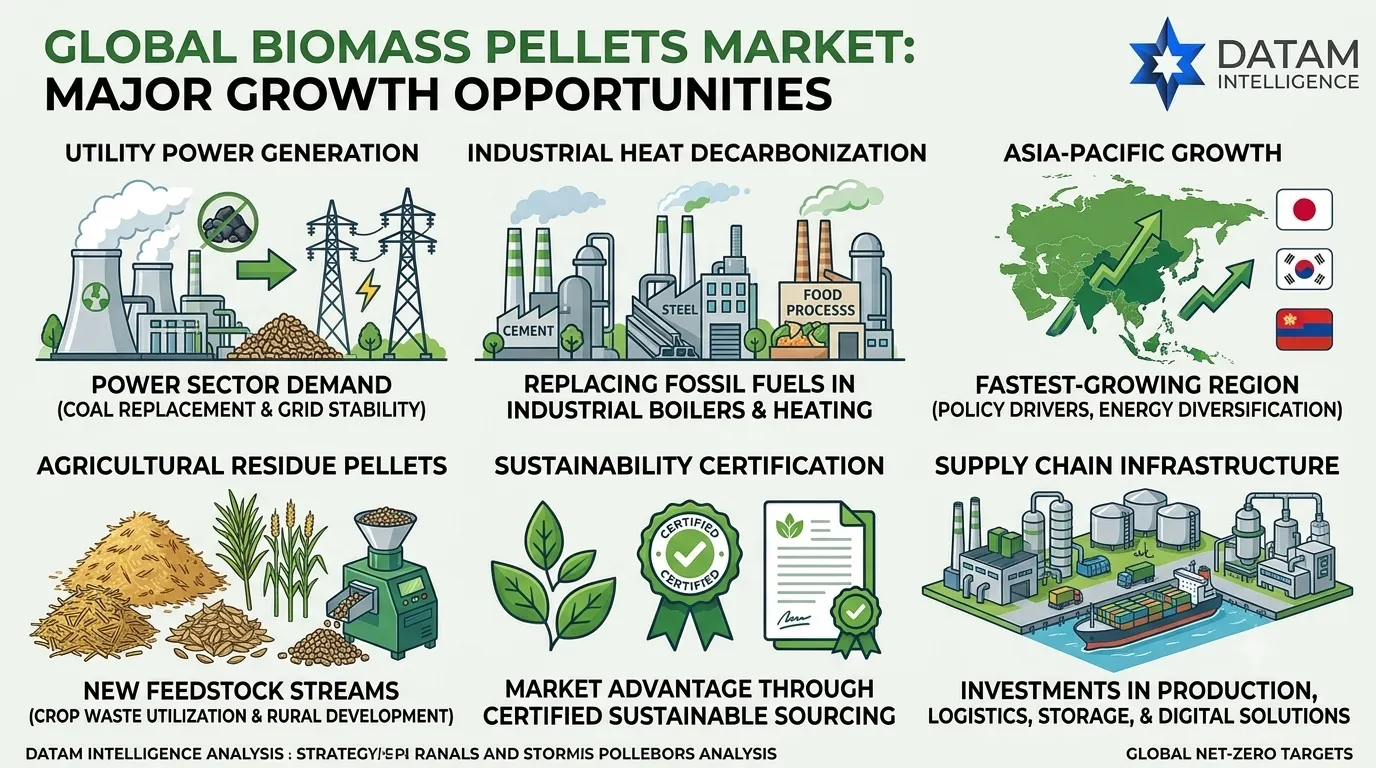
1. Utility-Scale Power Generation Creates Massive Demand
One of the largest growth opportunities in the biomass pellets market lies in power generation. Utilities worldwide are increasingly co-firing biomass pellets alongside coal or transitioning entirely to biomass-powered facilities.
Countries including the United Kingdom, Japan, South Korea, and several European nations continue to support biomass as part of their renewable energy mix. Biomass offers dispatchable renewable energy, providing grid stability when solar and wind generation fluctuate. This capability makes biomass an important complement to intermittent renewable energy sources.
Why is biomass pellet demand increasing in power generation?
Biomass pellets enable utilities to reduce carbon emissions while utilizing existing power generation infrastructure. Their compatibility with coal-fired plants lowers transition costs and supports renewable energy targets.
2. Industrial Heat Decarbonization Offers Significant Market Potential
Heavy industries face increasing pressure to reduce greenhouse gas emissions. Sectors such as cement, steel, food processing, pulp and paper, chemicals, and manufacturing are actively seeking renewable fuel alternatives.
Biomass pellets provide a practical solution for replacing coal and fuel oil in industrial boilers and heating systems. As carbon pricing policies expand globally, industrial users are expected to accelerate biomass adoption.
For pellet suppliers, this represents a high-volume and long-term demand opportunity driven by sustainability commitments and regulatory compliance requirements.
3. Asia-Pacific Emerges as the Fastest-Growing Region
Asia-Pacific is expected to be the fastest-growing regional market through 2035, supported by strong renewable energy policies and rising industrial demand. Japan and South Korea continue to import substantial quantities of biomass pellets to support renewable electricity generation and emissions reduction goals.
The region's growing focus on energy diversification and decarbonization creates opportunities for:
- Pellet manufacturers
- Feedstock suppliers
- Port and logistics operators
- Renewable energy developers
- Technology providers
As demand expands, Asia-Pacific is expected to become a major driver of global biomass pellet trade.
4. Agricultural Residue Pellets Unlock New Revenue Streams
While wood pellets currently dominate the market with more than 80% share, agricultural residue pellets are gaining increasing attention. Crop residues such as rice husks, wheat straw, corn stover, and sugarcane bagasse can be converted into valuable renewable fuel products.
Recent research highlights enormous untapped potential in agricultural pelletization. Global agricultural residues could significantly contribute to fossil fuel displacement while supporting rural economic development and reducing agricultural waste.
What are agricultural biomass pellets?
Agricultural biomass pellets are compressed fuels produced from crop residues such as straw, rice husks, and corn stalks. They provide a renewable alternative to coal while helping reduce agricultural waste and open-field burning.
5. Sustainability Certification Becomes a Competitive Advantage
The next phase of market growth will be heavily influenced by sustainability verification and carbon accountability.
Buyers increasingly require:
- Sustainable feedstock sourcing
- Forest certification compliance
- Carbon footprint reporting
- Supply chain traceability
- Environmental impact documentation
Companies capable of demonstrating transparent and certified biomass sourcing are expected to secure stronger long-term contracts and premium market positioning. Sustainability credentials are becoming a strategic differentiator rather than a compliance requirement.
6. Growing Opportunities in Biomass Supply Chain Infrastructure
As global biomass pellet consumption continues to expand, growth opportunities are increasingly emerging across the broader supply chain ecosystem. While pellet production remains a core market segment, the industry's long-term success depends on the development of efficient, scalable, and sustainable infrastructure that supports sourcing, processing, storage, transportation, and international trade.
The growing adoption of biomass pellets in power generation, industrial heating, and decarbonization initiatives is creating substantial demand for investments throughout the value chain. Companies that provide infrastructure, logistics, equipment, and digital solutions are well-positioned to benefit from the market's continued expansion.
Pellet Production Facilities
The rising demand for biomass pellets is driving significant investments in new production plants and capacity expansion projects worldwide. Manufacturers are increasingly establishing facilities closer to feedstock sources to optimize transportation costs and improve operational efficiency. Advanced production facilities equipped with automated processing technologies are enabling higher output, improved pellet quality, and enhanced sustainability performance.
As utilities and industrial users secure long-term biomass supply agreements, production capacity expansion is expected to remain a critical area of investment across North America, Europe, and Asia-Pacific.
Storage and Handling Systems
Efficient storage and handling infrastructure plays a vital role in maintaining pellet quality throughout the supply chain. Biomass pellets require specialized storage facilities designed to control moisture exposure, reduce degradation risks, and ensure safe handling during transportation.
Growing international trade volumes are increasing demand for bulk storage terminals, conveyor systems, automated loading equipment, and dedicated warehousing solutions. Investments in modern storage infrastructure can help improve supply chain reliability while minimizing product losses and operational disruptions.
Port and Export Facilities
As biomass pellets become a globally traded renewable fuel commodity, port infrastructure is emerging as a strategic growth area. Major exporting countries require specialized port facilities capable of handling large-scale pellet shipments efficiently and safely.
Investments in export terminals, bulk handling systems, loading equipment, and logistics hubs are becoming increasingly important to support cross-border biomass trade. Countries supplying pellets to high-demand markets such as Japan, South Korea, and Europe are expected to continue expanding export capacity to meet growing international demand.
Digital Supply Chain Solutions
The biomass industry is experiencing a digital transformation as stakeholders seek greater transparency, traceability, and sustainability accountability. Digital supply chain platforms are helping producers, traders, and end users track biomass sourcing, monitor inventory levels, verify sustainability certifications, and measure carbon emissions throughout the value chain.
Technologies such as IoT sensors, blockchain-enabled traceability systems, AI-powered logistics optimization, and carbon accounting software are becoming increasingly valuable. These solutions not only improve operational efficiency but also help organizations comply with evolving environmental regulations and sustainability reporting requirements.
Pellet Processing Equipment
Demand for advanced pellet processing equipment is growing alongside production capacity expansion. Modern pellet mills, dryers, grinders, screening systems, and quality control technologies are helping manufacturers improve efficiency, reduce energy consumption, and enhance product consistency.
Innovations in processing equipment are also enabling producers to utilize a wider range of feedstocks, including agricultural residues and non-wood biomass materials. As sustainability and cost optimization become key competitive factors, investment in next-generation processing technologies is expected to accelerate across the industry.
Strategic Outlook
The future growth of the biomass pellets market will depend not only on fuel demand but also on the strength and efficiency of the supporting infrastructure network. From production facilities and export terminals to digital traceability platforms and advanced processing technologies, every segment of the biomass supply chain is poised for expansion.
For investors, equipment manufacturers, logistics providers, and technology companies, the biomass supply chain represents a significant opportunity to participate in the global transition toward cleaner and more sustainable energy systems. As the biomass ecosystem matures, these supporting industries are expected to experience substantial parallel growth, creating new revenue streams and long-term value across the renewable energy sector.
Key Challenges Investors Should Monitor in the Biomass Pellets Market
While the global biomass pellets market presents significant growth opportunities, investors and industry stakeholders must carefully evaluate several challenges that could influence market expansion, profitability, and long-term sustainability. The industry's future growth will depend on the ability of market participants to overcome supply chain complexities, regulatory pressures, sustainability concerns, and operational risks.
Companies that proactively invest in advanced technologies, sustainable sourcing strategies, supply chain resilience, and compliance frameworks will be better positioned to capture emerging opportunities and maintain competitive advantage.
Feedstock Availability and Supply Volatility
The availability and consistency of biomass feedstock remain among the most critical challenges for pellet producers. Biomass pellets rely on raw materials such as wood residues, agricultural waste, forestry by-products, and other organic materials, which can be affected by seasonal variations, weather conditions, competing demand, and changes in land-use practices.
Fluctuations in feedstock supply can impact production costs, operational efficiency, and long-term supply commitments with customers. Companies with diversified sourcing networks, strategic partnerships with suppliers, and investments in alternative feedstock technologies are better equipped to manage supply risks.
Sustainability Concerns and Responsible Biomass Sourcing
Sustainability has become a key consideration for biomass pellet producers, buyers, regulators, and investors. While biomass is recognized as a renewable energy source, concerns around forest management practices, biodiversity impacts, and carbon neutrality assessments continue to influence market perception.
Increasingly, customers and regulatory authorities are demanding greater transparency regarding feedstock origin, harvesting practices, and environmental impact. Companies that adopt certified sourcing practices, implement responsible forestry management, and maintain strong sustainability reporting frameworks can strengthen market credibility and secure long-term partnerships.
Supply Chain Disruptions and Logistics Challenges
The global biomass pellets market depends heavily on complex supply chains connecting feedstock suppliers, pellet manufacturers, storage facilities, ports, and end users. Disruptions caused by geopolitical uncertainties, weather events, labor shortages, or infrastructure limitations can affect supply reliability and delivery schedules.
International biomass trade also requires efficient logistics networks, particularly for markets dependent on imports. Investing in resilient supply chain infrastructure, regional production capabilities, and advanced logistics management systems will be essential for reducing operational risks.
Transportation Costs and Infrastructure Limitations
Transportation represents a significant component of biomass pellet economics due to the bulk nature of the product and the distance between production locations and end markets. Rising fuel prices, limited port capacity, and increasing logistics expenses can impact overall profitability.
Optimizing transportation networks, developing strategically located production facilities, and improving storage and handling infrastructure will play an important role in controlling costs and enhancing supply chain efficiency.
Regulatory and Policy Uncertainty
Government policies, renewable energy incentives, carbon regulations, and sustainability standards significantly influence biomass pellet market development. Changes in energy policies, subsidy structures, or environmental regulations can create uncertainty for investors and businesses.
Market participants must continuously monitor regulatory developments across key markets, including Europe, North America, and Asia-Pacific, where biomass adoption is closely linked to government climate targets and renewable energy strategies.
Increasing Importance of Carbon Accounting and Verification
As global focus on emissions reduction intensifies, accurate carbon measurement and reporting are becoming essential requirements across the biomass value chain. Buyers and regulators increasingly expect detailed information regarding lifecycle emissions, carbon savings, and sustainability performance.
Companies that implement advanced carbon accounting systems, digital tracking technologies, and transparent reporting mechanisms will be better positioned to meet evolving compliance requirements and attract sustainability-focused investors.
Strategic Approach to Managing Market Risks
Although these challenges present potential barriers, they also create opportunities for innovation and differentiation. Companies that adopt proactive strategies including diversified feedstock sourcing, investment in digital supply chain solutions, sustainability certifications, and advanced processing technologies can improve operational resilience and strengthen market positioning.
As the biomass pellets industry continues to mature, successful market participants will be those capable of balancing growth ambitions with responsible resource management, regulatory compliance, and long-term sustainability commitments. This strategic approach will be critical for unlocking the full potential of biomass pellets as a key renewable energy solution.
Strategic Opportunities for Businesses
Organizations seeking exposure to the biomass pellets market should focus on:
- Expanding certified feedstock sourcing networks
- Investing in agricultural residue pellet technologies
- Targeting high-growth Asia-Pacific markets
- Developing industrial heating solutions
- Enhancing sustainability and carbon reporting capabilities
- Strengthening logistics and export infrastructure
These strategies can help companies capitalize on increasing demand while meeting evolving sustainability expectations.
Analyst Perspective
The biomass pellets market is evolving beyond its traditional role in renewable power generation. Industrial decarbonization, agricultural waste utilization, and sustainable energy security initiatives are creating new growth avenues across the value chain.
While sustainability scrutiny will continue to shape industry dynamics, demand fundamentals remain strong. Companies that prioritize certified sourcing, operational efficiency, and transparent environmental practices are expected to emerge as market leaders over the next decade.
With global renewable energy investments accelerating, biomass pellets are positioned to play an increasingly important role in supporting the transition toward a low-carbon economy.